
Acrocanthosaurus atokensis
Acrocanthosaurus atokensis
"High-spined lizard from Atoka"
Sobre esta espécie
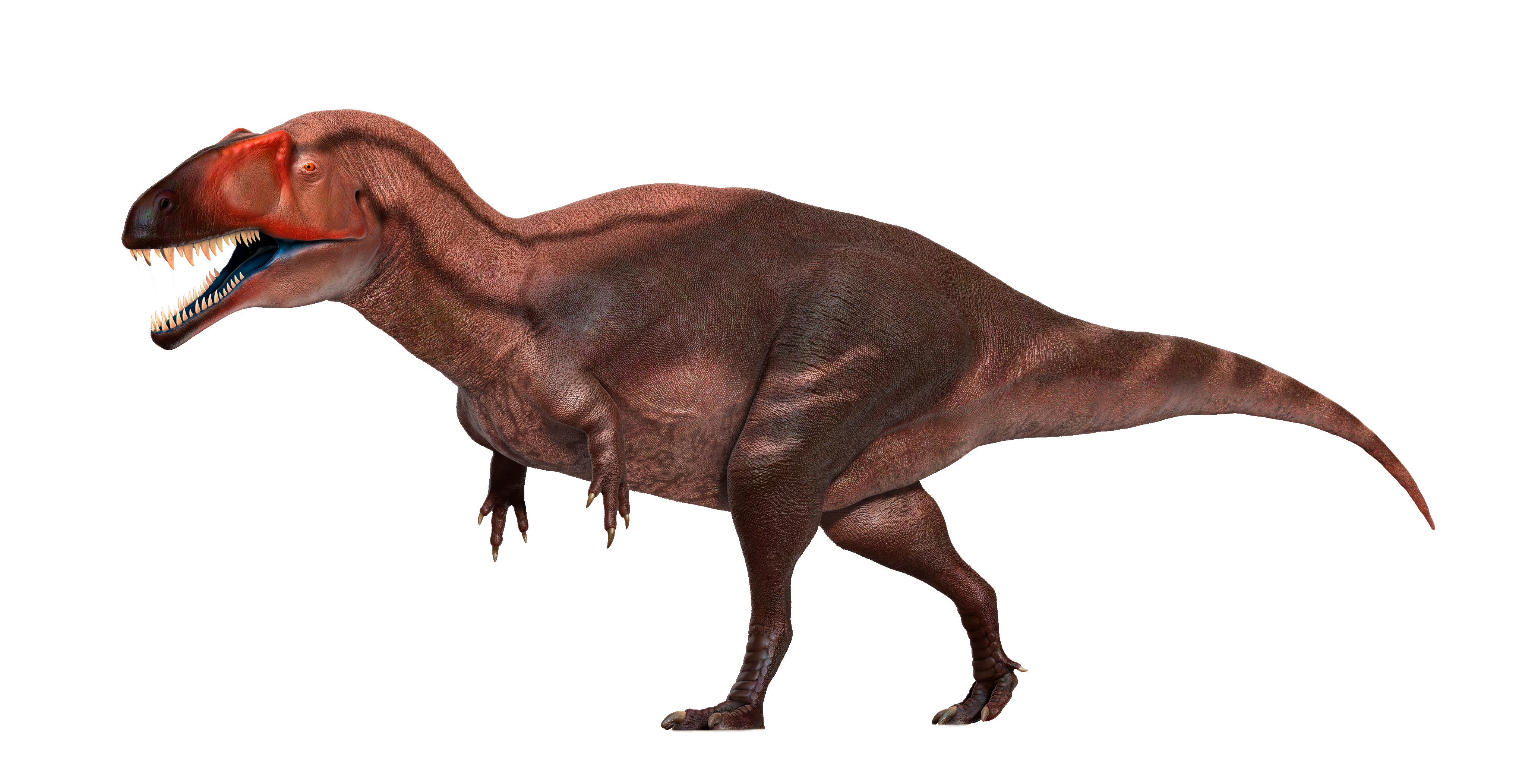
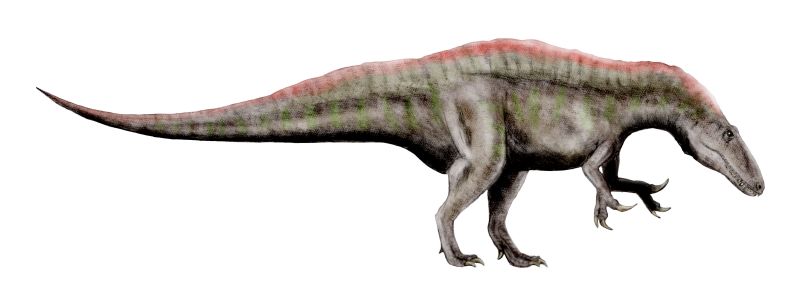
Acrocanthosaurus atokensis was the largest terrestrial predator of Early Cretaceous North America. Measuring around 11 to 12 meters long and weighing up to 6 metric tons, it was distinguished by tall neural spines running along its back, forming a prominent muscular ridge. Its long, narrow skull housed recurved serrated teeth, and its forelimbs, though robust, had limited range of motion. It lived approximately 113 to 110 million years ago on the coastal plains of what is now the southern and central United States, hunting large sauropods and ornithopods. Its giant trackways preserved in Texas are direct evidence of its dominant presence.
Geological formation & environment
The Antlers Formation and Twin Mountains Formation, both of Aptian/Albian age (approximately 125 to 110 Ma), are correlative geological units that outcrop in Oklahoma and Texas, respectively. Deposited in fluvial, deltaic, and coastal plain environments bordering the proto-Gulf of Mexico, they preserve a diverse Early Cretaceous North American fauna. In addition to Acrocanthosaurus, they include sauropod Sauroposeidon, ornithopod Tenontosaurus, nodosaurid Sauropelta, and dromaeosaurid Deinonychus. The climate was warm and humid, with vegetation dominated by araucarian conifers, ferns, and cycads.
Image gallery
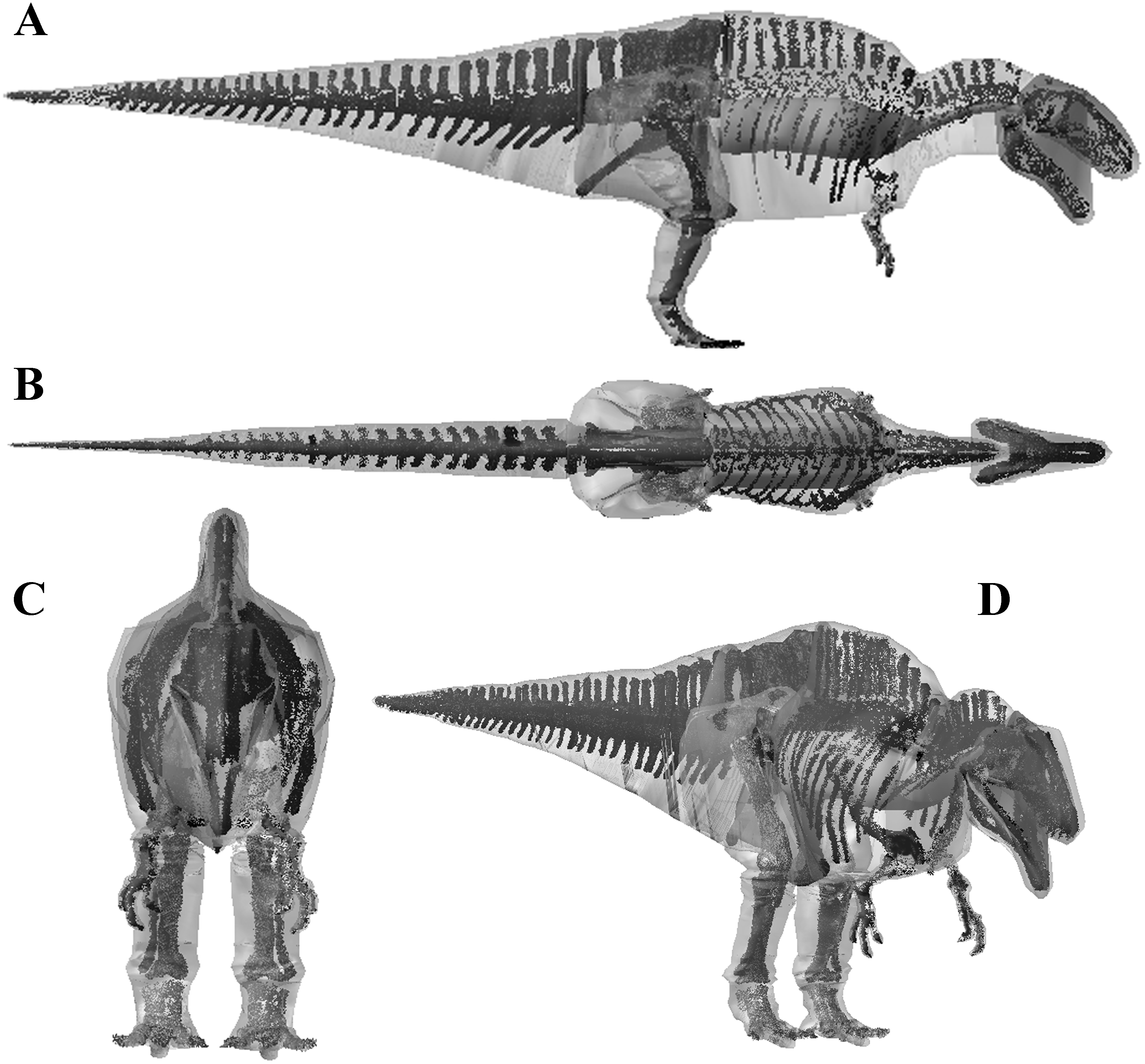






Best estimate reconstruction of specimen NCSM 14345 ('Fran') in four anatomical views, published by Bates et al. (2009) in PLOS ONE. The 3D laser analysis determined body mass between 4.4 and 9 metric tons.
Bates et al., 2009 / PLOS ONE — CC BY 4.0
Ecology and behavior
Habitat
Acrocanthosaurus inhabited the low, humid coastal plains of the North American Western Interior during the Early Cretaceous, 113 to 110 million years ago. The environment was dominated by araucarian conifer forests, ferns, and cycads on fluvial and deltaic plains bordering the proto-Gulf of Mexico. The climate was warm and humid, without polar ice, with rivers and ponds distributed across a continental corridor connecting the Atlantic to the Gulf. This ecosystem included sauropods like Sauroposeidon and Astrodon, ornithopods like Tenontosaurus, ankylosaurs like Sauropelta, and small theropods like Deinonychus.
Feeding
As the largest predator in its ecosystem, Acrocanthosaurus likely attacked large prey, including young sauropods and adult Tenontosaurus. Forelimb analysis by Senter and Robins (2005) indicates attacks were initiated by the mandible, with forelimbs used to hold and tear prey after contact. With anterior bite force estimated at 8,266 Newtons, the strategy likely involved repeated slashing bites rather than a single crushing bite. The Paluxy River trackways suggest possible pursuit or ambush episodes targeting sauropods.
Behavior and senses
Based on comparisons with modern crocodilians and birds, Acrocanthosaurus was likely solitary like most modern large predators, with wide territories and opportunistic behavior as both predator and scavenger. Brain endocast analysis by Franzosa and Rowe (2005) reveals large olfactory bulbs, suggesting keen sense of smell for detecting prey or carcasses at a distance. The dorsal muscular ridge may have served social display or thermoregulatory functions, similar to analogous structures in other vertebrates. Evidence of pathologies in the holotype indicates possible cannibalism or intraspecific conflict.
Physiology and growth
Bone histology data from D'Emic et al. (2012) indicate Acrocanthosaurus grew at rates comparable to Allosaurus and tyrannosaurids during early ontogeny, reaching adult size in two to three decades. This suggests a relatively elevated metabolism, intermediate between modern reptiles and birds. The S-shaped brain, revealed by the Franzosa and Rowe (2005) endocast, is similar to that of modern crocodilians. The semicircular canals indicate the head was held 25° below horizontal in natural posture, different from the vertical posture imagined by 20th-century researchers.
Paleogeography
Continental configuration

Ron Blakey · CC BY 3.0 · Cretáceous, ~90 Ma
During the Aptiano (~125–110 Ma), Acrocanthosaurus atokensis inhabited Laramidia, the western half of present-day North America, separated from the east by the Western Interior Seaway, a shallow sea dividing the continent. The continents were in very different positions: India was drifting toward Asia, Antarctica was still connected to Australia, and South America was an isolated island.
Inventário de Ossos
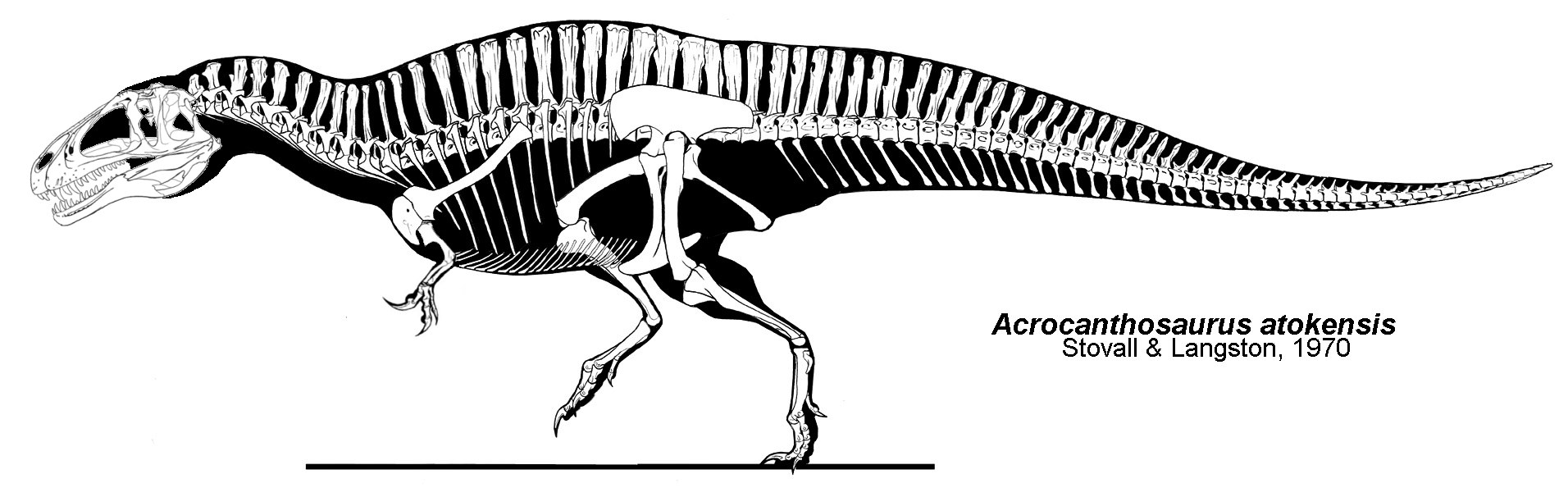
Based on multiple specimens. Specimen NCSM 14345 ('Fran'), at the North Carolina Museum of Natural Sciences in Raleigh, is the most complete ever found and includes the only known complete skull of the species. The original holotype (OMNH 10146) was described by Stovall and Langston in 1950.
Found elements
Inferred elements
Scientific Literature
15 papers in chronological order — from the original description to recent research.
Acrocanthosaurus atokensis, a new genus and species of Lower Cretaceous Theropoda from Oklahoma
Stovall, J.W. & Langston, W. · American Midland Naturalist
Founding paper formally describing Acrocanthosaurus atokensis based on holotype specimens OMNH 10146 and 10147 recovered from the Antlers Formation, Oklahoma. Stovall and Langston characterize the new genus and species, highlighting the tall neural spines on dorsal vertebrae, the elongated skull, and the recurved serrated teeth. Initially classified in family Antrodemidae (equivalent to Allosauridae), the animal is recognized as one of the largest Early Cretaceous North American predators. The name 'atokensis' refers to Atoka County, Oklahoma, where the holotype was collected. This work remains an indispensable primary reference for any study on the species, establishing the diagnostic characters defining the genus Acrocanthosaurus.
A new specimen of Acrocanthosaurus atokensis (Theropoda, Dinosauria) from the Lower Cretaceous Antlers Formation (Lower Cretaceous, Aptian) of Oklahoma, USA
Currie, P.J. & Carpenter, K. · Geodiversitas
This work describes specimen NCSM 14345, nicknamed 'Fran', the most complete Acrocanthosaurus skeleton ever found, including the only known complete skull and entire forelimb for the species. Currie and Carpenter provide a detailed osteological description of virtually all skeletal elements, with special attention to skull and forelimb morphology. The specimen was excavated by amateur paleontologists Cephis Hall and Sid Love in 1983 in Oklahoma, and prepared by the Black Hills Institute. The authors conclude, based on morphology, that Acrocanthosaurus is more closely related to Allosauridae than Carcharodontosauridae, a position subsequently revised by phylogenetic analyses. At 207 pages of description, this is the most complete anatomical study of the species.
A reanalysis of Acrocanthosaurus atokensis, its phylogenetic status, and paleobiogeographic implications, based on a new specimen from Texas
Harris, J.D. · New Mexico Museum of Natural History and Science Bulletin
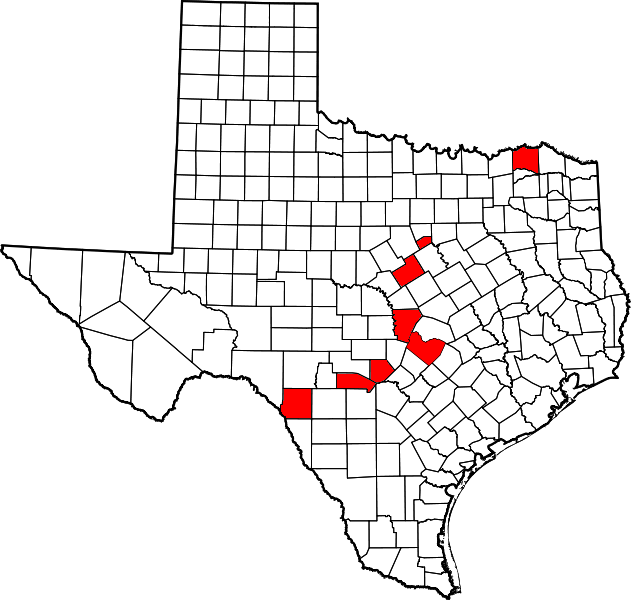
Harris presents a complete reanalysis of Acrocanthosaurus atokensis based on a new Texan specimen (SMU 74646) from the Twin Mountains Formation, Fort Worth. The phylogenetic analysis is the main contribution: contrary to Stovall and Langston's original classification in Antrodemidae/Allosauridae, Harris recovers Acrocanthosaurus as a member of Carcharodontosauridae, a group of large theropods previously known only from the southern hemisphere. This result has profound paleobiogeographic implications, suggesting dispersal routes between North America and Gondwana during the Early Cretaceous. The new specimen also extends the species' geographic record to Texas, confirming its distribution along the North American Western Interior coastal plains.


New Information on the Cranial Anatomy of Acrocanthosaurus atokensis and Its Implications for the Phylogeny of Allosauroidea (Dinosauria: Theropoda)
Eddy, D.R. & Clarke, J.A. · PLOS ONE
Eddy and Clarke re-examine the skull of specimen NCSM 14345 using modern techniques, describing for the first time internal surfaces and the palatal complex that remained inaccessible in previous analyses. Based on 24 new cranial characters identified via molding and scanning of the original material, the authors conduct a phylogenetic analysis that firmly recovers Acrocanthosaurus within Carcharodontosauridae, corroborating Harris (1998) and contradicting Currie and Carpenter's (2000) initial position. The study also documents features such as the quadrate, mandibular articular surfaces, and palatal elements in unprecedented detail. This paper has become the standard reference for the species' cranial anatomy, published open access and widely cited in subsequent phylogenetic analyses.

Cranial endocast of the Cretaceous theropod dinosaur Acrocanthosaurus atokensis
Franzosa, J. & Rowe, T. · Journal of Vertebrate Paleontology
Franzosa and Rowe apply high-resolution CT scanning to the holotype braincase (OMNH 10146), generating the first complete digital endocast of Acrocanthosaurus's endocranial cavity. Results reveal the brain was S-shaped, similar to modern crocodilians, with large olfactory bulbs indicating keen sense of smell. The semicircular canals of the vestibular labyrinth allow determination of the natural head posture: 25° below horizontal. The analysis also documents cranial nerve pathways and relative sizes of different brain regions. This pioneering study in CT use on large American theropods opened the way for comparative neurological investigations in dinosaurs, establishing Acrocanthosaurus as a model organism for paleoneurology studies.
Range of motion in the forelimb of the theropod dinosaur Acrocanthosaurus atokensis, and implications for predatory behaviour
Senter, P. & Robins, J.H. · Journal of Zoology
Senter and Robins analyze the range of motion of Acrocanthosaurus forelimbs using bone casts, precisely determining which movements were possible and which were anatomically impossible. The humerus could swing posteriorly to horizontal but could not reach glenoid height anteriorly. The forearm did not achieve full extension or right-angle flexion. Pronation and supination were precluded by radius immobility relative to the ulna. The palm faced medially. All three digits were capable of extreme hyper-extension, with only the third able to abduct or adduct. The central conclusion is that Acrocanthosaurus could not scratch its own neck and likely used forelimbs to hold and tear prey after an initial jaw-led strike.
Estimating Mass Properties of Dinosaurs Using Laser Imaging and 3D Computer Modelling
Bates, K.T., Manning, P.L., Hodgetts, D. & Sellers, W.I. · PLOS ONE
Bates and colleagues apply laser scanning (LiDAR) and 3D computer modeling to specimen NCSM 14345, producing precise estimates of body mass, center of mass, and moment of inertia for Acrocanthosaurus. Sensitivity analysis consistently places the center of mass well below and in front of the hip joint, regardless of body and respiratory structure volume combinations. Mass estimates range from 4.4 to 9 metric tons depending on reconstruction parameters, with the best estimate around 6 metric tons. The study establishes methodological protocols that have become standard for mass estimation in large theropods, using Acrocanthosaurus as the central test case for method validation.


Paleobiology and geographic range of the large-bodied Cretaceous theropod dinosaur Acrocanthosaurus atokensis
D'Emic, M.D., Melstrom, K.M. & Eddy, D.R. · Palaeogeography, Palaeoclimatology, Palaeoecology
D'Emic and colleagues describe a partial Acrocanthosaurus specimen (UM 20796) from the Cloverly Formation of Wyoming, representing the species' northernmost geographic record and confirming a broad latitudinal distribution across the North American Western Interior. Femur bone histology indicates this is a juvenile or subadult, with growth rates comparable to Allosaurus and tyrannosaurids during early ontogeny. Histological data from adult specimens suggest Acrocanthosaurus reached adult size in two to three decades. This paper combines histological analysis with paleobiogeographic data, serving as the primary source for longevity estimates and growth curves for the species.

Estimating bite force in extinct dinosaurs using phylogenetically predicted physiological cross-sectional areas of jaw adductor muscles
Sakamoto, M. · PeerJ
Sakamoto develops a Bayesian phylogenetic predictive modeling framework to estimate bite force in 33 extinct dinosaurs using skull width and phylogenetic relationships. For Acrocanthosaurus atokensis, anterior bite force is estimated at 8,266 Newtons and posterior at 16,894 N, substantially lower than Tyrannosaurus rex (48,505 N), reflecting fundamental differences in cranial biomechanics between the two large predators. The study demonstrates that bite force does not scale linearly with body size in theropods, being strongly influenced by cranial morphology and feeding strategies. These data are fundamental for understanding feeding ecology and niche partitioning among large Cretaceous predators.


Structural performance of tetanuran theropod skulls, with emphasis on the Megalosauridae, Spinosauridae and Carcharodontosauridae
Rayfield, E.J. · Special Papers in Palaeontology
Rayfield applies two-dimensional finite element analysis (FEA) to reconstruct stresses and deformations in the skulls of seven theropods during feeding, including Acrocanthosaurus atokensis and Carcharodontosaurus saharicus. Results reveal that allosauroids like Acrocanthosaurus have relatively efficient skulls in stress distribution during biting, despite their gracile appearance compared to tyrannosaurids. The analysis suggests Acrocanthosaurus's feeding strategy involved repeated shallow bites, with the head as the primary attack organ, rather than the intense compressive force of tyrannosaurids. This is one of the first FEA studies to explicitly include Acrocanthosaurus, serving as a reference for cranial biomechanical comparisons in carcharodontosaurids.


New specimens, including a growth series, of Fukuiraptor (Dinosauria, Theropoda) from the Lower Cretaceous Kitadani Dinosaur Quarry of Japan
Currie, P.J. & Azuma, Y. · Journal of the Paleontological Society of Korea
Currie and Azuma describe new specimens of Fukuiraptor kitadaniensis, including a growth series, from the Lower Cretaceous of Japan. Phylogenetic analysis places Fukuiraptor within Allosauroidea, near Acrocanthosaurus, providing evidence that primitive carcharodontosaurids occurred in Asia during the Early Cretaceous. This phylogenetic context is relevant for understanding the biogeography of the group to which Acrocanthosaurus belongs, suggesting that ancestors of North American carcharodontosaurids may have dispersed from Asia during the Jurassic or Early Cretaceous. The study is an important piece in the evolutionary puzzle connecting large theropod faunas of the Jurassic with those of the Early Cretaceous on different continental masses.

Brontopodus birdi, Lower Cretaceous sauropod footprints from the U.S. Gulf Coastal Plain
Farlow, J.O., Pittman, J.G. & Hawthorne, J.M. · Geological Society of America Special Paper
Farlow and colleagues describe and analyze sauropod and theropod trackways from the Glen Rose Formation of Texas, including the famous Paluxy River site. The large tridactyl theropod footprints, attributed to Acrocanthosaurus based on compatible size and shape, overlap sauropod trackways at specific points, suggesting possible hunting behavior. In one stretch, the theropod trackway coincides with the disappearance of a sauropod footprint, interpreted by some researchers as evidence of an attack. The study is fundamental for understanding Acrocanthosaurus's ecological behavior and remains a reference for Early Cretaceous North American ichnology.
Sauroposeidon: Oklahoma's Native Giant
Wedel, M.J. & Cifelli, R.L. · Oklahoma Geology Notes
Wedel and Cifelli describe and analyze Sauroposeidon proteles, a colossal titanosauriform sauropod from Oklahoma's Antlers Formation, a co-inhabitant and probable primary prey of Acrocanthosaurus. With neck height estimates up to 17 meters, Sauroposeidon was one of the largest animals ever to exist and a potential hunting target for adult Acrocanthosaurus. The article provides fundamental paleoecological context for understanding predator-prey interactions in Early Cretaceous North America, where Acrocanthosaurus was the only large predator capable of attacking sauropods of this magnitude. The Antlers Formation fauna emerges as one of the most impressive Mesozoic ecosystems of the Americas.

First definitive record of Acrocanthosaurus (Theropoda: Carcharodontosauridae) in the Lower Cretaceous of eastern North America
Carrano, M.T. · Cretaceous Research
Carrano describes specimen USNM 466054, a partial theropod skeleton from the Lower Cretaceous Arundel Clay of Maryland, and assigns it to Acrocanthosaurus based on a diagnostic autapomorphy of the genus. This is the species' easternmost geographic record, significantly extending its known range to Atlantic North America. The specimen is also the smallest known individual of Acrocanthosaurus, and bone morphology and histology data indicate it was a subadult. The discovery suggests Acrocanthosaurus had a broader continental distribution than previously assumed, potentially covering much of the territory that would become the United States during the Early Cretaceous.


Re-evaluation of the Bahariya Formation carcharodontosaurid (Dinosauria: Theropoda) and its implications for allosauroid phylogeny
Kellermann, M., Cuesta, E. & Rauhut, O.W.M. · PLOS ONE
Kellermann and colleagues re-examine the Egyptian carcharodontosaurid specimen from the Bahariya Formation destroyed during World War II, using archival photographs and Stromer's original descriptions (1931). The analysis proposes a new genus and species, Tameryraptor markgrafi, distinct from the Moroccan specimen designated as Carcharodontosaurus saharicus. The comprehensive phylogenetic analysis recovers Lusovenator and Veterupristisaurus as Late Jurassic carcharodontosaurids, and clarifies the position of Acrocanthosaurus within the group. This work represents the most recent and comprehensive analysis of Carcharodontosauridae phylogenetic relationships, providing the most up-to-date evolutionary context for understanding Acrocanthosaurus's position as a basal family member.


Espécimes famosos em museus
NCSM 14345 ('Fran')
North Carolina Museum of Natural Sciences, Raleigh, Carolina do Norte, EUA
The most complete Acrocanthosaurus specimen ever found, including the only known complete skull and entire forelimb for the species. Discovered by amateur paleontologists in McCurtain County, Oklahoma, it was prepared by the Black Hills Institute and has been on permanent display at the museum since 2000. It served as the basis for most modern biomechanical and anatomical studies on the species.
OMNH 10146 (holótipo)
Sam Noble Oklahoma Museum of Natural History, Norman, Oklahoma, EUA
Original holotype specimen described by Stovall and Langston in 1950, collected from the Antlers Formation of Oklahoma. Though incomplete, it includes a well-preserved braincase that was CT-scanned by Franzosa and Rowe (2005), generating the first digital endocast of the species' brain. It is the taxonomic reference specimen for the entire species.
SMU 74646
Perot Museum of Nature and Science, Fort Worth, Texas, EUA
Specimen from the Twin Mountains Formation of Texas described by Harris in 1998, which served as the basis for the phylogenetic reanalysis that positioned Acrocanthosaurus within Carcharodontosauridae. It represents the westernmost confirmed record of the species in Texas and expanded understanding of the animal's geographic distribution in Early Cretaceous North American coastal plains.
In cinema and popular culture
Acrocanthosaurus never achieved the fame of Tyrannosaurus or Velociraptor in popular culture, but accumulated a consistent presence in quality science documentaries. Its most notable debut was in the episode 'Great American Predator' of Monsters Resurrected (2009, Discovery Channel), where it starred in dramatic scenes hunting Sauroposeidon and conflicting with Deinonychus. In Jurassic Fight Club (History Channel, 2008), it appeared as a secondary predator of Tenontosaurus. The documentary series Prehistoric (Discovery Channel, 2010) introduced it to the general public as the great predator of Cretaceous Texas. In the video game universe, it found a new audience in Jurassic World Evolution 2 (2021), with an anatomically reasonable digital model. Scientific representation has evolved considerably: from the first 1950s reconstructions with upright posture and possible dorsal sail to current precise images, featuring a thick muscular ridge, inclined head, and jaw-led attack behavior.

Classificação
Descoberta
Curiosidade
The most famous dinosaur trackways in Texas, at Paluxy River in Glen Rose, show giant tridactyl footprints of a large theropod overlapping sauropod trackways, interpreted as evidence of a hunting chase. This site influenced decades of debates about Acrocanthosaurus predatory behavior, and part of the original trackway is on permanent display at the American Museum of Natural History in New York.