
Anhanguera blittersdorffi
Anhanguera blittersdorffi
"Blittersdorff's evil spirit"
Sobre esta espécie
Anhanguera blittersdorffi is an anhanguerid pterosaur from the Lower Cretaceous of Brazil, described by Campos and Kellner in 1985 from an extraordinarily preserved three-dimensional skull. With an estimated wingspan of 4 to 4.5 meters, it was an aerial predator specialized in fish capture, bearing characteristic premaxillary crests, curved coniform teeth, and a rosette-shaped mandible. Originating from the calcareous nodules of the Romualdo Formation, Araripe Basin, in Ceará, it is one of the most studied Brazilian pterosaurs and an emblem of the Cretaceous fauna of northeastern Brazil.
Geological formation & environment
The Romualdo Formation (former Romualdo Member of the Santana Formation), Araripe Basin, northeastern Brazil, is one of the world's most important Lagerstätten for pterosaur study. Deposited during the Aptian-Albian (approximately 112-108 Ma), it records the transition from a fluvio-deltaic environment to a shallow epicontinental sea formed by incursions of the proto-South Atlantic. The famous calcareous nodules of this formation preserve vertebrates in exceptional three dimensions: fish, turtles, crocodilians, spinosaurs, and especially pterosaurs like Anhanguera, with anatomical details rarely seen at other sites worldwide.
Image gallery


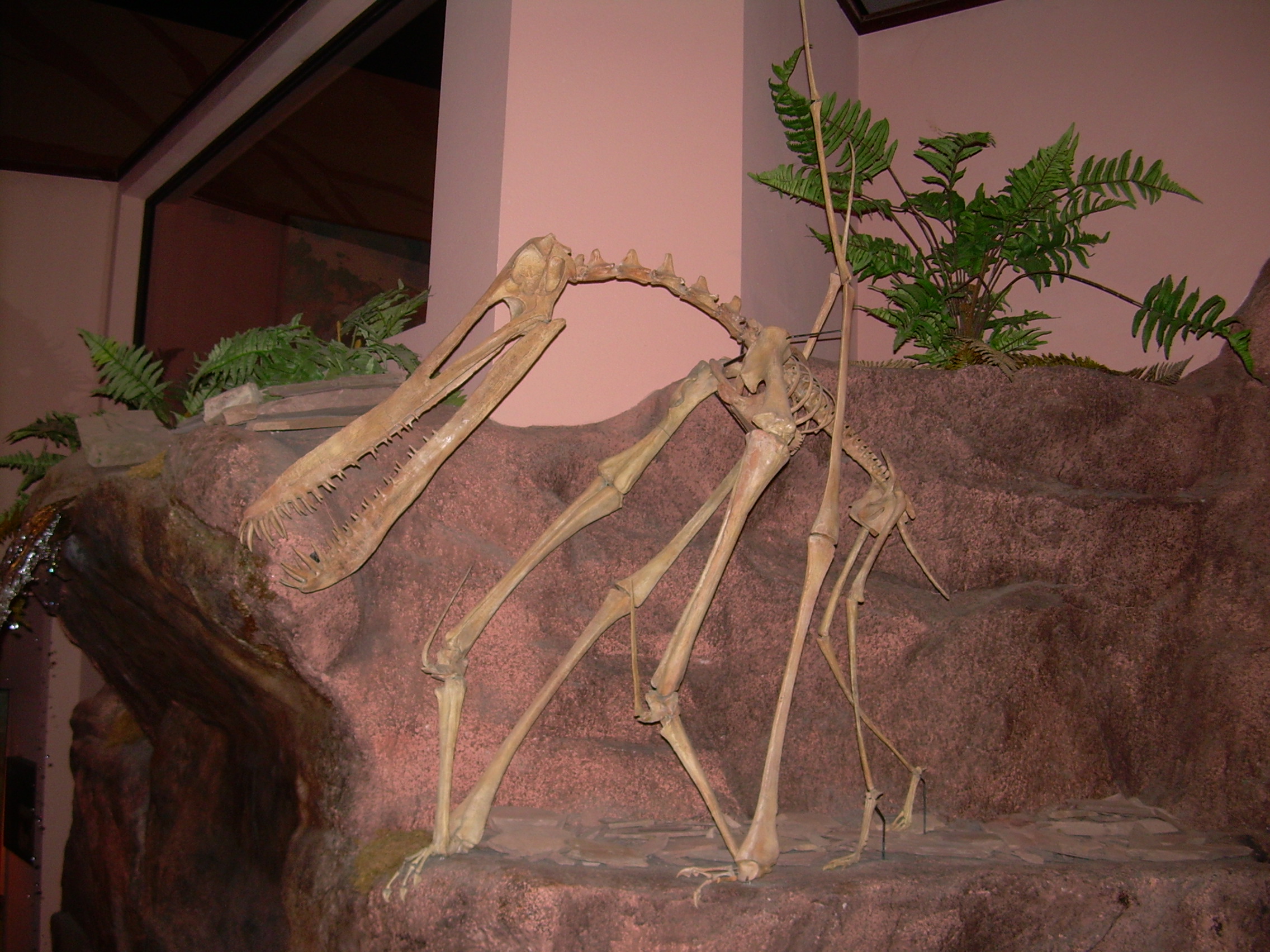
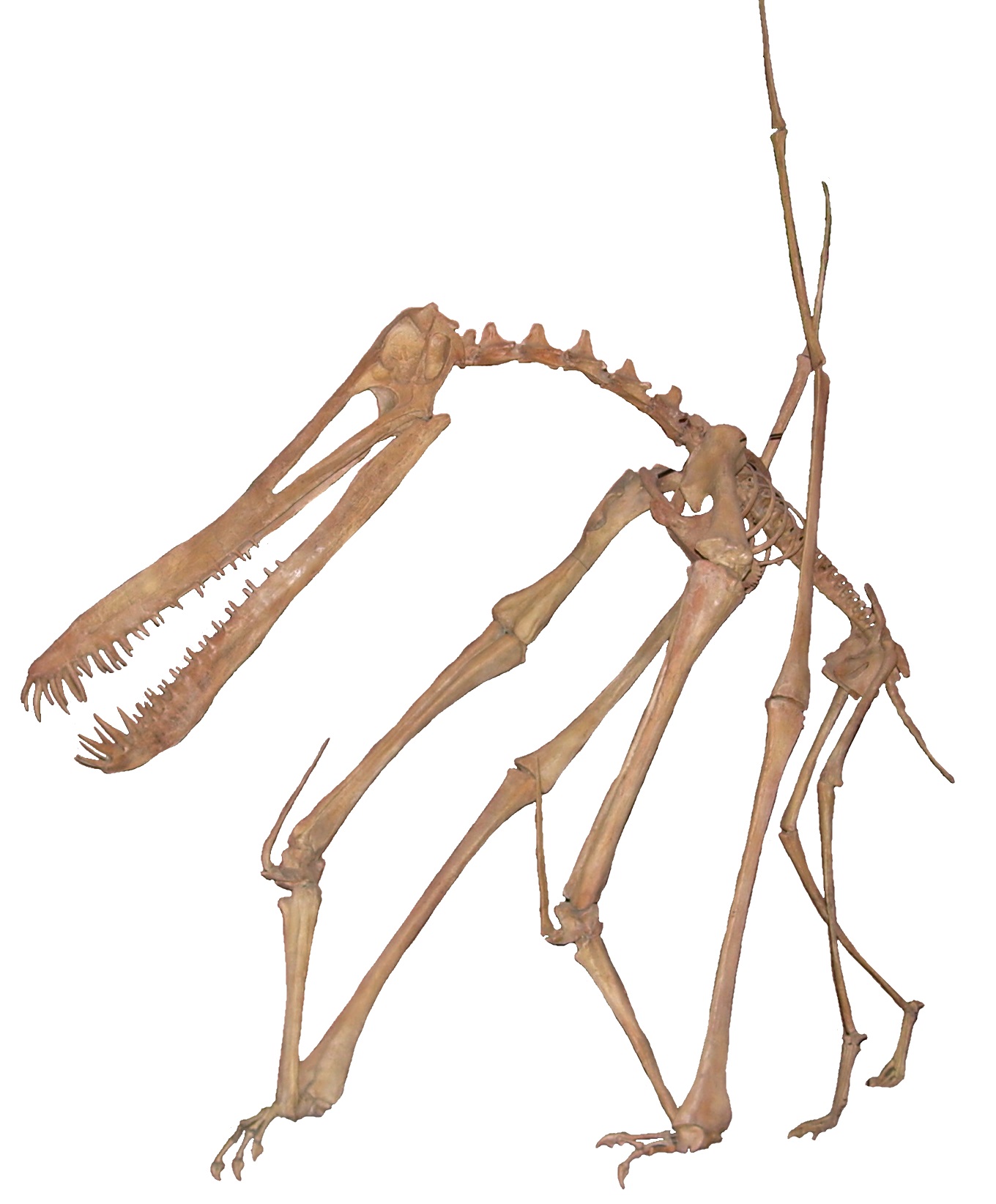


Holotype MN 4805-V of Anhanguera blittersdorffi in lateral view. The three-dimensionally preserved skull from the calcareous nodules of the Romualdo Formation is one of the most complete ever recovered from a Brazilian Cretaceous pterosaur.
Pinheiro & Rodrigues, PeerJ 2017 — CC BY 4.0
Ecology and behavior
Habitat
Anhanguera blittersdorffi inhabited the margins of a shallow epicontinental sea that covered part of northeastern Brazil during the Aptian-Albian, approximately 112-108 Ma. This environment, represented by the Romualdo Formation sediments, was an arm of the forming proto-South Atlantic. The climate was warm and semi-arid, with abundant shallow brackish to marine water rich in fish, invertebrates, and other aquatic reptiles. Pterosaurs like Anhanguera dominated the coastal airspace, coexisting with spinosaurs, crocodilians, turtles, and a diverse ichthyofauna.
Feeding
Anhanguera was a specialized piscivore, adapted to capture fish at the water surface during flight. The heterodontic curved teeth, arranged in a rosette pattern at the anterior of the mandible, were ideal for holding slippery prey. Morphological evidence suggests Anhanguera fished actively, plunging its beak into the water or targeting prey near the surface, similar to the behavior of modern frigatebirds and gannets. The premaxillary and mandibular crests may have helped in hydrodynamic stabilization of the head during fishing.
Behavior and senses
Based on fossil evidence and analogies with modern seabirds, Anhanguera was likely a colonial or semi-social animal, nesting in colonies in rocky or sandy coastal areas. The size variation of premaxillary crests, interpreted as sexual dimorphism, suggests that crests functioned as display ornaments in the context of sexual selection. Crestless juveniles were possibly dependent on parents for a period before their first flight. Foraging behavior was likely pelagic, with individuals covering large distances over the sea in search of fish schools.
Physiology and growth
Anhanguera possessed pneumatized bones (hollow and connected to the air sac system) that greatly reduced body mass. The bird-like air sac respiratory system provided efficient oxygen for the active metabolism required during flight. The brain had hypertrophied cerebellar flocculi, indicating refined postural control during flight, and large optic lobes, suggesting high visual acuity for locating prey at sea. The head was held inclined 30 degrees downward at rest. Metabolism was likely endothermic or mesothermic, similar to birds.
Paleogeography
Continental configuration

Ron Blakey · CC BY 3.0 · Cretáceous, ~90 Ma
During the Aptiano-Albiano (~112–108 Ma), Anhanguera blittersdorffi inhabited Laramidia, the western half of present-day North America, separated from the east by the Western Interior Seaway, a shallow sea dividing the continent. The continents were in very different positions: India was drifting toward Asia, Antarctica was still connected to Australia, and South America was an isolated island.
Inventário de Ossos
The holotype MN 4805-V consists of a three-dimensionally preserved skull, one of the most complete and well-preserved in the Anhangueridae family. Additional postcranial material is known from specimens referred to the genus Anhanguera, allowing inference of much of the skeletal anatomy.
Found elements
Inferred elements
Scientific Literature
15 papers in chronological order — from the original description to recent research.
Panorama of the Flying Reptiles Study in Brazil and South America (Pterosauria/Pterodactyloidea/Anhangueridae)
Campos, D.A. & Kellner, A.W.A. · Anais da Academia Brasileira de Ciências
Founding paper that formally describes Anhanguera blittersdorffi based on holotype MN 4805-V: a complete three-dimensionally preserved skull from the calcareous nodules of the Romualdo Formation, Chapada do Araripe, Ceará. Campos and Kellner establish the genus Anhanguera and the family Anhangueridae, distinguishing these pterosaurs from European Ornithocheiridae by premaxillary crest morphology and tooth pattern. The specimen was originally in the private collection of Rainer Alexander von Blittersdorff, to whom the species is dedicated. This work inaugurates the systematic study of Brazilian Cretaceous pterosaurs and defines the diagnostic characters that would guide decades of subsequent research on the Araripe Basin pterosaur fauna.
The Illustrated Encyclopedia of Pterosaurs
Wellnhofer, P. · Salamander Books
Fundamental reference work that compiles knowledge on pterosaurs up to the early 1990s, including a detailed section on Anhanguera. Wellnhofer describes cranial anatomy, tooth pattern, and wing morphology based on specimens available at the time. The ecological reconstruction shows Anhanguera as a pelagic fisher similar to modern albatrosses, capturing fish at the sea surface. Wellnhofer's work established the comparative foundations that guided subsequent decades of research on Brazilian pterosaurs and was the main Western reference on the group before the publication explosion of the 2000s.
Description of a new species of Anhangueridae (Pterodactyloidea) with comments on the pterosaur fauna from the Santana Formation (Aptian-Albian), Northeastern Brazil
Kellner, A.W.A. & Tomida, Y. · National Science Museum Monographs
Detailed description of Anhanguera piscator based on specimen NSM-PV 19892 housed at the National Museum of Nature and Science of Japan. Kellner and Tomida provide the first complete osteological description of the anhanguerid postcranium, including pectoral and pelvic girdles, limbs, and wing elements. The work includes extensive comparison with A. blittersdorffi, establishing differentiating characters between the two species. The skeletal reconstruction presented became a reference for subsequent biomechanical studies. The authors discuss the composition and diversity of the pterosaur fauna of the Santana Formation.
Neuroanatomy of flying reptiles and implications for flight, posture and behaviour
Witmer, L.M., Chatterjee, S., Franzosa, J. & Rowe, T. · Nature
Pioneering study using high-resolution CT scanning to reconstruct the endocast of Anhanguera santanae (AMNH 25555) and Rhamphorhynchus. The authors reveal that pterosaur brains, although similar in organization to birds, were smaller relative to body mass. Central finding: Anhanguera and other advanced pterodactyloids held the head tilted approximately 30 degrees downward at rest, inferred from semicircular canal orientation. Hypertrophied cerebellar flocculi suggest refined postural control during flight. The work transformed our understanding of pterosaur flight biomechanics and postural behavior.
Respiratory Evolution Facilitated the Origin of Pterosaur Flight and Aerial Gigantism
Claessens, L.P.A.M., O'Connor, P.M. & Unwin, D.M. · PLOS ONE
Detailed morphological analysis of the rib cage and sternum in pterosaurs including Anhanguera reveals a derived respiratory system similar to modern birds. Claessens and colleagues demonstrate that pterosaurs possessed a unidirectional lung system connected to an extensive network of air sacs, making their respiration more efficient than typical reptiles. This system would have been essential to sustaining active flight and allowing aerial gigantism. The paper proposes that respiratory system evolution was a critical pre-adaptation that enabled the origin of pterosaur flight during the Triassic.
New information on Anhanguera blittersdorffi (Reptilia, Pterosauria) based on a new specimen from the Santana Formation, Romualdo Member, NE Brazil, with comments on the paleoecology of the Santana Formation
Pinheiro, F.L., Fortier, D.C., Schultz, C.L., De Andrade, J.A.F.G. & Bantim, R.A.M. · Anais da Academia Brasileira de Ciências
Description of a new Anhanguera blittersdorffi specimen from the Santana Formation, Romualdo Member. Pinheiro and colleagues provide the first detailed study of known materials, concluding that fossils attributed to the species come from different individuals. The tooth pattern of specimens is indistinguishable from Anhanguera piscator, raising taxonomic questions that would be deepened in subsequent years. The work includes paleoecological analysis of the Romualdo Member, discussing Anhanguera's role in the coastal ecosystem of the proto-South Atlantic during the Aptian.
Skull variation and the shape of the sagittal premaxillary crest in anhanguerid pterosaurs (Pterosauria, Pterodactyloidea) from the Araripe Basin, Northeast Brazil
Bantim, R.A.M., Saraiva, A.A.F. & Sayão, J.M. · Historical Biology
Geometric morphometric analysis of 12 skulls of crested anhanguerids from the Araripe Basin demonstrates strong positive allometric growth of premaxillary crests. Bantim and colleagues argue that crest variation is non-specific and shows no trend of sexual dimorphism. The work documents that most cranial characters used to separate Anhanguera species are ontogenetic or individual variations, not diagnostic characters. The results cast doubt on the validity of multiple Anhanguera species and anticipate the comprehensive taxonomic revision by Pinheiro and Rodrigues (2017).
Anhanguera taxonomy revisited: is our understanding of Santana Group pterosaur diversity biased by poor biological and stratigraphic control?
Pinheiro, F.L. & Rodrigues, T. · PeerJ
Comprehensive taxonomic revision of Anhanguera using geometric morphometrics on 12 skulls. Pinheiro and Rodrigues conclude that only three species are potentially valid: A. blittersdorffi, A. piscator, and A. spielbergi. The analysis demonstrates strong positive allometric growth of premaxillary crests, consistent with sexual selection. The work includes new description of previously undescribed specimens and critically reassesses the diagnostic characters of all previously named species. Published as open access in PeerJ, it became a mandatory reference for any study on Santana Formation pterosaur diversity.
Biomechanics of the unique pterosaur pteroid
Palmer, C. & Dyke, G. · Proceedings of the Royal Society B: Biological Sciences
Biomechanical analysis of the pteroid, a bone unique to pterosaurs that controlled the anterior wing membrane, using Anhanguera as a model scaled to 5.8 meters wingspan. Palmer and Dyke demonstrate that an anteriorly directed pteroid orientation would be aerodynamically unstable and incompatible with efficient flight. The work calculates load distributions and lift forces for different wing membrane configurations, establishing that the medial pteroid orientation was the only mechanically viable one. The study uses Anhanguera as its central case study because it is one of the most anatomically well-known anhanguerids.
The earliest pterodactyloid and the origin of the group
Andres, B., Clark, J. & Xu, X. · Current Biology
Comprehensive phylogenetic analysis of pterodactyloids that formally redefines Ornithocheiridae as the most inclusive clade containing Ornithocheirus simus but not Anhanguera blittersdorffi. Andres, Clark, and Xu separate Anhanguera into the family Anhangueridae, clarifying the deep phylogenetic split within Ornithocheiroidea. The work includes analysis of the oldest known pterosaur with pterodactyloid anatomy and uses this new phylogenetic anchor to recalibrate relationships within the entire group. The formalization of this separation resolved decades of debate about whether Anhanguera belonged to Ornithocheiridae.
The ontogenetic growth of Anhangueridae (Pterosauria, Pterodactyloidea) premaxillary crests as revealed by a crestless Anhanguera specimen
Duque, R.R.C., Bittencourt, J.S., Pinheiro, F.L., Aureliano, T., Ghilardi, A.M. & Sayão, J.M. · Journal of Vertebrate Paleontology
Description of a crestless anhanguerid specimen interpreted as a juvenile or female Anhanguera, proving that premaxillary crests were ontogenetically variable or sexually dimorphic. Duque and colleagues argue that crest absence cannot be used as a diagnostic species character in anhanguerids. The work compiles histological and morphological data to estimate the ontogenetic stage of the specimen, contributing to the understanding of growth and sexual maturity in Araripe pterosaurs. The publication reinforces the hypothesis that crests functioned as sexual signaling ornaments.
Novo esqueleto parcial de pterossauro (Pterodactyloidea, Anhangueridae) do Membro Romualdo, Formação Santana, Cretáceo Inferior do Nordeste do Brasil
Sayão, J.M. & Kellner, A.W.A. · Estudos Geológicos
Description of a new partial anhanguerid skeleton from the Romualdo Member, Santana Formation, providing additional data on the postcranial anatomy of the group and discussing the biostratigraphy of pterosaur-bearing horizons in the Araripe Basin. The work analyzes the precise stratigraphic position of the specimen and correlates it with other Romualdo Member fossils. The biostratigraphic discussion contributes to refining the age of Anhanguera-bearing deposits, aiding in understanding the biogeography of Lower Cretaceous pterosaurs from Brazil.
Pterosaur dietary hypotheses: a review of ideas and approaches
Bestwick, J., Unwin, D.M., Butler, R.J., Henderson, D.M. & Purnell, M.A. · Biological Reviews
Comprehensive review of pterosaur dietary hypotheses analyzing evidence from tooth morphology, jaw mechanics, stable isotopes, and stomach contents. Bestwick and colleagues specifically discuss Anhanguera as a piscivore adapted for aerial fishing: the heterodontic curved teeth, jaw shape, and flight posture are consistent with capturing fish near the surface. The work critically evaluates the skimming hypothesis versus aerial plunge diving, concluding that Anhanguera morphology is more compatible with active capture at the sea surface.
Ferrodraco lentoni gen. et sp. nov., a new ornithocheirid pterosaur from the Winton Formation (Cenomanian-lower Turonian) of Queensland, Australia
Pentland, A.H., Poropat, S.F., Tischler, T.R., Sloan, T., Elliott, R.A., Elliott, H.A., Elliott, J.A. & Elliott, D.A. · Scientific Reports
Description of Ferrodraco lentoni, a new Australian pterosaur, with phylogenetic analysis positioning the species within Anhangueridae as sister taxon to Mythunga camara. The work clarifies the global distribution of the group and its relationship to Brazilian Anhanguera. The phylogenetic analysis uses A. blittersdorffi as a fundamental anchor taxon for Anhangueridae and compares in detail the cranial anatomy of Australian forms with Brazilian specimens. The authors discuss the biogeography of anhanguerids during the Cretaceous, when Gondwana continents were separating.
New Insights into the Skull of Istiodactylus latidens (Ornithocheiroidea, Pterodactyloidea)
Witton, M.P. · PLOS ONE
Revision of the skull of Istiodactylus latidens using new specimens reveals that previous reconstructions were distorted by post-depositional fossil deformation. Witton's cladistic analysis places Istiodactylidae within Ornithocheiroidea, providing a clearer phylogenetic framework for large Cretaceous pterosaurs including Anhanguera. The work is important for understanding Anhanguera's relationships with other ornithocheiroids, as the phylogenetic position of Istiodactylus directly affects interpretation of group diversity. Published open access in PLOS ONE.
Espécimes famosos em museus
MN 4805-V (Holótipo)
Museu Nacional, Universidade Federal do Rio de Janeiro, Rio de Janeiro
Holotype of Anhanguera blittersdorffi: three-dimensionally preserved skull of exceptional quality from the calcareous nodules of the Romualdo Member. Basis of the original description by Campos and Kellner (1985).
AMNH 22555
American Museum of Natural History, Nova York
One of the most complete anhanguerid specimens preserving both cranial and postcranial elements. Extensively studied in phylogenetic and morphometric analyses, including Pinheiro and Rodrigues (2017). Currently on display at the AMNH.
Espécime montado — North American Museum of Ancient Life
North American Museum of Ancient Life, Lehi, Utah
Complete Anhanguera cast in flight position, representing one of the best examples of museum display of this pterosaur. Allows the public to appreciate the animal's actual wingspan and flight posture.
In cinema and popular culture
Anhanguera blittersdorffi has achieved notable presence in popular culture thanks to its impressive morphology: the premaxillary crest, 4-meter wingspan, and rosette teeth made it recognizable in any visual medium. In the Dinosaur Revolution series (Discovery Channel, 2011), the pterosaur was portrayed with compelling maternal behavior, including scenes of a mother teaching chicks to fly, in high-quality digital reconstructions. The documentary Flying Monsters 3D (2011), narrated by David Attenborough for IMAX, used Anhanguera as a central example of Cretaceous fishing pterosaurs. In the Japanese animation Dinosaur King, Anhanguera was introduced to a generation of children worldwide as the flying creature of Cretaceous Brazil. The video game Jurassic Park III: Park Builder also included the pterosaur as a playable creature. In all media, Anhanguera represents prehistoric Brazil and is frequently the public's gateway to the fascinating paleontology of the Santana Formation.

Classificação
Descoberta
Curiosidade
The name 'Anhanguera' comes from the Tupi language and means 'evil spirit' or 'old devil': Brazilian indigenous people who inhabited the Chapada do Araripe believed that pterosaur bones found in the calcareous nodules were the remains of supernatural creatures. The holotype MN 4805-V was in the private collection of German businessman Rainer von Blittersdorff when it was described by Campos and Kellner in 1985, making Anhanguera blittersdorffi one of the first pterosaurs formally named from Brazil.