Carcharodontosaurus
Carcharodontosaurus saharicus
"Shark-toothed lizard of the Sahara"
Sobre esta espécie
Carcharodontosaurus saharicus was one of the largest terrestrial predators that ever lived. It inhabited northern Africa approximately 99 to 94 million years ago during the Cenomanian stage of the Cretaceous, sharing its ecosystem with Spinosaurus. Its name means 'shark-toothed lizard of the Sahara,' a reference to the sharp serrations on its teeth, which measured up to 6.5 centimeters. At roughly 12.5 meters long with a 1.6-meter skull, it rivaled T. rex in size but had different biomechanics, specializing in slicing flesh from large sauropods rather than crushing bone. The neotype skull SGM-Din 1 was discovered by Paul Sereno in 1995 in the Kem Kem Beds of Morocco.
Geological formation & environment
The Kem Kem Group (formerly known simply as 'Kem Kem Beds') is a sequence of Cenomanian continental sediments (100 to 94 Ma) exposed in the Errachidia and Taouz regions of eastern Morocco, extending into southwestern Algeria. The formation preserved one of the most extraordinary Mesozoic ecosystems: a river delta environment with coastal mangroves near the Tethys Sea, with a hot, humid climate and monsoon seasonality. The fauna was dominated by an unusual number of large carnivores for a single ecosystem, including Carcharodontosaurus saharicus, Spinosaurus aegyptiacus, and Deltadromeus agilis. Fossils include theropods, sauropods, giant crocodilians, pterosaurs, and a rich aquatic fauna.
Image gallery

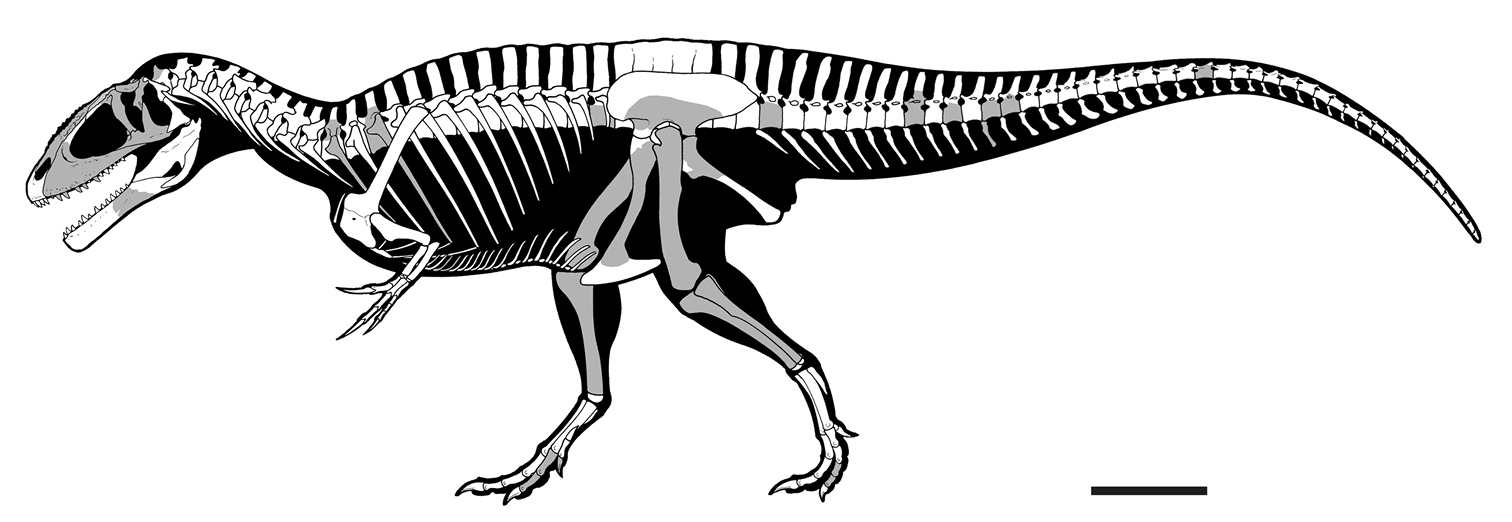

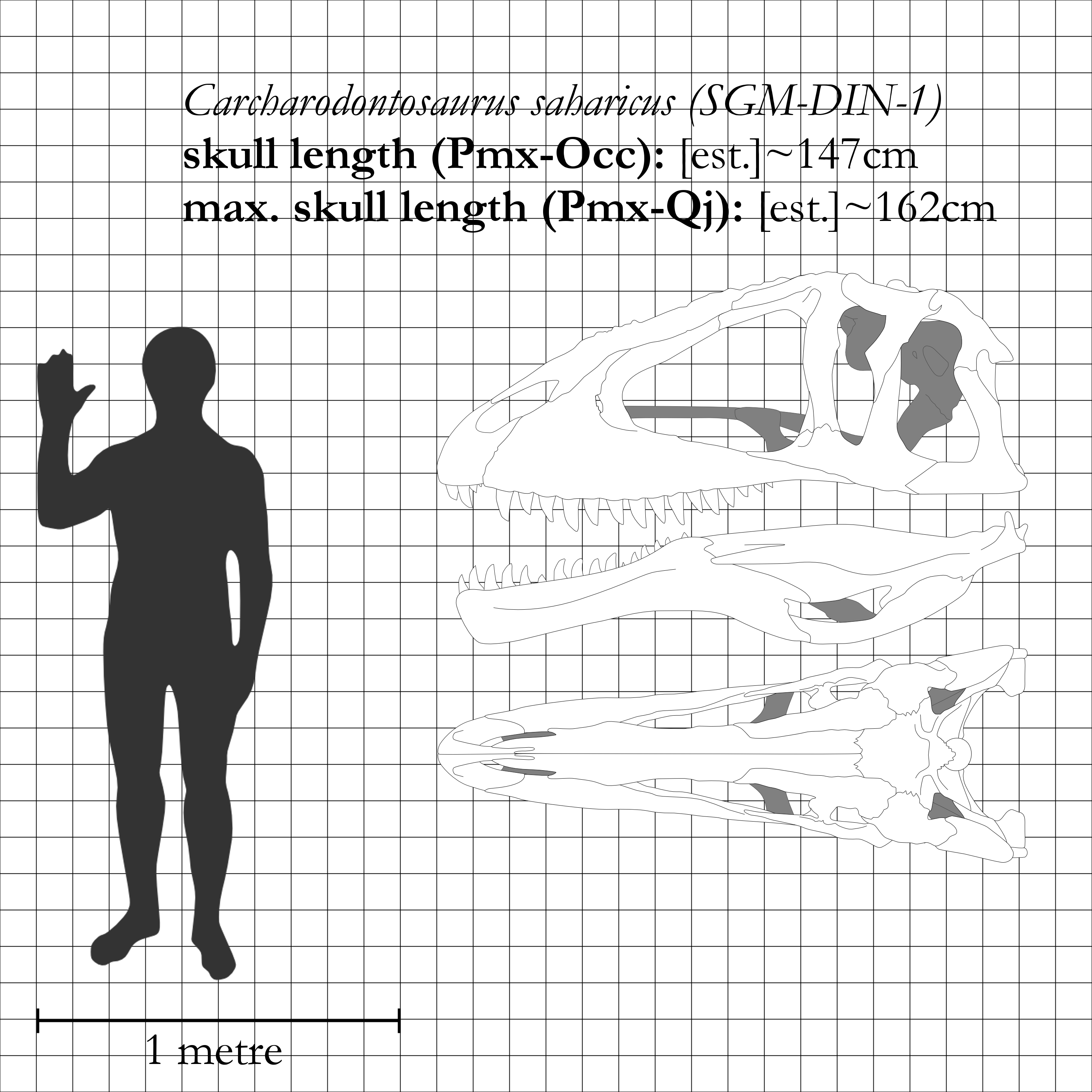


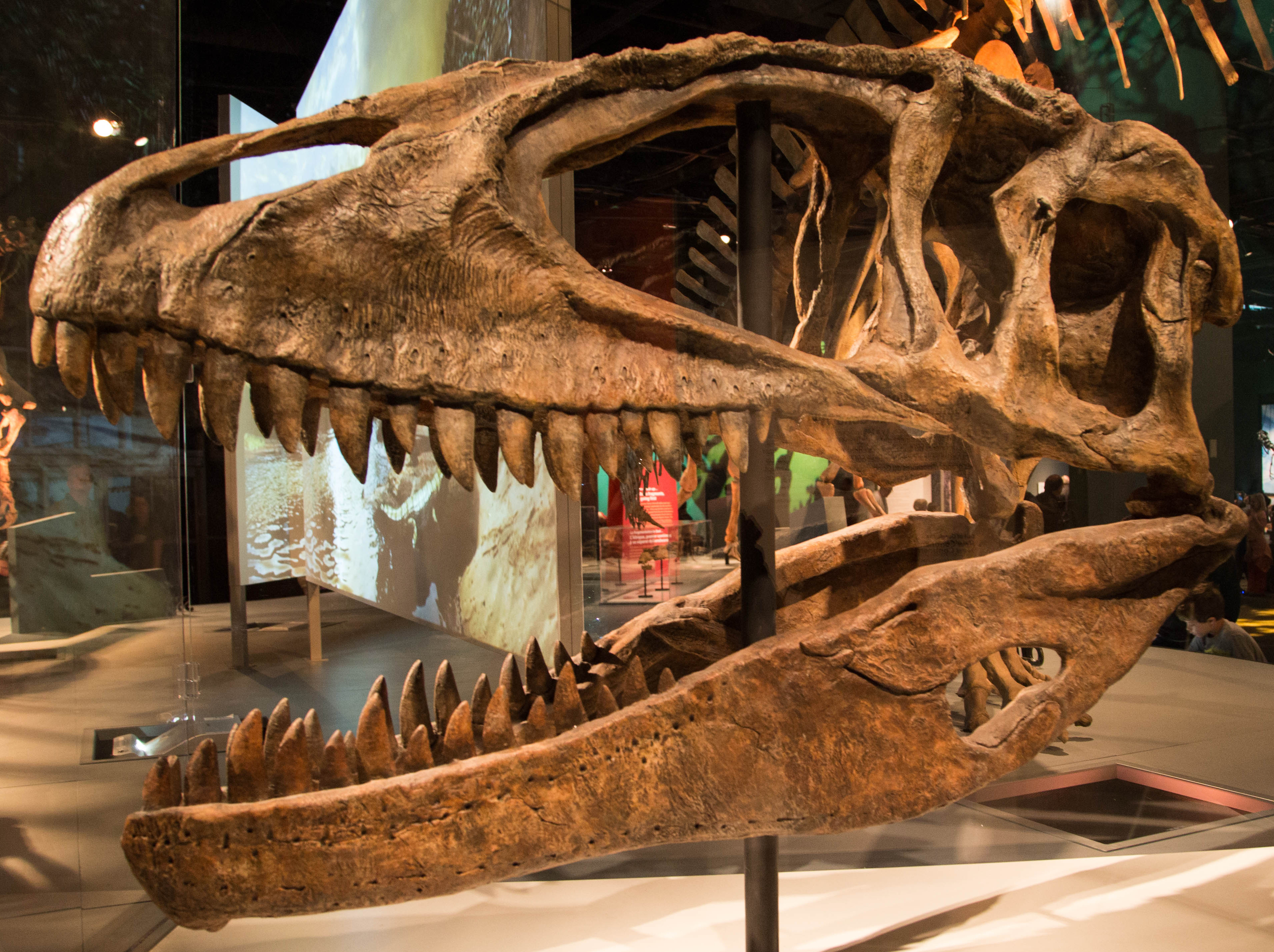


Modern scientific reconstruction of Carcharodontosaurus saharicus showing the complete body of the African Cretaceous predator.
TotalDino, CC BY-SA 4.0
Ecology and behavior
Habitat
Carcharodontosaurus saharicus inhabited northern Africa during the Cenomanian, approximately 99 to 94 million years ago. The paleoenvironment was dominated by coastal mangroves, large river deltas, and tidal flats near the Tethys Sea. The climate was hot and humid with monsoon seasonality. The ecosystem was unusual for harboring an exceptionally high proportion of large carnivores: besides C. saharicus, there were Spinosaurus aegyptiacus, a yet-unnamed abelisaurid, and Deltadromeus agilis.
Feeding
C. saharicus was an active predator of large terrestrial vertebrates, especially sauropods. Its highly serrated blade-like teeth, with 18 to 20 serrations per centimeter, were ideal for slicing flesh rather than crushing bone, differing fundamentally from T. rex. Estimated anterior bite force was 11,312 N, significantly lower than T. rex (48,505 N). Henderson's (2015) analysis showed that a pair of adults could lift up to 850 kg. Isotopes indicate preference for terrestrial prey over fish.
Behavior and senses
The behavioral fossil record for C. saharicus is scarce. Bite marks on large African theropod skulls suggest predators of this size occasionally fought over territory or carcasses, behavior depicted in the documentary Planet Dinosaur (2011). Binocular vision was limited due to the elongated snout, indicating hunting likely relied more on keen olfaction and ambush than active pursuit. There is no fossil evidence of social or reproductive behavior in the species.
Physiology and growth
Carcharodontosaurus saharicus did not belong to Coelurosauria, the group including feathered dinosaurs such as birds, raptors, and tyrannosaurs. Therefore, the presence of feathers is unlikely, and the integument was probably scaly, similar to other large allosauroids. Bone histology from related carcharodontosaurids (such as Meraxes gigas) indicates rapid juvenile growth with highly vascularized fibrolamellar bone, suggesting a metabolism higher than ectothermic reptiles. Skeletal maturity was reached after approximately 20 to 30 years.
Paleogeography
Continental configuration

Ron Blakey · CC BY 3.0 · Cretáceous, ~90 Ma
During the Cenomaniano (~99–94 Ma), Carcharodontosaurus saharicus inhabited Laramidia, the western half of present-day North America, separated from the east by the Western Interior Seaway, a shallow sea dividing the continent. The continents were in very different positions: India was drifting toward Asia, Antarctica was still connected to Australia, and South America was an isolated island.
Inventário de Ossos
The fossil record is fragmentary. The neotype SGM-Din 1 consists mainly of a partial skull discovered in 1995 by Paul Sereno in the Kem Kem Beds of Morocco. Stromer's original 1931 Egyptian material was destroyed during World War II. Various isolated teeth and bone fragments are known across North Africa.
Found elements
Inferred elements
Scientific Literature
15 papers in chronological order — from the original description to recent research.
Sur la decouverte d'une faune de vertebres albiens a Timimoun (Sahara occidental)
Deperet, C. & Savornin, J. · Comptes Rendus de l'Academie des Sciences
The founding paper establishing the taxon. French paleontologists Charles Deperet and Justin Savornin describe two giant theropod teeth collected near Timimoun, Algeria, naming them Megalosaurus saharicus. The material consisted only of isolated teeth, now lost. Nevertheless, the species name saharicus was preserved when Ernst Stromer recognized these teeth corresponded to the large theropod he would study in 1931 from Egyptian material. This paper represents the first scientific record of the animal that would later become one of the largest known predators in the history of life on Earth.

Wirbeltier-Reste der Baharije-Stufe (unterstes Cenoman). 10. Ein Skelett-Rest von Carcharodontosaurus nov. gen.
Stromer, E. · Abhandlungen der Bayerischen Akademie der Wissenschaften
Fundamental paper in which Ernst Stromer formally establishes the genus Carcharodontosaurus from partial skeletal material from the Bahariya Formation of Egypt. Stromer recognizes that the new specimen's teeth perfectly match those described by Deperet and Savornin in 1925, preserving the epithet saharicus. The material included teeth, vertebrae, and limb bones. This specimen was destroyed when Allied bombing struck the Munich Museum during World War II in 1944, making the 1996 redescription by Sereno and colleagues essential for science.


Predatory dinosaurs from the Sahara and Late Cretaceous faunal differentiation
Sereno, P.C. et al. · Science
Historic paper in which Paul Sereno and colleagues describe the nearly complete skull SGM-Din 1, found in Morocco's Kem Kem Beds in 1995. This discovery resolved a half-century mystery: Stromer's original material had been destroyed during World War II. The 1.6-meter skull confirmed Carcharodontosaurus rivaled T. rex in size and established detailed morphological diagnostics, including the expanded antorbita comprising over 30% of skull length. The paper also described Deltadromeus agilis and discussed Late Cretaceous faunal differentiation in Africa.
A new species of Carcharodontosaurus (Dinosauria: Theropoda) from the Cenomanian of Niger and a revision of the genus
Brusatte, S.L. & Sereno, P.C. · Journal of Vertebrate Paleontology
Brusatte and Sereno describe a second species of the genus: Carcharodontosaurus iguidensis from Niger. The paper formally revises the genus, compares cranial anatomy between both species, and proposes SGM-Din 1 as the neotype of C. saharicus, replacing Stromer's lost original material. The analysis demonstrates that the two species differ in frontal and nasal features, suggesting that shallow marine barriers in northern Africa during the Cenomanian may have isolated populations and promoted speciation. This work solidified the taxonomic position of C. saharicus and defined the anatomical criteria distinguishing the two species.

Phylogeny of Allosauroidea (Dinosauria: Theropoda): comparative analysis and resolution
Brusatte, S.L. & Sereno, P.C. · Journal of Systematic Palaeontology
Comprehensive phylogenetic analysis of Allosauroidea using 157 characters across 20 taxa. The study recovers Carcharodontosauridae as a well-supported monophyletic group including Carcharodontosaurus saharicus, Giganotosaurus carolinii, and Mapusaurus roseae. The analysis places Sinraptor as a basal allosauroid, Neovenator as a basal carcharodontosaurid member, and Acrocanthosaurus as a more derived member. This paper is the standard phylogenetic reference for understanding C. saharicus's relationships among large Cretaceous predators, demonstrating its derived position within South American and African carcharodontosaurids.

New Information on the Cranial Anatomy of Acrocanthosaurus atokensis and Its Implications for the Phylogeny of Allosauroidea (Dinosauria: Theropoda)
Eddy, D.R. & Clarke, J.A. · PLOS ONE
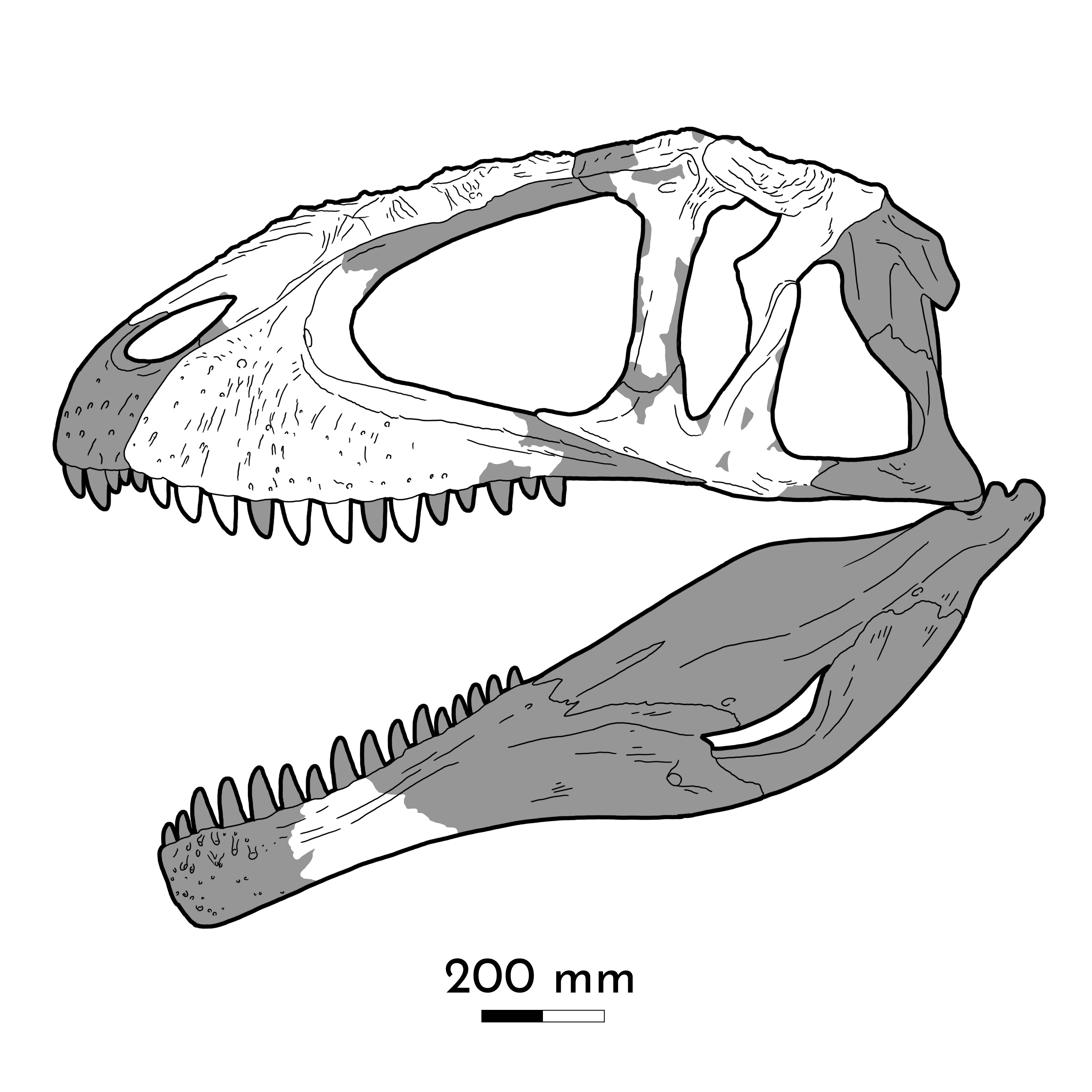
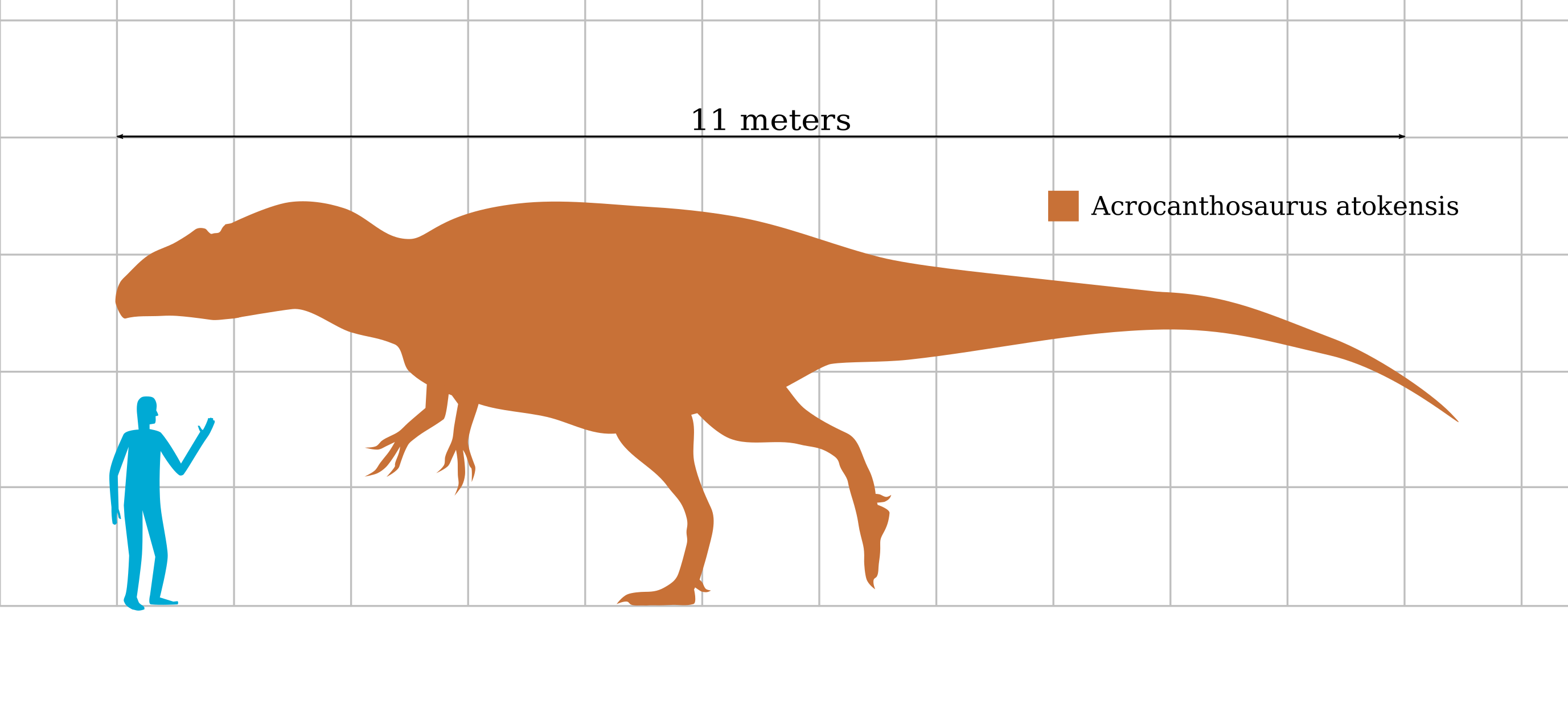
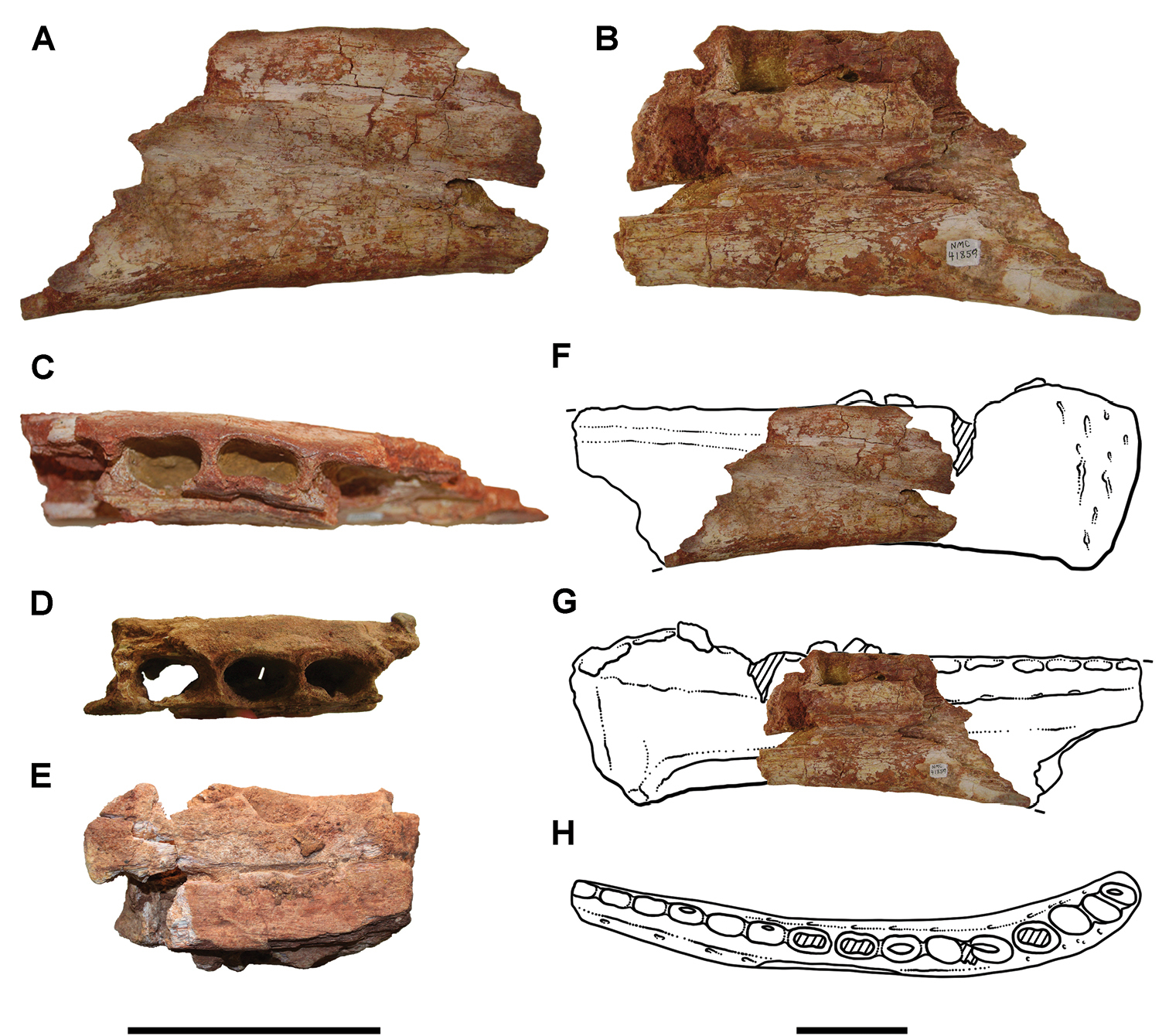
Eddy and Clarke re-examine the well-preserved skull of Acrocanthosaurus atokensis (NCSM 14345), identifying 24 new morphological characters. The resulting phylogenetic analysis includes Carcharodontosaurus saharicus as a central comparative taxon and recovers a topology placing Acrocanthosaurus firmly within Carcharodontosauridae. The paper demonstrates that shared cranial anatomy between C. saharicus and Acrocanthosaurus indicates a more derived phylogeny than previous studies suggested, contributing to understanding of internal carcharodontosaurid relationships and the evolution of large Cretaceous predators in North Africa and North America.

The phylogeny of Tetanurae (Dinosauria: Theropoda)
Carrano, M.T., Benson, R.B.J. & Sampson, S.D. · Journal of Systematic Palaeontology
Carrano, Benson, and Sampson present the most comprehensive Tetanurae phylogenetic analysis at that time, with 364 characters and 83 terminal taxa. The study firmly positions Carcharodontosauridae within Allosauroidea and makes an important taxonomic observation for C. saharicus: isolated theropod teeth from northern Africa cannot be confidently assigned to this species since other carcharodontosaurids were present in the same region and time period. This establishes a criterion of taxonomic caution that influenced all subsequent fragmentary material attributions.

Balance and Strength: Estimating the Maximum Prey-Lifting Potential of the Large Predatory Dinosaur Carcharodontosaurus saharicus
Henderson, D.M. · The Anatomical Record
Henderson uses three-dimensional digital models of Carcharodontosaurus saharicus to analyze its prey-lifting capacity. The study finds that a single adult could sustain approximately 424 kg in its jaws without losing balance, and two adults together could lift up to 850 kg. Using a subadult sauropod (Limaysaurus tessonei) as a prey model, the author demonstrates C. saharicus could lift and carry animals up to 8.3 meters long. This study provides concrete quantitative data on C. saharicus feeding ecology, distinguishing it from bone-crushing theropods like T. rex, whose bite forces were considerably greater.
Estimating bite force in extinct dinosaurs using phylogenetically predicted physiological cross-sectional areas of jaw adductor muscles
Sakamoto, M. · PeerJ
Sakamoto develops a Bayesian phylogenetic framework to estimate bite force in extinct archosaurs from skull measurements and evolutionary relationships. For Carcharodontosaurus saharicus, the model predicts anterior bite force of 11,312 N and posterior bite force of 25,449 N. These values are significantly lower than T. rex (48,505 N), confirming C. saharicus was not a bone-crusher. The analysis reinforces the hypothesis that different large theropods exploited distinct feeding niches: while T. rex processed whole carcasses, C. saharicus specialized in slicing flesh from live or dead sauropods using sharp blade-like teeth.

Geology and paleontology of the Upper Cretaceous Kem Kem Group of eastern Morocco
Ibrahim, N. et al. · ZooKeys
A 216-page monograph by Ibrahim, Sereno, and colleagues on the Kem Kem Group of Morocco, the geological context, and the Cenomanian African fauna. The work details the paleoenvironment dominated by coastal mangroves, large rivers, and tidal flats near the Tethys Sea. Carcharodontosaurus saharicus is documented as one of four large non-avian theropods in the ecosystem, alongside Spinosaurus, an abelisaurid, and Deltadromeus. The monograph consolidates the stratigraphic and taxonomic record and provides essential data on C. saharicus biogeography in northern Africa during the Cenomanian.

Re-evaluation of the Bahariya Formation carcharodontosaurid (Dinosauria: Theropoda) and its implications for allosauroid phylogeny
Kellermann, M., Cuesta, E. & Rauhut, O.W.M. · PLOS ONE
Kellermann, Cuesta, and Rauhut reexamine Stromer's original 1931 Egyptian Carcharodontosaurus material using historical documentation and photographs of the WWII-destroyed specimens. The analysis identifies numerous anatomical differences from the Moroccan neotype SGM-Din 1, including distinct nasal horn features and antorbital fossa characteristics. Based on these differences, the authors propose a new genus Tameryraptor markgrafi for the Egyptian material. This paper has direct implications for C. saharicus: the Moroccan neotype remains the valid species representative, but the historical Egyptian material no longer belongs to the same genus.

Endocranial anatomy of Carcharodontosaurus saharicus (Theropoda: Allosauroidea) and its implications for theropod brain evolution
Larsson, H.C.E. · Mesozoic Vertebrate Life (Indiana University Press)
Larsson uses CT scan data of skull SGM-Din 1 to obtain a complete endocast of Carcharodontosaurus saharicus, revealing unprecedented neuroanatomical details for the animal. The study describes semicircular canal geometry, olfactory lobes, and overall brain shape, which was relatively small and elongated compared to coelurosaurs. Implications for theropod brain evolution indicate C. saharicus had a well-developed sense of smell but limited binocular vision due to the elongated snout. This work was among the first to apply digital neuroimaging to large carnivorous theropods.


Carcharodontosaurus Stromer 1931 and Bahariasaurus Stromer 1934 — giant theropods from the Cretaceous of northern Africa
Rauhut, O.W.M. · Berliner Geowissenschaftliche Abhandlungen
Rauhut reevaluates Carcharodontosaurus and Bahariasaurus material from the Bahariya Formation of Egypt, working from photographs and descriptions of the war-destroyed material. The study analyzes the validity of both taxa and their distinguishing features, providing a crucial taxonomic foundation before the discovery of skull SGM-Din 1. This intermediate work was important for keeping the taxon C. saharicus in the literature while no substantial cranial material was available, and provided the context for Sereno et al. (1996) to correctly position the new Moroccan specimen.

A large Cretaceous theropod from Patagonia, Argentina, and the evolution of carcharodontosaurids
Novas, F.E. et al. · Naturwissenschaften
Novas and colleagues describe Tyrannotitan chubutensis from Patagonia and analyze carcharodontosaurid evolution, using Carcharodontosaurus saharicus as a central comparative taxon. The study demonstrates that African and South American giant predators share a common origin, likely derived from dispersal of Gondwanan ancestors before complete continental separation. This biogeographic analysis is fundamental for understanding why C. saharicus and Giganotosaurus carolinii are morphologically similar despite being separated by thousands of kilometers, and how carcharodontosaurids became dominant superpredators of the Cretaceous on multiple continents.
Calcium isotopes offer clues on resource partitioning among Cretaceous predatory dinosaurs
Hassler, A. et al. · Proceedings of the Royal Society B
Hassler and colleagues measure calcium isotopes in the tooth enamel of Cretaceous predatory theropods from Morocco's Kem Kem Beds and Gadoufaoua, Niger. Results show that carcharodontosaurids (including C. saharicus) and abelisaurids consumed predominantly terrestrial prey, while spinosaurids such as Spinosaurus were primarily piscivorous. This study resolves a fundamental question about how so many large predators could coexist in the same African ecosystem: they partitioned food resources by exploiting different trophic levels, with C. saharicus at the top of the terrestrial food chain and Spinosaurus dominating the aquatic environment.


Espécimes famosos em museus
SGM-Din 1 (Neotipo)
Ministerio de Energia, Minas e Meio Ambiente, Rabat, Marrocos
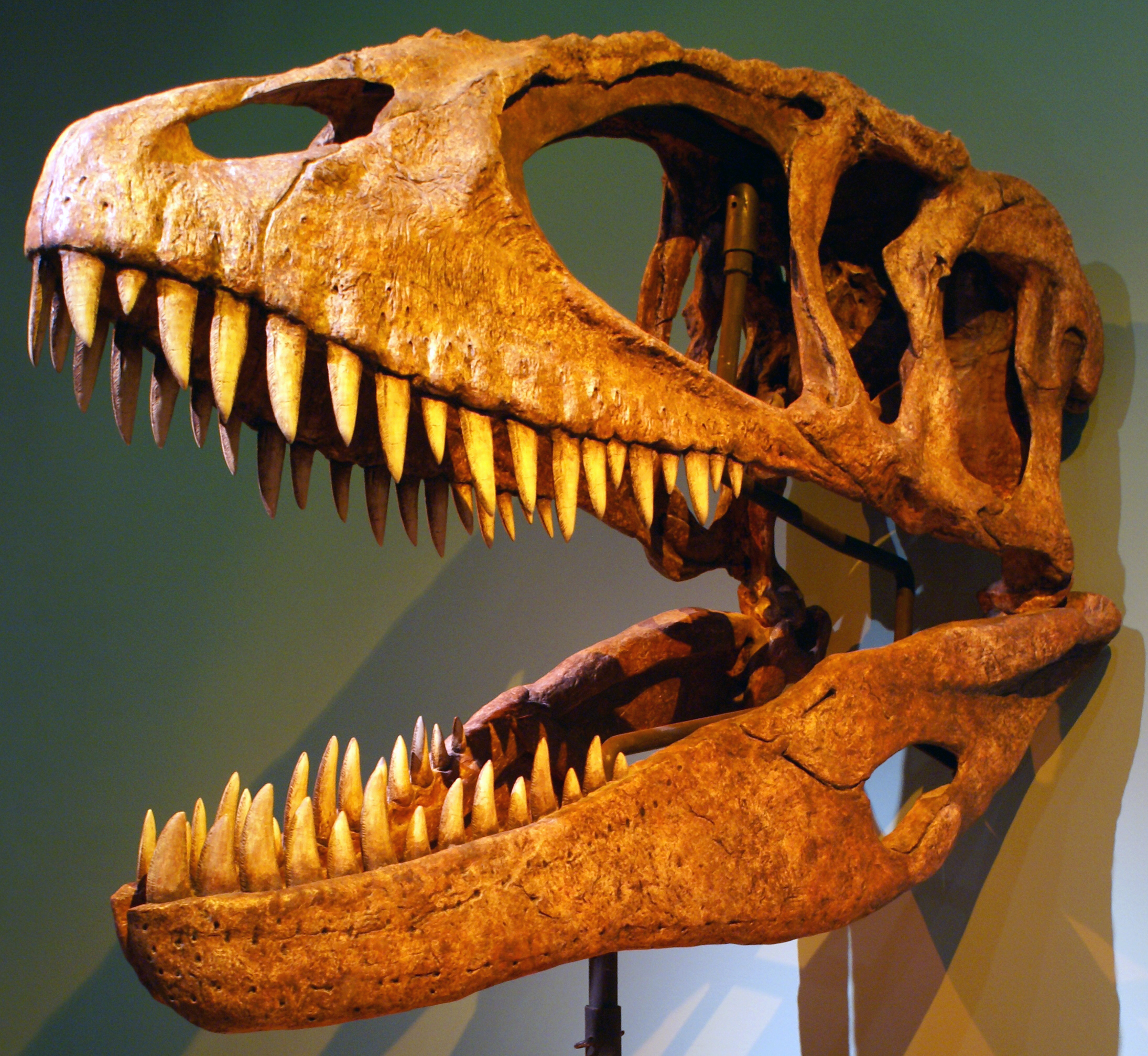
The official neotype of Carcharodontosaurus saharicus, designated in 2007. The partial 1.6-meter skull was found in Morocco's Kem Kem Beds and described in Science in 1996 by Sereno and colleagues. It is the most important specimen of the species and replaced Stromer's original material destroyed in World War II.
Cast do Cranio SGM-Din 1
Iziko South African Museum, Cape Town, Africa do Sul
Cast of the C. saharicus neotype skull displayed at the entrance of the permanent 'African Dinosaurs' exhibition at the Iziko South African Museum in Cape Town. The giant skull impresses visitors as representative of the largest terrestrial predator to inhabit the African continent.
Especime de Venezia
Museo di Storia Naturale di Venezia, Veneza, Italia
Cranial fragments of Carcharodontosaurus saharicus on display at the Venice Natural History Museum. The material is part of the North African fossil record of the species, composed primarily of fragmentary dental and bone elements.
In cinema and popular culture
Carcharodontosaurus saharicus never achieved the Jurassic Park fame of T. rex or Velociraptor, but it has built a solid presence in science documentaries and interactive media. Its most notable appearance was in the BBC series Planet Dinosaur (2011), where it featured in two episodes as the dominant predator of Cenomanian northern Africa, including a dramatic confrontation with a Spinosaurus over a carcass. Earlier, it appeared problematically in Discovery Channel's Dinosaur Planet (2003), where it was incorrectly portrayed in South America, confused with South American relatives like Giganotosaurus. In interactive media, it gained prominence in Jurassic World Evolution (2018) and its sequel, becoming a popular choice among fans of large African predators. A probable identification of the species in Primeval (2009) and a representation in the documentary Jurassic Fight Club (2024) complete its media record. In the toy market, it received its first official version in the Mattel Jurassic World line in 2021. As African paleontology gains more prominence, Carcharodontosaurus is likely to appear more frequently and accurately in future audiovisual productions.

Classificação

Descoberta
Curiosidade
The original Carcharodontosaurus material was destroyed when Allied bombing hit the Munich Museum during World War II in 1944. For decades, the animal was known only from old descriptions and photographs, until Paul Sereno found a new skull in the Sahara Desert in 1995, solving a half-century paleontological mystery.