
Deinocheirus mirificus
Deinocheirus mirificus
"Peculiar horrible hand"
Sobre esta espécie
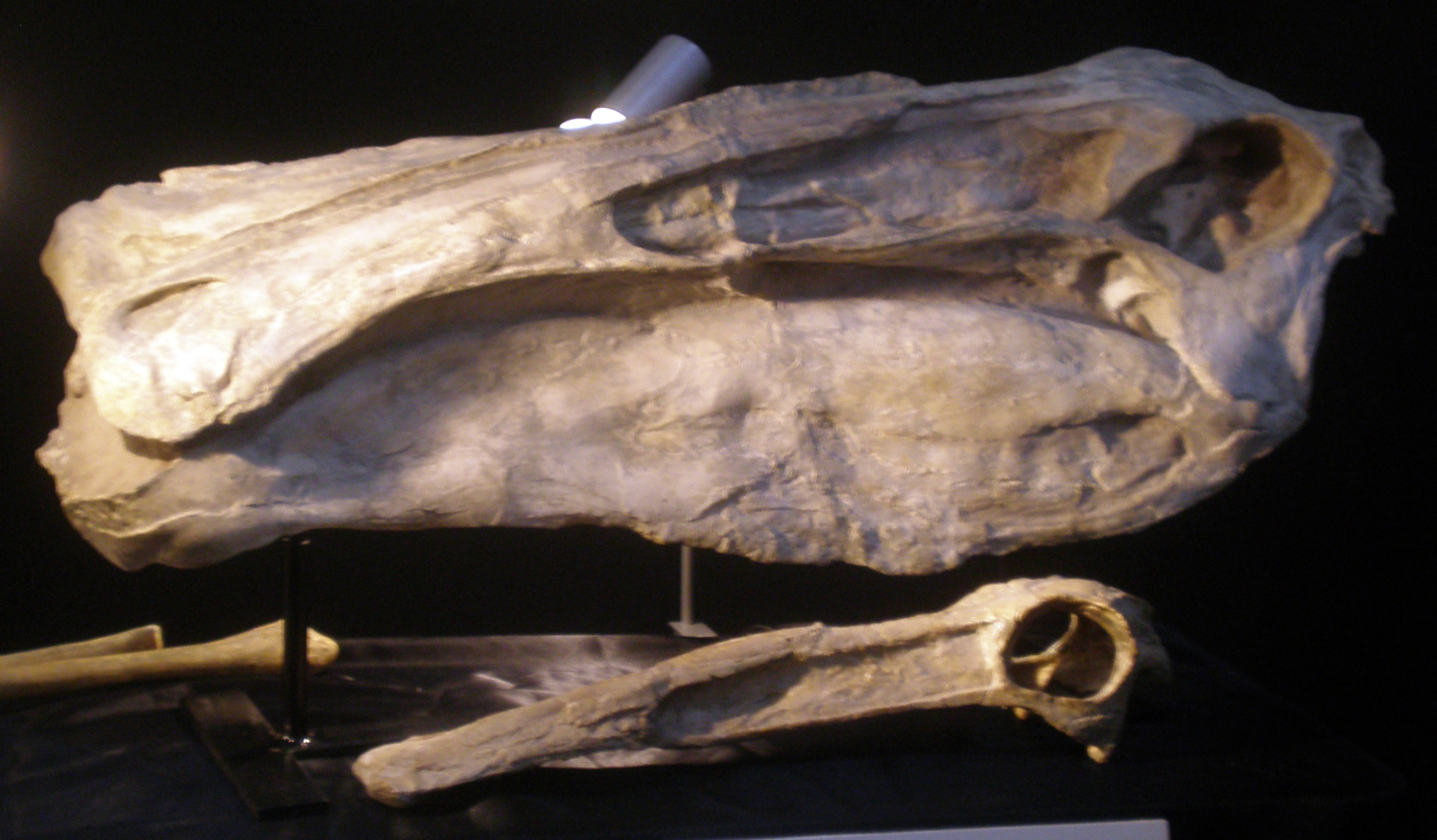
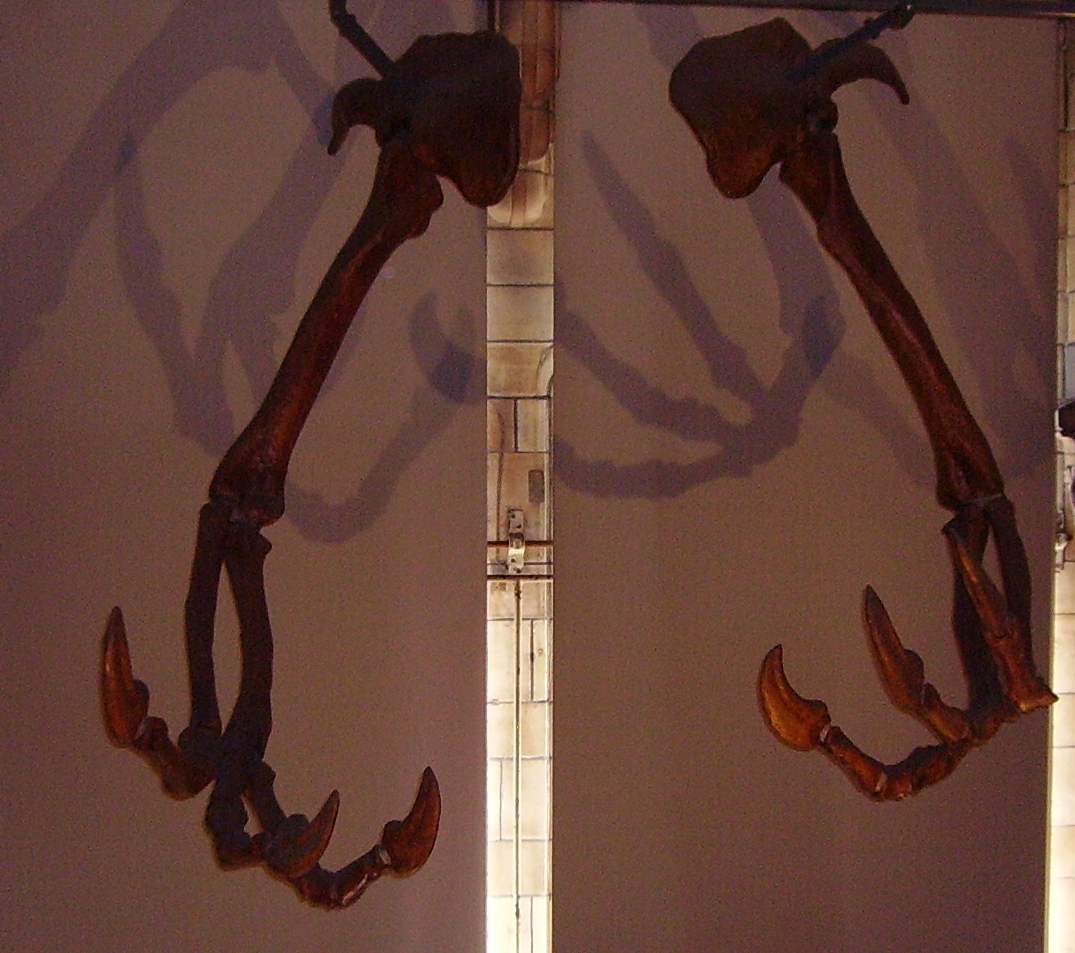
Deinocheirus mirificus was one of paleontology's greatest mysteries for nearly 50 years. Discovered in 1965 in Mongolia only through its gigantic arms — 2.4 meters with curved claws — it remained bodyless until 2014, when two nearly complete skeletons were described by Lee et al. in Nature. The result astonished: the largest known ornithomimosaur measured about 11 meters, weighed 6.4 tons, possessed a dorsal sail formed by tall neural spines, a broad hadrosaur-like bill, and an omnivorous diet including fish and aquatic plants.
Geological formation & environment
The Nemegt Formation is one of the richest Late Cretaceous faunas, deposited approximately 70 to 66 million years ago in what is now the Nemegt Basin, southern Mongolia. It represents a fluvial and seasonal floodplain environment, with full rivers in the wet season and arid savannas in the dry season. The fauna included Tarbosaurus bataar (apex predator), Therizinosaurus cheloniformis, Saurolophus angustirostris, Nemegtosaurus mongoliensis, and dozens of other species. The formation was explored by Polish-Mongolian, Soviet-Mongolian, and Sino-Mongolian expeditions throughout the 20th century, and more recently by Korean-Mongolian expeditions.
Image gallery






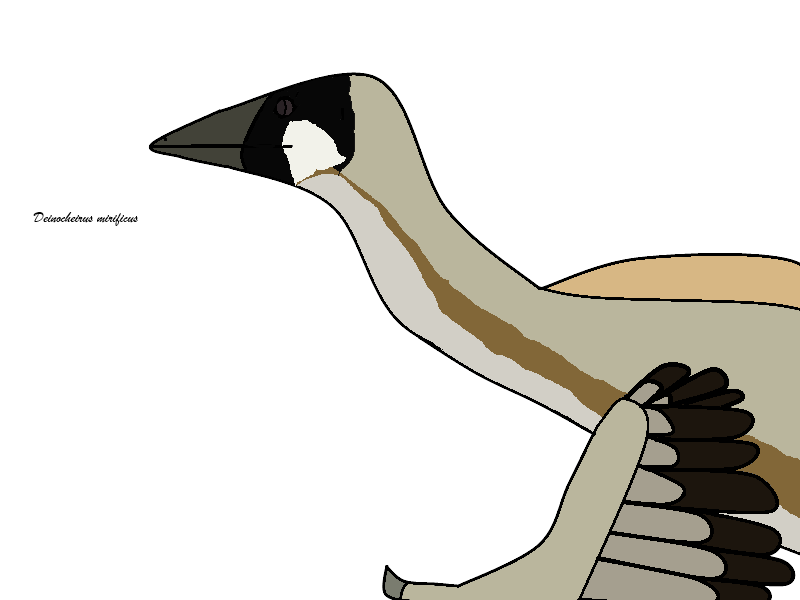
Scientific life restoration of Deinocheirus mirificus by PaleoNeolitic (2021), showing the animal with dense plumage, dorsal sail, and characteristic broad bill.
PaleoNeolitic, CC BY 4.0
Ecology and behavior
Habitat
Deinocheirus inhabited the fluvial and floodplain environments of the Nemegt Formation in what is now southern Mongolia. The climate was seasonal, alternating between wet seasons with full rivers and dry seasons. The ecosystem was dominated by giants: Tarbosaurus as apex predator, Therizinosaurus as a large herbivore, hadrosaurids like Saurolophus, and sauropods like Nemegtosaurus. Rivers and wetlands were essential for Deinocheirus, which depended on aquatic vegetation and fish.
Feeding
Deinocheirus was a mega-omnivore. Its broad, toothless bill — similar to a hadrosaur's — was adapted for efficient vegetation gathering. Over a thousand gastroliths found in the stomach indicated hard-plant grinding. Fish scale remains in stomach contents confirmed piscivory as part of its diet. The enormous curved forelimb claws likely served for dredging aquatic plants from shallow rivers — like Kodiak bear claws fishing for salmon, but at a much larger scale.
Behavior and senses
Indirect evidence suggests Deinocheirus was solitary or semi-solitary. Tarbosaurus bite marks on its gastralia indicate it was occasionally attacked or scavenged by the Nemegt Formation's apex predator. Its relatively short hind limbs for body size suggest it was not a runner — unlike smaller ornithomimids. The dorsal sail may have served for thermoregulation, intraspecific signaling, or energy storage. Based on its morphology, it was likely more slow-moving than its smaller relatives.
Physiology and growth
Bone histological analysis of Deinocheirus indicates high metabolic rate and rapid growth before sexual maturity, a pattern consistent with endothermy. The presence of a U-shaped furcula — a structure not observed in other ornithomimosaurs — and a pygostyle (fusion of distal caudal vertebrae, as in birds) indicates close physiological relationship with modern birds. The expanded pelvis suggested strong abdominal musculature. Plumage or feathers, inferred from phylogeny, likely covered much of the body.
Paleogeography
Continental configuration

Ron Blakey · CC BY 3.0 · Cretáceous, ~90 Ma
During the Maastrichtiano (~72–66 Ma), Deinocheirus mirificus inhabited Laramidia, the western half of present-day North America, separated from the east by the Western Interior Seaway, a shallow sea dividing the continent. The continents were in very different positions: India was drifting toward Asia, Antarctica was still connected to Australia, and South America was an isolated island.
Inventário de Ossos
Based on three specimens: the holotype (arms only, MPC 1966/IX), MPC-D 100/128 (subadult, ~74% of adult size, Altan Ula IV, 2006) and MPC-D 100/127 (nearly complete adult, Bugiin Tsav, 2009). Combined, they cover virtually the entire skeleton.
Found elements
Inferred elements
Scientific Literature
15 papers in chronological order — from the original description to recent research.
Deinocheiridae, a new family of theropod dinosaurs
Osmólska, H. & Roniewicz, E. · Palaeontologica Polonica
Founding paper in which Halszka Osmólska and Ewa Roniewicz describe the gigantic arms discovered in 1965 in Mongolia's Nemegt Formation. At 2.4 meters long with curved robust claws, the forelimbs did not fit any known family. The authors created family Deinocheiridae to accommodate the find. For decades, the animal's identity remained one of paleontology's greatest mysteries: giant carnivore? Therizinosaur relative? The initial study, based solely on the arms and shoulder girdle, generated decades of speculation about the rest of the animal.

New data on Deinocheirus Osmólska et Roniewicz, 1970 (Dinosauria)
Barsbold, R. · Palaeontologica Polonica
Rinchen Barsbold revisits the Deinocheirus arms and discusses their phylogenetic affinities with other theropod groups. The work compares the forelimbs with ornithomimids and proposes that Deinocheirus may represent a large primitive ornithomimosaur, challenging earlier interpretations linking it to carnosaurs. This perspective paved the way for later studies that finally confirmed its position within Ornithomimosauria.
Ornithomimosauria
Makovicky, P.J., Kobayashi, Y. & Currie, P.J. · The Dinosauria, 2nd ed. (University of California Press)
Makovicky, Kobayashi, and Currie authored the Ornithomimosauria review chapter in the second edition of The Dinosauria reference volume. Based on forelimb characters from the holotype, they conclude that Deinocheirus was likely a primitive ornithomimosaur, distinct from typical Ornithomimidae by retaining recurved claws and showing distinct humerus proportions. The phylogenetic analysis includes comparative characters with garudimimids and other ornithomimosaurs, establishing a framework later confirmed and detailed by Lee et al. in 2014.


Tyrannosaur feeding traces on Deinocheirus (Theropoda: ?Ornithomimosauria) remains from the Nemegt Formation (Late Cretaceous), Mongolia
Bell, P.R., Currie, P.J. & Lee, Y.N. · Cretaceous Research
Bell, Currie, and Lee identify Tarbosaurus bataar bite marks on gastralia fragments from Deinocheirus in the Nemegt Formation. Parallel striae and gouges on abdominal ribs are compared to denticle dimensions of several theropods from the same formation, pointing to Tarbosaurus as the most likely attacker. The discovery indicates that Deinocheirus, despite its enormous size, was vulnerable to the apex predator of the Nemegt Formation, providing paleoecological evidence of interspecific interactions in the Maastrichtian ecosystem of Mongolia.
Hip heights of the gigantic theropod dinosaurs Deinocheirus mirificus and Therizinosaurus cheloniformis, and implications for museum mounting and paleoecology
Senter, P. & Robins, J.H. · Bulletin of the Gunma Museum of Natural History
Senter and Robins calculate the hip height of Deinocheirus based on holotype limb proportions, arriving at approximately 3.3 meters. The study has direct implications for museum mountings and reconstruction of the paleoecological niche: hip height affects posture, feeding reach, and locomotion speed. Before the 2014 description of complete skeletons, studies like this were fundamental for estimating the animal's biology from fragmentary material. Results indicate Deinocheirus was a large animal capable of feeding at different vegetation strata.

Resolving the long-standing enigmas of a giant ornithomimosaur Deinocheirus mirificus
Lee, Y.N., Barsbold, R., Currie, P.J., Kobayashi, Y., Lee, H.J., Godefroit, P., Escuillié, F. & Tsogtbaatar Chinzorig · Nature
The most important paper on Deinocheirus. Lee et al. describe two nearly complete skeletons discovered in 2006 and 2009, solving a 49-year mystery. The animal turned out surprisingly different from what was imagined: instead of a predator, it was an omnivore with a broad hadrosaur-like bill, a dorsal sail of neural spines reaching 8.5 times the vertebral body height, and over a thousand gastroliths in the stomach along with fish remains. Cladistic analysis confirmed its position in Ornithomimosauria, forming family Deinocheiridae with Garudimimus and Beishanlong. At 11 meters and 6.4 tons, it is the largest known ornithomimosaur.
Paraxenisaurus normalensis, a large deinocheirid ornithomimosaur from the Cerro del Pueblo Formation (Upper Cretaceous), Coahuila, Mexico
Serrano-Brañas, C.I., Torres-Rodríguez, E., Reyes-Luna, P.C., González-Ramírez, I. & González-León, C. · Journal of South American Earth Sciences
Serrano-Brañas et al. describe Paraxenisaurus normalensis, a new deinocheirid ornithomimosaur from the Campanian of Mexico. Phylogenetic analysis recovers Paraxenisaurus as a member of Deinocheiridae alongside Garudimimus brevipes and Deinocheirus mirificus, representing the first record of the family in the Campanian of North America. The study expands the geographic and temporal distribution of deinocheirids, showing the group was more cosmopolitan than previously thought. The discovery has implications for Ornithomimosauria biogeography and understanding theropod migrations between Asia and North America during the Cretaceous.
Preliminary Study on the Reconstruction and Function of the Hyperelongate Neural Spines in the Dorsal Vertebrae of Deinocheirus mirificus (Theropoda: Ornithomimosauria)
Luo, X. & Liao, C. · Transactions on Social Science, Education and Humanities Research (ECSS 2024)
Luo and Liao analyze the hyperelongate neural spines of Deinocheirus dorsal vertebrae comparatively with 26 other dinosaur species. Results show the most similar structures belong to Spinosaurus and Ouranosaurus. The authors propose the spines served dual functions: supporting a sail related to aquatic habits and a hump for fat storage during dry seasons, in analogy with energy storage structures observed in modern vertebrates inhabiting seasonal environments.


A giant ornithomimosaur from the Early Cretaceous of China
Makovicky, P.J., Li, D., Gao, K.Q., Lewin, M., Erickson, G.M. & Norell, M.A. · Proceedings of the Royal Society B: Biological Sciences
Makovicky et al. describe Beishanlong grandis, a new giant ornithomimosaur from the Early Cretaceous of China. Histological analysis shows the holotype individual was still growing at death, indicating it could have reached even greater size. Phylogenetic analysis places Beishanlong as sister to a clade composed of Garudimimus and Ornithomimidae — a group that in Lee et al. (2014) forms part of Deinocheiridae with Deinocheirus. The paper documents parallel evolution of gigantism in multiple beaked coelurosaur lineages, offering evolutionary context for understanding Deinocheirus's exceptional size.
Reexamination of a primitive ornithomimosaur, Garudimimus brevipes Barsbold, 1981 (Dinosauria: Theropoda), from the Late Cretaceous of Mongolia
Kobayashi, Y. & Barsbold, R. · Canadian Journal of Earth Sciences
Kobayashi and Barsbold reexamine Garudimimus brevipes, a primitive ornithomimosaur from Mongolia that is a close relative of Deinocheirus. The study provides new phylogenetic analysis of Ornithomimosauria, placing Garudimimus as a primitive member of the group. Phylogenetic relationships of Garudimimus are relevant to understanding Deinocheirus's position, as both were ultimately classified together in Deinocheiridae by Lee et al. in 2014. The paper documents morphological characters shared between these two non-cursorial ornithomimosaurs from Asia.
Ecological niches in the Nemegt Formation: paleoecological reconstruction of the Late Cretaceous Mongolian fauna
Chiarenza, A.A. & Bonadonna, D. · Biology Letters (Royal Society)
Chiarenza and Bonadonna analyze the ecological niches occupied by dinosaurs and other vertebrates of the Upper Cretaceous Nemegt Formation of Mongolia. The study contextualizes Deinocheirus mirificus as a mega-omnivore in a rich and diversified ecosystem shared with Tarbosaurus, Therizinosaurus, Saurolophus, and other giants. The paleoecological reconstruction reveals how different feeding strategies coexisted: from apex predator (Tarbosaurus) to large aquatic omnivore (Deinocheirus) to large herbivores (hadrosaurids, sauropods). The work includes detailed scientific illustration of the environment.


First Ornithomimid (Theropoda, Ornithomimosauria) from the Upper Cretaceous Djadokhta Formation of Tögrögiin Shiree, Mongolia
Chinzorig, T., Kobayashi, Y., Tsogtbaatar, K., Currie, P.J., Watabe, M. & Barsbold, R. · Scientific Reports
Chinzorig et al. describe a new ornithomimid from the Djadokhta Formation of Mongolia and provide comprehensive phylogenetic analysis of Ornithomimosauria. The paper includes comparison of metatarsal morphology across various ornithomimosaurs, with Deinocheirus as a basal outgroup reference point. The study documents foot morphological variation among Ornithomimosauria members and how this reflects different locomotor strategies. The article is published open access in Scientific Reports with a complete Ornithomimosauria cladogram.


The internal cranial morphology of an armoured dinosaur Euoplocephalus corroborated by X-ray computed tomographic reconstruction
Miyashita, T., Arbour, V.M., Witton, M.P. & Currie, P.J. · Journal of Anatomy
Miyashita et al. apply computed tomography to reconstruct the internal cranial anatomy of Euoplocephalus tutus, an ankylosaur contemporary with Nemegt-equivalent faunas. The CT method is relevant to Deinocheirus because similar techniques were applied to analyze the skulls of ornithomimosaurs and other coelurosaurs, including specimens from the Nemegt Formation. The work demonstrates the power of modern imaging techniques in paleontology, which transformed our understanding of the neurology, sensory physiology, and behavior of dinosaurs like Deinocheirus.

Assignment of responsibility for the Gobi desert ornithomimosaur beds: letter to the editor
Eberth, D.A., Kobayashi, Y., Lee, Y.N., Mateus, O., Therrien, F., Zelenitsky, D.K. & Currie, P.J. · Journal of Vertebrate Paleontology
This paper discusses stratigraphic assignments and institutional responsibilities for ornithomimosaur-bearing beds of the Gobi Desert. Published in 2009, shortly before the expeditions that recovered the new Deinocheirus specimens, it documents the academic and geographic context of paleontological exploration of the region. The localities discussed include Nemegt Formation areas that produced specimens MPC-D 100/127 and MPC-D 100/128 described in 2014.


Growth dynamics and metabolic rate of the giant ornithomimosaur Deinocheirus mirificus inferred from bone histology
Lee, Y.N. & Werning, S. · Journal of Vertebrate Paleontology (SVP 2015 abstracts)
Lee and Werning present bone histology results of Deinocheirus mirificus, revealing high metabolic rate and rapid growth before sexual maturity. Lines of arrested growth (LAGs) in the bones allow age estimation of the studied specimens and reconstruction of growth curves. The data are consistent with endothermy in Deinocheirus, aligning it with other large coelurosaurs. This type of histological analysis transformed dinosaur paleontology by revealing growth rates independently of their living relatives.


Espécimes famosos em museus
MPC-D 100/127 (adulto, Bugiin Tsav)
Instituto Paleontológico da Academia de Ciências da Mongólia (IPAMN), Ulaanbaatar
Adult specimen found at Bugiin Tsav in 2009, 6% larger than the holotype. It is the most complete Deinocheirus specimen and the basis of Lee et al. (2014)'s description. Includes skull, shoulder girdle, vertebrae, pelvis, and limbs.
MPC-D 100/128 (subadulto, Altan Ula IV)
Instituto Paleontológico da Academia de Ciências da Mongólia (IPAMN), Ulaanbaatar
Subadult specimen damaged by fossil poachers before being found by paleontologists at Altan Ula IV. Complements MPC-D 100/127 with dorsal and caudal vertebrae, ilium, partial postcranium, and left hindlimb.
MPC 1966/IX (holótipo, Altan Ula III)
Instituto Paleontológico da Academia de Ciências da Mongólia (IPAMN), Ulaanbaatar
Original holotype discovered on July 9, 1965 at Altan Ula III (43°33.987'N, 100°28.959'E). Consists of both complete forelimbs except right hand claws, complete shoulder girdle, three dorsal vertebral centra, five ribs, gastralia, and two ceratobranchials.
In cinema and popular culture
Deinocheirus mirificus spent nearly five decades as a ghost in pop culture: mentioned in 'strangest dinosaurs' lists but almost never accurately depicted, simply because nobody knew what its body looked like. After the 2014 revelation, the Prehistoric Planet series (Apple TV+, 2022) changed everything, presenting the animal with a reconstruction widely considered the most accurate ever seen in popular media. Deinocheirus appeared in the 'Freshwater' episode with dense plumage, a broad bill, and convincing aquatic behavior, praised by paleontologists. Before 2014, depictions in the Bizarre Dinosaurs special (National Geographic, 2009) were inevitably speculation-based. In the gaming world, Deinocheirus appears in Jurassic World: The Game with a reasonably faithful post-2014 representation. The animal's popular culture trajectory directly mirrors its scientific arc: from frustrating enigma to icon of how science can solve its greatest mysteries.

Classificação
Descoberta
Curiosidade
For 49 years, Deinocheirus was a mystery: only its gigantic arms were known, and scientists debated whether it might be a carnivore larger than T. rex. In 2014, it turned out to be an omnivore with a duck-like bill, a dorsal sail, and a diet based on aquatic plants and fish — the opposite of the predator imagined.