
Dilophosaurus
Dilophosaurus wetherilli
"Two-crested lizard (honoring John Wetherill)"
Sobre esta espécie
Dilophosaurus wetherilli was the largest land predator in North America during the Early Jurassic, reaching about 7 meters in length and 400 kg. Its most distinctive feature was a pair of parallel crests running along the top of its skull, thin and delicate structures that likely served for visual display and species recognition. It lived approximately 196 to 183 million years ago in the Kayenta Formation of present-day Arizona, USA. The comprehensive anatomical revision by Marsh and Rowe (2020) confirmed the animal had robust jaws strong enough to puncture bone, overturning the notion it was a weak predator. There was no frill and no venom: these elements are inventions of the film Jurassic Park (1993).
Geological formation & environment
The Kayenta Formation is an Early Jurassic sedimentary unit (approximately 196 to 183 Ma) deposited in present-day Arizona, Utah, and Nevada, USA. It consists mainly of fine-grained siltstones and cross-bedded sandstones, representing deposits of low-gradient meandering rivers and flood plains with seasonal lakes. The climate was semi-arid with contrasting seasons. The fauna is rich and diverse: in addition to Dilophosaurus, it includes smaller theropods, sauropodomorphs, armored dinosaurs, pterosaurs, crocodyliformes, amphibians, chelonians, and the first mammals of North America. U-Pb dating of detrital zircons established the depositional age at 183.7 ±2.7 Ma.
Image gallery


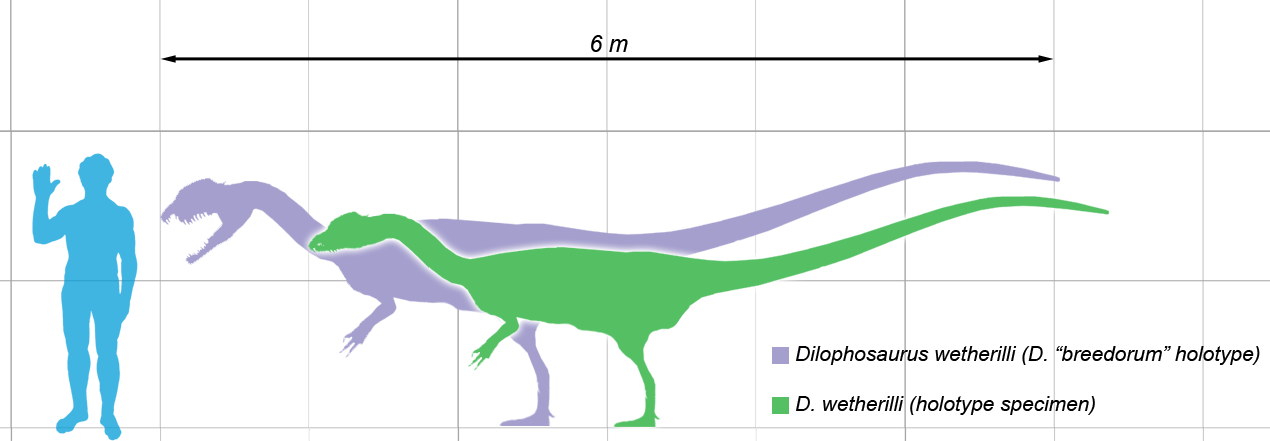


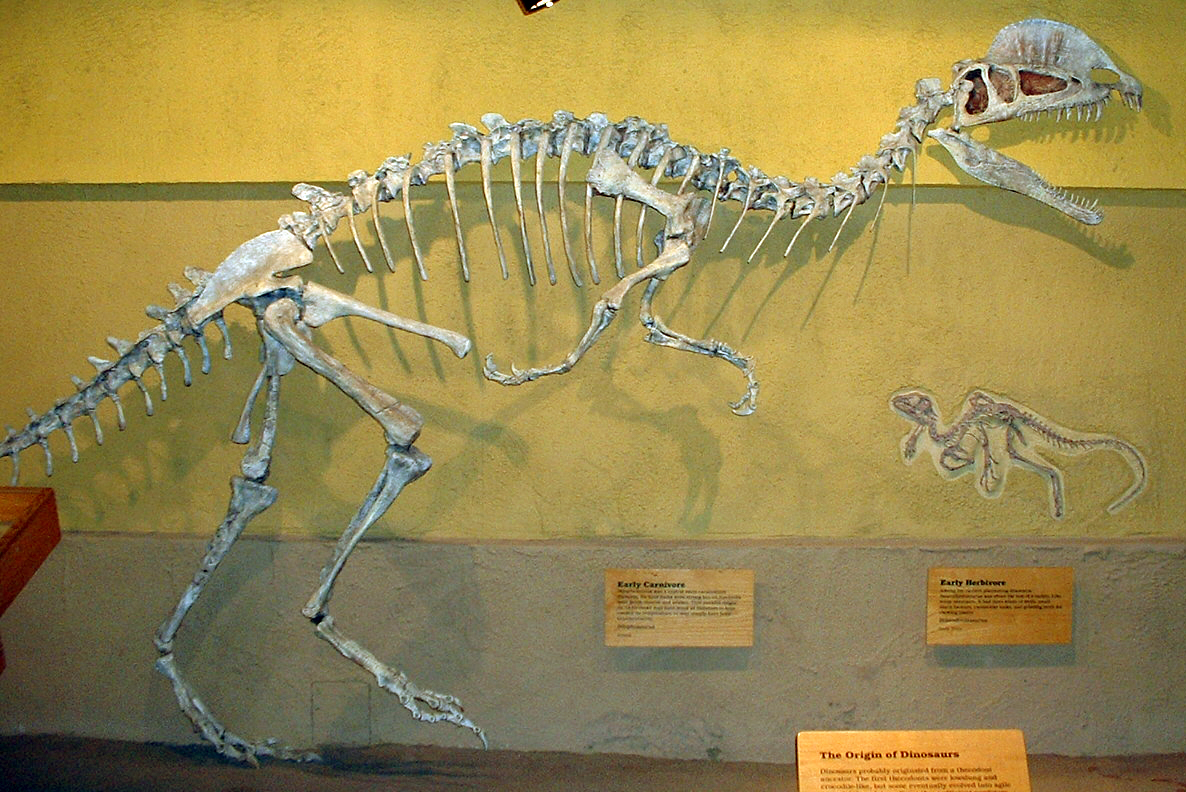


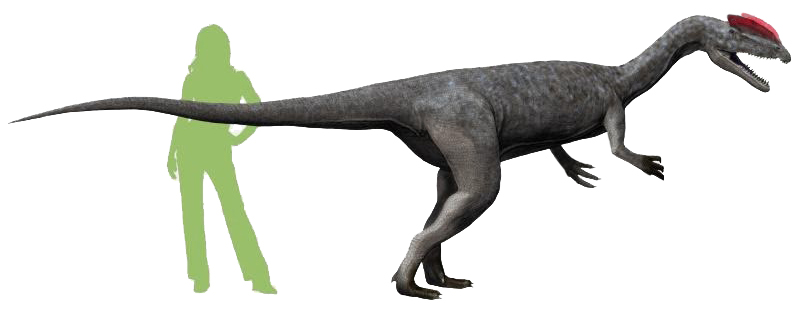
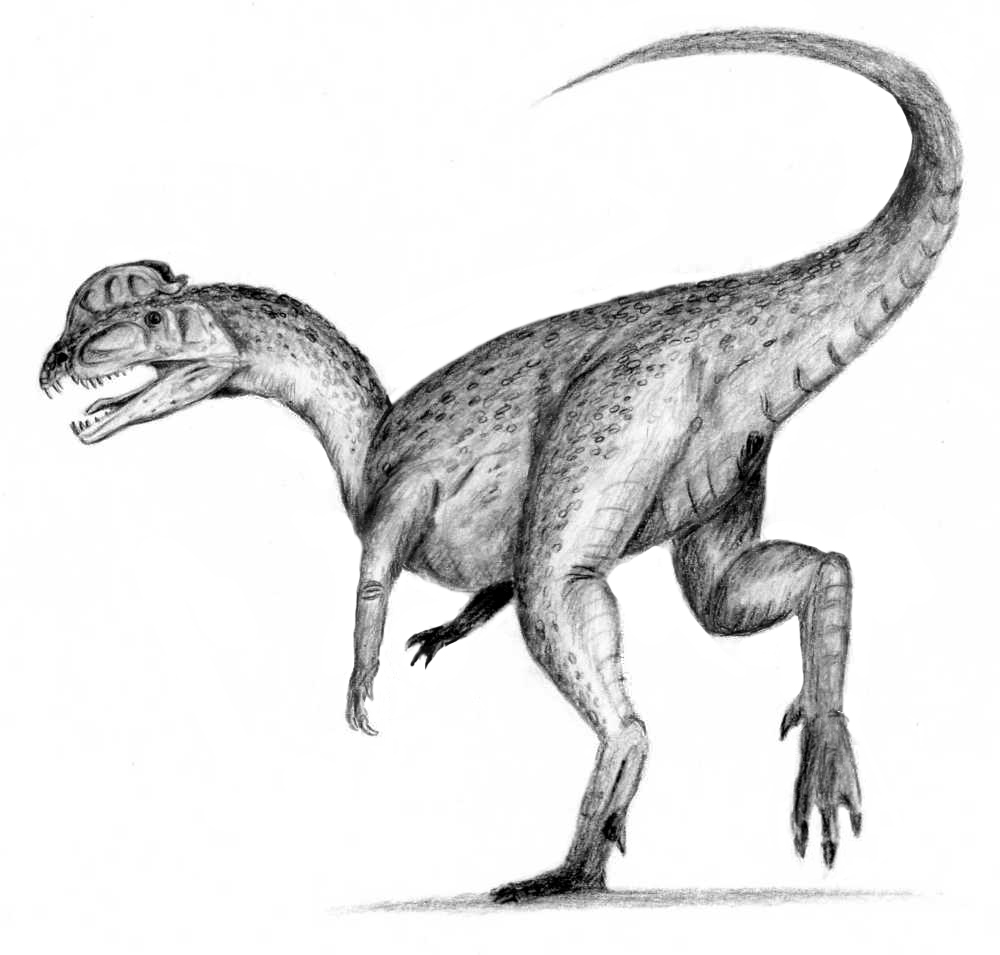


Scientific reconstruction of Dilophosaurus wetherilli by Leandra Walters (2015), published in PLOS ONE. White background, showing the two parallel skull crests, long tail, and modern bipedal posture.
Leandra Walters / Senter & Robins (2015) · CC BY 2.5
Ecology and behavior
Habitat
Dilophosaurus inhabited the semi-arid fluvial plain of the Kayenta Formation in the Early Jurassic, a region with rainy summers and dry winters, crossed by low-gradient meandering rivers and seasonal lakes. The environment was dominated by ferns and primitive conifers. Other inhabitants included the small armored dinosaur Scutellosaurus, the sauropodomorph Sarahsaurus, the pterosaur Rhamphinion, crocodyliformes, and the first true mammals of North America.
Feeding
As the apex predator of its ecosystem, Dilophosaurus hunted large prey like Sarahsaurus and likely also smaller prey like Scutellosaurus. The Marsh and Rowe (2020) revision demonstrated that its jaws were robust enough to puncture bone, overturning the weak predator hypothesis. The subnarial gap (opening between premaxilla and maxilla) may have facilitated prey hooking. Evidence of scavenging behavior on Sarahsaurus carcasses has also been documented.
Behavior and senses
The paired skull crests, too thin for combat, were likely used for visual display: species recognition, status signaling, and sexual attractiveness. The infant specimen MNA P1.3181 and multiple known adults suggest Dilophosaurus may have lived in family groups or tolerated other individuals at resource sites. Bone pathologies in the holotype indicate intraspecific combat or accidents during hunting. The bird-like resting posture documented by fossilized tracks suggests more avian than reptilian behavior.
Physiology and growth
The pneumatized cervical vertebrae of Dilophosaurus indicate a system of air sacs connected to the lungs, similar to the respiratory system of modern birds, suggesting high metabolic efficiency and likely endothermic (warm-blooded) metabolism. The estimated growth rate of 30 to 35 kg per year early in life indicates rapid growth typical of endotherms. Hollow bones reduced weight without sacrificing structural strength, an adaptation that would reach its apex in modern birds.
Paleogeography
Continental configuration

Ron Blakey · CC BY 3.0 · Jurassic, ~90 Ma
Fóssil sites

Marsh & Rowe (2020), Journal of Paleontology · CC BY 4.0
During the Sinemuriano-Pliensbachiano (~196–183 Ma), Dilophosaurus wetherilli inhabited the fragmenting Pangea. North America and Europe were still close, and the North Atlantic was just beginning to open. Climate was warm and humid globally, with no polar ice caps.
Inventário de Ossos
Based on five known specimens, including the nearly complete holotype UCMP 37302 and the large adult UCMP 77270, collected in 1964 about 400 meters from the original site. The infant specimen MNA P1.3181 is one of the oldest known juvenile theropods from North America. The Marsh and Rowe (2020) revision described new specimens, substantially expanding knowledge of the species' anatomy.
Found elements
Inferred elements
Scientific Literature
15 papers in chronological order — from the original description to recent research.
New Jurassic dinosaur from the Kayenta Formation of Arizona
Welles, S.P. · Bulletin of the Geological Society of America
The founding paper of Dilophosaurus. Sam Welles describes three theropod skeletons excavated in 1942 from the Kayenta Formation of Arizona, naming the species Megalosaurus wetherilli in honor of Navajo guide John Wetherill. The material included holotype UCMP 37302, a nearly complete skeleton, and paratype UCMP 37303. Welles had not yet recognized the skull crests, as the specimen had been damaged during preparation. The assignment to the wastebasket genus Megalosaurus would be corrected 16 years later.

Dilophosaurus (Reptilia: Saurischia), a new name for a dinosaur
Welles, S.P. · Journal of Paleontology
Key paper in which Welles establishes the new genus Dilophosaurus after examining a larger specimen collected in 1964 and recognizing the paired skull crests that had been destroyed during preparation of the original holotype. The generic name, from Greek di (two), lophos (crest) and sauros (lizard), perfectly describes the animal's most distinctive diagnostic feature. This short publication establishes Dilophosaurus wetherilli as an independent species and paves the way for the complete 1984 revision.


Dilophosaurus wetherilli (Dinosauria, Theropoda) osteology and comparisons
Welles, S.P. · Palaeontographica Abteilung A
A 185-page monograph that served as the definitive anatomical reference for Dilophosaurus for 36 years, until the Marsh and Rowe (2020) revision. Welles describes in detail the bones of the holotype and referred specimens, compares the animal with other theropods known at the time, and discusses its phylogeny. The work consolidates Dilophosaurus as a well-founded independent taxon and documents its osteological anatomy with unprecedented detail for the period. Many of Welles's interpretations were later revised by the 2020 analysis.


Bite me: biomechanical models of theropod mandibles and implications for feeding behaviour
Therrien, F., Henderson, D.M. & Ruff, C.B. · The Carnivorous Dinosaurs (ed. Carpenter, K.), Indiana University Press
Biomechanical study that analyzed mandibular force profiles of multiple theropods using beam-theory models, including Dilophosaurus wetherilli. Results indicated that Dilophosaurus bite force decreased rapidly along the tooth row, with anterior teeth being the strongest. This suggested adaptation for capturing and holding relatively smaller prey. The study also linked the subnarial gap to a specialized biting strategy, with middle teeth executing cuts while front teeth held prey.
Range of motion in the forelimb of the theropod dinosaur Guanlong wucaii, with implications for the use of the forelimbs in predation and support
Senter, P. & Robins, J.H. · Canadian Journal of Earth Sciences
Joint mobility study that examined the range of motion of forelimbs in basal theropods, including Dilophosaurus wetherilli. Results showed Dilophosaurus could retract the humerus nearly parallel to the scapula but could not raise it vertically. The range of motion was consistent with bilateral grasping and the ability to hold objects against the chest or neck base. The study revealed Dilophosaurus used its front claws to hook and immobilize prey, not for locomotory support.


Forelimbs of the theropod dinosaur Dilophosaurus wetherilli: Range of motion, influence of paleopathology and soft tissues, and description of a distal carpal bone
Senter, P. & Sullivan, C. · Palaeontologia Electronica
A study dedicated exclusively to the forelimbs of Dilophosaurus wetherilli, describing the range of motion of each joint from shoulder to digit, with particular attention to paleopathologies affecting the holotype's movements. The authors also describe a previously unreported distal carpal bone. Conclusions confirm that Dilophosaurus had functional forelimbs for prey grasping, but with limited shoulder mobility, requiring the mouth to make first contact during attacks. The role of venom and frills, as in Jurassic Park, is entirely rejected.
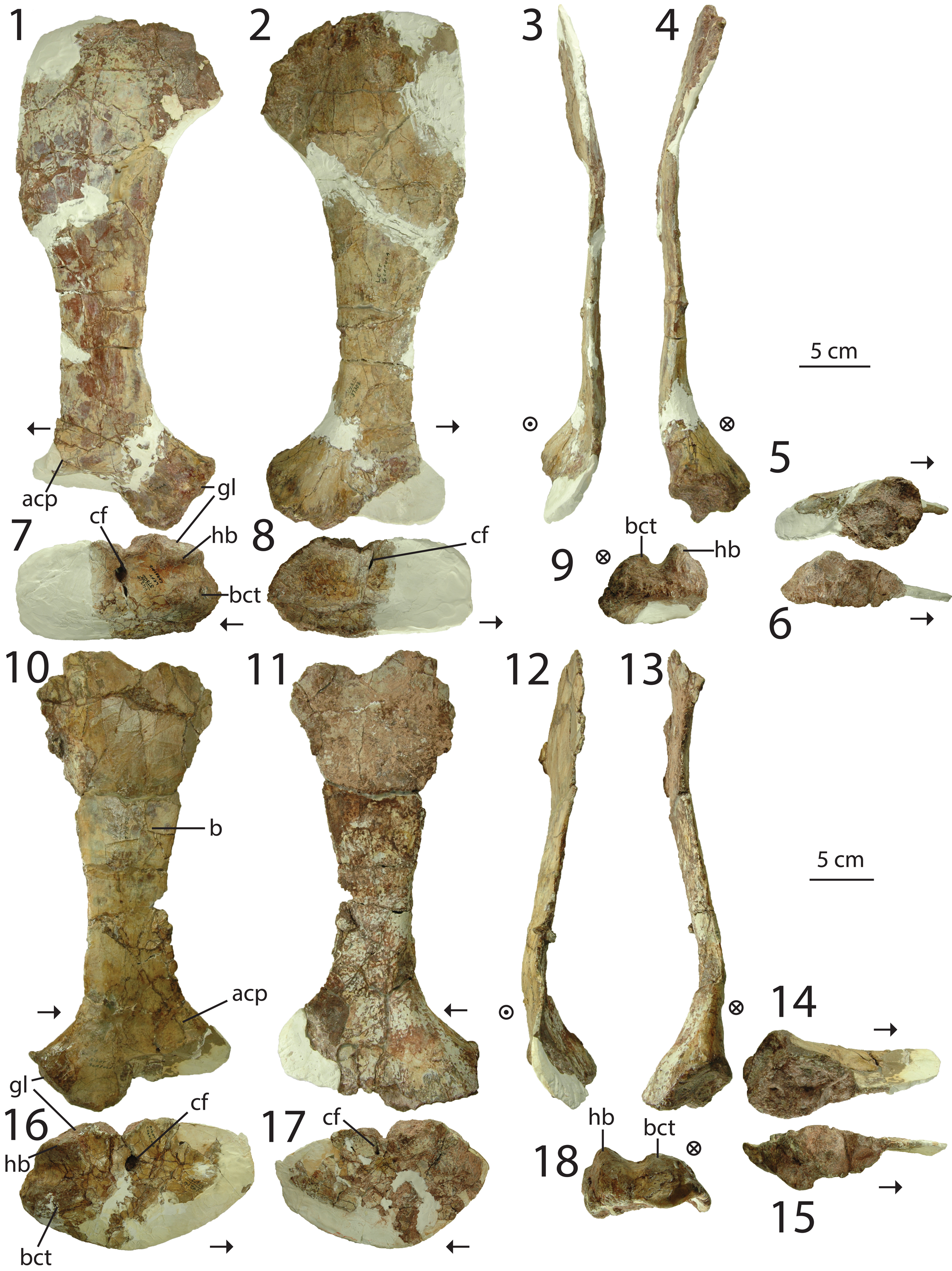
New specimens of Dilophosaurus wetherilli (Dinosauria: Theropoda) from the Early Jurassic Kayenta Formation of northern Arizona
Gay, R.J. · Zion and Bryce Canyon Studies and Resources, Bryce Canyon Natural History Association
Description of previously undescribed specimens of Dilophosaurus wetherilli from the Kayenta Formation of northern Arizona. Gay documents anatomical material not previously described, expanding the known fossil record of the species before the comprehensive Marsh and Rowe revision. The work includes observations on individual variation among specimens and raises questions about sexual dimorphism and ontogenetic growth in the genus. Despite being published in a lower-circulation volume, the paper contributes relevant raw data incorporated in the 2020 analysis.

A Triassic averostran-line theropod from Switzerland and the early evolution of dinosaurs
Zahner, M. & Brinkmann, W. · Nature Ecology & Evolution
Description of Notatesseraeraptor frickensis, a new Late Triassic theropod from Switzerland. The accompanying phylogenetic analysis places Dilophosaurus wetherilli as a non-averostran neotheropod, forming a grade with other basal forms relative to Averostra. This paper was one of the first to formally demonstrate that Dilophosaurus does not belong to Coelophysoidea or Ceratosauria, corroborating earlier analyses and establishing the phylogenetic baseline confirmed by Marsh and Rowe (2020).


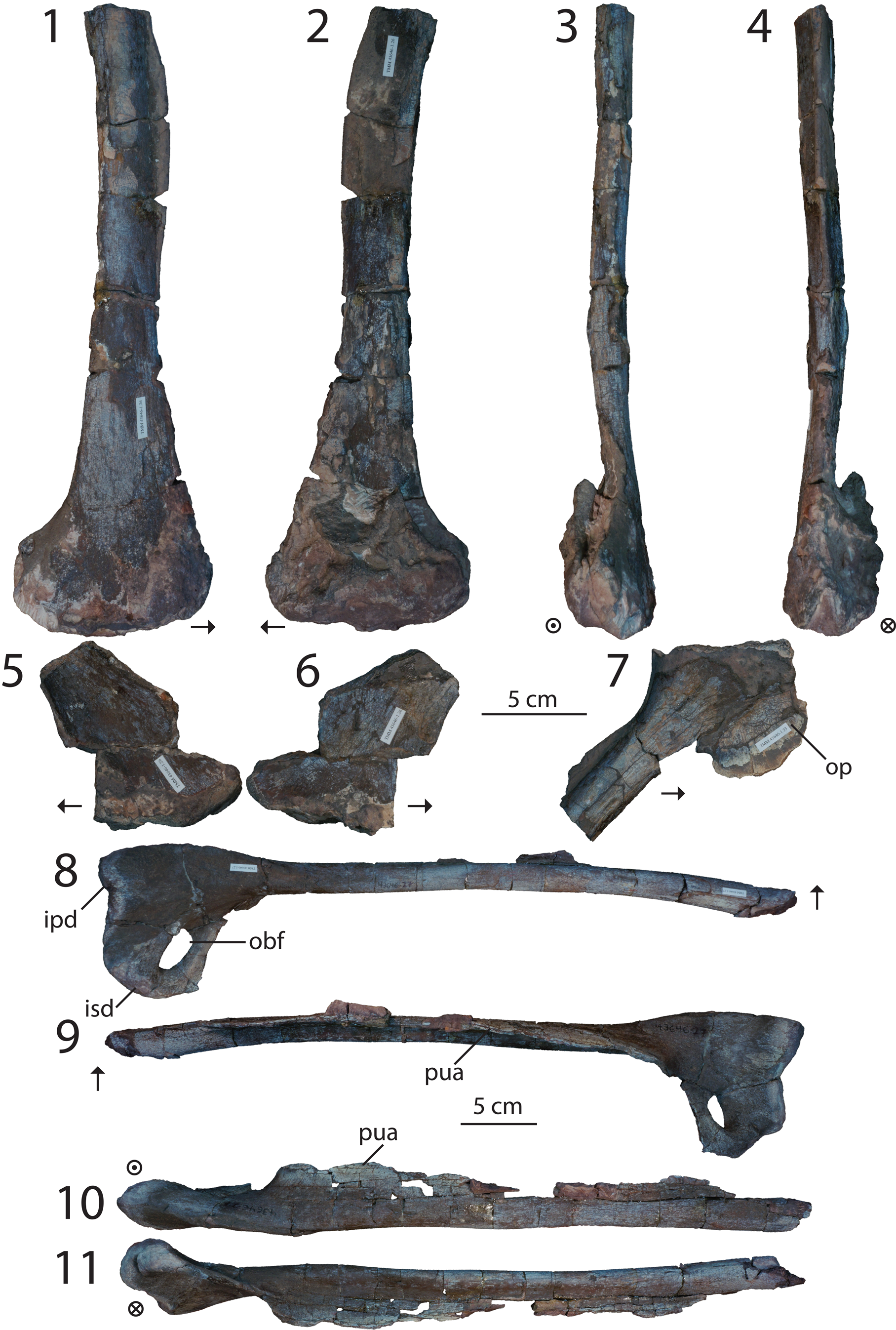
A comprehensive anatomical and phylogenetic evaluation of Dilophosaurus wetherilli (Dinosauria, Theropoda) with descriptions of new specimens from the Kayenta Formation of northern Arizona
Marsh, A.D. & Rowe, T.B. · Journal of Paleontology
The most comprehensive redescription ever published on Dilophosaurus wetherilli, spanning 103 pages covering holotype, referred, and new specimens. Marsh and Rowe demonstrate that Dilophosaurus had robust jaws strong enough to puncture bone, overturning the perception it was a weak predator. Phylogenetic analysis confirms its position as a non-averostran neotheropod, sister to Averostra, and more derived than Cryolophosaurus. The paper also documents bone pathologies, ontogenetic growth, and the infant specimen MNA P1.3181. It is the definitive modern reference for the taxon.

Osteology of the Early Jurassic theropod dinosaur Dilophosaurus wetherilli: axial skeleton
Marsh, A.D. & Rowe, T.B. · Journal of Paleontology
The axial skeleton osteological component within the comprehensive 2020 revision, describing in detail the cervical, dorsal, sacral and caudal vertebrae of Dilophosaurus wetherilli. Analysis reveals that cervical vertebrae were pneumatized with air sacs, considered an ancestral feature of birds representing early evolution of the high-efficiency respiratory system seen in modern birds. Axial skeleton data were used to calculate total length and body mass of known specimens.


Three-dimensional preservation of foot movements in Triassic theropod dinosaurs
Gatesy, S.M., Middleton, K.M., Jenkins, F.A. & Shubin, N.H. · Nature
Three-dimensional analysis of theropod trackways from Connecticut Valley, including large Eubrontes traces attributed to Dilophosaurus-grade theropods. The study used 3D scanning to reconstruct foot kinematics during locomotion, revealing that these large Early Jurassic theropods kept their feet highly flexed during gait. Eubrontes tracks are Connecticut's state dinosaur and likely represent the locomotory trace of Dilophosaurus or very similar animals.
A new species of the theropod dinosaur Syntarsus from the Early Jurassic Kayenta Formation of Arizona
Rowe, T.B. · Journal of Vertebrate Paleontology
Description of a new species of the theropod Syntarsus (now Megapnosaurus) from the Kayenta Formation of Arizona, the small predator that coexisted with Dilophosaurus. The paper documents contemporary fauna and establishes the paleoecological context of the Early Jurassic in Arizona: an ecosystem with one large apex predator (Dilophosaurus) and multiple smaller carnivores competing for the same territory. Associated fauna also included the dinosaurs Sarahsaurus and Scutellosaurus, along with pterosaurs, crocodyliformes, and primitive mammals.
The age of the Kayenta Formation and the age of Dilophosaurus wetherilli, Early Jurassic of Arizona
Marsh, A.D. · Journal of Paleontology
Radiometric dating using detrital zircons from the Kayenta Formation yielded a U-Pb age of 183.7 ±2.7 Ma, the first direct depositional radiometric date from the formation. This result shifted the dating of Dilophosaurus from Sinemurian-Pliensbachian to Pliensbachian-Toarcian, making it younger than previously thought. Geological data also reveal that the formation was deposited in a fluvial plain environment dominated by low-gradient meandering rivers, with seasonal lakes and pteridophyte forests.
The dinosaurs of the Early Jurassic Hanson Formation of the central Transantarctic Mountains: phylogenetic review and synthesis
Smith, N.D., Makovicky, P.J., Pol, D., Hammer, W.R. & Currie, P.J. · U.S. Geological Survey and The National Academies Open-File Report
Comprehensive review of Early Jurassic dinosaurs from the Hanson Formation of Antarctica, including Cryolophosaurus ellioti, the closest confirmed relative of Dilophosaurus. Phylogenetic analysis positions Dilophosaurus and Cryolophosaurus in a clade of pre-Averostra basal theropods, clarifying that cranial crests evolved independently in multiple Early Jurassic theropod lineages. The paper establishes the biogeographic context of the radiation of large-crested theropods during the Early Jurassic across Gondwana and Laurasia.

The Morrison Formation dinosaur fauna from the Nail Quarry and Dilophosaurus as the largest theropod from the Early Jurassic of North America
Breithaupt, B.H. · Museum of Northern Arizona Bulletin
Documents the status of Dilophosaurus wetherilli as the largest known theropod from the Early Jurassic of North America. The work compares Dilophosaurus with other large predators of the period, discusses its ecological role as apex predator in an ecosystem dominated by protodinosaurs and synapsids, and contextualizes Museum of Northern Arizona findings relative to Californian university specimens. Dilophosaurus was literally the 'king' of North America before the rise of large ceratosaurs and tetanurans.

Espécimes famosos em museus
UCMP 37302 (holótipo)
University of California Museum of Paleontology, Berkeley, California, EUA
Official holotype of Dilophosaurus wetherilli, excavated by Sam Welles in 1942 from the Kayenta Formation. Parts of the anterior skull, pelvis, and some vertebrae are missing. The skull crests were accidentally destroyed during preparation, preventing Welles from recognizing them until the new 1964 specimen.
UCMP 77270 (espécime adulto de 1964)
University of California Museum of Paleontology, Berkeley, California, EUA
Largest known Dilophosaurus specimen, collected in 1964 about 400 meters south of the holotype site. It was this specimen that revealed the preserved paired skull crests, leading Welles to establish the genus Dilophosaurus in 1970. The animal was visibly larger than the holotype, suggesting continuous growth throughout life.
MNA P1.3181 (espécime infantil)
Museum of Northern Arizona, Flagstaff, Arizona, EUA
Infant specimen of Dilophosaurus, one of the oldest known juvenile theropods from North America. Allows estimation of the species' growth curve: with a rate of 30 to 35 kg per year early in life, Dilophosaurus reached adult size relatively quickly for such a large animal.
In cinema and popular culture
No dinosaur has been as distorted by cinema as Dilophosaurus. Spielberg's Jurassic Park (1993) transformed a 7-meter predator, the largest in North America of its time, into a large-dog-sized animal with a lizard frill and venom-spitting ability. None of these features have any basis in the fossil record. The Dennis Nedry death scene is considered one of the most effective in horror cinema, but it is pure science fiction. The Making of Jurassic Park itself acknowledges Dilophosaurus as the film's only major creative license. Michael Crichton, in the original 1990 novel, based the venom on a marginal speculation from paleontology of the time. The Jurassic World franchise maintained the frilled design in all subsequent films, turning the error into a cultural icon. On the other hand, documentaries like When Dinosaurs Roamed America (2001) and The Dinosaurs series (2026) portrayed Dilophosaurus with much greater fidelity: a powerful giant, without frill or venom, whose jaws punctured bone. The Marsh and Rowe (2020) revision made Dilophosaurus the best-known dinosaur of the Early Jurassic, restoring the animal's true grandeur.

Classificação


Descoberta
Curiosidade
The state of Connecticut has Dilophosaurus as its official state dinosaur, but no bone of the animal has ever been found there. The title comes from the ichnogenus Eubrontes, enormous three-toed tracks discovered in abundance in the region and attributed to Dilophosaurus-sized theropods from the Early Jurassic. Connecticut has over 2,000 of these tracks preserved at Dinosaur State Park.