
Diplodocus
Diplodocus carnegii
"Carnegie's double beam"
Sobre esta espécie
Diplodocus carnegii is one of the largest animals ever to walk the Earth, reaching about 26 meters in length. It lived during the Late Jurassic, 154 to 152 million years ago, on the semi-arid plains of the Morrison Formation in the western United States. Its long neck and slender, whip-like tail served as counterweights. Peg-like teeth set only at the front of the jaw were specialized for raking low vegetation. The species was named in honor of industrialist Andrew Carnegie, who funded the excavation of the holotype specimen CM 84 in 1899. Plaster casts of its skeleton were distributed to museums worldwide, making Diplodocus carnegii the most-viewed dinosaur on the planet.
Geological formation & environment
The Morrison Formation is one of the most famous geological units in the world, outcropping in Colorado, Wyoming, Utah, Montana, South Dakota, and other western states. It dates to the Late Jurassic, between approximately 157 and 145 Ma. The environment was an extensive semiarid alluvial plain, crossed by episodic rivers and bounded by highlands to the west. The paleoclimate was seasonal, with precipitation concentrated in part of the year and a long dry season. Flora consisted of conifers, ferns, horsetails, and cycads. The Morrison is famous for hosting the greatest known diversity of Jurassic dinosaurs: in addition to Diplodocus carnegii, it includes Allosaurus fragilis, Stegosaurus armatus, Camarasaurus lentus, Apatosaurus louisae, and Brachiosaurus altithorax, among dozens of other species. The fossil richness results from rapid sedimentation on floodplains, which buried carcasses and preserved the bone record.
Image gallery


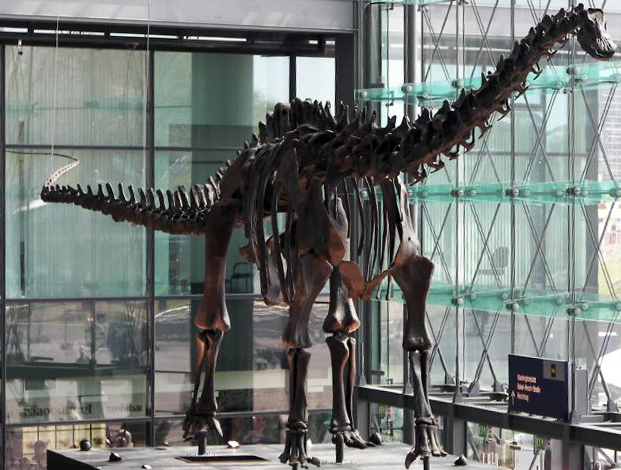


Mounted skeleton of Diplodocus carnegii at the Museo de La Plata, Argentina — one of the ten plaster casts sent by Andrew Carnegie between 1905 and 1913. The specimen is 25.6 meters long.
Javier Conles, CC BY-SA 3.0
Ecology and behavior
Habitat
Diplodocus carnegii inhabited the semiarid plains of the Morrison Formation 154–152 Ma ago, in what is now Colorado, Wyoming, Utah, and Montana. The paleoclimate was semiarid with a pronounced dry season — analogous to the modern Paraguayan Chaco — with estimated mean annual temperature of 20–25°C. Vegetation was dominated by conifers (araucarias, cypress), ferns, horsetails, and cycads, without true grasses but with low-growing ground plants. The Morrison ecosystem was one of the richest in Jurassic megafauna: Allosaurus fragilis (apex predator), Stegosaurus armatus, Camarasaurus lentus, Apatosaurus louisae, Brachiosaurus altithorax, Ornitholestes hermanni, and Ceratosaurus nasicornis shared the same environment.
Feeding
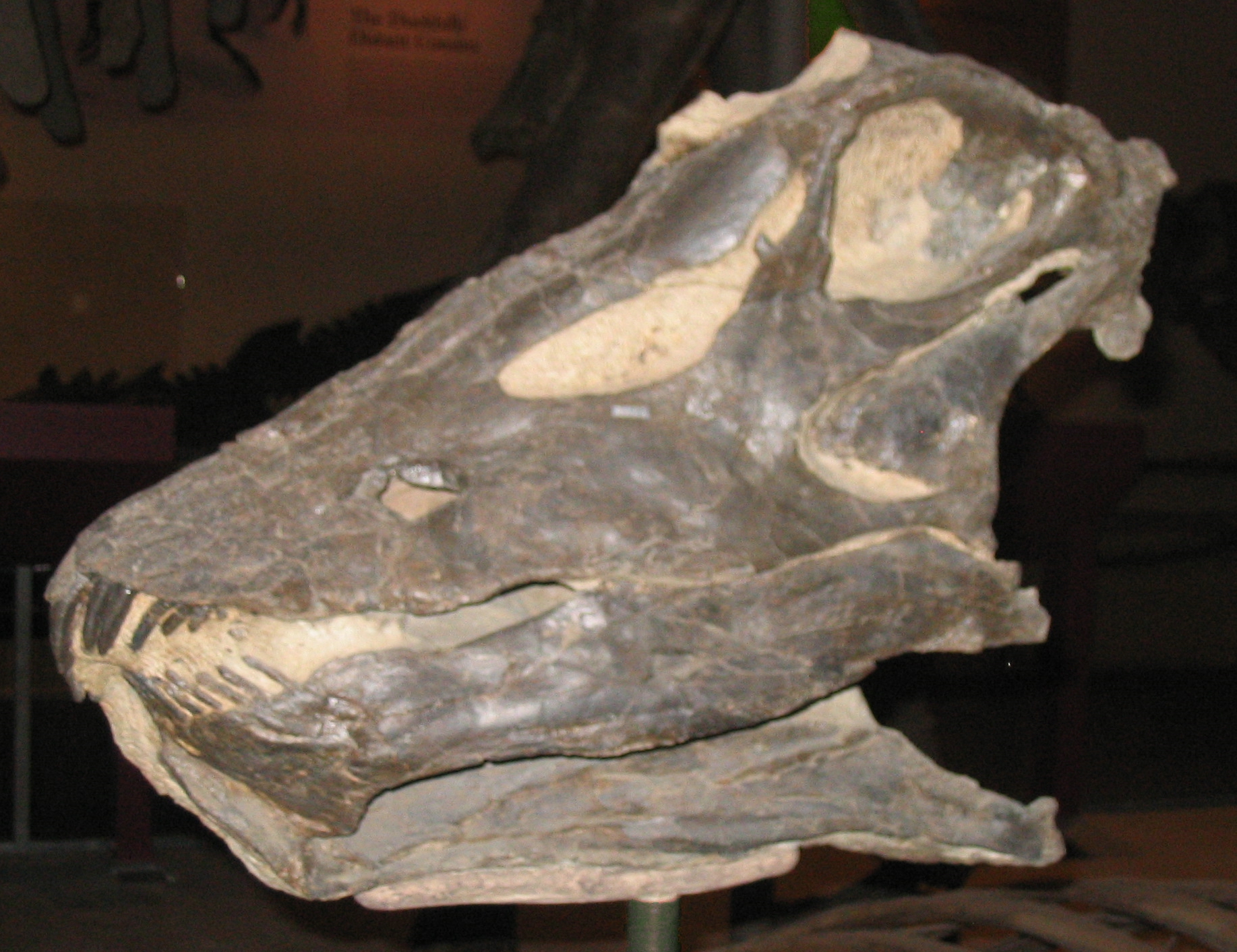
Based on studies by Stevens & Parrish (1999) and Button et al. (2014), Diplodocus carnegii was a ground-level grazer, sweeping low vegetation with the long neck extended horizontally. The peg-like teeth, confined to the front of the jaw, were specialized for stripping and gathering low plants, not for chewing: food was swallowed whole and digestion occurred in fermentation chambers in the gastrointestinal tract. FEA analysis of the skull revealed low bite force, incompatible with tough vegetation. Dental wear studies suggest ground-level feeding, consistent with the horizontal posture. The absence of molar teeth implies Diplodocus could ingest enormous volumes of vegetation daily, necessary to sustain 15 tonnes of elevated metabolism.
Behavior and senses
The social behavior of Diplodocus carnegii is inferred mainly by analogy with large modern herbivores and indirect fossil record evidence. The occurrence of multiple specimens of different ages at the same fossil site (such as Bone Cabin Quarry 9) suggests possible gregarious behavior. Ontogeny studies (Woodruff et al., 2018) indicate juveniles and adults exploited distinct food resources, reducing intraspecific competition. The long tail may have served as a social signaling instrument or defense, potentially capable of producing supersonic sounds (Myhrvold & Currie, 1997). Allosaurus bite marks on Diplodocus bones from the Morrison confirm it was frequent prey of the ecosystem's largest predator.
Physiology and growth
Bone histology of Diplodocus carnegii and close relatives reveals broad zones of fibrolamellar bone, characteristic of rapid growth and elevated metabolism similar to modern mammals and birds. Specimen CM 94 was an adult with a maximum age of 34 years at death, suggesting D. carnegii reached its maximum size of ~26 m in 24–34 years (Woodruff et al., 2024). Elevated metabolism imposed enormous caloric demands: estimates indicate an adult Diplodocus would need 100–200 kg of vegetation per day. The bird-like air sac respiratory system increased oxygen extraction efficiency and allowed body cooling — crucial for a 15-tonne animal in a hot semiarid climate. Thermoregulation was probably aided by the large body surface area of the tail and neck.
Paleogeography
Continental configuration

Ron Blakey · CC BY 3.0 · Jurassic, ~90 Ma
During the Kimmeridgiano-Titoniano (~154–152 Ma), Diplodocus carnegii inhabited the fragmenting Pangea. North America and Europe were still close, and the North Atlantic was just beginning to open. Climate was warm and humid globally, with no polar ice caps.
Inventário de Ossos
The holotype CM 84 preserves approximately 60% of the skeleton, including 41 articulated vertebrae from the neck to the tail, 18 ribs, partial pelvis, right scapulocoracoid, and right femur. The mounted specimen in Pittsburgh combines CM 84 with material from CM 94 and CM 307, plus casts from other specimens. The resulting reconstruction represents Diplodocus carnegii with high anatomical fidelity.
Found elements
Inferred elements
Scientific Literature
15 papers in chronological order — from the original description to recent research.
Diplodocus (Marsh): Its osteology, taxonomy and probable habits, with a restoration of the skeleton
Hatcher, J.B. · Memoirs of the Carnegie Museum
The founding paper describing Diplodocus carnegii as a new species. John Bell Hatcher analyzes specimens CM 84 (holotype) and CM 94 (paratype) collected at Sheep Creek, Wyoming, in 1899–1900, during expeditions funded by Andrew Carnegie. The work provides a bone-by-bone description of the entire preserved skeleton, covering the skull, cervical, dorsal, sacral, and caudal vertebrae, pectoral girdle, fore and hind limbs, and pelvis. Hatcher compares the species with Diplodocus longus Marsh (1878) and concludes the Albany County material represents a distinct species. He presents the first skeletal restoration and proposes a quadrupedal posture with a partially dragging tail — a view revised decades later. This paper is the mandatory starting point for any study of the species and remains the primary reference for D. carnegii anatomy.

The osteology of Diplodocus Marsh with special reference to the restoration of the skeleton of Diplodocus carnegiei Hatcher
Holland, W.J. · Memoirs of the Carnegie Museum
Osteological monograph complementing Hatcher's 1901 founding work, with William J. Holland deepening the analysis of the skull and other skeletal elements of Diplodocus carnegii. Holland focuses particularly on the position of the neck and tail in the museum mount — a debate that would continue for over a century. The work includes comparison with other Morrison Formation sauropods and clarifies issues about cervical vertebra articulation. Holland argues the neck was held approximately horizontally, a position that would prove closer to correct than the vertical stance some contemporaries proposed. The paper consolidates the cranial anatomy of D. carnegii and served as the basis for the casts sent to European museums between 1905 and 1913.
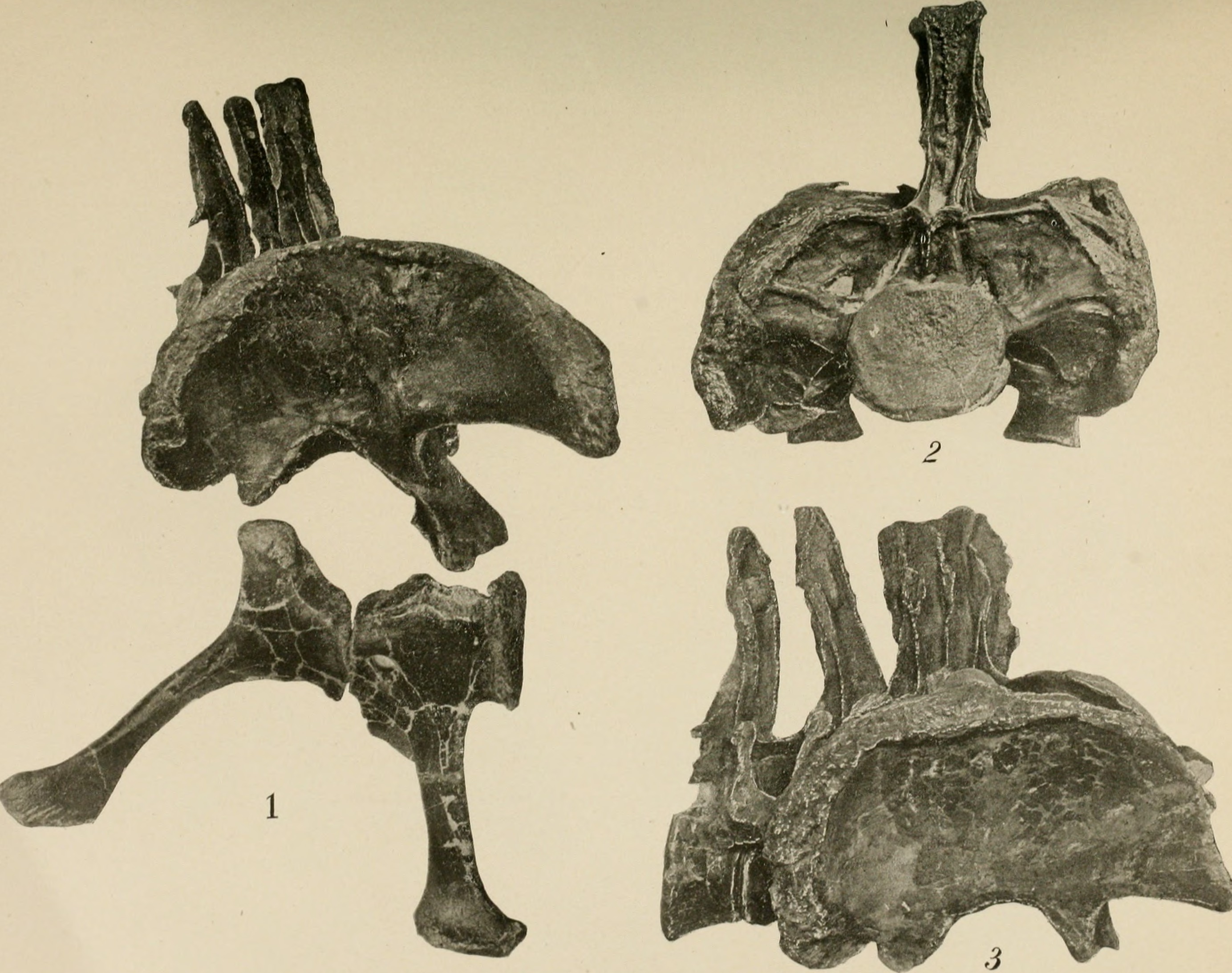
On a newly mounted skeleton of Diplodocus in the United States National Museum
Gilmore, C.W. · Proceedings of the United States National Museum
Charles W. Gilmore describes the mounting of specimen USNM 10865 at the United States National Museum (now the Smithsonian), one of the most complete Diplodocus specimens beyond the Carnegie material. The work provides detailed comparative data on proportions and anatomy relative to the Carnegie specimens, allowing evaluation of intraspecific variation. Gilmore discusses the tail and neck posture in the mount, contributing to the debate about the animal's natural stance. The paper includes precise measurements of each preserved skeletal element and comparative analysis with other diplodocids. This work established Diplodocus as one of the best-documented sauropods in the world, with data from multiple specimens complementing the holotype CM 84 anatomy.
The phylogenetic relationships of sauropod dinosaurs
Upchurch, P. · Zoological Journal of the Linnean Society
Seminal cladistic analysis by Paul Upchurch using 205 osteological characters for 26 sauropod taxa. The work places Diplodocoidea as the sister group of Macronaria within Neosauropoda. Diplodocidae is recovered as a monophyletic group, with Diplodocus and Barosaurus forming subfamily Diplodocinae. The study consolidates the phylogenetic position of Diplodocus carnegii within the dinosaur tree and identifies the diagnostic characters uniting diplodocids. Published in the Zoological Journal of the Linnean Society, this analysis became the mandatory reference for all subsequent sauropod phylogenetic analyses and established the framework still guiding modern sauropod classification.

Longbone histology of the Tendaguru sauropods: implications for growth and biology
Sander, P.M. · Paleobiology
Martin Sander analyzes bone histology of Tendaguru sauropods and comparative material including Diplodocus, revealing very rapid growth rates. Long bones show broad zones of fibrolamellar bone, typical of fast-growing endotherms like mammals rather than the slowly deposited lamellar bone of reptiles. Results imply that Diplodocus and other sauropods had elevated metabolism and grew continuously throughout life. The work concludes that sauropods reached sexual maturity before attaining maximum size, likely within two decades, and continued growing until death. This research transformed the view of sauropods from slow, cold-blooded animals to high-physiology organisms, paving the way for subsequent studies of D. carnegii biology.

Supersonic sauropods? Tail dynamics in the diplodocids
Myhrvold, N.P. & Currie, P.J. · Paleobiology
Nathan Myhrvold and Philip Currie use computational modeling of the tail of Apatosaurus louisae, a close relative of Diplodocus carnegii, to show that the distal tail could reach supersonic velocities, generating a crack like a bullwhip. Diplodocid tails had up to 70–80 caudal vertebrae and exceeded 10 meters in length, with progressive reduction in mass from base to tip. The model suggests this geometry allows the tail tip to exceed the speed of sound, producing a crack that could function in defense, intraspecific communication, rivalry, or courtship. The work sparked intense scientific debate: subsequent studies questioned whether biological tail tissues could withstand the required stresses, but the sonic whip hypothesis remains one of the most stimulating speculations in paleontological biomechanics.
Neck posture and feeding habits of two Jurassic sauropod dinosaurs
Stevens, K.A. & Parrish, J.M. · Science
Kent Stevens and Michael Parrish build three-dimensional digital models of the cervical vertebrae of Diplodocus carnegii and Apatosaurus louisae to determine neutral neck posture. Results show that Diplodocus's neutral posture was approximately horizontal or slightly declined, with the head near ground level, contradicting the earlier view of a vertically raised neck. This suggests Diplodocus was a ground-level feeder, sweeping low vegetation with the long neck extended horizontally like a broom rather than browsing high canopy as previously assumed. The study generated immediate controversy and opened a debate on sauropod neck posture that persists today, with works such as Taylor (2014) revising the role of intervertebral cartilage in correcting the estimates.


Biology of the sauropod dinosaurs: the evolution of gigantism
Sander, P.M. et al. · Biological Reviews
Comprehensive review by P. Martin Sander and sixteen co-authors integrating bone histology, biomechanics, ecology, and reproductive biology to explain the evolution of gigantism in sauropods, including Diplodocus carnegii. The work shows that several unique adaptations enabled sauropod gigantism: large eggs producing relatively large hatchlings, continuous lifelong growth, a bird-like air sac respiratory system (highly efficient), and simple peg-like teeth allowing massive ingestion without the cost of chewing. Body mass estimates for D. carnegii range from 4,000 to 15,200 kg depending on method, with a central value around 10,000–15,000 kg. This paper is considered the most complete reference on sauropod biology and cites D. carnegii extensively as a case study.

Cranial biomechanics underpins high sauropod diversity in resource-poor environments
Button, D.J., Rayfield, E.J. & Barrett, P.M. · Proceedings of the Royal Society B: Biological Sciences
David Button, Emily Rayfield, and Paul Barrett apply finite element analysis (FEA) to the skulls of Diplodocus carnegii and Camarasaurus lentus to compare their cranial biomechanics. The D. carnegii skull was CT-scanned (specimen CMNH 11161) and computationally modeled to simulate stresses during biting. Results show that Diplodocus had relatively low bite force, compatible with feeding on soft vegetation (grasses, low ferns) at ground level, while Camarasaurus could process harder vegetation. This divergent specialization explains how both species coexisted in the Morrison Formation without directly competing for the same resources. The study demonstrates that the high sauropod diversity of the Morrison was sustained by dietary niche partitioning driven by differences in cranial anatomy.


Quantifying the effect of intervertebral cartilage on neutral posture in the necks of sauropod dinosaurs
Taylor, M.P. · PeerJ
Michael Taylor develops a mathematical formula to quantify the effect of intervertebral cartilage thickness on sauropod neck posture, applying the method specifically to Diplodocus carnegii holotype CM 84. Results show that cartilage would add 8.4 to 33.3 degrees of extension to the neutral neck posture depending on assumed thickness — significantly more than Stevens & Parrish (1999) calculated from bone geometry alone. This implies the Diplodocus neck may have been held higher than bone models suggest. The paper represents a critical revision of sauropod postural reconstruction methodology and opens new avenues for research on the role of soft tissue in the cervical biomechanics of giant dinosaurs.

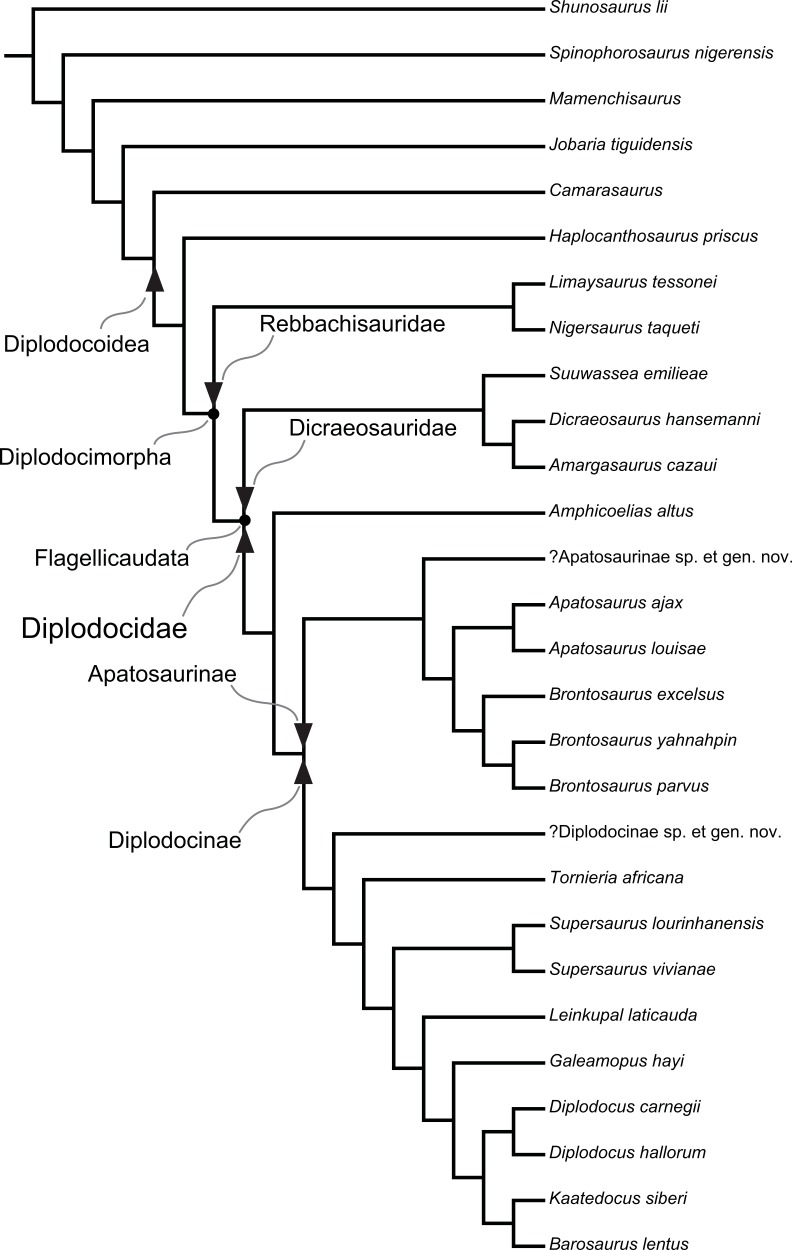
A specimen-level phylogenetic analysis and taxonomic revision of Diplodocidae (Dinosauria, Sauropoda)
Tschopp, E., Mateus, O. & Benson, R.B.J. · PeerJ
The broadest specimen-level phylogenetic analysis ever performed for Diplodocidae, with Emanuel Tschopp, Octávio Mateus, and Roger Benson scoring 81 operational taxonomic units (OTUs) for 477 morphological characters. The holotype CM 84 and cotype CM 94 of Diplodocus carnegii are extensively analyzed. The most impactful findings are the revalidation of Brontosaurus as a genus distinct from Apatosaurus (after 112 years of synonymy) and the creation of Galeamopus gen. nov. for Diplodocus hayi. Diplodocus carnegii is confirmed as the type species of the genus (replacing D. longus, whose holotype material was undiagnosable). The work redefines diplodocid taxonomy and establishes the precise position of D. carnegii in subfamily Diplodocinae.


Torsion and Bending in the Neck and Tail of Sauropod Dinosaurs and the Function of Cervical Ribs: Insights from Functional Morphology and Biomechanics
Preuschoft, H. & Klein, N. · PLOS ONE
Holger Preuschoft and Nicole Klein directly analyze specimens of Diplodocus carnegii (SMF R462, Naturmuseum Senckenberg, Frankfurt) and other sauropods to understand torsional and bending stresses in the neck and tail. The study reinterprets cervical ribs: rather than ventral support (traditional view), they were ossified scaleni muscle tendons controlling torsion — not bending. The analysis shows Diplodocus could move its neck laterally with more freedom than bone models suggested, thanks to short cervical ribs (unlike brachiosaurids, with long rigid cervical ribs). The work demonstrates that D. carnegii neck biomechanics was distinct from other sauropods, corroborating the dietary specialization proposed by Stevens & Parrish (1999) and Button et al. (2014).


The Smallest Diplodocid Skull Reveals Cranial Ontogeny and Growth-Related Dietary Changes in the Largest Dinosaurs
Woodruff, D.C., Carr, T.D., Storrs, G.W., Waskow, K., Scannella, J.B., Nordén, K.K. & Wilson, J.P. · Scientific Reports
D. Cary Woodruff and six co-authors describe the smallest diplodocid skull yet discovered, a cf. Diplodocus from Montana measuring only ~24 cm in length, revealing previously unknown aspects of cranial ontogeny. The juvenile skull shows morphology distinct from adults: narrow snout with posteriorly positioned spatulate teeth for bulk feeding, versus the widened snout and peg-like teeth restricted to the anterior mandible of adults, adapted for ground-level feeding. This difference indicates ontogenetic dietary partitioning: juvenile and adult Diplodocus exploited distinct microhabitats or food resources, reducing intraspecific competition. The work also cautions against naming new taxa based solely on juvenile diplodocid specimens.

The implications of a dry climate for the paleoecology of the fauna of the Upper Jurassic Morrison Formation
Engelmann, G.F., Chure, D.J. & Fiorillo, A.R. · Sedimentary Geology
George Engelmann, Daniel Chure, and Anthony Fiorillo review sedimentological and paleontological data to conclude that the Morrison Formation paleoclimate was semiarid with a pronounced dry season. This climate implies feast-famine cycles for Morrison fauna including Diplodocus carnegii. During dry periods, the low vegetation that Diplodocus grazed would become scarce, possibly forcing seasonal migrations or alternating feeding strategies. The work discusses how sauropod gigantism may have been an advantageous adaptation in seasonally arid environments: larger animals have lower relative metabolic rates and tolerate longer periods of food scarcity. The paper contextualizes the ecology of D. carnegii in an environment very different from the lush tropical forests with which the genus is often associated.


A review and reappraisal of the specific gravities of present and past multicellular organisms, with an emphasis on tetrapods
Larramendi, A. · The Anatomical Record
Asier Larramendi publishes a comprehensive review of the specific gravity of multicellular organisms with emphasis on extinct tetrapods, including a detailed 3D musculoskeletal reconstruction of Diplodocus carnegii. The three-dimensional reconstruction of D. carnegii's skeleton enabled calculation of body volume and, combined with tissue density estimates (bone, muscle, viscera, air in air sacs), produced the most anatomically rigorous body mass estimate ever published for the species. The work accounts for the extensive pneumatization of Diplodocus's axial skeleton, which significantly reduces average body density compared to a simple solid model. The results revise previous body mass estimates and establish fundamental physiological parameters for D. carnegii. This paper is the basis for EoFauna's three-dimensional model released in 2022.


Espécimes famosos em museus
CM 84 (holótipo) — 'Dippy'
Carnegie Museum of Natural History, Pittsburgh
The holotype of Diplodocus carnegii, collected at Sheep Creek, Albany County, Wyoming, in 1899. The mounted skeleton in Pittsburgh combines CM 84 with material from CM 94 and CM 307, resulting in a ~26 m long mount on display since 1907. It is the original specimen from which the ten plaster casts were made and sent to museums worldwide by Andrew Carnegie between 1905 and 1913.
Dippy (cópia do NHM, London)
Natural History Museum, Londres (originalmente)
The most famous plaster cast of Diplodocus carnegii, displayed in the entrance hall of the Natural History Museum in London from 1905 to 2017, when it was replaced by the blue whale skeleton Hope. The 25.6 m specimen became the cultural symbol of the museum and of British paleontology, appearing in films, stamps, and popular iconography. In 2018, Dippy began a tour of UK museums and returned to the NHM in 2023.
In cinema and popular culture
Few dinosaurs have left as deep a mark on popular culture as Diplodocus carnegii, and not through horror or adventure cinema, but through the quiet power of a museum skeleton. Dippy's presence in the entrance hall of the Natural History Museum in London from 1905 to 2017 shaped generations of British people and tourists worldwide, making Diplodocus the face of paleontology for millions. The skeleton appeared in films such as One of Our Dinosaurs Is Missing (1975, Disney), where the enormous fossil served as a hiding place for a spy microfilm. The documentary series Walking with Dinosaurs (BBC, 1999) brought Diplodocus to life on television for the first time with convincing special effects, and the episode Time of the Titans, centered on the life of a female Diplodocus in Jurassic Colorado, became one of the most-watched paleontological documentaries of all time. In 2017, the documentary Horizon: Dippy and the Whale (BBC Two), narrated by David Attenborough, emotionally documented Dippy's removal from the NHM, revealing the public's deep affection for the skeleton. In 2023, the series Life on Our Planet (Netflix) presented a photorealistic CGI herd of Diplodocus being attacked by Allosaurus during a nocturnal storm, a depiction aligned with current scientific consensus. Carnegie's dinosaur diplomacy transformed a Jurassic animal into a scientific ambassador of the twentieth century.

Classificação
Descoberta
Curiosidade
Andrew Carnegie was so captivated by Diplodocus carnegii that he paid to send plaster cast copies of the skeleton to ten museums worldwide — including gifts to King Edward VII of England, Tsar Nicholas II of Russia, and Kaiser Wilhelm II of Germany. As a result, Diplodocus carnegii is probably the most-viewed dinosaur skeleton in history.