
Futalognkosaurus
Futalognkosaurus dukei
"Giant chief lizard (from the Mapuche language)"
Sobre esta espécie
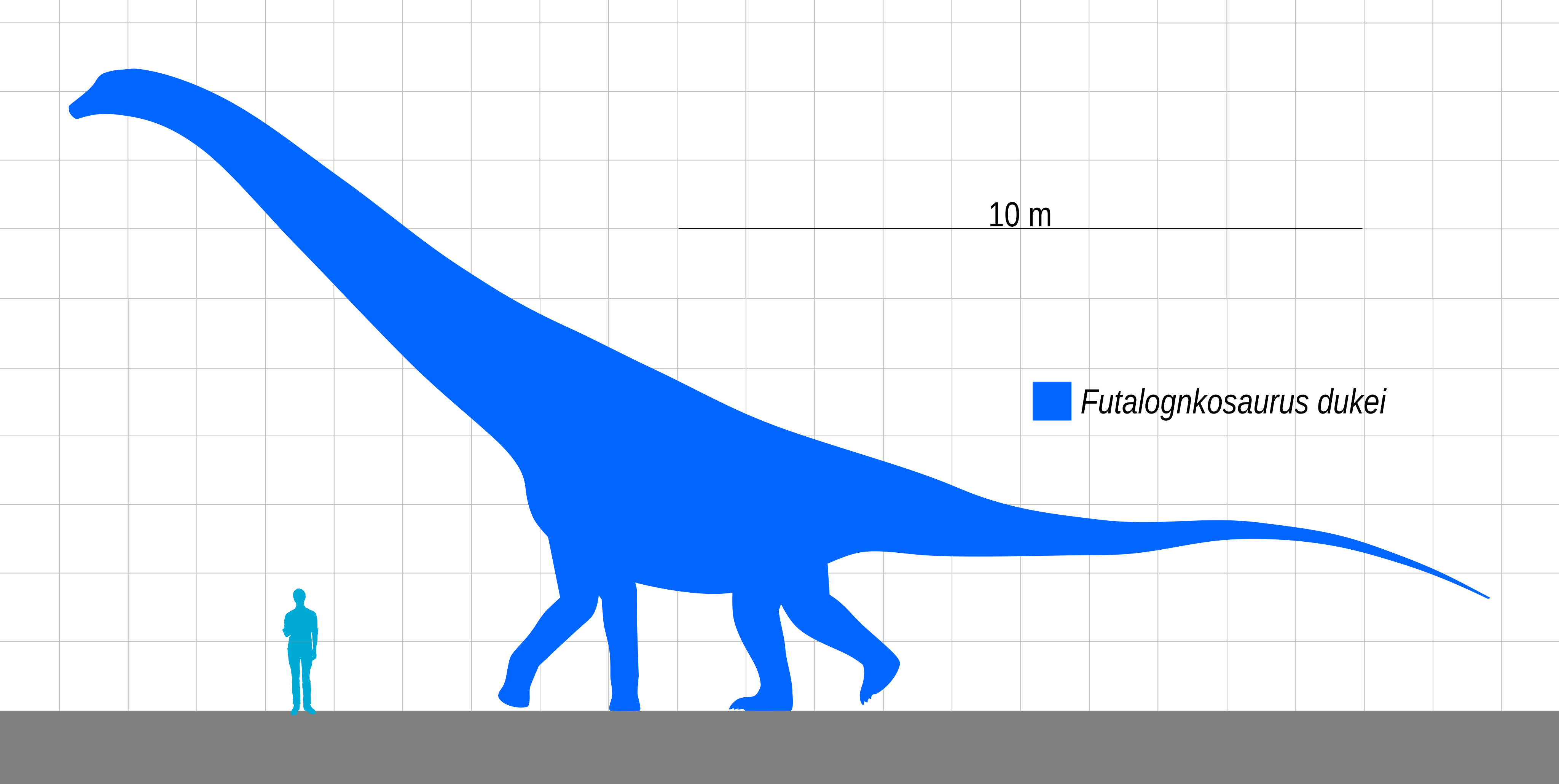
Futalognkosaurus dukei is one of the most complete titanosaurs ever discovered, with approximately 70% of the skeleton preserved across three specimens. Found in 2000 on the shores of Lake Barreales in Neuquén, Argentine Patagonia, it was formally described in 2007 by Calvo, Porfiri, González-Riga, and Kellner. With length estimates ranging from 24 to 30 meters, it belonged to the clade Lognkosauria, a group of giant titanosaurs that also includes Mendozasaurus and possibly Argentinosaurus. Its cervical vertebrae with extraordinarily tall neural spines, exceeding one meter, distinguish it from other sauropods and suggest unique adaptations for neck muscle support.
Geological formation & environment
The Portezuelo Formation is part of the Neuquén Group and represents fluvial deposits from the Turonian-Coniacian (Late Cretaceous, approximately 90-86 Ma) in the provinces of Neuquén, Río Negro, and Mendoza in Argentina. Lithologically, it consists of yellowish sandstones with intercalated red and green shales, deposited in a meandering fluvial system with floodplains and developed paleosols. Lake Barreales, where CEPALB is located, exposes the upper section of the Portezuelo Formation, preserving with extraordinary richness a complete Late Cretaceous biota, including Futalognkosaurus, Megaraptor, Unenlagia, crocodylomorphs, pterosaurs, and a flora dominated by angiosperms.
Image gallery
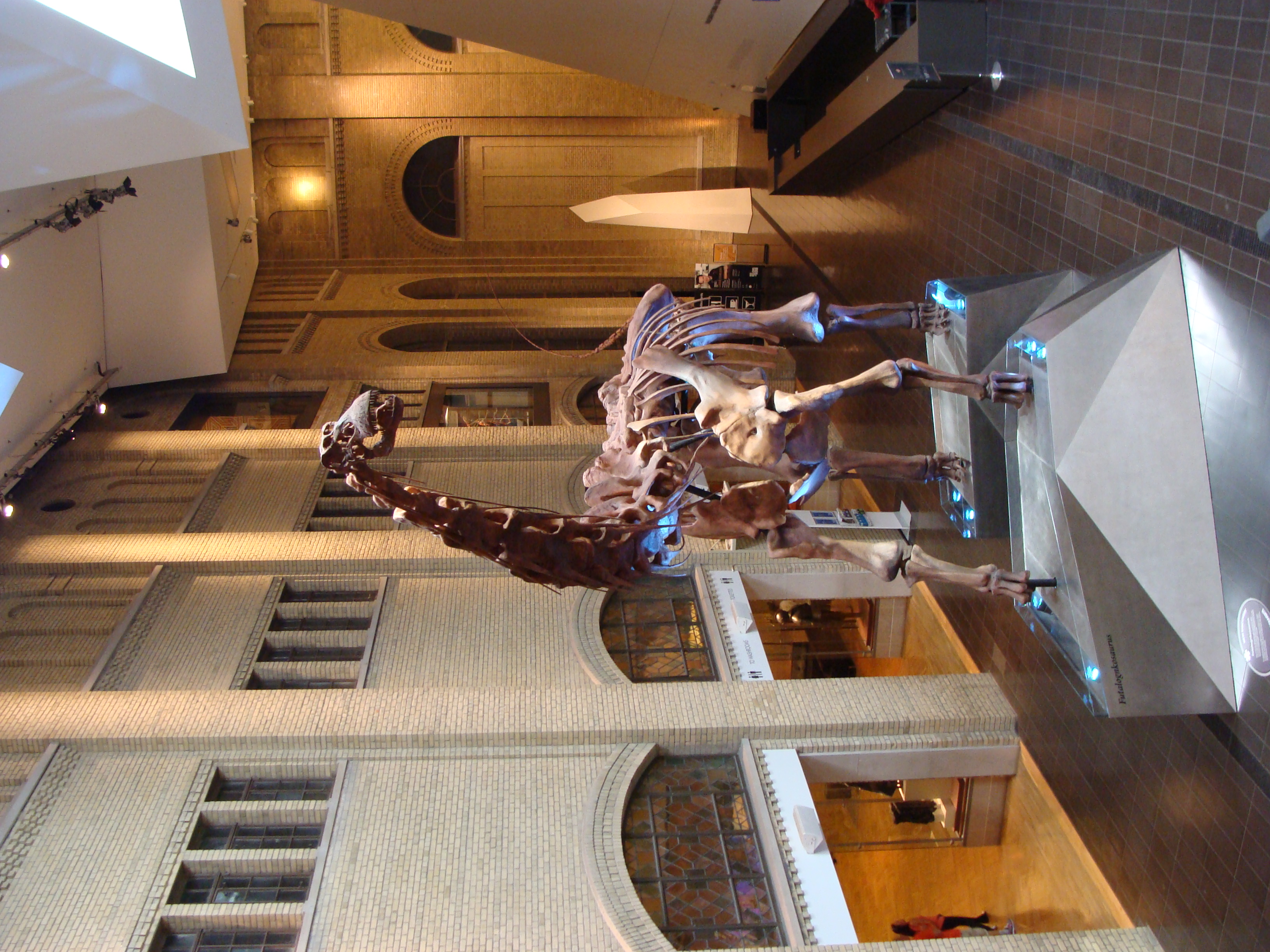





Mounted skeleton of Futalognkosaurus dukei on display at the Royal Ontario Museum, Toronto, Canada. The replica stretches across nearly the entire entrance atrium of the museum.
Esv, CC BY-SA 3.0, Wikimedia Commons
Ecology and behavior
Habitat
Futalognkosaurus lived in tropical to subtropical fluvial plains of Gondwana, dominated by angiosperm forests with lush vegetation along the shores of Lake Barreales and associated rivers in what is now Argentine Patagonia. The paleoenvironment of the Portezuelo Formation was a meandering system with river channels, floodplains, and crevasse deposits. The climate was warm and humid, with marked seasonal cycles. It coexisted with Megaraptor, Unenlagia, iguanodonts, crocodylomorphs, pterosaurs, turtles, and fish, in a diverse and abundant fauna.
Feeding
As a giant titanosaur, Futalognkosaurus was a highly efficient herbivore, consuming large amounts of vegetation to sustain its estimated body mass of 40 to 50 tonnes. The exceptionally tall neural spines of the cervical vertebrae suggest powerful musculature for neck support, possibly adapted for both ground-level grazing and reaching elevated foliage. The presence of angiosperms in the site's flora indicates these flowering plants constituted an important part of the diet. The animal processed food in the digestive system without chewing, possibly using gastroliths (stomach stones) to grind ingested vegetation.
Behavior and senses
Futalognkosaurus was likely gregarious, a behavior inferred from the discovery of multiple specimens in the same stratigraphic horizon at Los Barreales. The presence of three specimens of different sizes at the same site suggests possible herding behavior or at least intraspecific tolerance. Being one of the largest terrestrial animals in its ecosystem, mature adults likely had few natural predators beyond Megaraptor, which coexisted at the same site. Titanosaur trackways discovered at CEPALB may provide additional evidence about group movement patterns.
Physiology and growth
As a titanosaur, Futalognkosaurus likely had elevated metabolism compared to ectothermic reptiles, evidenced by the rapid growth inferred in related titanosaurs like Dreadnoughtus. The exceptionally tall neural spines of the cervical vertebrae, reaching more than one meter, may have functioned as thermoregulators, increasing surface area for heat dissipation. The massiveness of the pelvic girdle, with ilia nearly 3 meters wide, reflects the biomechanical adaptations needed to support the enormous body weight. Growth to reach this size likely took decades, similar to that observed in other giant titanosaurs.
Paleogeography
Continental configuration

Ron Blakey · CC BY 3.0 · Cretáceous, ~90 Ma
During the Coniaciano (~90–86 Ma), Futalognkosaurus dukei inhabited Laramidia, the western half of present-day North America, separated from the east by the Western Interior Seaway, a shallow sea dividing the continent. The continents were in very different positions: India was drifting toward Asia, Antarctica was still connected to Australia, and South America was an isolated island.
Inventário de Ossos
Based on three specimens (MUCPv-323, MUCPv-324, and MUCPv-325), the material includes 14 complete cervical vertebrae, 10 dorsal vertebrae, the sacrum, the first caudal vertebra, dorsal ribs, both ilia, and the right pubis and ischium. The skull, tail, and limbs are absent or fragmentary, making it simultaneously the most complete giant titanosaur and still partially incomplete.
Found elements
Inferred elements
Scientific Literature
15 papers in chronological order — from the original description to recent research.
A new Cretaceous terrestrial ecosystem from Gondwana with the description of a new sauropod dinosaur
Calvo, J.O., Porfiri, J.D., González-Riga, B.J. e Kellner, A.W.A. · Anais da Academia Brasileira de Ciências
This founding paper describes the extraordinary Futalognko fossil site on the shores of Lake Barreales, Neuquén, Argentina. Within a layer of just 0.5 meters thick, researchers recovered more than 1,000 specimens representing an entire Late Cretaceous fauna and flora, including the holotype of the new giant titanosaur Futalognkosaurus dukei. Associated fauna includes Megaraptor, Unenlagia, iguanodonts, crocodylomorphs, pterosaurs, pleurodiran turtles, and fish. The flora is dominated by angiosperms. The paper establishes Futalognkosaurus within Lognkosauria and proposes an original length estimate of 32 to 34 meters, making it the most complete giant titanosaur known at the time.
Anatomy of Futalognkosaurus dukei Calvo, Porfiri, González Riga & Kellner, 2007 (Dinosauria, Titanosauridae) from the Neuquén Group (Late Cretaceous), Patagonia, Argentina
Calvo, J.O., Porfiri, J.D., González-Riga, B.J. e Kellner, A.W.A. · Arquivos do Museu Nacional
This anatomical monograph details the osteology of the holotype MUCPv-323 and referred specimens of Futalognkosaurus dukei. It describes 14 cervical vertebrae with exceptionally tall neural spines, which in some positions exceed 1 meter in height, giving the neck a 'shark fin' appearance. The dorsal vertebrae display characteristic accessory laminae. The pelvic girdle is massive, with ilia reaching nearly 3 meters in width. The paper includes a revised formal diagnosis and a phylogenetic analysis that positions the taxon as a member of Lognkosauria, sister group to Mendozasaurus, with Malawisaurus as the more external outgroup.
Re-sizing giants: estimation of body length of Futalognkosaurus dukei and implications for giant titanosaurian sauropods
Calvo, J.O., Juárez Valieri, R.D. e Porfiri, J.D. · Congreso Latinoamericano de Paleontología de Vertebrados, Neuquén
This work critically revised the length estimates for Futalognkosaurus dukei, which had been announced in the original description as 32 to 34 meters. Using proportions inferred from the known segments, including the complete cervical sequence and dorsal vertebrae, the authors calculated a pre-caudal length of approximately 13 meters and estimated the tail as of similar length, resulting in a revised total length of about 26 meters. The paper has methodological implications for size estimation in giant titanosaurs with fragmentary material, demonstrating that size announcements made before formal publication often overestimate the animals.
Osteology of the Late Cretaceous Argentinean sauropod dinosaur Mendozasaurus neguyelap: implications for basal titanosaur relationships
González Riga, B.J., Mannion, P.D., Poropat, S.F., Ortiz David, L.D. e Coria, J.P. · Zoological Journal of the Linnean Society
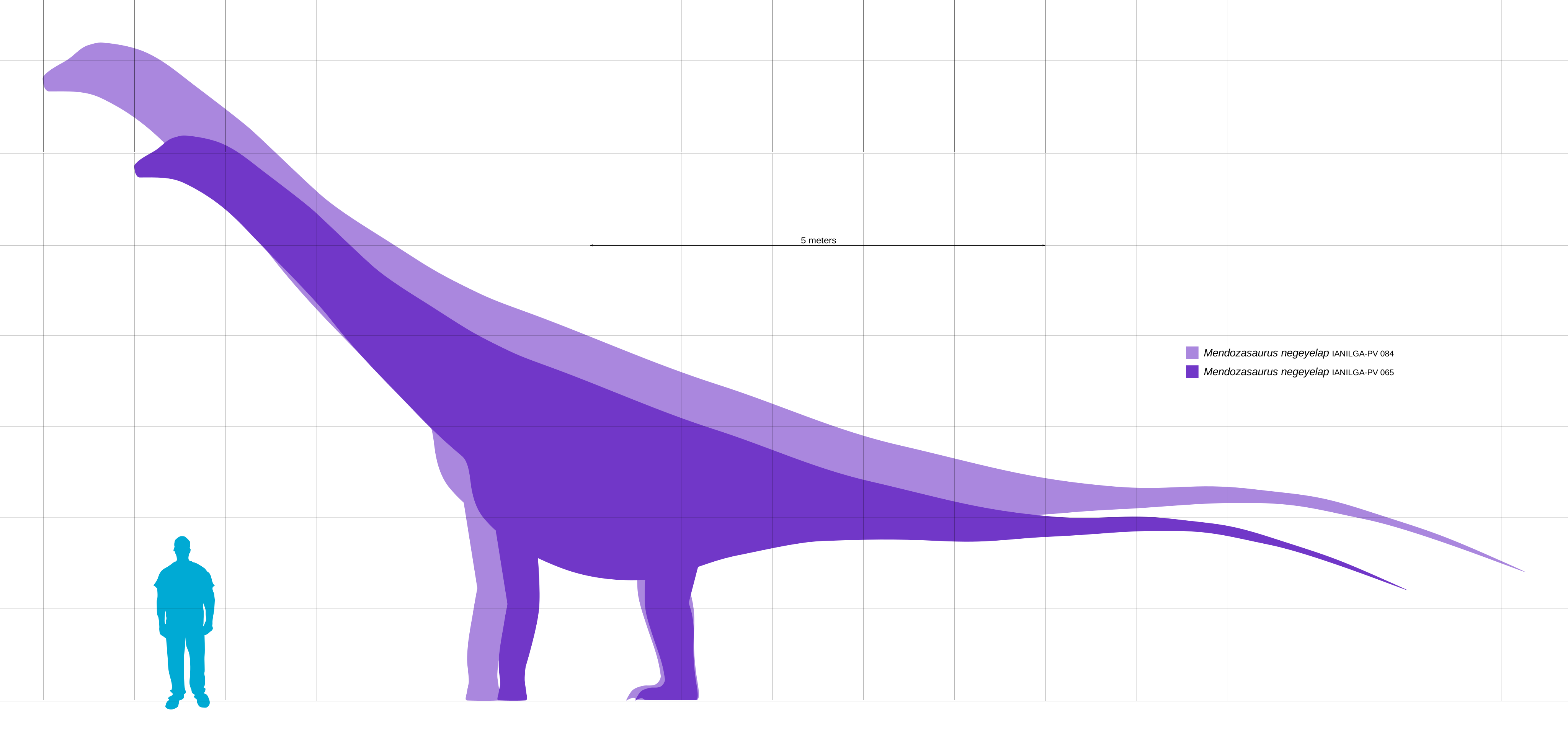
This monographic study redescrives the complete osteology of Mendozasaurus neguyelap, the closest relative of Futalognkosaurus within Lognkosauria. The most comprehensive phylogenetic analysis of Lognkosauria published through 2018 positions Mendozasaurus as the most basal member of the clade, with Futalognkosaurus forming a more derived group together with the giants Argentinosaurus, Notocolossus, Patagotitan, and Puertasaurus. The paper identifies exclusive anatomical synapomorphies of Lognkosauria, contributing to understanding how the largest sauropods in history evolved from a common ancestor in South America during the Late Cretaceous.
A New Giant Titanosauria (Dinosauria: Sauropoda) from the Late Cretaceous Bauru Group, Brazil
Bandeira, K.L.N., Simbras, F.M., Machado, E.B., Campos, D.A., Oliveira, G.R. e Kellner, A.W.A. · PLOS ONE
This PLOS ONE article describes Austroposeidon magnificus, the largest dinosaur known from Brazil, from the Late Cretaceous Bauru Group. The phylogenetic analysis conducted by the authors represents one of the largest titanosaur analyses ever published and recovers Austroposeidon as the sister group of Lognkosauria. Within Lognkosauria, Futalognkosaurus and Mendozasaurus are recovered as a basal clade, with the giants Argentinosaurus, Patagotitan, and Puertasaurus in more derived positions. The paper is essential for understanding the biogeography and evolutionary history of giant Gondwanan titanosaurs.

A new giant titanosaur sheds light on body mass evolution among sauropod dinosaurs
Carballido, J.L., Pol, D., Otero, A., Cerda, I.A., Salgado, L., Garrido, A.C., Ramezani, J., Cúneo, N.R. e Krause, J.M. · Proceedings of the Royal Society B
This paper describes Patagotitan mayorum, the largest land animal with a reliably estimable body mass (about 69 tonnes), from the Cerro Barcino Formation of Patagonia. The most comprehensive somphospondylan phylogenetic analysis published in 2017 recovers Patagotitan as a member of Lognkosauria, in a more derived position than Futalognkosaurus and Mendozasaurus, alongside Argentinosaurus. The study includes modeling of body mass evolution throughout titanosaur evolutionary history, demonstrating that extreme gigantism evolved multiple times independently and that Lognkosauria was the primary evolutionary laboratory for sauropod gigantism.

A Gigantic, Exceptionally Complete Titanosaurian Sauropod Dinosaur from Southern Patagonia, Argentina
Lacovara, K.J., Lamanna, M.C., Ibiricu, L.M., Poole, J.C., Schroeter, E.R., Ullmann, P.V., Voegele, K.K., Boles, Z.M., Carter, A.M., Cooper, E.K., Schein, J.P., Sertich, J.J.W., Gheerbrant, E. e Sereno, P.C. · Scientific Reports
This Scientific Reports paper describes Dreadnoughtus schrani, the most complete giant titanosaur then known, representing approximately 70% of the postcranial skeleton. Discovered in the Cerro Fortaleza Formation of southern Argentine Patagonia, Dreadnoughtus has an estimated mass of 65 tonnes and length of about 26 meters. Osteohistological analysis revealed the specimen was still in active growth at the time of death, suggesting mature individuals could be even larger. Dreadnoughtus and Futalognkosaurus share analogous gigantism strategies and come from nearby Cretaceous formations, making anatomical comparison between them fundamental for understanding the evolution of giant South American titanosaurs.

Sedimentary paleoenvironments of the upper section of Portezuelo Formation, Neuquen Group (Upper Cretaceous), Los Barreales, Neuquen Province
Sánchez, M.L., Calvo, J.O. e Heredia, S. · Revista de la Asociación Geológica Argentina
This sedimentological study characterizes the paleoenvironment of the upper section of the Portezuelo Formation at the Los Barreales site, where Futalognkosaurus dukei was discovered. The authors identify a sand-bed meandering fluvial system with variations between channels and floodplain deposits. The sedimentary facies indicate that the Futalognko site corresponds to a rapid and catastrophic deposition event, possibly a fluvial flood that quickly buried the biota. This paleoenvironmental context explains the exceptional preservation of more than 1,000 specimens in just 0.5 meters of thickness, including the remains of Futalognkosaurus and all associated fauna and flora.


Rinconsaurus caudamirus gen. et sp. nov., a new titanosaurid (Dinosauria, Sauropoda) from the Late Cretaceous of Patagonia, Argentina
Calvo, J.O. e González Riga, B.J. · Revista Geológica de Chile
This paper describes Rinconsaurus caudamirus, a medium-sized titanosaur from the Portezuelo Formation of Neuquén, the same geological formation that would produce Futalognkosaurus three years later. The study includes characterization of the Portezuelo Formation and a phylogenetic analysis of Patagonian titanosaurs. The work of Calvo and González Riga paved the understanding of sauropod faunas of the Portezuelo Formation, establishing a taxonomic context that would help in the phylogenetic interpretation of Futalognkosaurus when it was described in 2007. The two taxa coexisted in the same Late Cretaceous fluvial environment of Neuquén.


El género Aeolosaurus (Sauropoda, Titanosauridae) en la Formación Allen (Campaniano-Maastrichtiano) de la Provincia de Río Negro, Argentina
Salgado, L. e Coria, R.A. · Ameghiniana
This foundational work by Salgado and Coria on the titanosaur Aeolosaurus established the basis for phylogenetic systematics of South American titanosaurs. Understanding the relationships of Aeolosaurus with other titanosaurs, including taxa from the Portezuelo Formation such as Futalognkosaurus, was essential for the phylogenetic interpretation that would come to characterize Lognkosauria. The paper exemplifies the cladistic-based phylogeny methodology that would be applied to the description of Futalognkosaurus in 2007, and the authors would become central figures in Patagonian titanosaur paleontology.


A new titanosaur (Dinosauria, Sauropoda) from the Upper Cretaceous of Mendoza Province, Argentina
González Riga, B.J. · Ameghiniana
This work by González Riga describes Mendozasaurus neguyelap, the closest relative of Futalognkosaurus within Lognkosauria, from the Sierra Barrosa Formation of the Late Cretaceous of Mendoza, Argentina. The original description establishes Mendozasaurus as a large titanosaur with osteological features that would later be recognized as Lognkosauria synapomorphies. When Futalognkosaurus was described in 2007, Mendozasaurus was its only known close relative, and the relationship between the two taxa led Calvo et al. to formally define the clade Lognkosauria. González Riga's work was fundamental to understanding the evolution of Patagonian titanosaurs.


Dermal armor histology of Saltasaurus loricatus, an Upper Cretaceous sauropod dinosaur from Northwest Argentina
Cerda, I.A. e Powell, J.E. · Acta Palaeontologica Polonica
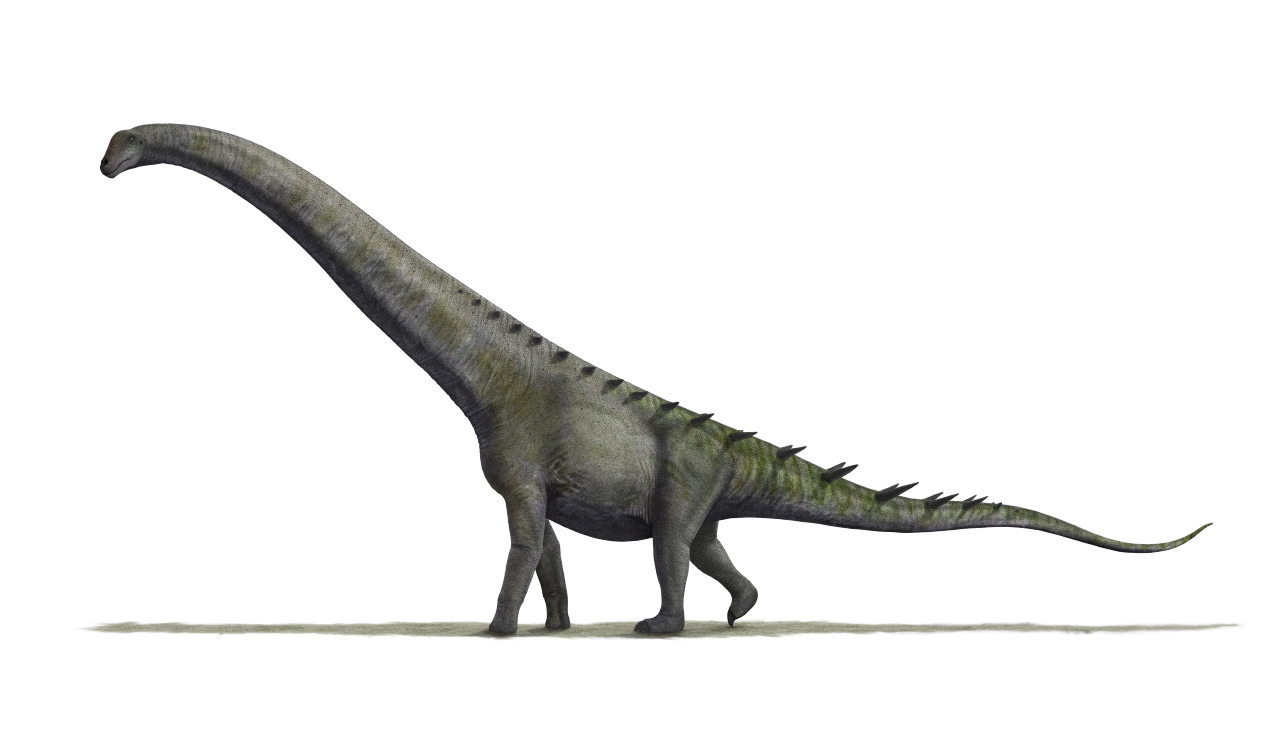
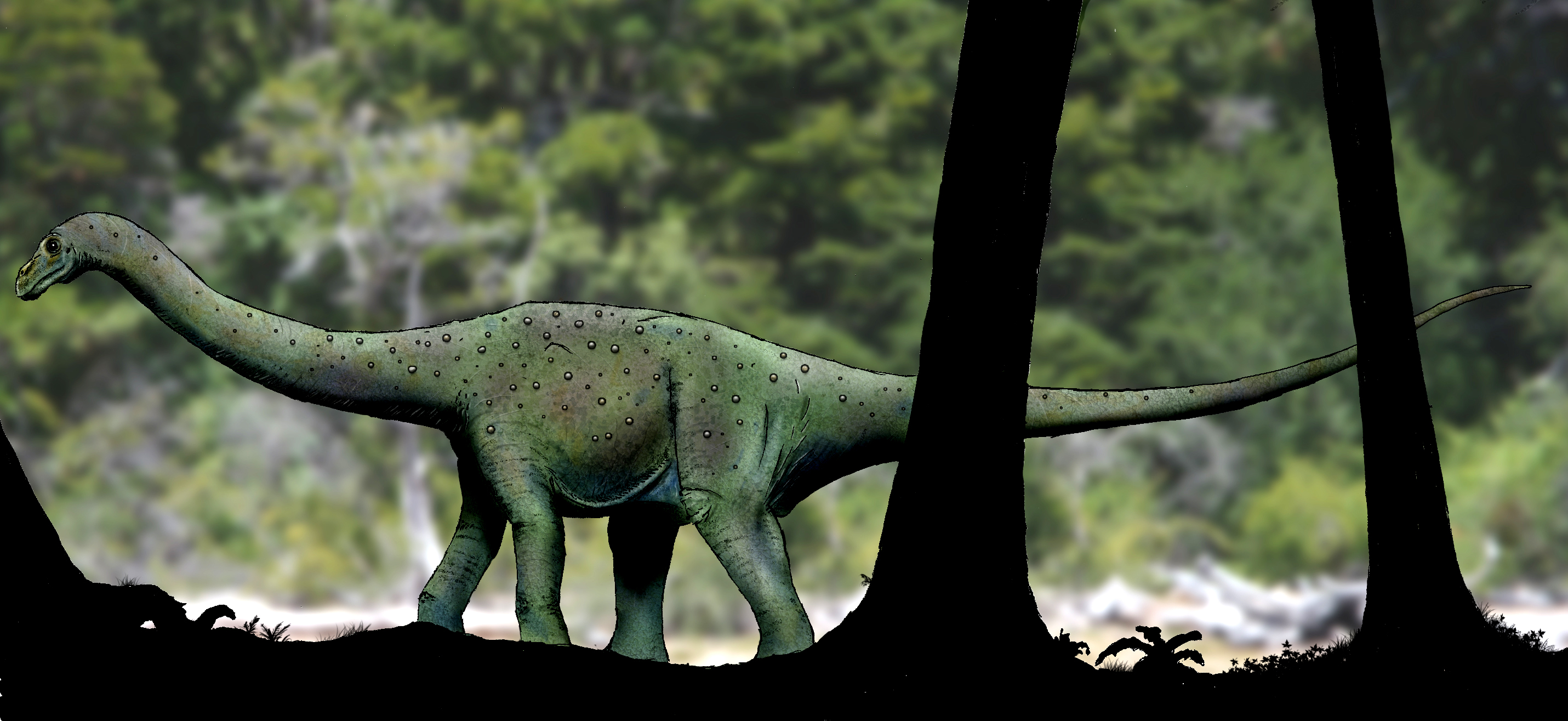
This study examines the histology of osteoderms (dermal armor) of Saltasaurus loricatus, a Late Cretaceous South American titanosaur. The osteoderms display spongy bone tissue with a vascularization pattern suggesting rapid growth, consistent with what is expected of animals reaching large dimensions. Although Futalognkosaurus is not known to have confirmed osteoderms, the authors of Nobu Tamura's reconstruction speculated the presence of similar structures based on relatives such as Mendozasaurus. Cerda and Powell's histological analysis provides the comparative framework for understanding the growth and biology of giant titanosaurs like Futalognkosaurus.


New sauropod from the Lower Cretaceous of Utah, USA
Tidwell, V., Carpenter, K. e Brooks, W. · Oryctos
This paper describes Venenosaurus dicrocei, a basal titanosaur from the Lower Cretaceous of the United States. Although geographically distant from Futalognkosaurus, the study is relevant for understanding the basal position of Titanosauria and the progressive evolution toward gigantism that would culminate in taxa like Futalognkosaurus in South America. The anatomical comparison between basal North American titanosaurs and derived South American giants evidences the evolutionary trends that led to taxa like Lognkosauria, the group to which Futalognkosaurus belongs. The paper establishes anatomical parameters useful for titanosaur phylogenetic analyses.

Panamericansaurus schroederi gen. nov. sp. nov. Un nuevo Sauropoda (Titanosauridae) del Cretácico Superior del Neuquén, Patagonia, Argentina
Calvo, J.O. e Porfiri, J.D. · Brazilian Geographical Journal
This work by Calvo and Porfiri, the same authors responsible for the description of Futalognkosaurus, describes Panamericansaurus schroederi, another Late Cretaceous titanosaur from Neuquén, Argentina. The study expands the picture of sauropod diversity in Patagonia and documents the richness of titanosaur fauna in the Neuquén region during the Late Cretaceous, the context in which Futalognkosaurus was the most gigantic member. The paper evidences that the Centro Paleontológico Lago Barreales and surroundings were a hotspot of sauropod diversity, with multiple species of different sizes coexisting in the same Coniacian fluvial paleoenvironment.

Morphological changes in sauropod osteoderms during the titanosaurian radiation
Cerda, I.A., Salgado, L. e Powell, J.E. · Naturwissenschaften
This paper examines the morphological and histological variation of osteoderms (dermal bony structures) throughout the evolutionary radiation of titanosaurs. The authors demonstrate that osteoderm morphology varies systematically among different titanosaur lineages and can provide relevant phylogenetic and ecological information. For Futalognkosaurus, a member of Lognkosauria, the absence of confirmed osteoderms may reflect secondary loss or simply lack of adequate preservation. The study contextualizes the biology of giant South American titanosaurs and their growth and defense strategies, contributing to understanding the biology of Futalognkosaurus.


Espécimes famosos em museus
MUCPv-323 (holótipo)
Museo Universidad Nacional del Comahue, Neuquén, Argentina
Holotype of Futalognkosaurus dukei, including 14 complete cervical vertebrae, 10 dorsals, sacrum, first caudal vertebra, ribs, both ilia, and the right pubis and ischium. It is the most complete known giant titanosaur, allowing the formal description of the new genus and species in 2007. The specimen is housed at the Universidad Nacional del Comahue, and a fiberglass cast is on permanent display at CEPALB.
Réplica em exposição
Royal Ontario Museum, Toronto, Canadá
The Royal Ontario Museum displays a complete resin replica of Futalognkosaurus dukei that stretches across nearly the entire entrance atrium of the museum, approximately 26 meters long. The replica is based on the original specimens MUCPv-323, MUCPv-324, and MUCPv-325, with gaps filled by bones from other related titanosaurs. The display is part of ROM's permanent exhibition of South American dinosaurs and is considered one of the most impressive in the world.
CEPALB (Centro Paleontológico Lago Barreales)
Centro Paleontológico Lago Barreales, Neuquén, Argentina
CEPALB is the open-air museum founded by Jorge Calvo on the shores of Lake Barreales where Futalognkosaurus was discovered. The center keeps the original excavation site accessible to the public, with interpretive panels and in-situ fossil replicas. Excavations are still ongoing at the site, which has already produced more than 1,000 specimens. CEPALB is the main research and exhibition center for Futalognkosaurus and the Late Cretaceous fauna of Neuquén.
In cinema and popular culture
Futalognkosaurus dukei has a modest presence in popular culture compared to its more famous relatives such as Argentinosaurus and Patagotitan. Since its description in 2007, the animal has gained growing recognition, appearing in the Canadian children's series Dino Dan and the popular online game Dinosaur Simulator on Roblox, demonstrating its growing appeal among dinosaur enthusiasts. In scientific television, Futalognkosaurus is frequently mentioned in the context of documentaries about the largest Patagonian dinosaurs, such as BBC's Planet Dinosaur (2011) and Attenborough and the Giant Dinosaur (2016), even without direct starring roles. Apple TV+'s Prehistoric Planet series used models based on giant Patagonian titanosaurs to depict Late Cretaceous environments, indirectly drawing on the accumulated knowledge about Futalognkosaurus. The animal still awaits its debut in a documentary dedicated exclusively to it, but its position as the most complete known giant titanosaur ensures it remains a fundamental scientific reference for any production addressing the giants of Patagonia.

Classificação
Descoberta
Curiosidade
Futalognkosaurus was named in honor of the company Duke Energy Argentina, which funded the excavations at Los Barreales: 'dukei' is a Latinization of 'Duke'. The genus name comes from the Mapuche language (native peoples of Patagonia): 'futa' means 'giant' and 'logkno' means 'chief' or 'leader'. So the animal is literally named 'giant chief lizard, in honor of Duke'.