Giganotosaurus
Giganotosaurus carolinii
"Giant southern lizard"
Sobre esta espécie
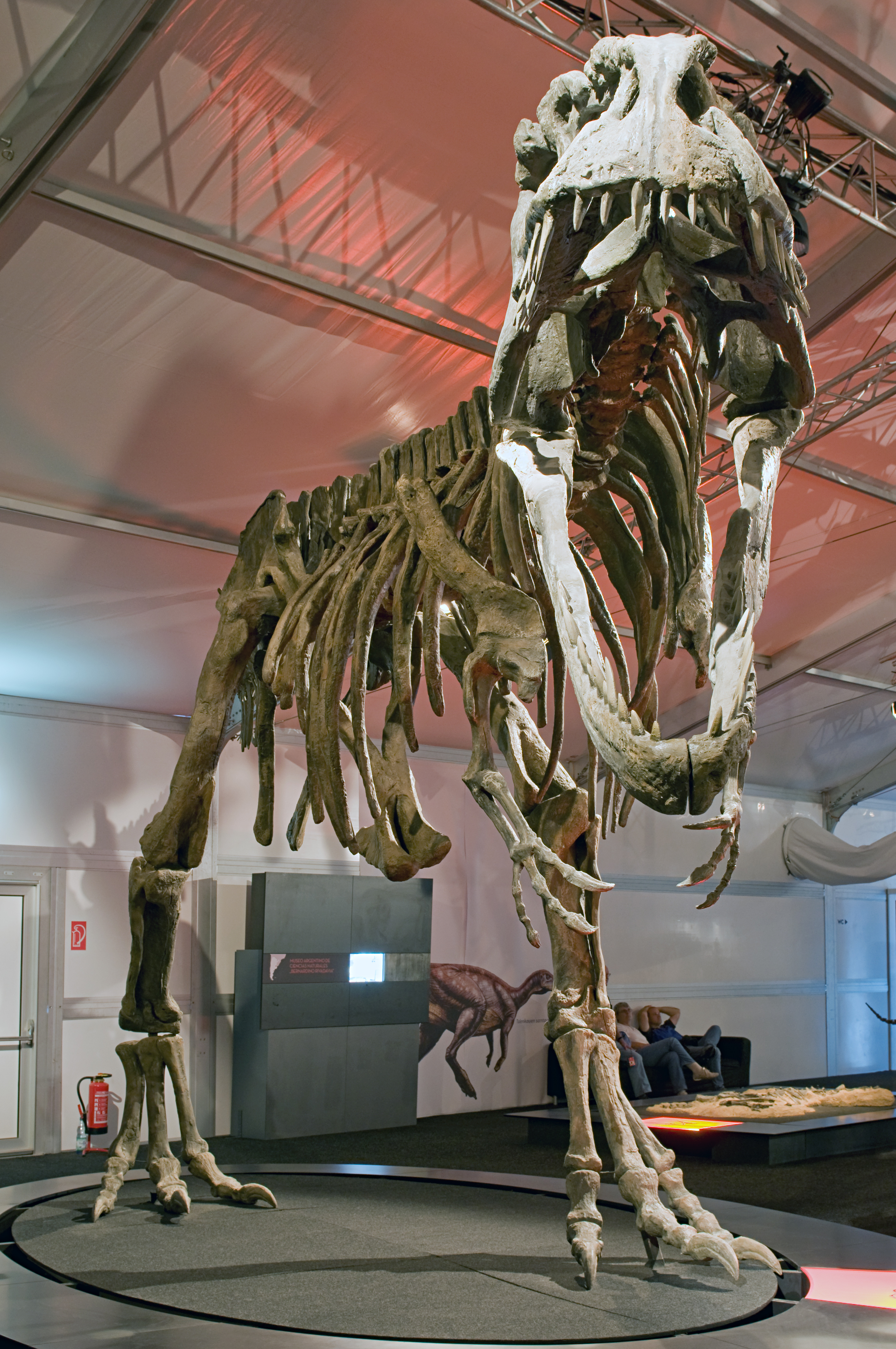
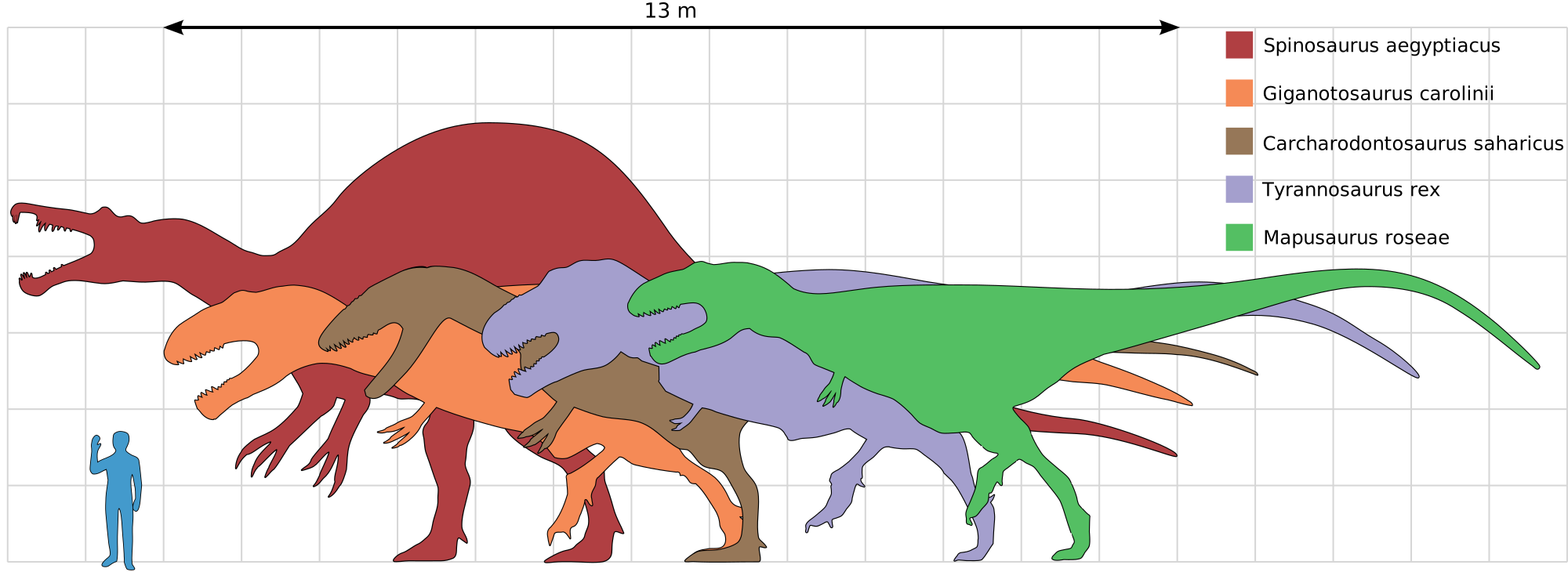
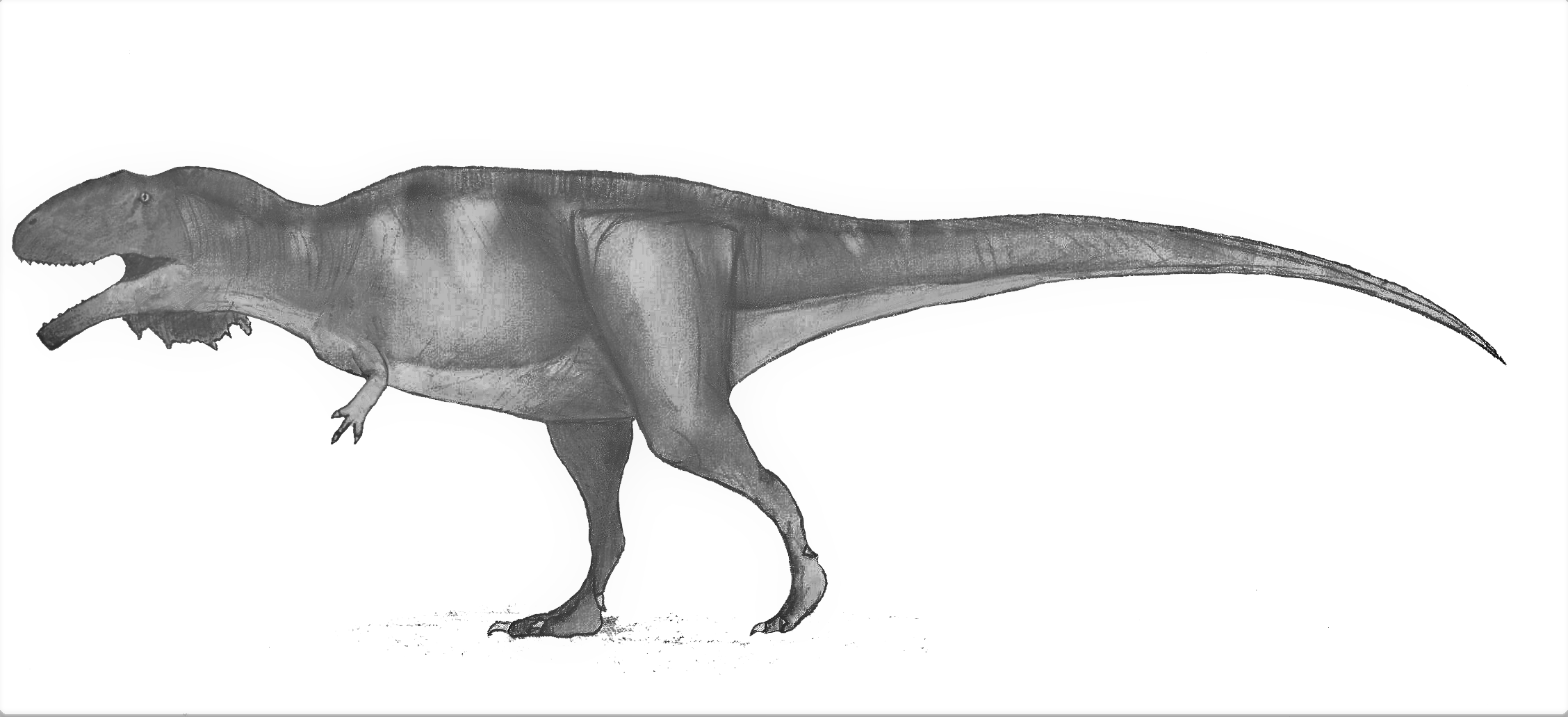
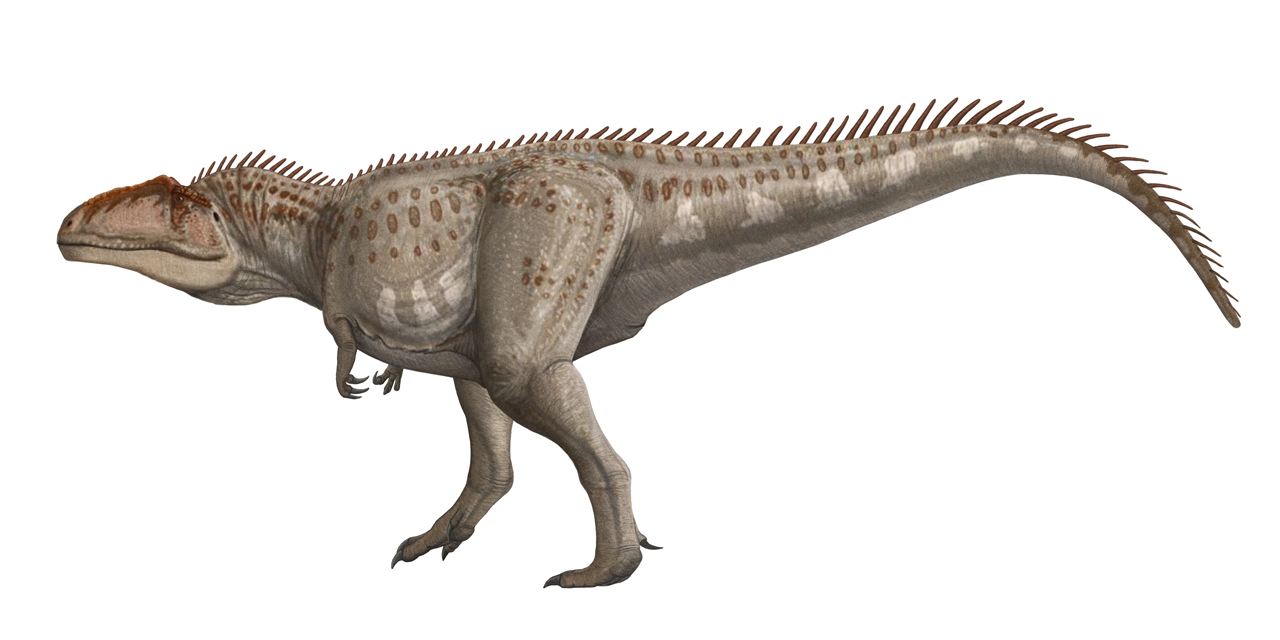
Giganotosaurus carolinii was one of the largest terrestrial predators ever known, with an estimated length of up to 13 meters and mass around 7 tonnes. Discovered in 1993 by Rubén Carolini in the Candeleros Formation of Neuquén, Argentina, and described by Coria and Salgado in 1995, it belongs to the family Carcharodontosauridae. Its skull measured 1.56 m, larger than that of T. rex, with serrated teeth resembling shark teeth. It lived during the Cenomanian (~99–95 Ma), sharing its ecosystem with giant titanosaurs like Andesaurus and Argentinosaurus. Isotope analysis of bones suggests an intermediate metabolism between reptiles and mammals, and computer simulations indicate a maximum running speed of approximately 14 m/s.
Geological formation & environment
The Candeleros Formation is the basal unit of the Neuquén Group, deposited during the Cenomanian (~99–97 Ma) of the Neuquén Basin, Argentina. Composed predominantly of coarse and medium sandstones deposited in fluvial (river) and aeolian (wind dune) environments, it represents a braided river system on a low-latitude plain. The formation preserved a diverse fauna, including Giganotosaurus carolinii, the sauropods Andesaurus and Limaysaurus, the abelisaurid Ekrixinatosaurus, the dromaeosaurid Buitreraptor, and the alvarezsauroid Alnashetri.
Image gallery




Comparison of the two known Giganotosaurus carolinii specimens. Holotype MUCPv-Ch1 (below) and second specimen MUCPv-95 (above), 8% larger.
Wikimedia Commons — domínio público
Ecology and behavior
Habitat
Giganotosaurus carolinii inhabited the fluvial plains and aeolian (wind-associated) environments of the Candeleros Formation, deposited during the Cenomanian (~99–97 Ma) of the Neuquén Basin. The climate was warm and semi-arid, with seasonal rivers and vast open plains covered by low vegetation. This low-latitude environment was dominated by ferns, conifers, and cycads. It shared the ecosystem with sauropods Andesaurus and Limaysaurus, and other theropods like Ekrixinatosaurus and Buitreraptor.
Feeding
Giganotosaurus was the apex predator of its ecosystem, likely feeding on large sauropods such as Andesaurus and Limaysaurus. The long, low skull with laterally compressed serrated shark-like teeth suggests a hunting mode by cutting and lacerating large prey, rather than crushing bone as in Tyrannosaurus. The hypothesis of cooperative hunting was raised for the close relative Mapusaurus and may extend to Giganotosaurus, which coexisted with 70+ tonne titanosaurs.
Behavior and senses
Giganotosaurus behavior is inferred primarily by analogy with close relatives and biomechanical analysis of the skeleton. The estimated speed of up to 14 m/s suggested an active predator capable of pursuing prey. Isotope analysis indicates metabolism intermediate between reptiles and mammals, suggesting constant activity rather than intermittent bursts. The hypothesis of gregarious behavior, raised for Mapusaurus, could be relevant to Giganotosaurus if groups of individuals cooperated in bringing down giant titanosaurs.
Physiology and growth
Oxygen isotope analysis of Giganotosaurus bones by Barrick and Showers (1999) revealed isotopic variation between different skeletal regions compatible with thermoregulation intermediate between ectothermic reptiles and endothermic mammals. This suggests higher metabolism than typical reptiles, possibly a physiological necessity to sustain gigantism. The robust skull and relatively reduced forelimbs relative to the body are features shared with other large non-coelurosaurian theropods.
Paleogeography
Continental configuration

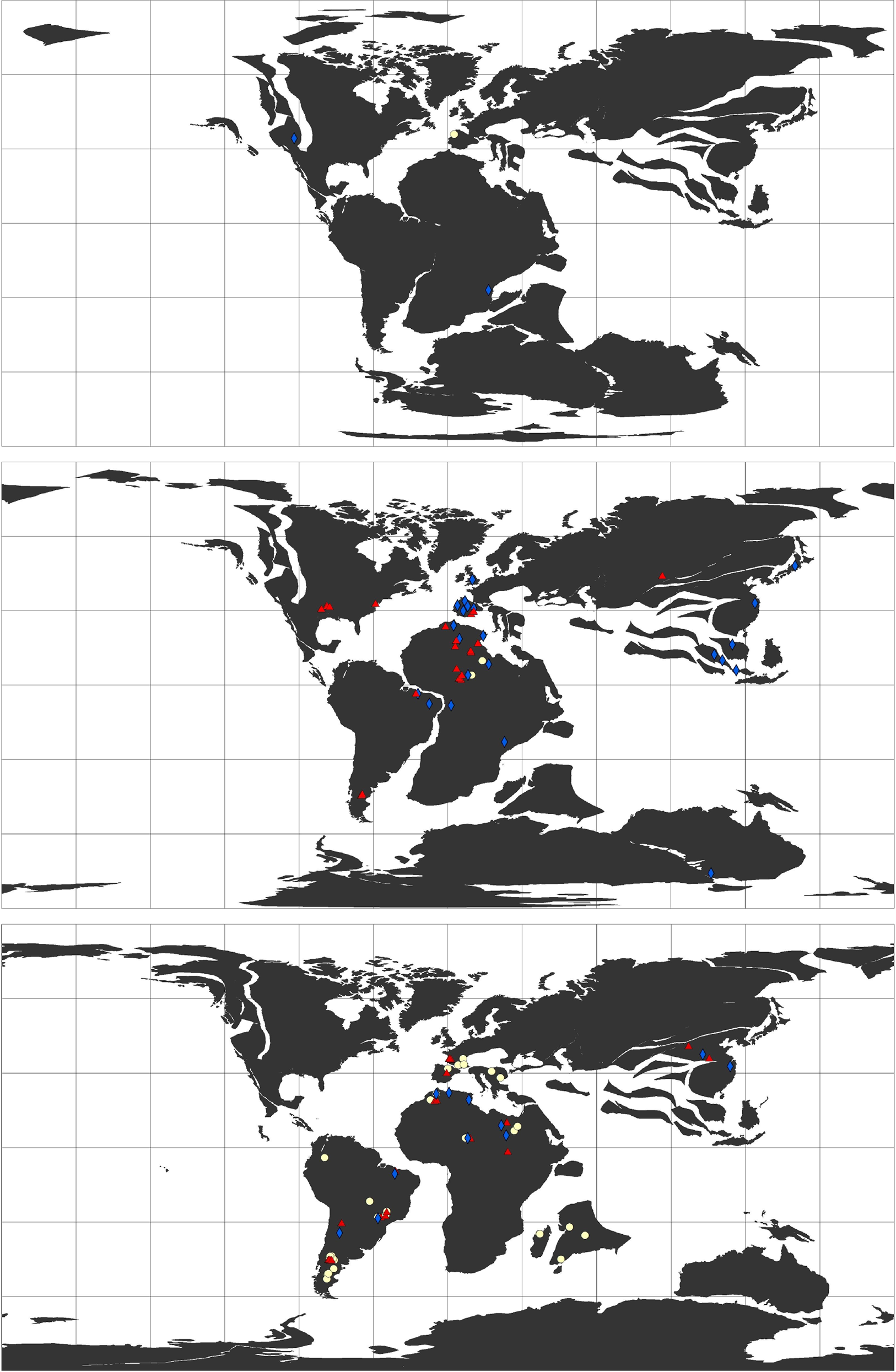
Ron Blakey · CC BY 3.0 · Cretáceous, ~90 Ma
During the Cenomaniano (~99–95 Ma), Giganotosaurus carolinii inhabited Laramidia, the western half of present-day North America, separated from the east by the Western Interior Seaway, a shallow sea dividing the continent. The continents were in very different positions: India was drifting toward Asia, Antarctica was still connected to Australia, and South America was an isolated island.
Inventário de Ossos
The holotype MUCPv-Ch1 preserves approximately 70% of the skeleton, including most of the vertebral column, pectoral and pelvic girdles, femora, and left tibia and fibula. The skull is fragmentary and was extensively reconstructed. A second specimen (MUCPv-95) provided a dentary 8% larger than the holotype, suggesting larger individuals existed.

Found elements
Inferred elements
Scientific Literature
15 papers in chronological order — from the original description to recent research.
A new giant carnivorous dinosaur from the Cretaceous of Patagonia
Coria, R.A. e Salgado, L. · Nature
Coria and Salgado describe Giganotosaurus carolinii as a new giant theropod based on holotype MUCPv-Ch1, with a 1.53 m skull and estimated length of 12.5 m, potentially larger than Tyrannosaurus rex. The specimen preserves approximately 70% of the skeleton, collected from the Cenomanian Candeleros Formation of Neuquén. The authors place the animal in Carcharodontosauridae, a group of large Gondwanan theropods with shark-like teeth. Publication in Nature generated immediate worldwide scientific and media interest in Gondwana's large predators.
New specimen of Giganotosaurus carolinii (Coria and Salgado, 1995), supports it as the largest theropod ever found
Calvo, J.O. e Coria, R.A. · Gaia
Calvo and Coria describe specimen MUCPv-95, represented by an isolated dentary 8% larger than the corresponding element in the holotype. Extrapolating this difference to the whole body, the authors estimate this individual could reach 14 m in length, reinforcing Giganotosaurus as the largest theropod found at that time. The paper also discusses implications for gigantism in Gondwanan theropods and compares Giganotosaurus with Tyrannosaurus and Carcharodontosaurus.

Thermophysiology and biology of Giganotosaurus: comparison with Tyrannosaurus
Barrick, R.E. e Showers, W.J. · Palaeontologia Electronica
Barrick and Showers analyze oxygen isotopes (δ¹⁸O) in bone phosphate of Giganotosaurus carolinii, using isotopic variation between different skeletal parts as a thermophysiology indicator. Results indicate a thermophysiological pattern intermediate between ectothermic reptiles and endothermic mammals, similar to that found in Tyrannosaurus. This suggests both giant theropods from both hemispheres convergently developed elevated metabolism relative to typical reptiles, possibly as a physiological necessity associated with gigantism.

Predatory dinosaurs from the Sahara and Late Cretaceous faunal differentiation
Sereno, P.C., Dutheil, D.B., Iarochene, M., Larsson, H.C.E., Lyon, G.H., Magwene, P.M., Sidor, C.A., Varricchio, D.J. e Wilson, J.A. · Science
Sereno and colleagues describe a new skull of Carcharodontosaurus saharicus from the Cretaceous of Morocco, measuring 1.6 m in length, comparable to or larger than Giganotosaurus carolinii. The phylogenetic analysis positions both as basal carcharodontosaurids and discusses faunal differentiation between Gondwana continents in the Cretaceous. The paper demonstrates that giant theropods of similar morphology evolved independently in Africa and South America as the continents drifted after Gondwana fragmentation.

The braincase of Giganotosaurus carolinii (Dinosauria: Theropoda) from the Upper Cretaceous of Argentina
Coria, R.A. e Currie, P.J. · Journal of Vertebrate Paleontology
Coria and Currie describe in detail the endocranium and braincase of Giganotosaurus carolinii, identifying diagnostic characters confirming its placement in Carcharodontosauridae. Analysis reveals a brain endocast with prominent olfactory lobes and semicircular canals indicative of sensory agility, questioning the notion that large theropods were necessarily less cognitively agile than Tyrannosaurus. The paper also discusses homologies of braincase structures with other basal and derived theropods.

A new approach to evaluate the cursorial ability of the giant theropod Giganotosaurus carolinii
Blanco, R.E. e Mazzetta, G.V. · Acta Palaeontologica Polonica
Blanco and Mazzetta evaluate the cursorial ability of Giganotosaurus carolinii through biomechanical models considering the robustness of hindlimb bones. Contradicting earlier hypotheses that large theropods were necessarily slow, the authors estimate a maximum speed of up to 14 m/s (approximately 50 km/h). The study also debates limits imposed by injury risk from falling at high speeds in large-mass animals, a topic relevant to understanding the predatory ecology of Giganotosaurus in its Cenomanian ecosystem.


My theropod is bigger than yours — or not: estimating body size from skull length in theropods
Therrien, F. e Henderson, D.M. · Journal of Vertebrate Paleontology
Therrien and Henderson develop scalar regressions between skull length, body length, and mass in 13 taxa of carnivorous theropods of known size. Applying the equations to the Giganotosaurus carolinii skull, they estimate length up to 13 m and mass exceeding 13 tonnes for the largest specimen (MUCPv-95). The paper provides a robust and widely cited methodology for comparing the largest theropods and discusses evolutionary mechanisms behind convergent gigantism in distinct lineages.

A new carcharodontosaurid (Dinosauria, Theropoda) from the Upper Cretaceous of Argentina
Coria, R.A. e Currie, P.J. · Geodiversitas
Coria and Currie describe Mapusaurus roseae from the Huincul Formation of Neuquén, a gracile carcharodontosaurid found in a bone accumulation of multiple individuals suggesting gregarious behavior. Phylogenetic analysis unites Mapusaurus and Giganotosaurus in Giganotosaurinae, based on shared femoral characters. Notably, specimens include individuals of different ages, raising hypotheses about cooperative hunting of large sauropods like Argentinosaurus, with implications for the predatory ecology of both carcharodontosaurids.


Phylogeny of Allosauroidea (Dinosauria: Theropoda): comparative analysis and resolution
Brusatte, S.L. e Sereno, P.C. · Journal of Systematic Palaeontology
Brusatte and Sereno perform an exhaustive phylogenetic analysis of Allosauroidea, including all valid genera and morphological characters from the literature. The paper resolves Giganotosaurus' position within Carcharodontosauridae and proposes the tribe Giganotosaurini to unite Giganotosaurus, Mapusaurus, and Tyrannotitan. Analysis confirms carcharodontosaurids are the sister group of Allosauridae, and that Gondwanan giants diverged from the European/North American branch during Pangaea fragmentation in the Jurassic.


Re-evaluation of the Bahariya Formation carcharodontosaurid (Dinosauria: Theropoda) and its implications for allosauroid phylogeny
Kellermann, M., Cuesta, E. e Rauhut, O.W.M. · PLOS ONE
Kellermann, Cuesta, and Rauhut re-evaluated the carcharodontosaurid material from the Bahariya Formation of Egypt, providing a new phylogenetic analysis of allosauroids with modern character-coding techniques. The re-evaluation impacts the relative position of Carcharodontosaurus, Giganotosaurus, and other family members, demonstrating the fluidity of relationships within Carcharodontosauridae as new specimens and analyses are incorporated. The work exemplifies how the taxonomy of large Gondwanan theropods remains under continuous revision with increasingly rigorous phylogenetic methodologies.
Cranial ontogenetic variation in Mapusaurus roseae (Dinosauria: Theropoda) and the probable role of heterochrony in carcharodontosaurid evolution
Canale, J.I., Novas, F.E., Salgado, L. e Coria, R.A. · Paläontologische Zeitschrift
Canale and colleagues analyze cranial ontogenetic variation in multiple Mapusaurus roseae specimens of different ages, identifying morphological changes throughout growth. The study is directly relevant to Giganotosaurus, as Mapusaurus is its closest relative in Giganotosaurinae. The authors propose a significant role for heterochrony (changes in developmental timing) in the morphological diversification of carcharodontosaurids, with implications for interpreting intraspecific vs. interspecific variation in large Gondwanan theropods.


A large Cretaceous theropod from Patagonia, Argentina, and the evolution of carcharodontosaurids
Novas, F.E., de Valais, S., Vickers-Rich, P. e Rich, T. · Naturwissenschaften
Novas and colleagues describe Tyrannotitan chubutensis from the Cerro Barcino Formation (Aptian-Albian) of Patagonia, a carcharodontosaurid that would be a temporal ancestor of Giganotosaurinae. The paper discusses the evolution of gigantism in the lineage that would lead to Giganotosaurus carolinii, proposing that South American carcharodontosaurids progressively increased in size through the Cretaceous. Identification of Tyrannotitan as a basal carcharodontosaurid provides essential data for understanding the biogeography and morphological evolution of large Patagonian predators.

A new species of agile theropod from the Upper Cretaceous of Patagonia, Argentina
Gianechini, F.A., Apesteguía, S. e Cerdeño, E. · Acta Palaeontologica Polonica
Gianechini, Apesteguía, and Cerdeño describe a new gracile theropod from the Upper Cretaceous of Patagonia, contributing to understanding the diversity of carnivores in the ecosystem shared with Giganotosaurus carolinii. The paper demonstrates that the Patagonian Cenomanian had a hierarchical predator guild, with Giganotosaurus as apex, accompanied by medium and small predators. This resource partitioning in the Candeleros Formation ecosystem is fundamental to understanding the paleoecology and evolutionary pressures that shaped the large carcharodontosaurids.


Bone histology of the late Jurassic diplodocid sauropod dinosaur Tornieria africana: implications for the lifestyle and longevity of giant dinosaurs
Evers, S.W., Wings, O., Sander, P.M. e Klein, N. · PLOS ONE
Evers and colleagues analyze the bone microstructure of the sauropod Tornieria africana, offering a comparative window into understanding how large dinosaurs grew and survived. Although focused on sauropods, this bone histology work is directly relevant to Giganotosaurus, as large sauropods were its primary prey. Understanding the rapid growth of sauropods explains how prey large enough to feed predators like Giganotosaurus were available in the Cenomanian ecosystem.


A new Cretaceous terrestrial ecosystem from Gondwana with the description of a new sauropod dinosaur
Novas, F.E., Carvalho, I.S., Agnolin, F.L., Pol, D., Ezcurra, M.D., Pais, D.F. e Freitas, F.I. · Anais da Academia Brasileira de Ciências
Novas and colleagues describe a new Cretaceous terrestrial ecosystem from Gondwana with diversified fauna, including theropods and sauropods, contextualizing the environments that supported large predators like Giganotosaurus. The paper demonstrates that Gondwanan Cretaceous ecosystems were rich and supported long food chains with prey of sufficient mass to feed the largest terrestrial predators. The described faunal diversity reflects the paleoenvironmental conditions that allowed the development of giants like Giganotosaurus carolinii in Cenomanian Patagonia.


Espécimes famosos em museus
MUCPv-Ch1 (Holótipo)
Museo de Geología y Paleontología, Cipolletti; réplica no Museo Ernesto Bachmann, Villa El Chocón, Neuquén
Holotype MUCPv-Ch1 preserves approximately 70% of the skeleton, including most of the vertebral column, pectoral and pelvic girdles, femora, and left tibia and fibula. The fragmentary skull was extensively reconstructed. The replica at the Museo Ernesto Bachmann in Villa El Chocón is the main tourist reference point for this specimen.
MUCPv-95 (Segundo espécime)
Museo Municipal Carmen Funes, Plaza Huincul, Neuquén
Specimen MUCPv-95 consists mainly of an isolated dentary (lower jaw bone) 8% larger than the corresponding element in the holotype. Extrapolated to the whole body, it suggests an animal that could exceed 14 m in length. The Museo Carmen Funes in Plaza Huincul also houses the Argentinosaurus holotype, making it a reference museum for Patagonia's largest dinosaurs.
In cinema and popular culture
Giganotosaurus carolinii remained relatively obscure to the general public for nearly three decades after its 1995 description, despite starring in documentaries like 'Chased by Dinosaurs' (2002) and 'Planet Dinosaur' (2011). Its rise to popular fame occurred dramatically with 'Jurassic World: Dominion' (2022), where it was chosen as the ultimate antagonist of the trilogy, facing the iconic T. rex. The animal's design for the film was deliberately theatrical: filmmakers inspired the facial markings on the Joker's face to evoke immediate malice in the viewer. Although artistic liberties are evident, facial crests and dramatic coloration lack fossil support, but the film placed the name 'Giganotosaurus' in the global popular vocabulary, generating renewed interest in Patagonian paleontology and the debate over which was the largest terrestrial carnivore in history.

Classificação

Descoberta
Curiosidade
Giganotosaurus carolinii owes its scientific name to its discoverer: Rubén Darío Carolini was an automobile mechanic and amateur fossil hunter who found the tibia bone in 1993 while exploring the badlands of Villa El Chocón. With no formal training in paleontology, Carolini notified local authorities and the specimen was recovered by a professional team, culminating in the 1995 publication that shocked the scientific world by presenting a carnivore potentially larger than T. rex.