
Herrerasaurus ischigualastensis
Herrerasaurus ischigualastensis
"Herrera's lizard from Ischigualasto"
Sobre esta espécie
Herrerasaurus ischigualastensis is one of the most primitive known dinosaurs, living approximately 231 to 229 million years ago in South America. Up to 6 meters long and around 350 kg, it was the apex predator of the Ischigualasto Formation ecosystem in Argentina. An agile biped, it had forelimbs specialized for grasping prey and a unique intramandibular joint in its lower jaw that enhanced prey capture and retention. Its phylogenetic position remains debated: classified variously as a basal theropod or as a pre-eusaurischian saurischian. The complete skull, discovered by Sereno and Novas in 1988, revolutionized understanding of the earliest dinosaurs.
Geological formation & environment
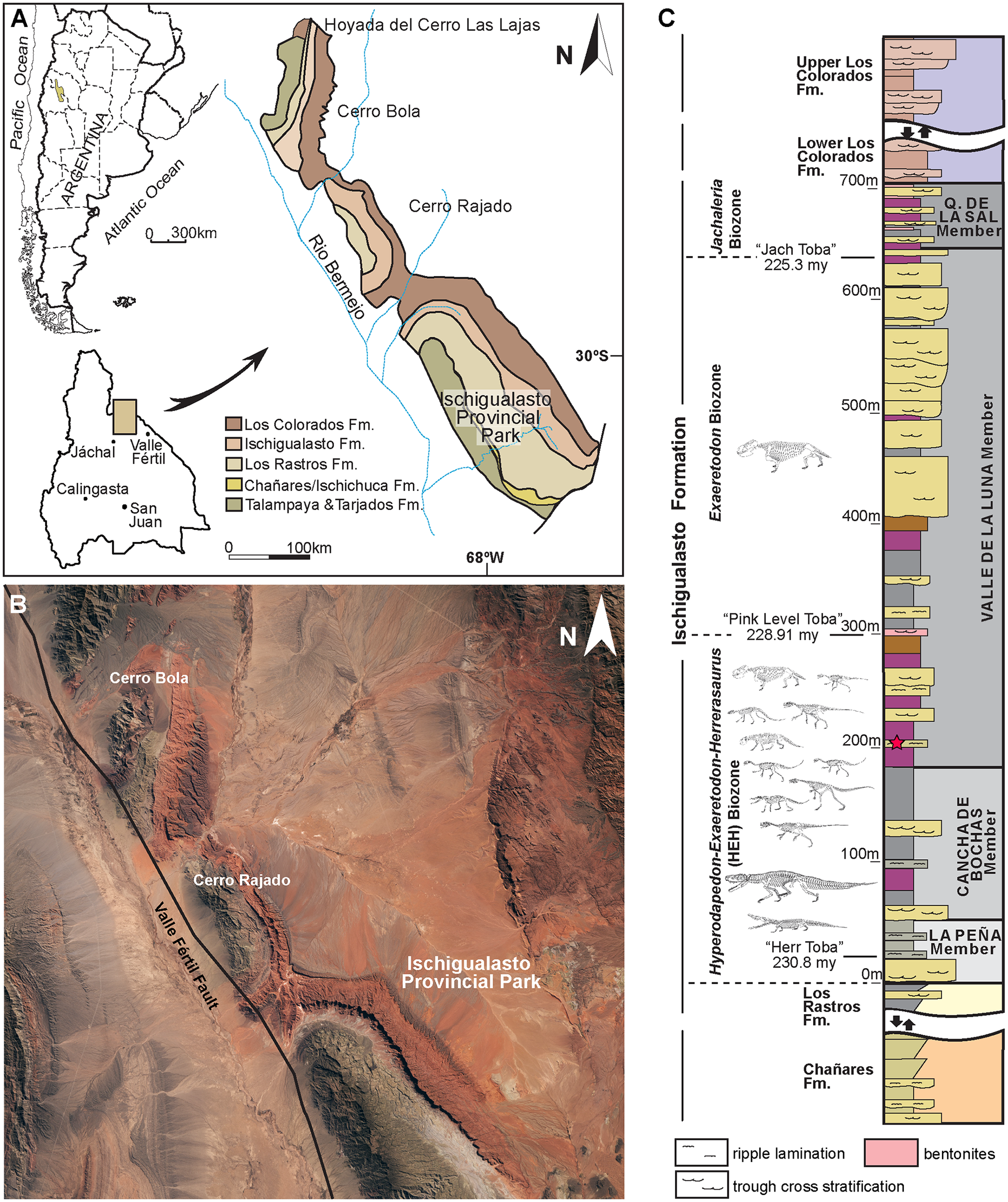
The Ischigualasto Formation occurs in the Ischigualasto-Villa Unión Basin, San Juan Province, Argentina. It dates from the late Carnian (~231.4 to 225.9 Ma), with radiometric ages confirmed by 40Ar/39Ar analyses. The environment was an alluvial plain in a volcanically active region, with meandering rivers and forests along the banks. The fauna was dominated by rhynchosaurs and cynodonts, with dinosaurs representing only ~10% of the total. Ischigualasto Provincial Park, where most fossils were collected, has been a UNESCO World Heritage Site since 2000. The formation preserves the oldest dinosaur assemblage in the world, with Herrerasaurus, Eoraptor, and Eodromaeus as representatives.
Image gallery


Scientific reconstruction of Herrerasaurus ischigualastensis by Nobu Tamura (2016). The horizontal posture, rigid tail, and bipedal morphology reflect the modern scientific consensus based on specimen PVSJ 407 and others.
Nobu Tamura — CC BY-SA 4.0
Ecology and behavior
Habitat
Herrerasaurus inhabited the Ischigualasto Formation during the late Carnian, 231 to 229 Ma ago, on a volcanically active alluvial plain in southwestern Pangaea, corresponding today to San Juan Province, Argentina. The climate was warm and humid, with intense seasonal rainfall. Vegetation was dominated by ferns (Cladophlebis), horsetails, and giant conifers (Protojuniperoxylon) along riverbanks. Associated fauna included rhynchosaurs (dominant in the lower formation), traversodontid and carnivorous cynodonts, pseudosuchian archosaurs, proterochampsids, and temnospondyl amphibians. Dinosaurs represented only ~10% of total fossils, with Herrerasaurus being the largest carnivore in the ecosystem.
Feeding
Herrerasaurus was a specialized active predator, likely hunting medium-sized prey such as cynodonts and rhynchosaurs. The sliding intramandibular joint allowed greater mouth opening and retention of struggling prey. The short but muscular forelimbs with trenchant claws on digits I-III were adapted for grasping and raking prey. The laterally compressed serrated teeth were efficient for slicing flesh. Coprolites found in the Ischigualasto Formation, containing small bones with no trace of plant material and attributed to Herrerasaurus based on fossil abundance, suggest the animal could digest bone.
Behavior and senses
Herrerasaurus social behavior is poorly documented, but paleopathological evidence provides important clues. Specimen PVSJ 407 bears a healed depression on a cranial bone interpreted as a bite mark, possibly the result of intraspecific combat for territory or social hierarchy, as documented by Tanke and Currie in 1998. This aggressive head-biting behavior is found in at least eight other theropod species, suggesting it was ancestral in the group. There is no direct evidence of gregarious behavior, but it cannot be ruled out based on available fossil records.
Physiology and growth
Bone histology of Herrerasaurus, analyzed by Curry Rogers et al. (2024) on specimen PVSJ 614, reveals that the animal had a relatively fast but not exceptional growth rate compared to other archosaurs in its ecosystem. Long bones show fibrolamellar bone tissue, indicative of active metabolism. This continuous growth rate suggests that the earliest dinosaurs had already acquired higher growth physiology than basal reptiles, but not yet as accelerated as derived Jurassic and Cretaceous dinosaurs. Herrerasaurus possibly maintained an intermediate body temperature between ectothermic reptiles and modern birds.
Paleogeography
Continental configuration

Ron Blakey · CC BY 3.0 · Triassic, ~90 Ma
During the Carniano (~231–229 Ma), Herrerasaurus ischigualastensis inhabited Pangea, the single supercontinent joining all modern continents. Climate was dry and hot across much of the continental interior.
Inventário de Ossos
Based on multiple specimens. The holotype (PVL 2566) is partial. Specimen PVSJ 407, discovered in 1988 by Paul Sereno and Fernando Novas, provides the most complete known skull and skeleton. Together, the specimens document virtually the entire skeleton.
Found elements
Inferred elements
Scientific Literature
15 papers in chronological order — from the original description to recent research.
La presencia de dinosaurios saurisquios en los 'Estratos de Ischigualasto' (Mesotriásico superior) de las provincias de San Juan y La Rioja (República Argentina)
Reig, O.A. · Ameghiniana
The founding paper formally describing Herrerasaurus ischigualastensis for the first time. Osvaldo Reig reports the presence of saurischian dinosaurs in the Ischigualasto Formation of San Juan and La Rioja, Argentina, based on bone fragments collected by goatherd Victorino Herrera in 1959. The material includes vertebrae, pelvic elements, and hindlimb bones. Reig recognizes the exceptional antiquity of the fossils and proposes they represent some of the most primitive known dinosaurs. The name honors the lay discoverer of the site, inaugurating a tradition of recognizing local collectors in Argentine paleontology. The work establishes the Ischigualasto Formation as a globally important site for understanding dinosaur origins.
The complete skull and skeleton of an early dinosaur
Sereno, P.C. & Novas, F.E. · Science
Transformative paper describing specimen PVSJ 407, the most complete Herrerasaurus skull and skeleton ever discovered, found in the Ischigualasto Formation. Sereno and Novas demonstrate that Herrerasaurus was an agile bipedal theropod and active predator, with short but highly specialized forelimbs for grasping and raking prey. The skull, with a rectangular profile and transversally narrow snout, shows a sliding intramandibular joint that allowed greater mouth opening during prey capture. This paper redefined the phylogenetic position of the group and established Herrerasaurus as a central reference in the debate on dinosaur origins.
The skull and neck of the basal theropod Herrerasaurus ischigualastensis
Sereno, P.C. & Novas, F.E. · Journal of Vertebrate Paleontology
In-depth osteological description of the skull and neck of Herrerasaurus. Sereno and Novas document the sliding intramandibular joint, a functional mechanism that allowed lateral displacement of the lower jaw rami during mouth opening, increasing the prey-capture area. The deep supratemporal depressions on the skull roof indicate exceptionally developed jaw-closing muscles for a basal theropod of its size. The paper establishes comparisons with other primitive theropods and reinforces Herrerasaurus's position as one of the most specialized carnivores of its period, challenging the notion that the earliest dinosaurs were ecological generalists.

The pectoral girdle and forelimb of the basal theropod Herrerasaurus ischigualastensis
Sereno, P.C. · Journal of Vertebrate Paleontology
Sereno describes in detail the pectoral girdle and forelimb of Herrerasaurus, demonstrating that although the forelimb measured less than half the length of the hindlimb, it was highly specialized for prey capture and manipulation. Marked metacarpal extensor depressions, long penultimate phalanges, and trenchant unguals of digits I-III converged during flexion, creating an effective grasping claw. The study establishes morphological comparisons with more derived theropods and suggests that this forelimb specialization for active prey capture represents a synapomorphy of theropods, with implications for understanding the origin and evolution of the group.
New information on the systematics and postcranial skeleton of Herrerasaurus ischigualastensis (Theropoda: Herrerasauridae) from the Ischigualasto Formation (Upper Triassic) of Argentina
Novas, F.E. · Journal of Vertebrate Paleontology
Fernando Novas revises the type and referred specimens of Herrerasauridae from the Ischigualasto Formation, concluding that Ischisaurus cattoi and Frenguellisaurus ischigualastensis are junior synonyms of Herrerasaurus ischigualastensis. The paper provides new information on the postcranial skeleton, including details of vertebrae, pectoral girdle, and limbs. Cladistic analysis supports the position of herrerasaurids as basal saurischians, against hypotheses placing them outside dinosaurs. The study consolidates Herrerasaurus as the only valid Argentine herrerasaurid genus and establishes the basis for subsequent phylogenetic revisions.


The Ischigualasto tetrapod assemblage (Late Triassic, Argentina) and 40Ar/39Ar dating of dinosaur origins
Rogers, R.R., Swisher, C.C. III, Sereno, P.C., Forster, C.A. & Monetta, A.M. · Science
Rogers and colleagues present radiometric dating of the Ischigualasto Formation using 40Ar/39Ar on sanidine from intercalated bentonite, obtaining an age of 227.8 ± 0.3 Ma for the tetrapod assemblage that includes Herrerasaurus ischigualastensis. This result directly calibrates the moment of dinosaur origins and confirms the Carnian antiquity of the Ischigualasto fauna. The paper demonstrates that dinosaurs appeared earlier than expected and that the Ischigualasto Formation preserves one of the most important transitional faunas in the fossil record, predating dinosaur dominance in the Late Triassic.
Primitive dinosaur skeleton from Argentina and the early evolution of Dinosauria
Sereno, P.C., Forster, C.A., Rogers, R.R. & Monetta, A.M. · Nature
Sereno and colleagues describe Eoraptor lunensis, a primitive dinosaur from the Ischigualasto Formation contemporary with Herrerasaurus, and perform a phylogenetic analysis positioning both as the most basal known dinosaurs. The paper discusses the character states shared by Herrerasaurus with more derived theropods, such as the intramandibular joint, and those that distance it from derived saurischians. The Ischigualasto fauna is presented as a unique window into the initial diversification of dinosaurs in the Carnian, with implications for understanding the biogeography and evolutionary tempo of the group in the Late Triassic.

A complete skeleton of a Late Triassic saurischian and the early evolution of dinosaurs
Nesbitt, S.J., Smith, N.D., Irmis, R.B., Turner, A.H., Downs, A. & Norell, M.A. · Science
Nesbitt and colleagues describe Tawa hallae, a new Late Triassic theropod from New Mexico, based on nearly complete skeletons. The phylogenetic analysis includes Herrerasaurus and positions herrerasaurids as basal saurischians, outside Eusaurischia. The paper demonstrates that several advanced dinosaur features, including skeletal pneumaticity, were ancestral to the split between theropods and sauropodomorphs. Herrerasaurus is used as a crucial phylogenetic anchor point for calibrating the appearance of derived characters in saurischians, confirming its position as one of the most primitive and informative dinosaurs in the fossil record.
A new herrerasaurid (Dinosauria, Saurischia) from the Upper Triassic Ischigualasto Formation of northwestern Argentina
Alcober, O.A. & Martinez, R.N. · ZooKeys
Alcober and Martinez describe Sanjuansaurus gordilloi, a new herrerasaurid based on a partial skeleton from Carnian strata of the Ischigualasto Formation. Phylogenetic analysis positions Herrerasaurus, Sanjuansaurus, and Staurikosaurus in a polytomy as the most primitive saurischian members, outside Eusaurischia. The paper demonstrates that saurischians of southwestern Pangaea were already widely diversified in the late Carnian, with multiple herrerasaurid lineages coexisting in the same geological formation, evidence of an earlier diversification than previously estimated.


Head-biting behavior in theropod dinosaurs: Paleopathological evidence
Tanke, D.H. & Currie, P.J. · Gaia
Tanke and Currie document paleopathological evidence of aggressive head-biting behavior in nine theropod species, from the Triassic to the Cretaceous. For Herrerasaurus ischigualastensis, specimen PVSJ 407 bears a depression in the cranial bone interpreted as a bite scar, attributed to intraspecific combat. The paper demonstrates that violent intraspecific aggression, possibly for establishing dominance or territorial disputes, was present since the most primitive carnivorous dinosaurs, suggesting this behavioral pattern is ancestral in theropods.


Basal Saurischia
Langer, M.C. · The Dinosauria (2nd edition), University of California Press
Langer synthesizes knowledge on basal saurischians, including Herrerasaurus and herrerasaurids, in the reference work The Dinosauria (2nd edition). The review analyzes the diagnostic anatomical features of the group, discusses phylogenetic hypotheses available at the time, and evaluates the stratigraphic and geographic distribution of the most primitive saurischians. The paper consolidates Herrerasaurus's position as a basal saurischian outside Eusaurischia and establishes the basis for subsequent phylogenetic analyses, which continue to refine the group's position in the dinosaur tree.


Osteohistological insight into the growth dynamics of early dinosaurs and their contemporaries
Curry Rogers, K., Martínez, R.N., Colombi, C., Rogers, R.R. & Alcober, O. · PLOS ONE
Curry Rogers and colleagues analyze bone histology of early dinosaurs from the Ischigualasto Formation, including Herrerasaurus ischigualastensis (specimen PVSJ 614), and their non-dinosaurian contemporaries. Results show that the earliest dinosaurs exhibited relatively fast growth rates, but not unique within their ecosystem: crocodylomorphs, archosauriforms, and large pseudosuchians showed comparable growth speeds. The most primitive dinosaurs grew more continuously than later Mesozoic dinosaurs, suggesting that elevated growth rates were ancestral to Dinosauria without initially distinguishing them from their ecological competitors.


A new early dinosaur (Saurischia: Sauropodomorpha) from the Late Triassic of Argentina: a reassessment of dinosaur origin and phylogeny
Ezcurra, M.D. · Journal of Systematic Palaeontology
Ezcurra describes Chromogisaurus novasi, a new dinosaur from the Ischichuca Formation, and performs a comprehensive phylogenetic analysis that includes Herrerasaurus. Results position herrerasaurids as basal saurischians to Eusaurischia, closer to the base of the saurischian tree than theropods or sauropodomorphs, but not truly members of either group. This interpretation represents an alternative to hypotheses classifying Herrerasaurus as a basal theropod or as a non-dinosaurian. The paper has significant implications for understanding the initial diversification of saurischians in the Late Triassic of South America.


Gnathovorax cabreirai: a new early dinosaur and the origin and initial radiation of predatory dinosaurs
Pacheco, C., Müller, R.T., Langer, M., Pretto, F.A., Kerber, L. & Dias da Silva, S. · PeerJ
Pacheco and colleagues describe Gnathovorax cabreirai, a new Late Triassic herrerasaurid from Brazil based on the most complete individual herrerasaurid skeleton ever found. Phylogenetic analysis positions Herrerasaurus and its relatives as basal members of Saurischia, closer to theropods than to sauropodomorphs. The paper demonstrates that predatory dinosaurs were already diversified in the middle Carnian (~233 Ma), with herrerasaurids distributed throughout western Pangaea, from Argentina to Brazil. The discovery of Gnathovorax reinforces the importance of the Gondwanan continent in the initial radiation of carnivorous dinosaurs.


Early Crocodylomorpha
Irmis, R.B., Nesbitt, S.J. & Sues, H.-D. · The Rise of Reptiles: 320 Million Years of Evolution, Johns Hopkins University Press
Irmis, Nesbitt, and Sues synthesize knowledge on Late Triassic archosaurs, with a comparative analysis that contextualizes Herrerasaurus in the ecological scenario of its time. The Ischigualasto Formation is presented as an exemplary case study for understanding the transition from archosaurian dominance (with pseudosuchians and rhynchosaurs as predominant elements) to dinosaur dominance. The paper highlights that Herrerasaurus coexisted with non-dinosaurian archosaurs, and that dinosaurs represented only ~10% of the Ischigualasto fauna in the Carnian, suggesting that the rise of dinosaurs was a gradual process.


Espécimes famosos em museus
PVSJ 407
Museo de Ciencias Naturales de San Juan (MUSEO), San Juan, Argentina
Most complete specimen ever found, including a complete skull and articulated skeleton. Its 1988 discovery transformed understanding of Herrerasaurus and the earliest dinosaurs in general.
FMNH PR 2081 (molde)
Field Museum of Natural History, Chicago, Estados Unidos
Cast of specimen PVSJ 407, displayed at the Field Museum of Chicago in the Evolving Planet exhibition. One of the few museums outside Argentina to display the complete mounted skeleton.
Molde exposto
Museo Civico di Storia Naturale, Milão, Itália
Fossil or cast displayed at the natural history museum of Milan. One of the few European specimens on permanent display.
In cinema and popular culture
Herrerasaurus occupies a curious position in pop culture: it is one of the most scientifically important dinosaurs, yet nearly absent from cinema screens. In the Jurassic Park franchise, its name appears on the park brochure map in the first 1993 film, revealing that there was an enclosure for it at the far northwestern end of the island, where tourists never reached. It was only in the game Jurassic Park: The Game (Telltale, 2011) that the animal gained effective narrative presence, attacking characters in an action scene on the Bone Shaker. In the simulation series Jurassic World Evolution (2018) and Jurassic World Evolution 2 (2021), it became available as a playable species, with modeling reasonably faithful to known anatomy. Outside the Jurassic franchise, it appears in toy collections and educational materials. Herrerasaurus's relative absence from mainstream cinema is paradoxical: its status as one of the most primitive known dinosaurs would make it a fascinating narrative character, representing the dawn of the age of dinosaurs. Modern science, with its bone histology analyses and molecular phylogenetics, continues revealing new details about this pioneer from Triassic Argentina.

Classificação


Descoberta
Curiosidade
Herrerasaurus was discovered by a goatherd named Victorino Herrera, who was not a paleontologist but recognized that the bones he found in his grazing land in the Valle de la Luna were something extraordinary. The animal was named in his honor in 1963, making it one of the rare cases where a dinosaur bears the name of an ordinary citizen.