
Hypsilophodon
Hypsilophodon foxii
"High-ridged tooth (from the Isle of Wight)"
Sobre esta espécie
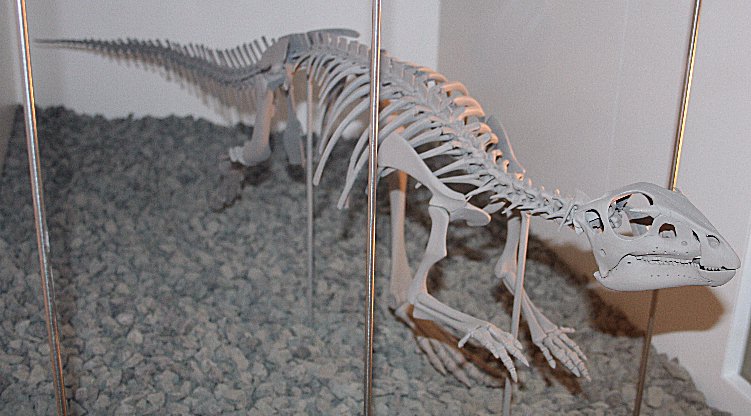
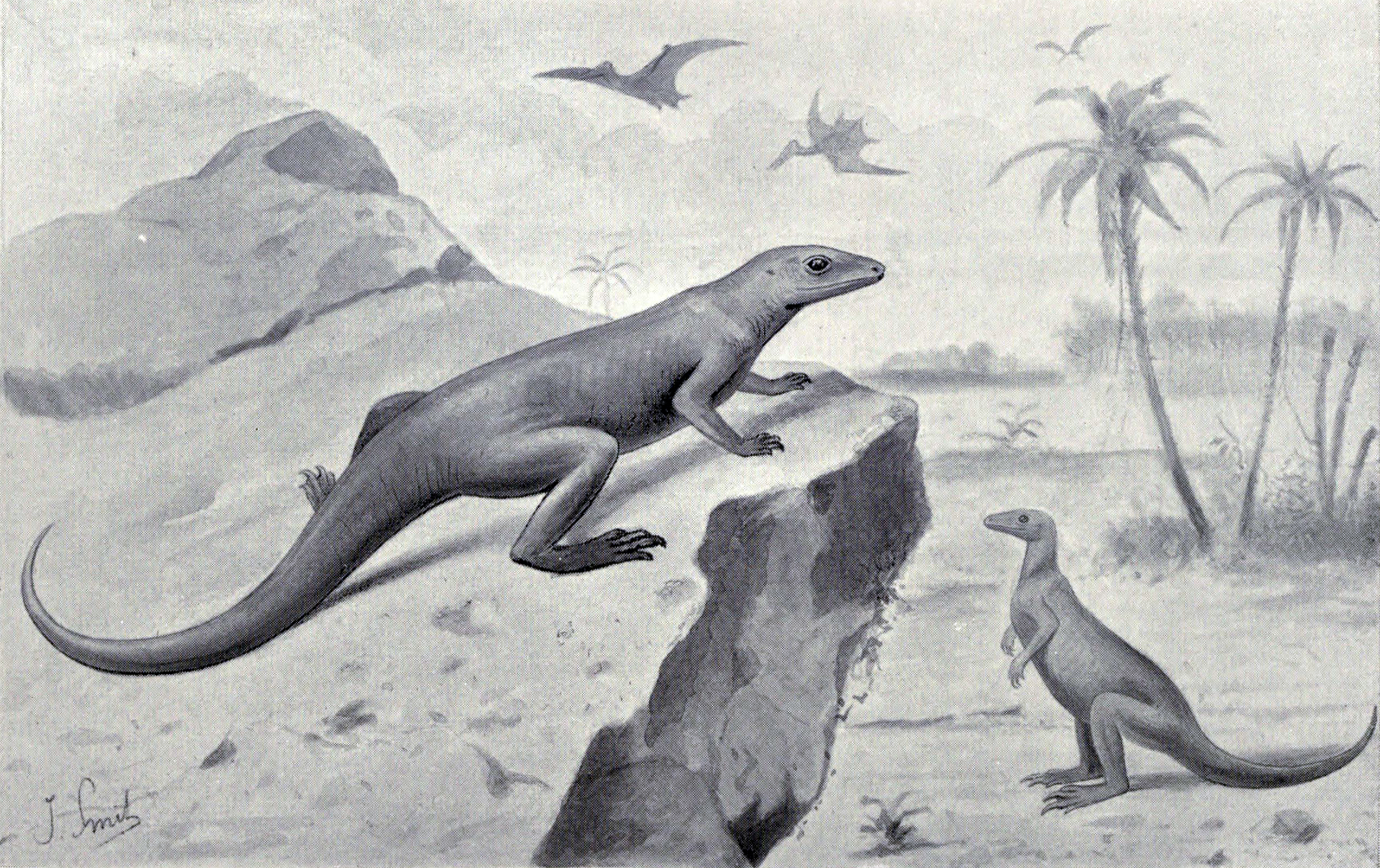
Hypsilophodon foxii was a small bipedal ornithopod from the Early Cretaceous of the Isle of Wight, England. Measuring about 1.8 meters in length and weighing just 20 kg, it was an agile, fast-running herbivore adapted for life on savanna-like floodplains. Described by Thomas Henry Huxley in 1869 from a skull collected by Reverend William Fox, the species endured decades of misinterpretation: early 20th-century researchers incorrectly depicted it as an arboreal climber. Peter Galton, in papers published between 1969 and 1974, definitively refuted this hypothesis, establishing Hypsilophodon as a specialized terrestrial runner with long hind legs and a stiff tail for balance.
Geological formation & environment
The Wessex Formation (Wealden Group) is a Barremian (~130-125 Ma) sedimentary unit from the Isle of Wight, southern England. It represents high-sinuosity fluvial deposits on a low-relief floodplain under a hot and seasonal climate, with periods of aridity documented by desiccation cracks and calcrete. Vegetation was dominated by Cheirolepidiaceae conifers. In addition to Hypsilophodon, the formation preserved Iguanodon, Neovenator, Baryonyx, Polacanthus, Eotyrannus, pterosaurs, crocodiles, turtles, and mammals. The Hypsilophodon Bed, at the top of the formation, is the most productive layer for specimens of this species.
Image gallery




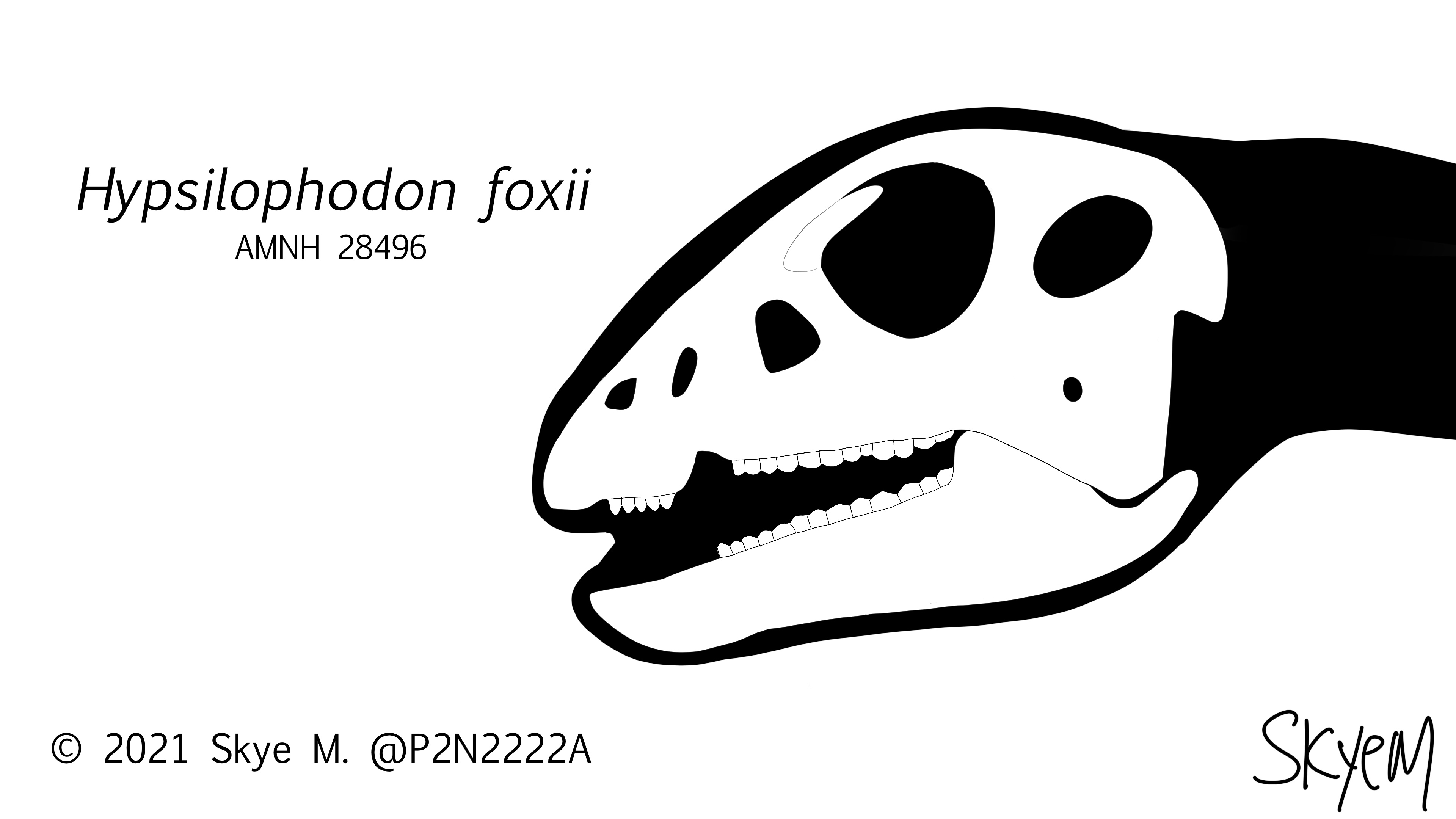
Holotype skull of Hypsilophodon foxii (NHM R197), the same specimen described by Huxley in 1870. The leaf-shaped dentition with elevated ridges is clearly visible.
Ghedoghedo / Wikimedia Commons, CC BY-SA 3.0
Ecology and behavior
Habitat
Hypsilophodon lived on savanna-like floodplains in what is now the Isle of Wight, England, during the Barremian (~130-125 Ma). The climate was hot and seasonal, with pronounced wet and dry seasons. Vegetation was dominated by conifers of the family Cheirolepidiaceae, with ferns and cycads. The environment was shared with Iguanodon, Baryonyx, Neovenator, Eotyrannus, Polacanthus, pterosaurs, and primitive mammals. Seasonal rivers and lakes structured the landscape, creating edge habitats that the small ornithopod likely exploited.
Feeding
A herbivore specialized in low-growing vegetation, Hypsilophodon used a distinct horny beak to cut leaves, shoots, and possibly roots. The leaf-shaped dentition with elevated ridges, the characteristic that gave the genus its name, was efficient for grinding fibrous plant material. Muscular cheeks, evidenced by bony margins in the maxillary region, allowed more efficient oral processing than in other reptiles. The bipedal posture allowed access to vegetation at heights between 0 and 1 meter from the ground, a different niche from the large iguanodonts that fed at greater heights.
Behavior and senses
Taphonomic evidence suggests Hypsilophodon was gregarious: multiple specimens of different ages were found together in the Hypsilophodon Bed at Cowleaze Chine, suggesting social behavior or at least collective use of the same site. The presence of juveniles and adults in the same deposit is consistent with parental care or mixed-age groups. The animal was likely frequent prey for Baryonyx, Neovenator, and Eotyrannus, and cursorial agility was its primary defense against predators. There is no evidence of marked sexual dimorphism.
Physiology and growth
Hypsilophodon had ossified caudal tendons that kept the tail rigid and horizontal, functioning as a counterbalance during high-speed running. The hind limb structure, with a short femur and long tibia, is typical of fast runners. Estimates based on limb proportions indicate maximum speed of up to 40 km/h. There is no direct evidence of metabolic type, but bone structure and body proportions are consistent with active and possibly endothermic metabolism, as suggested by the histology of related ornithopods studied in Australia.
Paleogeography
Continental configuration

Ron Blakey · CC BY 3.0 · Cretáceous, ~90 Ma
During the Barremiano (~130–125 Ma), Hypsilophodon foxii inhabited Laramidia, the western half of present-day North America, separated from the east by the Western Interior Seaway, a shallow sea dividing the continent. The continents were in very different positions: India was drifting toward Asia, Antarctica was still connected to Australia, and South America was an isolated island.
Inventário de Ossos
Known from approximately 20 individuals, most from the Isle of Wight. Several specimens include articulated sections of the postcranial skeleton, though few are complete. The holotype skull (NHMUK PV R 197) and the Mantell-Bowerbank block are particularly well preserved.
Found elements
Inferred elements
Scientific Literature
15 papers in chronological order — from the original description to recent research.
On Hypsilophodon foxii, a New Dinosaurian from the Wealden of the Isle of Wight
Huxley, T.H. · Quarterly Journal of the Geological Society of London
The founding description of the genus Hypsilophodon. Thomas Henry Huxley examines the skull collected by Reverend William Fox and recognizes a unique dentition: leaf-shaped teeth with elevated longitudinal ridges, distinct from any dinosaur then known. Huxley distinguishes the material from Iguanodon and names the species after its collector. The paper establishes the first diagnostic characters of the species, including premaxillary shape, number and morphology of maxillary and dentary teeth, and skull proportions. This publication inaugurated over 150 years of research on the small ornithopods of the Wessex Formation and positioned Hypsilophodon as the best-documented basal ornithischian from England.
Contribution to the Anatomy of Hypsilophodon foxii
Hulke, J.W. · Quarterly Journal of the Geological Society of London
John Whitaker Hulke supplements Huxley's original description with newly acquired postcranial material at the British Museum. The paper describes for the first time the hind limbs, pelvic girdle, and parts of the vertebral column of Hypsilophodon, revealing its bipedal structure and elongated leg proportions. Hulke notes plate-like structures associated with the ribs, which would be mistakenly interpreted as dermal armor for decades. The paper documents the position of sacral vertebrae and ilium morphology, establishing the foundation for future analyses of the animal's locomotion and posture. This work, together with the 1882 monograph, forms the classical anatomical basis for Hypsilophodon studies.
An Attempt at a Complete Osteology of Hypsilophodon foxii; a British Wealden Dinosaur
Hulke, J.W. · Philosophical Transactions of the Royal Society of London
The largest and most detailed 19th-century anatomical monograph on Hypsilophodon. Hulke synthesizes all available British Museum material and systematically describes every skeletal element: skull, mandible, cervical to caudal vertebrae, ribs, pectoral and pelvic girdles, and all limbs. The work definitively resolves the taxonomic question: Hypsilophodon is not a juvenile Iguanodon but an entirely distinct genus with its own cranial morphology, dentition, and skeletal proportions. Hulke first documents the ossified tail tendons and discusses the animal's bipedal posture. With over 50 pages and detailed illustrations, this paper remained the primary osteological reference for nearly a century, until superseded by Galton's 1974 monograph.

Notes on British Dinosaurs. Part I: Hypsilophodon
Nopcsa, F. · Geological Magazine
Baron Franz Nopcsa dedicates a critical note to Hypsilophodon, revisiting available anatomical material and discussing hypotheses about the animal's lifestyle. Notably, Nopcsa expresses skepticism about the arboreal interpretation that was gaining traction at the time, anticipating the formal refutation that would only come decades later with Galton. The paper discusses foot and digit morphology, questioning whether the fifth toe truly functioned as an opposable hallux for gripping branches. Nopcsa also comments on the taxonomic position of the genus within ornithopods and provides comparisons with Iguanodon and other British dinosaurs. This publication is significant in the history of late Victorian paleontology and demonstrates how conflicting interpretations of Hypsilophodon coexisted for decades.
The pelvic musculature of the dinosaur Hypsilophodon (Reptilia: Ornithischia)
Galton, P.M. · Postilla
Peter Galton presents the first detailed reconstruction of Hypsilophodon pelvic musculature, using comparative anatomy with modern birds and reptiles. The work demonstrates that the prepubic process, ilium orientation, and femur morphology were adaptations for terrestrial cursorial locomotion, incompatible with arboreal climbing. Galton shows that thigh extensor and depressor muscles had large origins on the expanded ilium, suggesting fast-running capability. This paper inaugurated Galton's systematic revision of Hypsilophodon, which culminated in the 1974 monograph. It is considered the first modern paper to treat Hypsilophodon as a specialized terrestrial runner, establishing a paradigm that remains valid today.

Hypsilophodon, the Cursorial Non-arboreal Dinosaur
Galton, P.M. · Nature
In one of the most influential short notes ever published on Hypsilophodon, Galton concisely and definitively demonstrates that this dinosaur was a terrestrial runner, not an arboreal climber. The work refutes Abel (1912) and Heilmann (1926) point by point: the first toe was not opposable as imagined, the claws were not curved enough to grip branches, and neither the pectoral girdle nor the tail showed climbing adaptations. Published in Nature with broad visibility, the paper definitively ended decades of debate and redefined the public image of Hypsilophodon as an agile runner of the Early Cretaceous plains of England.

The Ornithischian Dinosaur Hypsilophodon from the Wealden of the Isle of Wight
Galton, P.M. · Bulletin of the British Museum (Natural History), Geology
The definitive monograph on Hypsilophodon, running 152 pages with 64 figures. Galton systematically describes all known specimens at the British Museum (Natural History) and documents in detail the geology of the Wessex Formation, taphonomic preservation of specimens, and every skeletal element. The myology section reconstructed the animal's muscles based on comparison with modern birds and crocodilians. Galton calculated that Hypsilophodon could reach speeds up to 40 km/h thanks to hind limb proportions and a stiff balancing tail. The work includes biogeographic and paleoecological analysis, describing the Early Cretaceous island environment. This monograph remains the fundamental anatomical reference for any research on the species over 50 years after publication.

The 'dermal armour' of the ornithopod dinosaur Hypsilophodon from the Wealden (Early Cretaceous: Barremian) of the Isle of Wight: a reappraisal
Butler, R.J. & Galton, P.M. · Cretaceous Research
Butler and Galton review Hypsilophodon fossil material at the Natural History Museum London and reinterpret the plate-like structures described by Hulke in 1873 as possible dermal armor. Using comparative morphological analysis with other ornithopods, the authors demonstrate these structures are associated with the lateral surfaces of distal sections of anterior dorsal ribs and represent mineralized cartilaginous intercostal plates, not dermal bony shields. The work suggests such intercostal plates were probably widespread among basal ornithopods but rarely preserved due to variation in timing and degree of mineralization. This reinterpretation removes Hypsilophodon from the category of armored dinosaurs and clarifies these structures' role in respiratory support.
The systematic relationships and biogeographic history of ornithischian dinosaurs
Boyd, C.A. · PeerJ
Boyd presents the broadest phylogenetic analysis of basal ornithischians at the time, with 255 characters evaluated across 65 species. The result is highly significant for understanding Hypsilophodon: it is recovered as the only non-iguanodontian ornithopod, a position distinguishing it from all other former Hypsilophodontidae members, which are reallocated to Parksosauridae as sister to Cerapoda. This finding formally dissolves the hypothesis of a monophyletic Hypsilophodontidae family. The work also proposes a Gondwanan origin for Dinosauria and Asian diversification of basal neornithischians. Published open access in PeerJ with supplementary data and matrix available, it became a fundamental phylogenetic reference for all subsequent studies on basal ornithopods.


A basal ornithischian dinosaur from the Aptian of the Czech Republic
Madzia, D., Boyd, C.A. & Mazuch, M. · Journal of Systematic Palaeontology
Madzia, Boyd, and Mazuch describe a new basal ornithischian from the Aptian of the Czech Republic and perform a phylogenetic analysis proposing a significant repositioning of Hypsilophodon: rather than a basal ornithopod, it would be the sister taxon to Cerapoda, outside Ornithopoda sensu stricto. This position, if confirmed, would have profound implications for understanding neornithischian evolution. The work exemplifies the ongoing phylogenetic debate about Hypsilophodon, whose relationships remained unstable in analyses of the 2010s. The instability reflects both the plesiomorphic morphology of the animal and incomplete preservation of key characters. The paper is important for understanding how Hypsilophodon continues to be a fundamental problem taxon in ornithischian phylogenetic analyses.


The plant debris beds of the Early Cretaceous (Barremian) Wessex Formation of the Isle of Wight, southern England: their genesis and palaeontological significance
Sweetman, S.C. & Insole, A.N. · Palaeogeography, Palaeoclimatology, Palaeoecology
Sweetman and Insole investigate plant debris beds within the Barremian Wessex Formation on the Isle of Wight and reconstruct the paleoclimate and paleoenvironment in which Hypsilophodon lived. Sedimentological and paleobotanical data indicate a hot to very hot climate with pronounced wet and dry seasons, similar to modern savannas. The flora was dominated by conifers of the family Cheirolepidiaceae. The work documents freshwater bivalves, insects, fish, pterosaurs, and multiple dinosaur genera coexisting on the floodplain. The plant debris beds exceptionally preserved insects and plant material, offering a unique window into the Early Cretaceous European ecosystem. This paleoenvironmental context is fundamental for understanding the selective pressures that shaped Hypsilophodon ecology.


A new basal ornithopod (Dinosauria: Ornithischia) from the Early Cretaceous of Texas
Andrzejewski, K.A., Winkler, D.A. & Jacobs, L.L. · PLOS ONE
Andrzejewski, Winkler, and Jacobs describe Convolosaurus marri, a new basal ornithopod from the Aptian of Texas, based on over 29 individuals from the Proctor Lake site. Phylogenetic analysis positions the new taxon in a clade with Iguanodontia exclusive of Hypsilophodon foxii, reinforcing the isolated position of Hypsilophodon as the only non-iguanodontian ornithopod. The work provides biogeographic data on the distribution of basal ornithopods in North America during the Early Cretaceous and demonstrates that Hypsilophodon-like forms existed on other continents but with distinct phylogenetic relationships. The study is relevant for understanding the radiation of small bipedal herbivores in the Cretaceous and Hypsilophodon's unique position in the ornithischian phylogenetic tree.
Palaeoenvironment and taphonomy of the Hypsilophodon Bed, Lower Cretaceous Wessex Formation, Isle of Wight
Marsden, M.K. et al. · Journal of the Geological Society
Marsden and colleagues perform the most comprehensive taphonomic and paleoenvironmental analysis ever published on the Hypsilophodon Bed, the geological layer from which most Hypsilophodon specimens have been recovered since the mid-19th century. Using sedimentology, geochemistry, and detailed taphonomic analysis of Natural History Museum London specimens, the authors demonstrate that fossil accumulation resulted from gradual processes, not a single catastrophic mass death event as proposed by earlier researchers. The work reconstructs the paleoenvironment as a floodplain with diverse fauna and flora. The paper is the most modern and complete study on the geological context of Hypsilophodon and contributes to understanding how fossils were preserved over millions of years.

Vectidromeus insularis, a new hypsilophodontid dinosaur from the Lower Cretaceous Wessex Formation of the Isle of Wight, England
Longrich, N.R. et al. · Cretaceous Research
Longrich and colleagues describe Vectidromeus insularis, a new hypsilophodontid ornithopod from the Wessex Formation of the Isle of Wight, contemporaneous with Hypsilophodon foxii. The specimen, a juvenile with parts of the pelvic girdle, hind limbs, and caudal vertebrae, reveals that the Wessex Formation hosted at least two distinct genera of small bipedal ornithopods. The work performs detailed comparative analysis with Hypsilophodon, clarifying which characters are diagnostic for each genus and which are shared. The discovery demonstrates that small bipedal herbivores were more diverse in Early Cretaceous Europe than previously thought. For Hypsilophodon research, this paper is important as it provides more precise taxonomic criteria for identifying specimens and establishes the context of hypsilophodontid diversity on the island.

The bone microstructure of polar 'hypsilophodontid' dinosaurs from Victoria, Australia
Herne, M.C. et al. · Scientific Reports
Herne and colleagues analyze the bone microstructure of 18 polar hypsilophodontid ornithopod specimens from the Early Cretaceous of Victoria, Australia, which at the time lived within the Antarctic Circle. The work provides the first detailed ontogenetic description with multi-sample growth data for any Antarctic Circle dinosaur taxon. Results show fastest growth during the first three years, with skeletal maturity between five and seven years. Inner cortical tissue is primarily fibrolamellar, while middle and outer cortex shows less organized parallel-fibered tissue. There is no evidence of hibernation or seasonal torpor. Although the study focuses on Australian specimens rather than Hypsilophodon foxii directly, it provides essential comparative data on physiology and growth of the hypsilophodontid group to which Hypsilophodon belongs.


Espécimes famosos em museus
NHMUK PV R 5829 (grande espécime adulto)
Natural History Museum, Londres, Reino Unido
The largest known Hypsilophodon specimen, mounted in 1934 by Louis Parsons and Frank Barlow in an upright posture (later revised in 1992 to a horizontal posture). Displayed at the NHM until 2016, it served as the basis for the new bronze sculpture installed in the museum gardens in 2024.
NHMUK PV R 197 (holótipo — crânio Fox)
Natural History Museum, Londres, Reino Unido
The holotype of the species, a skull collected by Reverend William Fox on the Isle of Wight. This specimen was the original material described by Thomas Henry Huxley in 1869-1870 and served as the basis for establishing the genus and species. CT scanning of the skull in 2024 for the first time allowed precise reconstruction of internal cranial anatomy.
Espécime do Oxford University Museum of Natural History
Oxford University Museum of Natural History, Oxford, Reino Unido
Mounted skeleton on permanent display at the Oxford University Museum of Natural History, one of the few Hypsilophodon specimens outside the Natural History Museum London. The specimen allows visitors to closely observe the long hind limb proportions, stiff tail, and bipedal structure of the animal.
In cinema and popular culture
Hypsilophodon never achieved stardom in major cinema or big-budget series, but it is a constant presence in the most respected scientific documentaries about dinosaurs. In the BBC's Walking with Dinosaurs series (1999), it appears as representative of small Cretaceous European herbivores. More recent series such as Dinosaur Revolution (2011) and Planet Dinosaur (2011) have again included it, always emphasizing its agility as a runner and its role as a vulnerable prey animal in the Wessex Formation ecosystem. In educational culture, Hypsilophodon has importance disproportionate to its size: the history of its misinterpretation as an arboreal animal and its correction by Galton have become classic case studies in how science revises its own hypotheses. Children's productions like Dino Dana depict the animal with increasing scientific care, helping build a more accurate image than the prehistoric koala representations that dominated the 20th century.

Classificação
Descoberta
Curiosidade
For over 60 years, science books depicted Hypsilophodon as a 'prehistoric koala' that lived clinging to trees for shelter from predators. This idea, popularized by Othenio Abel in 1912 and Gerhard Heilmann in 1926, was definitively refuted by Peter Galton only in 1969-1971 — when he proved that the first toe was not opposable and the claws were too straight to grip branches.