
Iguanodon
Iguanodon bernissartensis
"Iguana tooth from Bernissart"
Sobre esta espécie
Iguanodon bernissartensis was one of the first dinosaurs described by science and remains one of the most studied. Initially discovered in 1822 by Gideon Mantell in England and renamed after the extraordinary discovery of 38 complete skeletons in Bernissart, Belgium, in 1878, this Early Cretaceous herbivorous ornithopod measured up to 11 meters and weighed around 4.5 tonnes. Its conical thumb spike is one of its trademarks, and modern biomechanics analyses indicate it was an obligate quadruped. It lived during the Barremian-Aptian (~126–122 Ma) in rich ecosystems of western Europe.
Geological formation & environment
The Barremian Sainte-Barbe Clays Formation (Wealden) of Belgium represents a lacustrine-fluvial environment where Iguanodon bernissartensis lived and died. The Bernissart site was deposited in a small carbonized lake that extraordinarily preserved the animal's bones. The Wealden Group, distributed across England, Belgium, Germany, and Spain, records a great diversity of Early Cretaceous European fauna, including other ornithopods, sauropods, theropods, and crocodylomorphs that coexisted with Iguanodon.
Image gallery


.001_-_Natural_History_Museum_of_London.JPG)


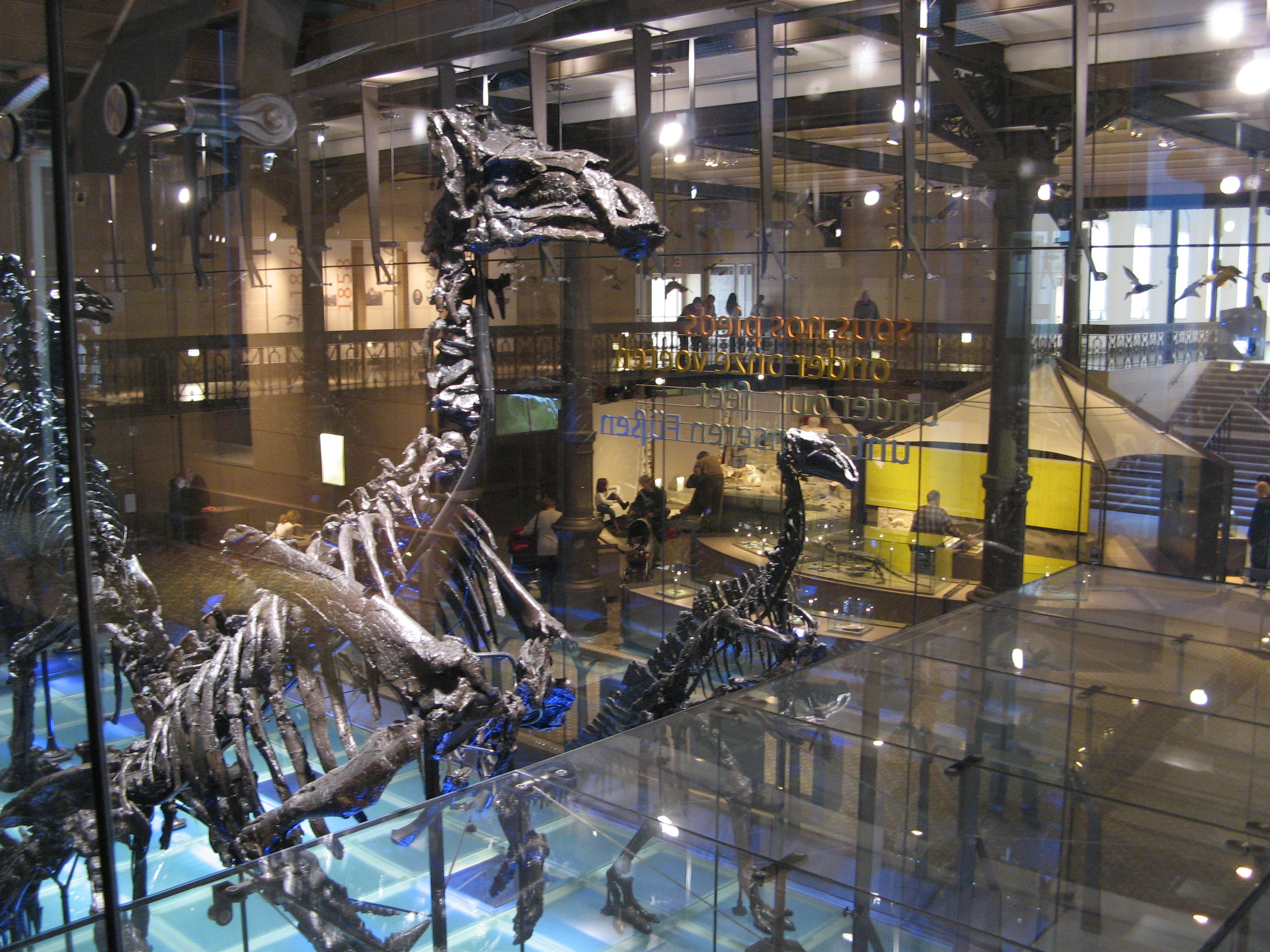
Mounted skeletons of Iguanodon bernissartensis and Mantellisaurus atherfieldensis at the Royal Belgian Institute of Natural Sciences, Brussels.
Wikimedia Commons — CC BY-SA
Ecology and behavior
Habitat
Iguanodon bernissartensis inhabited the coastal marshes and fluvial plains of the Barremian-Aptian of western Europe (~126–122 Ma). The Bernissart environment was a lacustrine system in a river valley, with warm and humid climate, covered by dense vegetation of conifers, cycads, pteridophytes, and basal angiosperms. Paleopalynology indicates the species frequented varied habitats, including riverbanks, floodplains, and dense forests in western Europe.
Feeding
Iguanodon bernissartensis was a broad-spectrum herbivore, capable of feeding both in quadrupedal position (low-growing vegetation) and briefly rearing into bipedal position (tree canopy). Paleobotanical studies indicate conifers and ferns were the main available food sources. The mandibular mechanism described by Weishampel (1984), with lateral movement of the maxillae (pleurokinesics), allowed efficient processing of fibrous vegetation. The 29 teeth per side in the upper jaw were continuously replaced throughout life.
Behavior and senses
The discovery of 38 skeletons together at Bernissart suggested gregarious behavior for Iguanodon bernissartensis, although the taphonomy of the site indicates accumulated death rather than necessarily a contemporaneous herd. The conical thumb spike was likely used as a defensive weapon against predators. Individual variation analyses in Bernissart specimens found no clear sexual dimorphism, suggesting males and females had similar size and morphology.
Physiology and growth
Iguanodon bernissartensis had ossified tendons along the vertebral column and tail, which stiffened the axial axis and likely aided in trunk support during quadrupedal locomotion. Bone histological analysis indicates rapid growth during the juvenile phase, with growth lines suggesting seasonality in growth rate. Metabolism was likely intermediate, characteristic of non-avian dinosaurs with accelerated growth rates compared to typical reptiles.
Paleogeography
Continental configuration

Ron Blakey · CC BY 3.0 · Cretáceous, ~90 Ma
During the Barremiano-Aptiano (~126–122 Ma), Iguanodon bernissartensis inhabited Laramidia, the western half of present-day North America, separated from the east by the Western Interior Seaway, a shallow sea dividing the continent. The continents were in very different positions: India was drifting toward Asia, Antarctica was still connected to Australia, and South America was an isolated island.
Inventário de Ossos
The discovery of 38 skeletons at Bernissart (1878) made Iguanodon bernissartensis one of the most complete dinosaurs in the fossil record. The Royal Belgian Institute of Natural Sciences in Brussels houses nine mounted skeletons and nineteen additional specimens in storage. The exceptional completeness of the material allowed detailed studies of individual variation, ontogeny, and biomechanics impossible for most other dinosaurs.
Found elements
Inferred elements
Scientific Literature
15 papers in chronological order — from the original description to recent research.
Notice on the Iguanodon, a newly discovered fossil reptile, from the sandstone of Tilgate Forest, in Sussex
Mantell, G.A. · Philosophical Transactions of the Royal Society of London
Gideon Mantell first presents Iguanodon fossil teeth to the scientific community, describing them as belonging to a giant herbivorous reptile. The identification of similarity with iguana teeth led to the generic name 'Iguanodon'. Although the material was fragmentary, the publication laid the groundwork for the study of herbivorous dinosaurs and was one of the first descriptions of a dinosaur in the history of paleontology. Mantell's work represented one of the founding milestones of dinosaur science.

On the ornithischian dinosaur Iguanodon bernissartensis from the Lower Cretaceous of Bernissart (Belgium)
Norman, D.B. · Mémoires de l'Institut Royal des Sciences Naturelles de Belgique
David Norman produces the most comprehensive anatomical study of Iguanodon bernissartensis, based on the 38 skeletons discovered at Bernissart (1878). The monograph describes in detail every bone of the skeleton, discussing individual variation, locomotor biomechanics, and posture. The work became the fundamental reference for all subsequent studies on the species, cited in virtually every publication on Iguanodon published in the following decades. The bipedal posture proposed by Norman was later revised to obligate quadruped.
Note sur l'ostéologie des Iguanodons de Bernissart
Dollo, L. · Bulletin du Musée Royal d'Histoire Naturelle de Belgique
Louis Dollo describes the Iguanodon bernissartensis skeletons discovered at Bernissart (1878) and oversees the mounting of the first complete dinosaur skeletons for public exhibition. Dollo's work established the bipedal posture with the tail as a support, which would influence depictions of the animal for over a century. Dollo's methodology for mounting and studying multiple specimens of the same species inaugurated an approach that would become standard in modern paleontology. Dollo also proposed the law of evolutionary irreversibility based on these studies.

A revised taxonomy of the iguanodont dinosaur genera and species
Paul, G.S. · Cretaceous Research
Gregory Paul carries out a comprehensive taxonomic revision of iguanodonts, proposing the separation of Iguanodon atherfieldensis into a distinct genus (Mantellisaurus). He restricts the diagnosis of Iguanodon bernissartensis as the sole valid representative of the genus Iguanodon sensu stricto. The paper significantly reorganized the classification of Early Cretaceous European iguanodonts, clarifying which specimens belong to which taxon and proposing precise morphological criteria for distinguishing Iguanodon from its close relatives.

Phylogeny of basal iguanodonts (Dinosauria: Ornithischia): an update
McDonald, A.T. · PLOS ONE
Andrew McDonald performs an exhaustive phylogenetic analysis of basal Iguanodontia, including virtually all valid taxa and using Iguanodon bernissartensis as a fundamental reference point. The analysis, published in PLOS ONE as open access, resolves several controversial relationships within the group and provides precise phylogenetic context for Iguanodon's position within derived ornithopods. The paper is widely cited in subsequent iguanodont research and demonstrates the centrality of I. bernissartensis as the anchor taxon of iguanodontia.
Basal Iguanodontia
Norman, D.B. · The Dinosauria (2nd edition), University of California Press
David Norman contributes the chapter on basal iguanodonts for the second edition of The Dinosauria, the reference work of dinosaur paleontology. The chapter revises the anatomy, phylogeny, and paleoecology of Iguanodon bernissartensis in light of advances from the 1980s-2000s. Norman discusses the animal's posture, locomotion, and biomechanics, recognizing the facultatively bipedal-quadrupedal nature suggested by the Bernissart material. The work is a fundamental reference for understanding the state of scientific knowledge about Iguanodon at the beginning of the 21st century.
Individual variation in the postcranial skeleton of the Early Cretaceous Iguanodon bernissartensis (Dinosauria: Ornithopoda)
Verdú, F.J., Godefroit, P., Royo-Torres, R., Cobos, A. e Alcalá, L. · Cretaceous Research
Verdú and colleagues perform a systematic analysis of individual variation in the postcranial bones of the Bernissart specimens, identifying significant variations in the axis, sacrum, caudal vertebrae, scapula, humerus, pollex, ilium, ischium, femur, and tibia. The study demonstrates that intraspecific morphological variation in I. bernissartensis is substantial, with implications for interpreting other ornithopods where only few specimens are known. The analysis found no definitive evidence of sexual dimorphism in the Bernissart collection.


Evolution of jaw mechanisms in ornithopod dinosaurs
Weishampel, D.B. · Advances in Anatomy, Embryology and Cell Biology
David Weishampel analyzes in detail the evolution of mandibular mechanisms in ornithopods, proposing a pleurokinesic model (lateral movement of the maxillae) for food processing in Iguanodon. The work established Iguanodon bernissartensis as a fundamental case study for understanding how ornithopods processed tough vegetation. Weishampel's model influenced decades of interpretations about ornithopod feeding and stimulated subsequent studies of mandibular biomechanics in multiple herbivorous dinosaur groups.


New Iguanodon bernissartensis axial bones (Dinosauria, Ornithopoda) from the Early Cretaceous of Morella, Spain
Verdú, F.J., Cobos, A., Royo-Torres, R. e Alcalá, L. · Diversity
Verdú and colleagues describe new axial materials of Iguanodon bernissartensis from the Morella locality, northeastern Spain, contributing to expanding the known geographic distribution of the species beyond Bernissart. Material from the Arcillas de Morella Formation includes dorsal vertebrae and other axial skeleton elements that can be confidently referred to I. bernissartensis based on a unique combination of shared characters. The paper demonstrates that I. bernissartensis was widely distributed across western Europe during the late Barremian.

Evolutionary trends in the jaw adductor mechanics of ornithischian dinosaurs
Nabavizadeh, A. · The Anatomical Record
Nabavizadeh analyzes the evolution of mandibular adductor muscles in ornithischian dinosaurs, with special focus on Ornithopoda including Iguanodon bernissartensis. The study uses moment-of-force analyses to infer bite capacity and food processing in different ornithischian groups. For Iguanodon, results indicate substantial bite force with the capacity to process tough vegetation, consistent with the generalist herbivore diet inferred for the species. The work connects mandibular morphology with ecological feeding strategies.
A new iguanodontian dinosaur from the Wealden Group (Lower Cretaceous) of the Isle of Wight, southern England
Lockwood, J.A.F., Martill, D.M. e Maidment, S.C.R. · Journal of Systematic Palaeontology
Lockwood and colleagues describe Brighstoneus simmondsi, a new iguanodontian from the Barremian-Aptian of the Wealden Group on the Isle of Wight, providing a new perspective on the diversity of European iguanodonts. The study performs a phylogenetic analysis positioning the new taxon relative to Iguanodon bernissartensis, demonstrating that the Wealden fauna was more diverse than previously recognized. The work has direct implications for understanding the environment and biogeographic relationships of Early Cretaceous European iguanodonts.
The last polar dinosaurs: high diversity of latest Cretaceous arctic dinosaurs in Russia
Godefroit, P., Golovneva, L., Shchepetov, S., Garcia, G. e Alekseev, P. · Naturwissenschaften
Godefroit and colleagues document the diversity of late Cretaceous dinosaurs in the Arctic regions of Russia, including ornithopods related to Iguanodon. The paper provides context about the broad biogeographic distribution of Eurasian iguanodonts, demonstrating that the group including Iguanodon bernissartensis was capable of inhabiting extreme latitudes. This study contributes to understanding the geographic extent of styracosternans and the climatic conditions that allowed colonization of high-latitude environments.

Histological analysis and etiology of a pathological iguanodontian femur from England
Bertozzo, F., Manucci, F. e Ferrara, A. · Journal of Anatomy
Bertozzo and colleagues analyze a pathological iguanodontian femur from England using microCT and bone histology. Histology indicates an early adult stage of the animal, and internal analysis of the anomalous bone growth diagnoses a fracture callus, demonstrating that the animal survived a serious bone injury. The work shows that iguanodonts like I. bernissartensis had the capacity to heal bone fractures, contributing to understanding physiological and behavioral aspects of these large ornithopods. The application of microCT on fossils is highlighted as a central tool for modern paleohistology.


A new sauropod dinosaur from the Late Jurassic of Portugal, phylogenetic and paleo-biogeographic implications
Díez Díaz, V., Mocho, P., Páramo, A., Escaso, F., Marcos-Fernández, F., Sanz, J.L. e Ortega, F. · Journal of Iberian Geology
Díez Díaz and colleagues describe a new sauropod from the Late Jurassic of Portugal and perform phylogenetic and paleobiogeographic analysis of European Mesozoic fauna. The paper is relevant to Iguanodon bernissartensis by contextualizing the biogeography of European dinosaurs, demonstrating faunal connections between western Europe and other regions during the Jurassic-Cretaceous. The Iberian Platform was a center of dinosaur diversification that preceded and influenced the Early Cretaceous fauna where Iguanodon lived.

Perinates of a new species of Iguanodon (Ornithischia: Ornithopoda) from the lower Barremian of Galve (Teruel, Spain)
Verdú, F.J., Cobos, A., Royo-Torres, R., Luque, L. e Alcalá, L. · Cretaceous Research
Verdú and colleagues describe perinatal specimens of a new Iguanodon species from the Camarillas Formation (lower Barremian) of Galve, Spain, providing unique data on the initial ontogeny of the genus. The study is directly relevant to Iguanodon bernissartensis, as it allows inference of early developmental characteristics of these large ornithopods. Perinatal specimens demonstrate that iguanodont hatchlings are born with morphology already recognizable as iguanodontian, with cranial and dental proportions indicating herbivory from early age.


Espécimes famosos em museus
Coleção de Bernissart (38 espécimes, IRSNB vários números)
Institut Royal des Sciences Naturelles de Belgique, Bruxelas, Bélgica
The discovery of 38 Iguanodon bernissartensis skeletons in the Bernissart coal mine (1878) is one of the most important events in the history of paleontology. The Royal Belgian Institute of Natural Sciences in Brussels displays nine mounted skeletons and preserves nineteen additional specimens, constituting the largest known collection of a single dinosaur taxon. The collection is an internationally recognized heritage site.
NHMUK PV OR 3791 (Espécime Maidstone)
Natural History Museum, Londres, Reino Unido
The Maidstone specimen (NHMUK PV OR 3791) was the first partial Iguanodon skeleton described, acquired by Gideon Mantell in 1834. Still preserved in part of the original rock, the specimen first revealed the animal's general proportions. The coat of arms of the city of Maidstone was modified to include the image of an Iguanodon in honor of the discovery, one of the rare cases where a dinosaur influenced municipal heraldry.
In cinema and popular culture
Iguanodon bernissartensis has a unique pop culture history: it was one of the first dinosaurs to enter the modern public imagination, in the Crystal Palace Park models (1853), and remains relevant in the 21st century. Disney's 'Dinosaur' (2000) animation placed an iguanodont as the protagonist of a feature film, making Iguanodon known to generations of children as an unlikely prehistoric hero. The film presents Aladar, an iguanodont with great empathy and courage, a narrative achievement that humanizes a 4.5-tonne animal. The British series 'Primeval' (2007) used the animal as a present-day creature invader, while high-quality documentaries like 'Planet Dinosaur' (2011) and 'Prehistoric Planet' (2022) depicted Iguanodon with increasing scientific accuracy, reflecting the biomechanical revisions that revealed its quadrupedal nature.

Classificação
Descoberta
Curiosidade
Iguanodon was the second dinosaur to receive a formal scientific name in history (1825), shortly after Megalosaurus (1824). Before discovering that its conical thumb spike belonged to the thumb, 19th century scientists erroneously placed it on the nose, as seen in the Crystal Palace Park models in London (1853) that still exist today. For decades, the name 'Iguanodon' appeared in encyclopedias with a creature resembling a prehistoric rhinoceros.