
Mapusaurus roseae
Mapusaurus roseae
"Earth lizard (of the rose-colored rocks)"
Sobre esta espécie
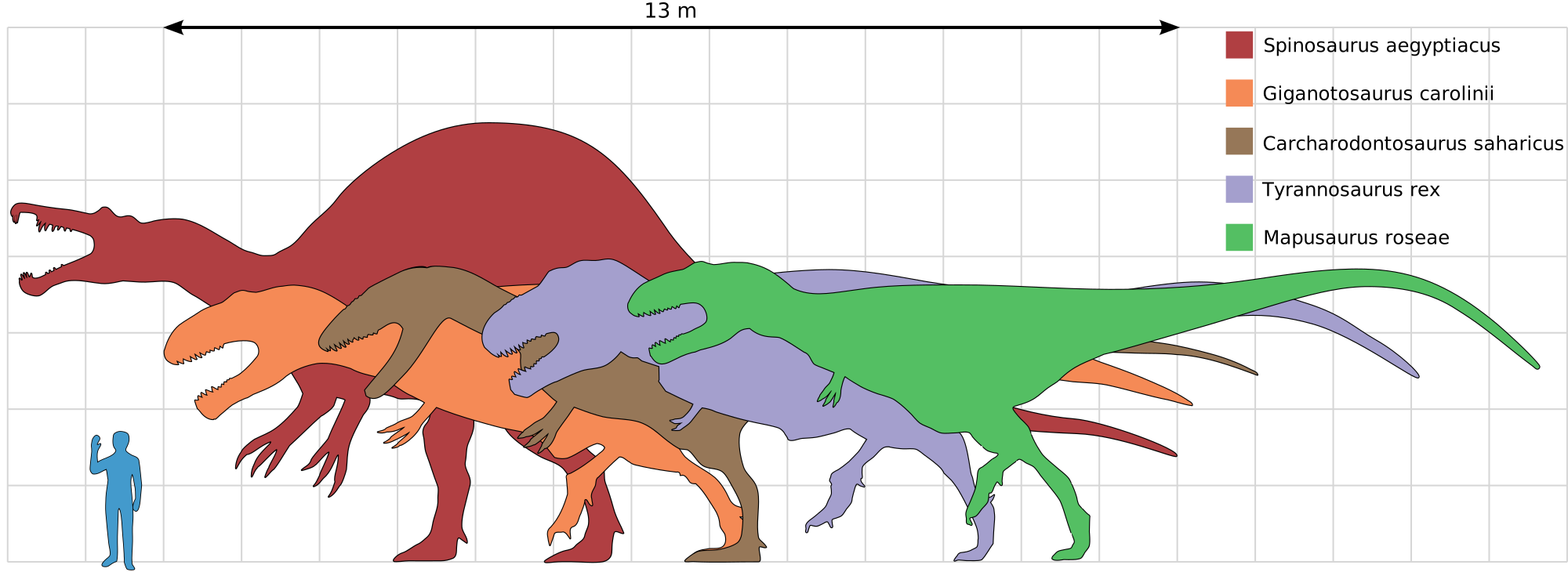
Mapusaurus roseae was one of the largest terrestrial predators of the Late Cretaceous, inhabiting what is now Argentine Patagonia approximately 97 to 93 million years ago. A member of Carcharodontosauridae, this giant theropod reached 10 to 13 meters in length and weighed between 3 and 6 tonnes. Its skull was deeper and narrower than that of its close relative Giganotosaurus, with characteristic rugose nasals. The discovery of a bonebed containing at least seven to nine individuals of varying ages in the Huincul Formation led researchers to suggest Mapusaurus may have lived and hunted in groups, possibly cooperating to bring down giant prey such as Argentinosaurus.
Geological formation & environment
The Huincul Formation is a Cenomanian to Early Turonian geological unit (97 to 93 Ma) of the Neuquén Basin, outcropping in the provinces of Mendoza, Río Negro, and Neuquén in northern Argentine Patagonia. It is mainly composed of green and yellow sandstones with claystone interbeds, up to 250 meters thick. The paleoenvironment is interpreted as arid to semi-arid, with ephemeral watercourses in a braided river system. The formation is one of Patagonia's richest fossiliferous deposits, preserving giant titanosaurs like Argentinosaurus, theropods like Mapusaurus and other carcharodontosaurids, plus a diverse fauna of crocodilians, turtles, reptiles, and flora of over 40 pollen taxa.
Image gallery
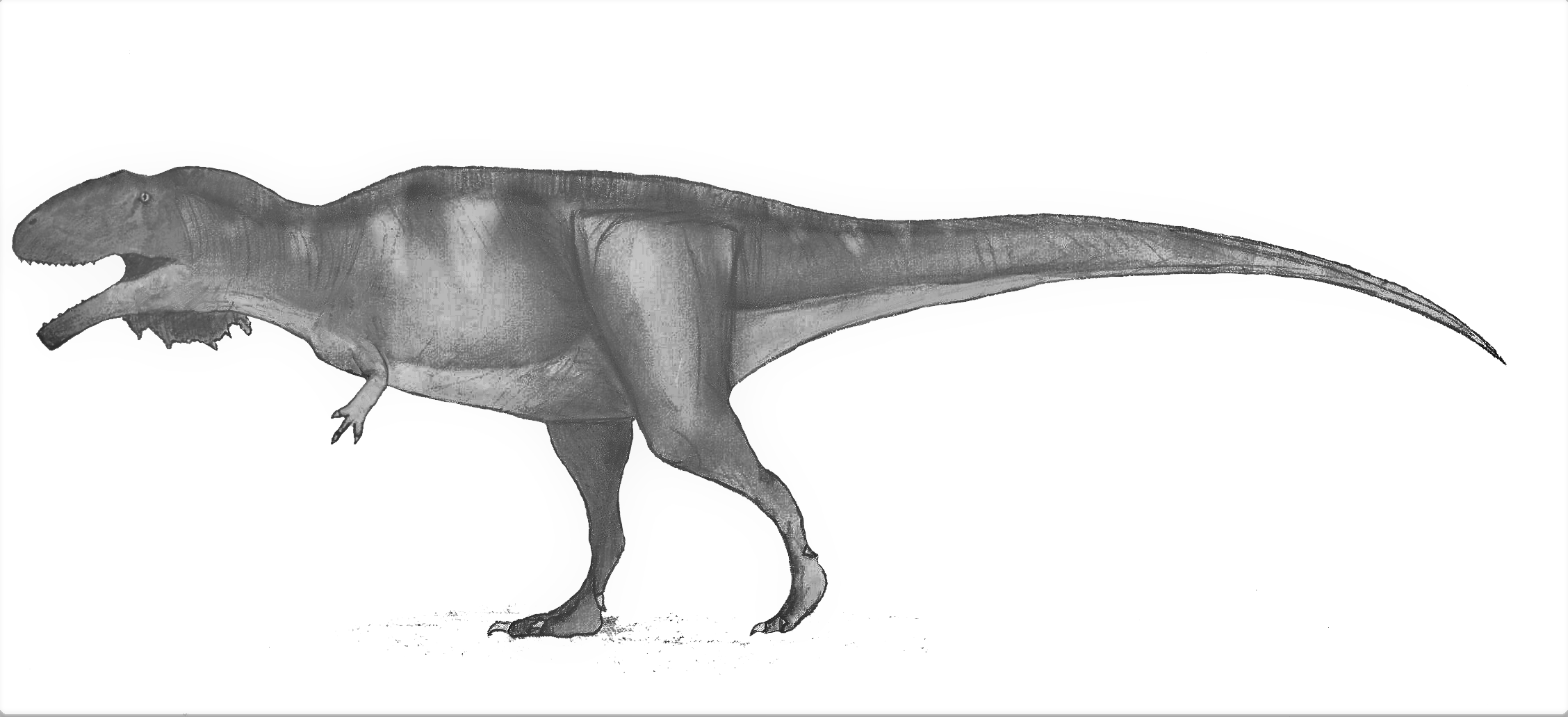




Artistic restoration of Mapusaurus roseae in lateral view, based on a skeletal diagram by Franoys. This is one of the most widely used life restorations for the species.
KoprX, CC BY-SA 4.0
Ecology and behavior
Habitat
Mapusaurus inhabited what is now Argentine Patagonia during the Cenomanian, 97 to 93 million years ago. The paleoenvironment of the Huincul Formation was arid to semi-arid, with ephemeral or seasonal watercourses in a braided river system. Vegetation included ferns, conifers, gnetophytes, and flowering plants at an early stage of expansion. The same ecosystem harbored giant titanosaurs like Argentinosaurus and Choconsaurus, rebbachisaurids, abelisaurids, paravians, crocodilians, chelid turtles, and squamates.
Feeding
Mapusaurus was an apex predator with laterally compressed serrated teeth adapted for slicing the flesh of large prey. The most discussed hypothesis is that groups of Mapusaurus cooperatively hunted giant titanosaurs like Argentinosaurus, which could reach 30 to 40 meters and was considered immune to solitary predators. The presence of multiple individuals of different ages in the bonebed suggests habitual interspecific association. Biomechanical studies indicate that at 3-6 tonne body mass, maximum speed was below 20 km/h, favoring ambush tactics or collective attrition against sauropods.
Behavior and senses
The monospecific bonebed at Cañadón del Gato, with at least seven to nine individuals of different ages, is the strongest evidence for gregarious behavior in a carcharodontosaurid. Researchers including Rodolfo Coria and Philip Currie interpreted the site as indicating Mapusaurus lived and possibly hunted in groups, although taphonomic accumulation through other factors (such as drought mortality events) cannot be ruled out. Bell & Coria's (2013) paleopathological study revealed bone traumas consistent with an active and hazardous lifestyle, possibly including intra or interspecific conflicts.
Physiology and growth
As a large theropod, Mapusaurus likely had endothermic or mesothermic metabolism, similar to that demonstrated by bone histology in tyrannosaurids (Erickson et al., 2004). Forelimbs were vestigial relative to body size, a convergent trend with tyrannosaurids and abelisaurids documented by Canale et al. (2022) in Meraxes. The prominent fourth trochanter on the femur is a diagnostic character of clade Giganotosaurini. Maximum speed estimates based on giant theropod biomechanics fall below 20 km/h for individuals of 3 tonnes or more.
Paleogeography
Continental configuration

Ron Blakey · CC BY 3.0 · Cretáceous, ~90 Ma
During the Cenomaniano (~97–93 Ma), Mapusaurus roseae inhabited Laramidia, the western half of present-day North America, separated from the east by the Western Interior Seaway, a shallow sea dividing the continent. The continents were in very different positions: India was drifting toward Asia, Antarctica was still connected to Australia, and South America was an isolated island.
Inventário de Ossos
Known from a bonebed with at least seven to nine individuals (MCF-PVPH-108), representing different growth stages. The holotype is right nasal MCF-PVPH-108.1, housed at the Museo Carmen Funes, Plaza Huincul, Argentina. Cranial and postcranial elements have been recovered, but no single individual skeleton is complete.

Found elements
Inferred elements
Scientific Literature
15 papers in chronological order — from the original description to recent research.
A new carcharodontosaurid (Dinosauria, Theropoda) from the Upper Cretaceous of Argentina
Coria, R.A. & Currie, P.J. · Geodiversitas
Founding paper formally describing Mapusaurus roseae based on material from a monospecific bonebed in the Huincul Formation, Neuquén, Argentina. Rodolfo Coria and Philip Currie analyze cranial and postcranial elements from at least seven individuals of different sizes, diagnose the new genus and species, and perform phylogenetic analysis placing Mapusaurus within a new subfamily, Giganotosaurinae, more closely related to Giganotosaurus than to Carcharodontosaurus. The paper describes the deeper and narrower skull compared to Giganotosaurus, fused rugose nasals, and proportionally shorter cervical vertebrae. The presence of multiple individuals of varying ages at the same site led the authors to hypothesize gregarious behavior or cooperative hunting against giant prey like Argentinosaurus. Published in Geodiversitas 28(1):71-118, this work is the primary taxonomic reference for the species.
A new giant carnivorous dinosaur from the Cretaceous of Patagonia
Coria, R.A. & Salgado, L. · Nature
Description of Giganotosaurus carolinii, the closest South American relative of Mapusaurus and coexistent in the same Patagonian region. This Nature paper is fundamental for contextualizing Mapusaurus: both species form the tribe Giganotosaurini within Carcharodontosauridae, defined by Coria & Currie (2006) when describing Mapusaurus. Coria & Salgado establish diagnostic characters of Giganotosaurus, such as the proportionally low skull and reduced shoulder girdle, which would serve as the basis for anatomical comparisons Coria would use ten years later to separate Mapusaurus as a distinct genus. The discovery of a giant South American carcharodontosaurid also paved the way for accepting Mapusaurus as the apex predator of the Cenomanian Patagonia.
Palaeopathological Survey of a Population of Mapusaurus (Theropoda: Carcharodontosauridae) from the Late Cretaceous Huincul Formation, Argentina
Bell, P.R. & Coria, R.A. · PLOS ONE
Phil Bell and Rodolfo Coria examine 176 skeletal elements from at least nine Mapusaurus individuals from the monospecific bonebed of the Huincul Formation and identify five bones with pathologies. Lesions include traumatic fractures, infectious erosions, and developmental anomalies in a cervical vertebra, ribs, phalanx, and ilium. The anomaly rate (7-19% of individuals) is compared with tyrannosaurid and allosaurid populations, reflecting an active and hazardous lifestyle for these apex predators. The study is pioneering in applying population paleopathology to carcharodontosaurids, providing unprecedented data on behavior and life risks in a poorly known dinosaur group. Trauma evidence is consistent with active predatory behavior against large-bodied prey.
Cranial ontogenetic variation in Mapusaurus roseae (Dinosauria: Theropoda) and the probable role of heterochrony in carcharodontosaurid evolution
Canale, J.I., Novas, F.E., Salgado, L. & Coria, R.A. · Paläontologische Zeitschrift
Canale, Novas, Salgado, and Coria analyze cranial ontogenetic variation in multiple Mapusaurus roseae individuals from the Huincul Formation bonebed. The study demonstrates significant differences in the maxillary fenestra and surface bone texture between individuals of different sizes, indicating heterochrony: differing developmental rates of cranial features relative to overall body growth. The authors suggest this pattern may have played an evolutionary role in cranial diversification of carcharodontosaurids as a group. The work is fundamental for understanding how Mapusaurus grew and how the bonebed represents a multi-ontogenetic sample of the population. Published in Paläontologische Zeitschrift 89, 983-993, 2015, the paper strengthens the interpretation that the bonebed preserves individuals of different ages from the same group.


The phylogeny of Tetanurae (Dinosauria: Theropoda)
Carrano, M.T., Benson, R.B.J. & Sampson, S.D. · Journal of Systematic Palaeontology
Comprehensive phylogenetic analysis of Tetanurae by Carrano, Benson, and Sampson, coding 65 taxa and 290 morphological characters, with direct implications for Mapusaurus's position within Carcharodontosauridae. The work confirms Mapusaurus and Giganotosaurus as sister taxa in tribe Giganotosaurini, and firmly places Carcharodontosauridae within Allosauroidea. The authors discuss that they could not identify unambiguous autapomorphies separating Mapusaurus from Giganotosaurus based solely on postcranial morphology, but maintain both as distinct genera. The work provides the most complete tetanuran phylogenetic matrix published to that date and is widely cited in all subsequent carcharodontosaurid studies, including analyses incorporating Meraxes (2022) and new African carcharodontosaurids (2025).

New giant carnivorous dinosaur reveals convergent evolutionary trends in theropod arm reduction
Canale, J.I., Apesteguía, S., Gallina, P.A., Mitchell, J., Smith, N.D., Cullen, T.M., Shinya, A., Haluza, A., Gianechini, F.A. & Makovicky, P.J. · Current Biology
Description of Meraxes gigas, a new giant carcharodontosaurid from the Huincul Formation, Argentina, whose phylogenetic analyses place it as the most basally branching member of tribe Giganotosaurini, as sister taxon to the clade formed by Mapusaurus and Giganotosaurus. Canale et al. (2022) in Current Biology has direct implications for understanding Mapusaurus evolution: it demonstrates that forelimb reduction in large theropods is a convergent independent trend across different lineages (carcharodontosaurids, tyrannosaurids, abelisaurids), not an inheritance from a common ancestor. The study updates the phylogenetic tree of Carcharodontosauridae and provides new divergence time estimates between Mapusaurus and its relatives, showing that tribe Giganotosaurini diversified mainly in South America during the Cretaceous.
Predatory dinosaurs from the Sahara and Late Cretaceous faunal differentiation
Sereno, P.C., Dutheil, D.B., Iarochene, M., Larsson, H.C.E., Lyon, G.H., Magwene, P.M., Sidor, C.A., Varricchio, D.J. & Wilson, J.A. · Science
Seminal paper by Paul Sereno and coauthors re-describing Carcharodontosaurus saharicus based on African material and positioning it as a close relative of South American carcharodontosaurids, including the clade that would come to include Mapusaurus. The biogeographic analysis demonstrates faunal connections between Africa and South America during the Cretaceous, when both continents were still closer before the full opening of the South Atlantic. This work establishes the essential paleobiogeographic context for understanding why Mapusaurus exists in Patagonia: carcharodontosaurids originated in Gondwana and diversified in parallel on South American and African landmasses. Sereno et al. (1996) in Science is widely cited in all Mapusaurus papers as the basis for discussing the family's historical biogeography.

A 3D interactive method for estimating body segmental parameters in animals: application to the turning and running performance of Tyrannosaurus rex
Hutchinson, J.R., Ng-Thow-Hing, V. & Anderson, F.C. · Journal of Theoretical Biology
Hutchinson, Ng-Thow-Hing, and Anderson develop 3D interactive methods for estimating body segment parameters in extinct animals and apply them to giant theropods. Locomotor performance estimates are especially relevant for Mapusaurus, whose bonebed led to speculation about group hunting against Argentinosaurus. The study demonstrates that for individuals above 3 tonnes, maximum sustainable speeds fall below 20 km/h, implying that large sauropod hunting by carcharodontosaurids depended more on strategy and collective force than on individual speed. The paper contextualizes biomechanics and behavior in giant predators of the dinosaur age and is a mandatory reference for discussion of Mapusaurus locomotor capabilities.
Gigantism and comparative life-history parameters of tyrannosaurid dinosaurs
Erickson, G.M., Makovicky, P.J., Currie, P.J., Norell, M.A., Yerby, S.A. & Brochu, C.A. · Nature
Although focused on tyrannosaurids, this paper by Erickson et al. establishes the bone histology method for estimating growth rates in giant theropods that would be applied by subsequent researchers to carcharodontosaurids like Mapusaurus. The study demonstrates endothermic metabolism in large theropods based on explosive adolescent growth, with T. rex gaining over 700 kg per year. These growth patterns have implications for interpreting the Mapusaurus bonebed: if carcharodontosaurids shared similar growth rates to tyrannosaurids, the very differently sized individuals in the bonebed could represent a relatively small age range, reinforcing the family group or multigenerational herd hypothesis. Erickson et al.'s histological method is the methodological foundation for any future growth study on Mapusaurus.

A bizarre Cretaceous theropod dinosaur from Patagonia and the evolution of Gondwanan theropods
Novas, F.E., Pol, D., Canale, J.I., Porfiri, J.D. & Calvo, J.O. · Proceedings of the Royal Society B
Novas, Pol, Canale, Porfiri, and Calvo describe a new bizarre Patagonian theropod and discuss Gondwanan theropod evolution during the Cretaceous, including phylogenetic and biogeographic context for carcharodontosaurids like Mapusaurus. The work helps understand the diversity of apex predators inhabiting the same region and time period as Mapusaurus, offering evidence that Gondwanan continents maintained limited faunal exchanges with the Northern Hemisphere during the Late Cretaceous. Novas et al. (2009) in Proceedings of the Royal Society B is widely cited in discussions of Gondwanan theropod biogeography and evolutionary isolation that led to independent diversification of groups like giganotosaurines in South America.


Re-evaluation of the Bahariya Formation carcharodontosaurid (Dinosauria: Theropoda) and its implications for allosauroid phylogeny
Kellermann, M., Cuesta, E. & Rauhut, O.W.M. · PLOS ONE
Kellermann, Cuesta, and Rauhut reexamine a destroyed Egyptian carcharodontosaurid specimen using historical photographs and propose a new genus, Tameryraptor markgrafi, separate from Carcharodontosaurus saharicus. The phylogenetic analysis included in the paper, published in PLOS ONE in 2025, confirms Mapusaurus and Giganotosaurus as sister taxa in Giganotosaurini and presents the most updated phylogenetic matrix of Allosauroidea. The work has direct implications for carcharodontosaurid biogeography: the separation of African and South American species into distinct genera reinforces the vicariant diversification scenario following Gondwana fragmentation. This is the most recent high-relevance paper including phylogenetic analysis positioning Mapusaurus and discussing the family's evolutionary history.

New theropod fauna from the Upper Cretaceous (Huincul Formation) of northwestern Patagonia
Pol, D. & Novas, F.E. · Journal of Vertebrate Paleontology
Pol and Novas describe new theropod fauna from the Huincul Formation of northwestern Patagonia, documenting faunal diversity of the Cenomanian-Turonian Patagonian ecosystem contemporaneous with Mapusaurus. The work records carcharodontosaurids, abelisaurids, and paravians from the same formation, indicating Mapusaurus coexisted with other predators of different sizes and ecological strategies. The coexistence of a giant apex predator like Mapusaurus with medium-sized abelisaurids and smaller paravians suggests ecological niche partitioning, with each group exploiting different prey classes. This paper is fundamental for understanding the ecological context in which Mapusaurus lived and the biological interactions that shaped the Huincul Formation ecosystem during the Cenomanian.


Rates of dinosaur body mass evolution indicate 170 million years of sustained ecological innovation on the avian stem lineage
Benson, R.B.J., Campione, N.E., Carrano, M.T., Mannion, P.D., Sullivan, C., Upchurch, P. & Evans, D.C. · PLOS Biology
Benson et al. analyze body mass evolution rates across the entire dinosaur phylogeny, including carcharodontosaurids like Mapusaurus. The study demonstrates that the avian lineage (leading to modern birds) maintained sustained ecological innovation for 170 million years, while lineages like carcharodontosaurids evolved gigantism as a niche specialization for apex predators. Mapusaurus data (3-6 tonnes) is incorporated into the macroscopic analysis, and the paper provides the broadest evolutionary context for understanding why Mapusaurus and its relatives achieved such extreme sizes. Published in PLOS Biology, the work is a reference for macroecological dinosaur studies and includes Mapusaurus in comparative analyses of body mass evolution in Carnosauria.


A reappraisal of the Cretaceous non-avian dinosaur faunas from Australia and New Zealand: evidence for their Gondwanan affinities
Agnolin, F.L., Ezcurra, M.D., Pais, D.F. & Salisbury, S.W. · Journal of Systematic Palaeontology
Agnolin et al. reassessed non-avian dinosaur faunas from Cretaceous Australia and New Zealand, documenting Gondwanan affinities with South American and African faunas. The work has implications for understanding the biogeographic distribution of carcharodontosaurids like Mapusaurus in the context of Gondwana fragmentation. Analysis suggests that faunal connections between Gondwanan landmasses during the Cretaceous were more extensive than previously thought, helping explain the disjunct geographic distribution of Carcharodontosauridae between South America, Africa, and Asia. The paper provides complementary biogeographic context for understanding why predators so similar to Mapusaurus evolved in different parts of the ancient Gondwana supercontinent.


The non-avian theropod quadrate I: standardized terminology with an overview of the anatomy, and phylogenetic utility of the lower jaws in non-avian theropods
Hendrickx, C., Araújo, R. & Mateus, O. · PLOS ONE
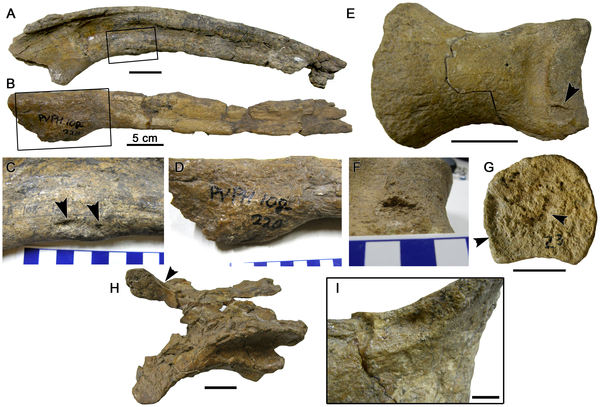
Hendrickx, Araújo, and Mateus propose standardized terminology for theropod quadrate morphology and document the comparative anatomy of this bone across various lineages, including carcharodontosaurids like Mapusaurus. The quadrate is demonstrated as a highly phylogenetically useful element, with pneumatic features being particularly diagnostic at family and genus levels. The image published in the article, available on Wikimedia Commons, shows pneumatic openings in the quadrate of multiple theropods including carcharodontosaurids, allowing direct comparison with Mapusaurus material. Published in PLOS ONE, the work is a reference for comparative cranial anatomy in theropods and was widely used in subsequent carcharodontosaurid studies like Kellermann et al. (2025).


Espécimes famosos em museus
MCF-PVPH-108 (Bonebed Collection)
Museo Carmen Funes, Plaza Huincul, Neuquén, Argentina
The holotype (MCF-PVPH-108.1, right nasal) and 12 paratypes make up the collection from the monospecific bonebed at Cañadón del Gato. Specimens represent at least seven to nine individuals of different ages, excavated between 1997 and 2001. The collection is housed at Museo Carmen Funes and is under continuous preparation.
Montagem de Réplica (Pai e Filhote)
Nagoya City Science Museum, Nagoya, Japão
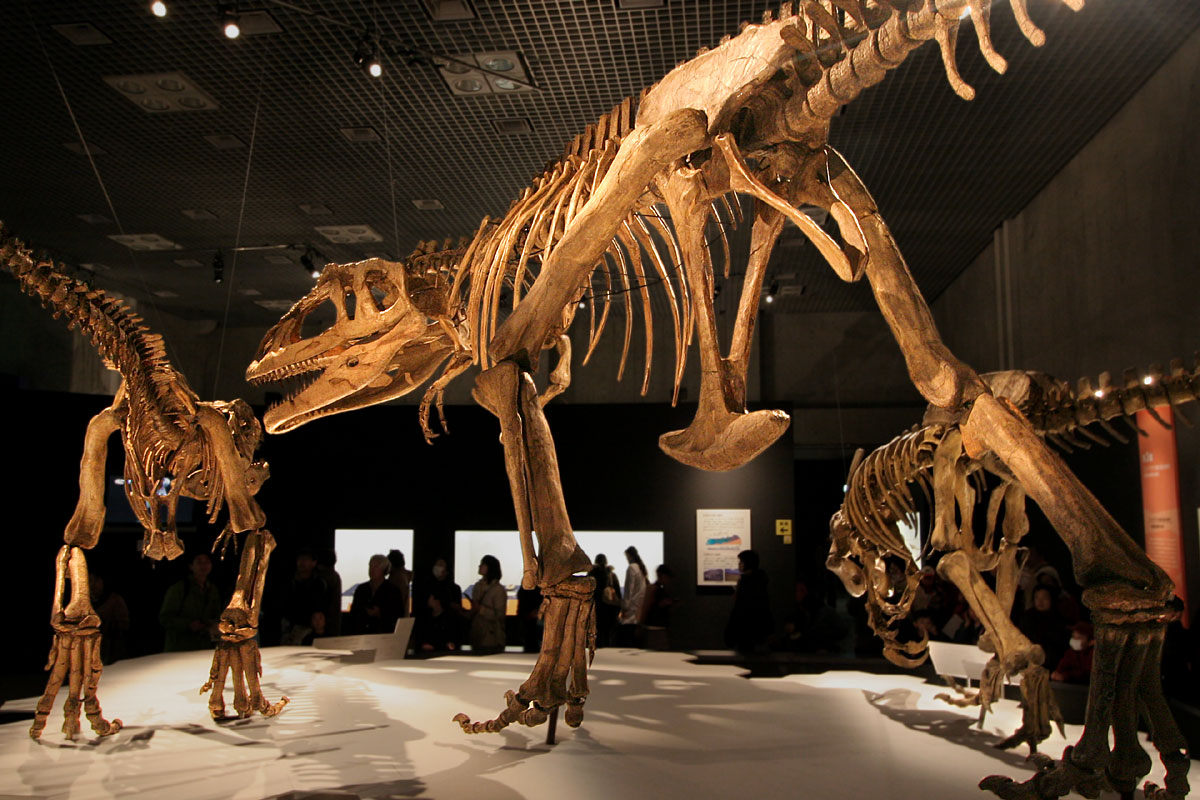
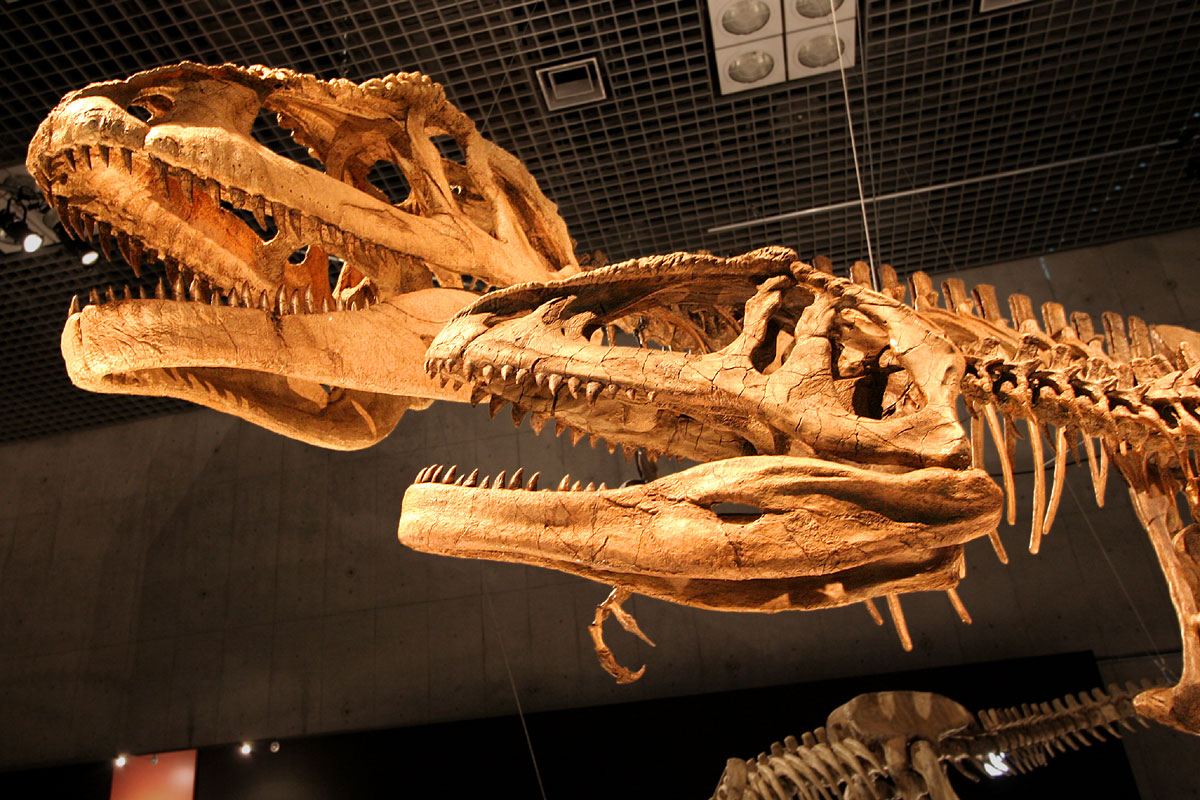
Nagoya City Science Museum displays a unique replica mount of Mapusaurus roseae depicting two individuals: an adult and a juvenile, a hypothesis based on the presence of multiple size classes in the bonebed. The mount was conceived to illustrate the gregarious behavior hypothesis and possibly parental care in carcharodontosaurids.
In cinema and popular culture
Mapusaurus broke into popular culture forcefully after the publication of its scientific description in 2006, but it was Planet Dinosaur (BBC, 2011) that made it known to the general public. In the 'New Giants' episode, scenes of Mapusaurus hunting in a group the colossal Argentinosaurus became among the most memorable in dinosaur documentary history. The narrative of gregarious behavior captured public imagination in a way few dinosaurs achieve: here was not just one enormous predator, but a team of enormous predators taking on the most gigantic prey the Earth ever produced. In the Jurassic Park franchise, Mapusaurus was absent from the main films until 2024, when it first appeared in the Jurassic World: Epic Evolution toy line, associated with Netflix's Chaos Theory animated series. This delay reflects the franchise's historical tendency to favor tyrannosaurids and velociraptors, but growing scientific interest in carcharodontosaurids, driven by discoveries like Meraxes gigas (2022), is bringing more attention to this group. In the Dinosaur King card game and anime (Sega), Mapusaurus gained supernatural fire powers far removed from real biology, but which consolidated its presence in Japanese pop culture. Mapusaurus's media presence is growing as audiences open up to giant predators beyond T. rex.

Classificação

Descoberta
Curiosidade
The name roseae honors two things simultaneously: the rose-colored rocks of the Huincul Formation where the fossils were found, and Rose Letwin, a sponsor of the Argentina-Canada Dinosaur Project that made the excavations possible.