
Microraptor gui
Microraptor gui
"Small thief of Gui"
Sobre esta espécie
Microraptor gui is one of the most extraordinary dinosaurs ever discovered: a four-winged dromaeosaurid approximately 77 centimeters long and weighing about 1 kilogram, living in what is now Liaoning, China, between 125 and 120 million years ago. Its body was covered in aerodynamically preserved feathers in remarkable detail, including long flight feathers on the hindlimbs as well as the forelimbs. The plumage was iridescent black, similar to that of a modern starling. It is considered fundamental evidence in the debate about the origin of avian flight, demonstrating that the four-surface aerodynamic configuration predated modern birds and was functional in the Early Cretaceous.
Geological formation & environment
The Jiufotang Formation is an Early Cretaceous (Aptian, approximately 125 to 120 million years ago) geological unit located in Liaoning Province, northeastern China. It belongs to the Jehol Group, one of the most important Mesozoic fossil deposits. The formation is composed primarily of fine shales, volcanic tuffs, and lacustrine limestones deposited in a lacustrine environment within a tectonic basin. The anoxic conditions of the lake bottoms, combined with rapid burial by volcanic ash, created exceptional preservation conditions for organisms with soft tissues, including feathers, scales, and stomach contents. The Jiufotang Formation has produced hundreds of Microraptor specimens and dozens of other Jehol Biota taxa, including birds, pterosaurs, fish, lizards, and plants.
Image gallery

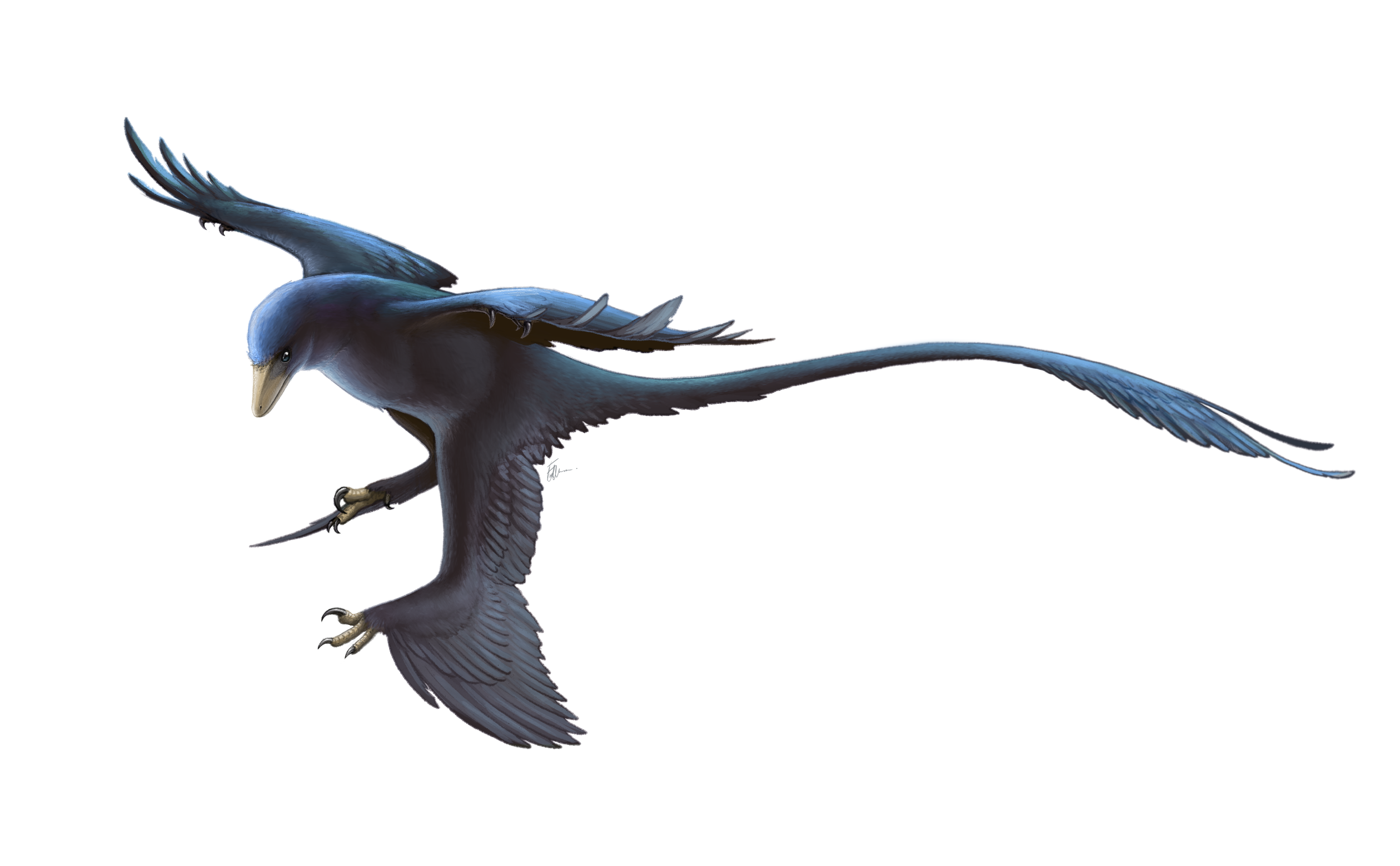


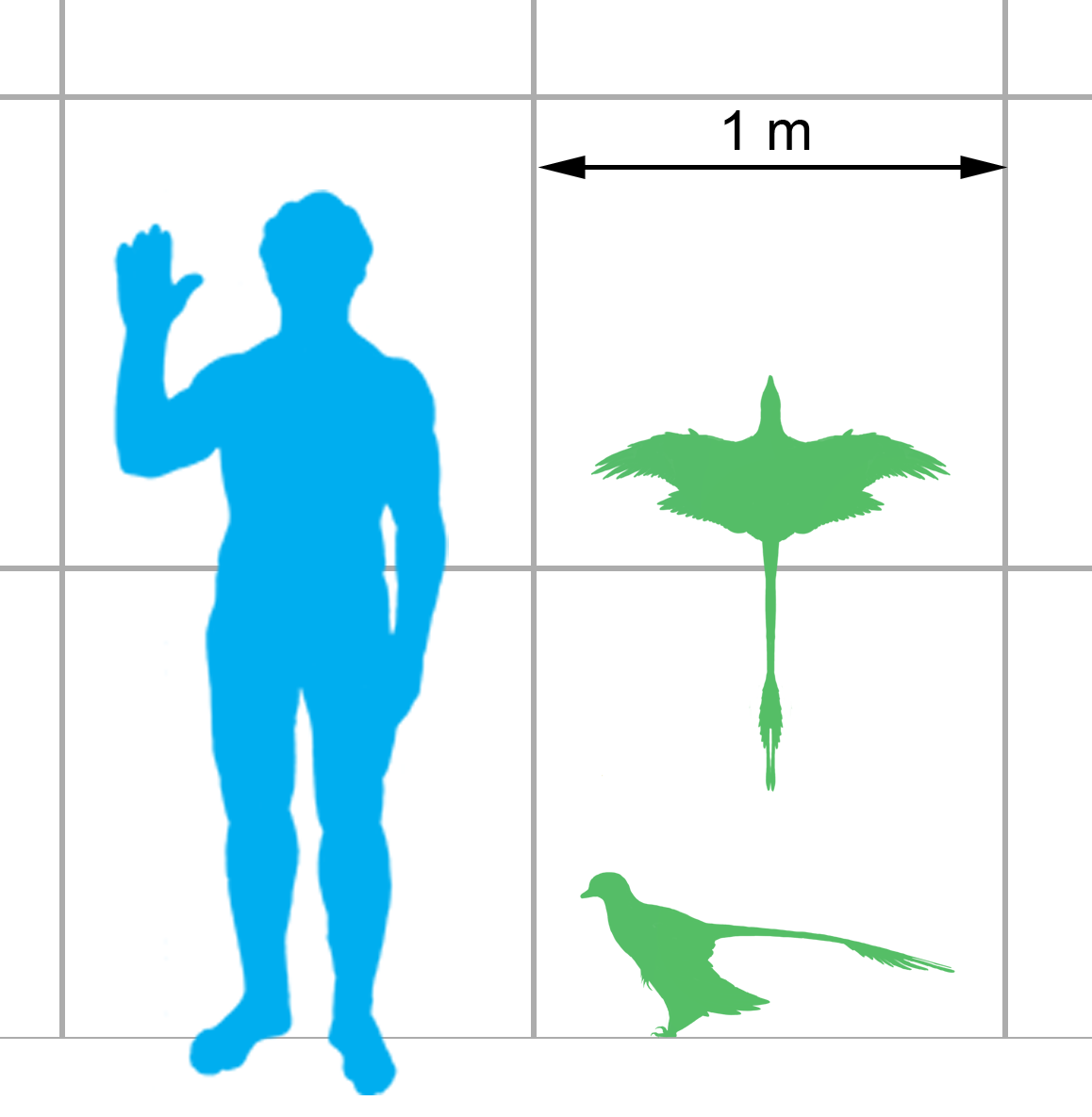

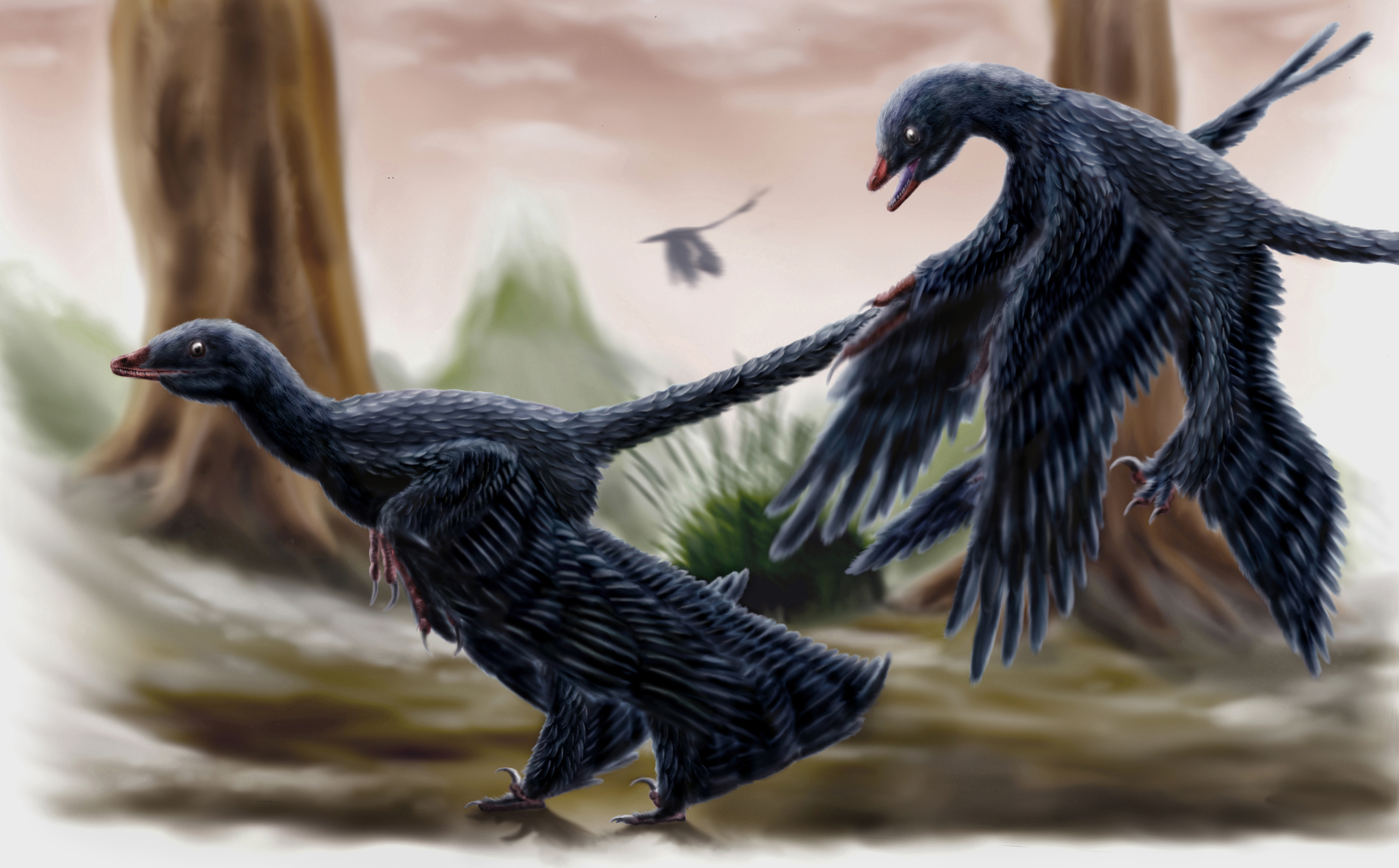


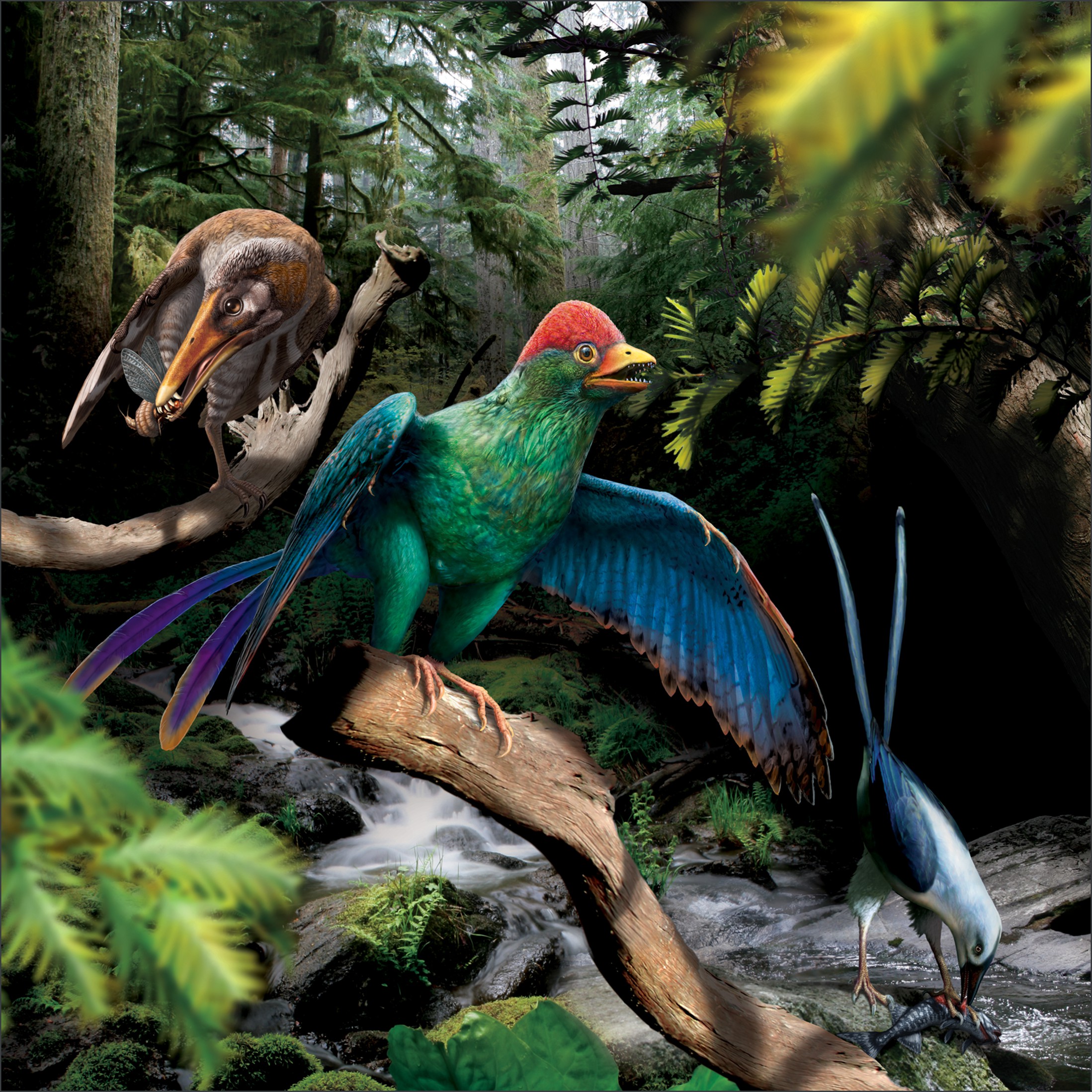
Reconstruction of Microraptor gui with iridescent black coloration based on Li et al.'s (2012) melanosome analysis, showing the four wings and fan-shaped tail.
Entelognathus — CC BY-SA 4.0
Ecology and behavior
Habitat
Microraptor gui inhabited the riverine and lacustrine forests of the Jehol Biota in Early Cretaceous Liaoning, China, 125 to 120 million years ago. The environment was a mosaic of dense forests with conifers, cycads, and ginkgos, interspersed with shallow lakes and rivers with rich fish fauna. The climate was warm and humid with distinct seasons. Associated fauna included pterosaurs, enantiornithine birds, small mammals such as Eomaia, lizards, fish, and a wide variety of invertebrates. The Jehol Biota is considered one of the best-documented Cretaceous ecosystems in the world.
Feeding
Microraptor was a remarkably versatile generalist predator, with direct fossil evidence of four prey categories: fish (scales preserved in the stomach), enantiornithine birds (bones swallowed head-first), mammals (small mammal bones similar to Eomaia), and lizards (the lizard Indrasaurus preserved whole in the stomach). The dentition with teeth with constricted bases and variable inclination in the anterior teeth indicates adaptations for different prey types. This dietary versatility suggests an opportunistic predator capable of exploiting aquatic, arboreal, and terrestrial environments.
Behavior and senses
Microraptor's behavior was primarily arboreal, based on the foot morphology with recurved sickle claw suitable for gripping branches and the four-wing configuration ideal for gliding between trees. Stomach content studies indicate birds were swallowed head-first, behavior typical of modern avian predators such as hawks and owls. The iridescent black plumage may have had a sexual signaling or intraspecific communication function. With over 300 known specimens, the abundance of Microraptor suggests it was a common and likely gregarious component of the Liaoning forest ecosystems.
Physiology and growth
Microraptor was endothermic, like all dromaeosaurids, with active metabolism compatible with flight and hunting. Dense plumage across the entire body, including all four wings, provided thermal insulation and aerodynamic surfaces. Iridescent melanosomes organized in narrow bands, identical to those of the European starling, indicate sophisticated melanin-based color production physiology. The reduced body size proportion (miniaturization) within dromaeosaurids may be related to selection for arboreal life, where lower body mass favors branch locomotion and better glide ratio.
Paleogeography
Continental configuration

Ron Blakey · CC BY 3.0 · Cretáceous, ~90 Ma
During the Aptiano (~125–120 Ma), Microraptor gui inhabited Laramidia, the western half of present-day North America, separated from the east by the Western Interior Seaway, a shallow sea dividing the continent. The continents were in very different positions: India was drifting toward Asia, Antarctica was still connected to Australia, and South America was an isolated island.
Inventário de Ossos
With over 300 known specimens, Microraptor is the most abundant dromaeosaurid in the fossil record. The holotype BPM 1 3-13 and specimen LPM 0200 (formerly referred to as Cryptovolans pauli) preserve nearly complete skeletons with exceptional feather impressions. Several specimens preserve stomach contents including fish, birds, mammals, and lizards.
Found elements
Inferred elements
Scientific Literature
15 papers in chronological order — from the original description to recent research.
Four-winged dinosaurs from China
Xu, X., Zhou, Z., Wang, X., Kuang, X., Zhang, F. & Du, X. · Nature
Founding publication in which Xu Xing and colleagues formally describe Microraptor gui from multiple specimens of the Jiufotang Formation. The species name honors Gu Zhiwei, director of the Paleozoological Museum of China. The authors demonstrate that four dromaeosaurid species possessed long pennaceous feathers on the hindlimbs as well as the forelimbs, suggesting the four-winged configuration may have been a transitional evolutionary stage in the origin of avian flight. The paper proposes that flight evolved top-down, from arboreal gliders, rather than from terrestrial runners.
The smallest known non-avian theropod dinosaur
Xu, X., Zhou, Z. & Wang, X. · Nature
Xu Xing and colleagues describe Microraptor zhaoianus, the type species of the genus, based on a remarkably small specimen from the Yixian Formation of China. The animal measured only 39 centimeters, making it at the time the smallest known non-avian dinosaur. The paper establishes the combination of characters defining the genus: teeth with basal constriction, limb proportions, and ankle articulation. The discovery reinforced that miniaturization was a relevant phenomenon in the dinosaur-bird transition, and Microraptor zhaoianus remains the type species, with M. gui later recognized as possibly conspecific.


Biplane wing planform and flight performance of the feathered dinosaur Microraptor gui
Chatterjee, S. & Templin, R.J. · Proceedings of the National Academy of Sciences
Chatterjee and Templin perform the first detailed computational aerodynamic analysis of Microraptor gui, modeling the four-wing configuration as a biplane. The authors argue that the hindlimbs would be extended laterally and slightly below the body, forming a functional biplane similar to World War I Curtiss JN-4 aircraft. The model demonstrates that this posture would allow efficient gliding from branch to branch. Calculations indicate a glide ratio of 4:1 and minimum sinking speed of 5.8 meters per second. This seminal work initiated decades of debate about the exact posture of the hindlimbs during gliding.
Model tests of gliding with different hindwing configurations in the four-winged dromaeosaurid Microraptor gui
Alexander, D.E., Gong, E., Martin, L.D., Burnham, D.A. & Falk, A.R. · Proceedings of the National Academy of Sciences
Alexander and colleagues test physical models of Microraptor gui in a wind tunnel, evaluating three different hindlimb postures: laterally extended (Chatterjee's biplane), folded under the body, and swept backward. Results indicate that the configuration with hindlimbs partially folded under the body produced the best aerodynamic performance: lowest drag coefficient, highest lift ratio, and greatest gliding stability. This posture is more consistent with the hip anatomy of Microraptor, which did not permit full lateral extension. The work directly contests the biplane model and suggests a gliding posture more similar to that of modern birds.
The extent of the preserved feathers on the four-winged dinosaur Microraptor gui under ultraviolet light
Hone, D.W.E., Tischlinger, H., Xu, X. & Zhang, F. · PLOS ONE
Hone and colleagues examine the holotype of Microraptor gui under different combinations of ultraviolet light, discovering that the feathers penetrate the phosphatized tissue halo surrounding the bones that was invisible under normal illumination. Results show the feathers were significantly longer than previous estimates: forelimb wing feathers measured 18 to 20 centimeters, and hindlimb feathers 14 to 16 centimeters. These corrected measurements substantially alter previous aerodynamic models, as larger lifting surfaces imply different flight characteristics. The study also demonstrates that feathers were naturally oriented in flight position at the time of fossilization.


Reconstruction of Microraptor and the Evolution of Iridescent Plumage
Li, Q., Gao, K.-Q., Meng, Q., Clarke, J.A., Shawkey, M.D., D'Alba, L., Pei, R., Ellison, M., Norell, M.A. & Vinther, J. · Science
Li and colleagues analyze fossilized melanosomes from multiple Microraptor specimens by scanning electron microscopy, comparing the geometry and arrangement of these structures with a database of 111 modern bird species. Results unequivocally indicate Microraptor had iridescent black plumage: the melanosomes are narrow, highly organized bands identical to those of modern birds with structural iridescence such as the European starling (Sturnus vulgaris). This is the first evidence of iridescent coloration in a non-avian dinosaur. The authors propose iridescence may have evolved for social communication before the origin of modern birds, with implications for sexual selection in the group.

Aerodynamic performance of the feathered dinosaur Microraptor and the evolution of feathered flight
Dyke, G., de Kat, R., Palmer, C., van der Kindere, J., Naish, D. & Ganapathisubramani, B. · Nature Communications
Dyke and colleagues perform comprehensive aerodynamic analysis combining computational modeling with physical experiments on full-scale models of Microraptor gui. Unlike Chatterjee's biplane model, results indicate the hindlimbs likely adopted a posture similar to modern birds, folded under the body. Microraptor in modern bird posture would have had a glide ratio of 4:1 to 7:1 depending on speed, performance comparable to modern flying squirrels. The authors conclude that Microraptor was primarily a glider adapted to the arboreal environment, and that active powered flight was likely not possible with available musculature. The paper is the most cited aerodynamic study on the genus.
Abdominal contents from two large Early Cretaceous compsognathids (Dinosauria: Theropoda) demonstrate feeding on confuciusornithids and dromaeosaurids
Xing, L., Bell, P.R., Persons, W.S., Ji, S., Miyashita, T., Burns, M.E., Ji, Q. & Currie, P.J. · PLOS ONE
Xing and colleagues analyze preserved abdominal contents from Early Cretaceous compsognathid specimens, revealing bones of Confuciusornis birds and dromaeosaurids. The study documents for the first time direct predation on enantiornithine birds in the Jehol Biota context. These data complement the stomach content evidence found in Microraptor specimens (fish, birds, mammals, lizards), establishing that small predators of the Jehol Biota were opportunistic feeders exploiting a wide variety of prey. The diversity of prey found in Microraptor suggests it was capable of hunting in both aquatic and arboreal environments.


Piscivory in the feathered dinosaur Microraptor
Xing, L., Persons, W.S., Bell, P.R., Xu, X., Zhang, F., Miyashita, T., Wang, F. & Currie, P.J. · Evolution
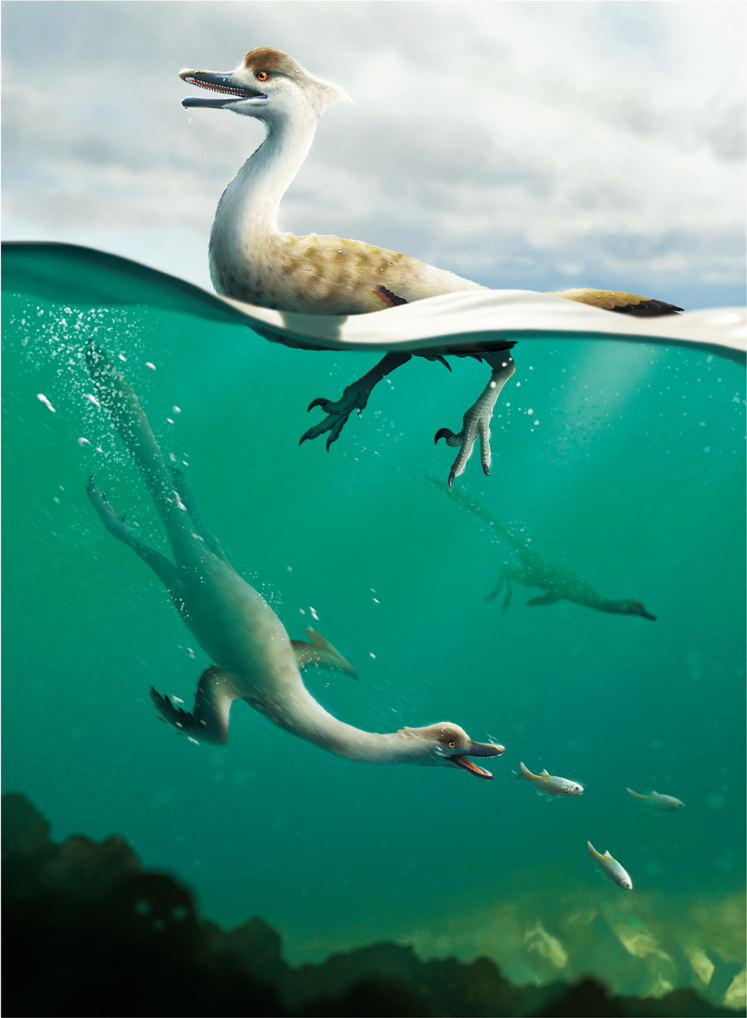
Xing and colleagues describe a Microraptor specimen with fish scales preserved in the abdominal cavity, documenting for the first time direct piscivorous behavior in this species. Analysis reveals that the first three mandibular teeth of Microraptor were inclined anterodorsally, unlike posterior teeth, a functional morphology for capturing slippery aquatic prey. The presence of fish in the stomach indicates Microraptor was not exclusively arboreal but would descend to the ground or water bodies to hunt fish. This paper significantly broadens the image of Microraptor as a versatile opportunistic predator and suggests it inhabited lacustrine ecosystems beyond forests.
Additional specimen of Microraptor provides unique evidence of dinosaurs preying on birds
O'Connor, J., Zhou, Z. & Xu, X. · Proceedings of the National Academy of Sciences
O'Connor, Zhou, and Xu describe an exceptional Microraptor specimen preserving bones of an enantiornithine bird in the stomach, swallowed head-first as modern predatory birds such as hawks and owls do. The bird bones show evidence of partial digestion, confirming they were ingested in life by the Microraptor. This is the first direct evidence of a non-avian dinosaur preying on birds, and the head-first orientation indicates a sophisticated predation method. The paper documents that Microraptor was capable of capturing avian prey, possibly in the shared arboreal environment, with implications for the predator-prey ecology of the Jehol Biota.
A basal dromaeosaurid and size evolution preceding avian flight
Turner, A.H., Pol, D., Clarke, J.A., Erickson, G.M. & Norell, M. · Science
Turner and colleagues describe Mahakala omnogovae from Mongolia, the most primitive and smallest basal dromaeosaurid then known, performing a phylogenetic analysis that places Microraptor within the clade Microraptoria. The study demonstrates that body size reduction occurred multiple times independently within dromaeosaurids, and that the common ancestor of Dromaeosauridae was likely small. The resulting phylogeny places Microraptor as the sister group of Dromaeosaurinae+Velociraptorinae, within Microraptoria. Bone histology data from Mahakala reveals rapid growth typical of coelurosaur dinosaurs, suggesting miniaturization did not imply reduced growth rate.


'Modern' feathers on a non-avian dinosaur
Norell, M., Ji, Q., Gao, K., Yuan, C., Zhao, Y. & Wang, L. · Nature
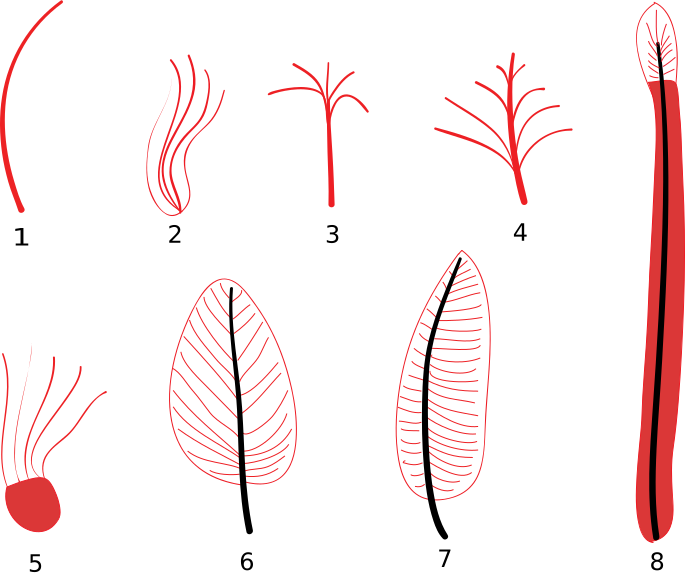
Norell and colleagues describe a juvenile specimen of Microraptor zhaoianus from the Yixian Formation that preserves pennaceous feathers with fully modern structure: central rachis, primary barbs, and barbules with hooks. This was one of the first demonstrations that non-avian dinosaurs possessed feathers with structure identical to modern birds, not just simple filaments. The specimen, the smallest Microraptor known at the time, provided crucial evidence that feathers evolved much earlier and more complexly than suspected. The paper contributed to the revision of the hypothesis that complex feathers were exclusive to birds and reinforced the evolutionary proximity between Microraptor and the first birds.

The wings before the bird: an evaluation of flapping-based locomotory hypotheses in bird antecedents
Dececchi, T.A., Larsson, H.C.E. & Habib, M.B. · PeerJ
Dececchi, Larsson, and Habib perform comprehensive biomechanical analysis to evaluate whether dromaeosaurids, including Microraptor, were capable of active powered flapping flight. Using morphometric parameters from more than 50 taxa, the authors calculate the mechanical work available for wing flapping and compare it to minimum lift demands. Results indicate that Microraptor, despite being closer to the flight threshold than other dromaeosaurids, was likely not capable of active powered flight. Gliding remains the most supported hypothesis for its aerial locomotion. The paper provides the most rigorous biomechanical framework for discussing flight capability in bird relatives.


Generalist diet of Microraptor zhaoianus included mammals
Hone, D.W., Dececchi, T.A., Sullivan, C., Xu, X. & Larsson, H.C. · Journal of Vertebrate Paleontology
Hone and colleagues describe a Microraptor zhaoianus specimen with mammal bones preserved in the abdominal region, the fourth prey type documented for the genus after fish, enantiornithine birds, and lizards. The bones are identified as belonging to a small mammal similar to Eomaia or Sinodelphys, with estimated length between 5 and 8 centimeters. This documentation completes the portrait of Microraptor as an extraordinarily versatile generalist predator: the only dinosaur known with direct evidence of four distinct prey categories. The authors discuss implications for community ecology of the Jehol Biota and the food niche of small feathered predators of the Early Cretaceous.


The smallest known specimen of Microraptor (Dinosauria: Dromaeosauridae) from the Jiufotang Formation in northeastern China
Wang, R. & Pei, R. · Historical Biology
Wang and Pei describe the smallest known specimen of Microraptor, recovered from the Jiufotang Formation of Liaoning. The juvenile specimen presents bone fusion indices that allow inferring developmental stage and estimating the growth rate of the genus. Morphological analysis reveals that diagnostic characteristics of Microraptor were present even in very young individuals, while others emerged during ontogeny. The specimen broadens understanding of individual variation and the life cycle of this dromaeosaurid, and the scaling data demonstrate that Microraptor reached adult proportions at very reduced size, consistent with the hypothesis of evolutionary paedomorphy in the clade Microraptoria.


Espécimes famosos em museus
BMNHC Ph763
Museu Nacional de Ciências Naturais, Taichung, Taiwan
One of the most complete and well-preserved specimens of Microraptor gui, with exceptional feather impressions on all four limbs. Permanently displayed in gliding position, it is one of the most photographed fossils concerning the origin of avian flight.

Coleção do Museu de História Natural de Pequim
Museu de História Natural de Pequim, Pequim, China
Set of Microraptor gui specimens in permanent public display, including specimens with preserved stomach contents. The museum houses the largest public collection of Microraptor specimens, fundamental for research on diet, behavior, and ecology.
Coleção Shandong Tianyu Museum of Nature
Shandong Tianyu Museum of Nature, Pingyi, China
The Shandong Tianyu houses hundreds of Jehol Biota specimens, including multiple Microraptor specimens. The museum holds the largest private collection of feathered dinosaur fossils in the world, with special emphasis on Early Cretaceous dromaeosaurids.
In cinema and popular culture
Microraptor gui occupies a unique position in dinosaur popular culture: it is simultaneously one of the most scientifically fascinating animals and one of the least represented in major film productions. While Velociraptor and Tyrannosaurus dominate cinema, Microraptor has gained ground primarily in high-quality scientific documentaries. Apple TV+'s 'Prehistoric Planet' series (2022) offered the most accurate representation to date, with iridescent black plumage, arboreal behavior, and diversified diet faithfully documented. 'Dinosaur Revolution' (2011) pioneered showing Microraptor preying on birds before the 2011 scientific confirmation. In the Jurassic World universe, Microraptor gained visibility in the animated series 'Camp Cretaceous' (Netflix, 2020), reaching global young audiences, albeit with compromised scientific accuracy. Microraptor's true cultural legacy lies in museums: its iridescent specimens have captured the public imagination, transforming perceptions about dinosaur appearance and consolidating the idea that many were more similar to colorful birds than gray reptiles.

Classificação
Descoberta
Curiosidade
Microraptor gui is the only dinosaur known with direct and verified evidence of having fed on four completely different prey categories throughout its life: fish, birds, mammals, and lizards, all documented by preserved stomach contents in distinct specimens. Combined with its iridescent black plumage and four functional wings, no other dinosaur combines so many extraordinary characteristics in an animal the size of a crow.