
Monolophosaurus jiangi
Monolophosaurus jiangi
"Single-crested lizard (of Jiang)"
Sobre esta espécie
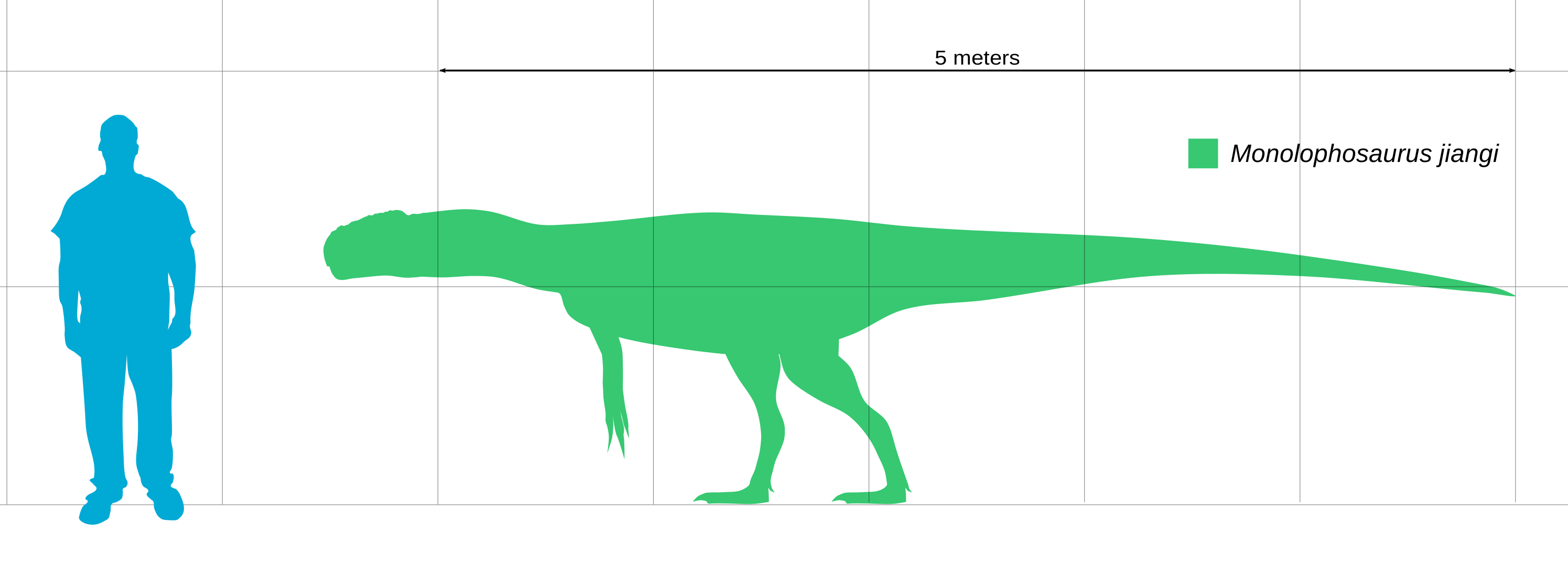
Monolophosaurus jiangi was a Middle Jurassic tetanuran theropod that lived in what is now Xinjiang Province, northwestern China, approximately 166 to 161 million years ago. At roughly 5 to 5.5 meters long and 475 kg, it was a medium-sized predator distinguished by a large, single cranial crest running along the midline of the snout, formed by the nasal and premaxillary bones. This pneumatized structure was its most remarkable feature, likely used for visual recognition among members of its own species. Known from a single nearly complete holotype, it preserves one of the best-known basal tetanuran skulls in science.
Geological formation & environment
The Shishugou Formation is a Middle to Late Jurassic geological unit (Callovian-Oxfordian, ~164 to 159 Ma) located in the Junggar Basin, Xinjiang, northwestern China. Composed mainly of green, gray-yellow and red mudstones and sandstones intercalated with conglomerates and volcanic tuffs, the formation represents an alluvial plain environment with seasonal rivers and marshes adjacent to a mountain range with active volcanoes. It is one of the most biodiverse Middle Jurassic dinosaur-bearing formations, with fauna including Monolophosaurus, Guanlong, Sinraptor, Bellusaurus, Mamenchisaurus, Zuolong, Aorun and Haplocheirus.
Image gallery

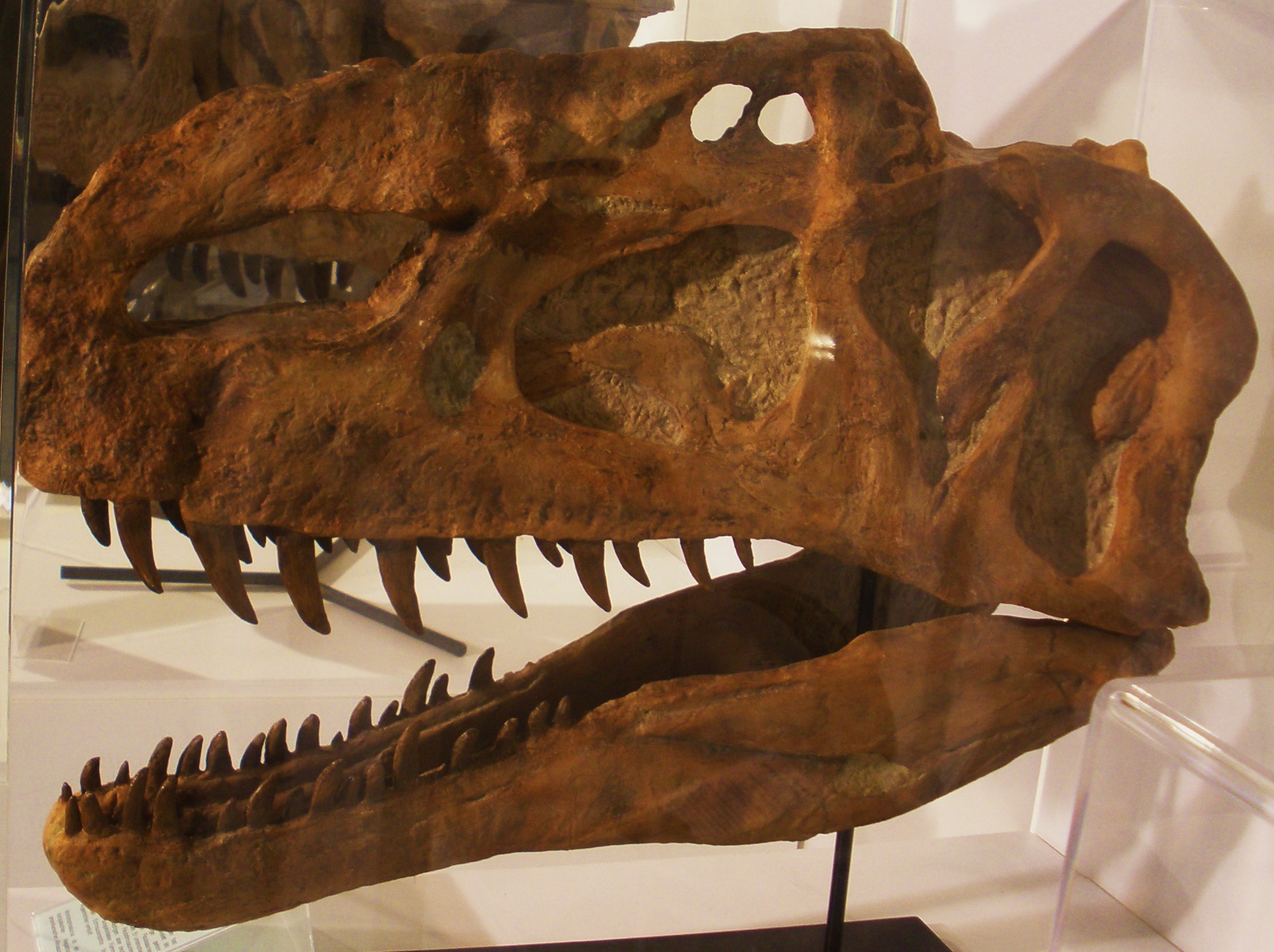
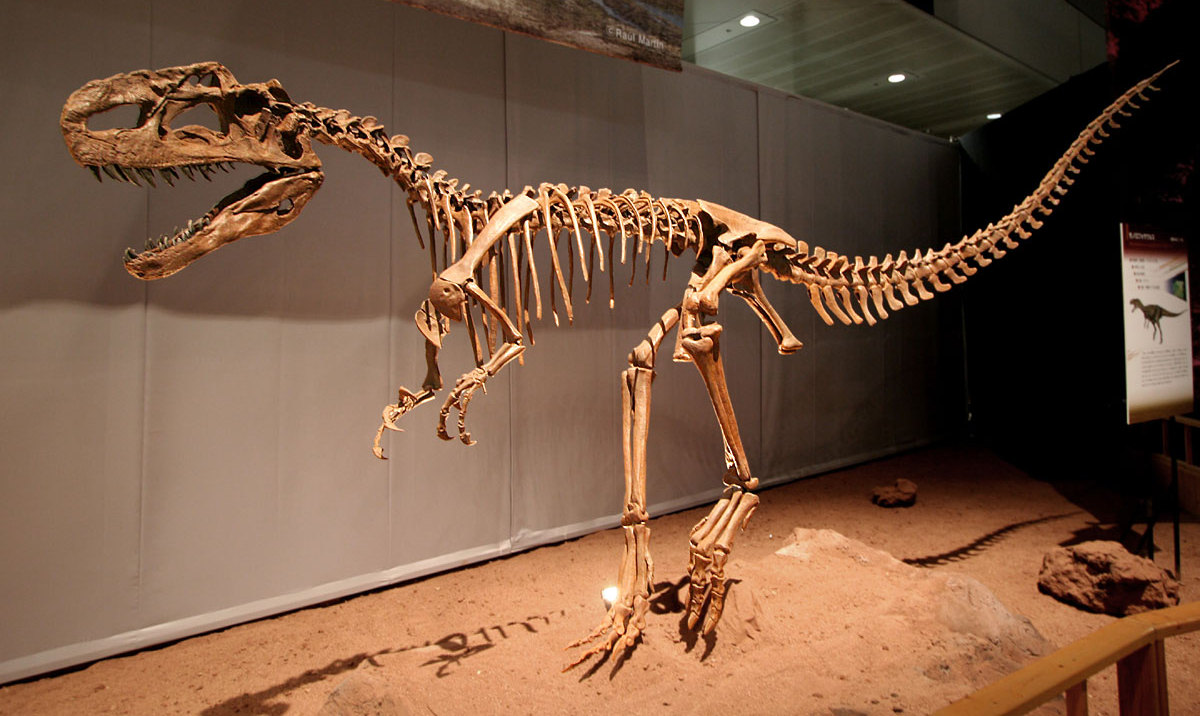

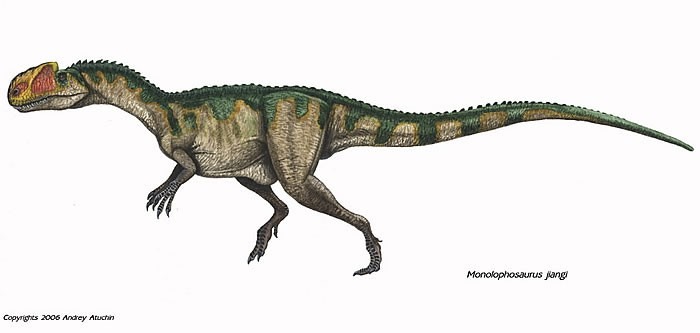
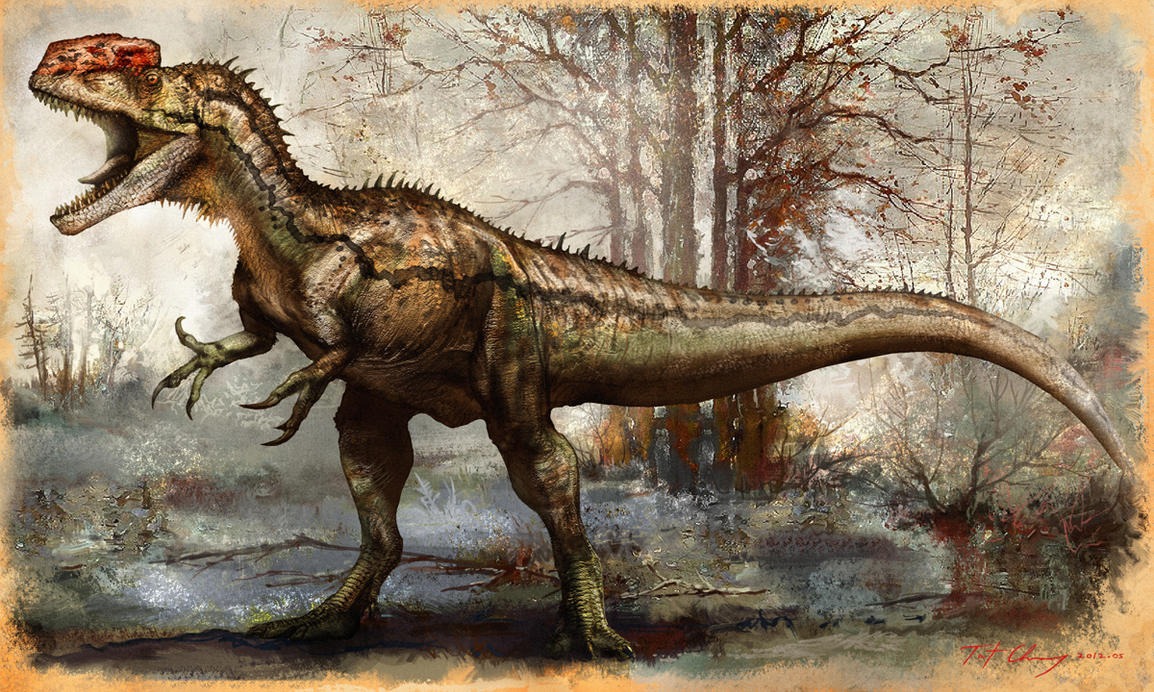
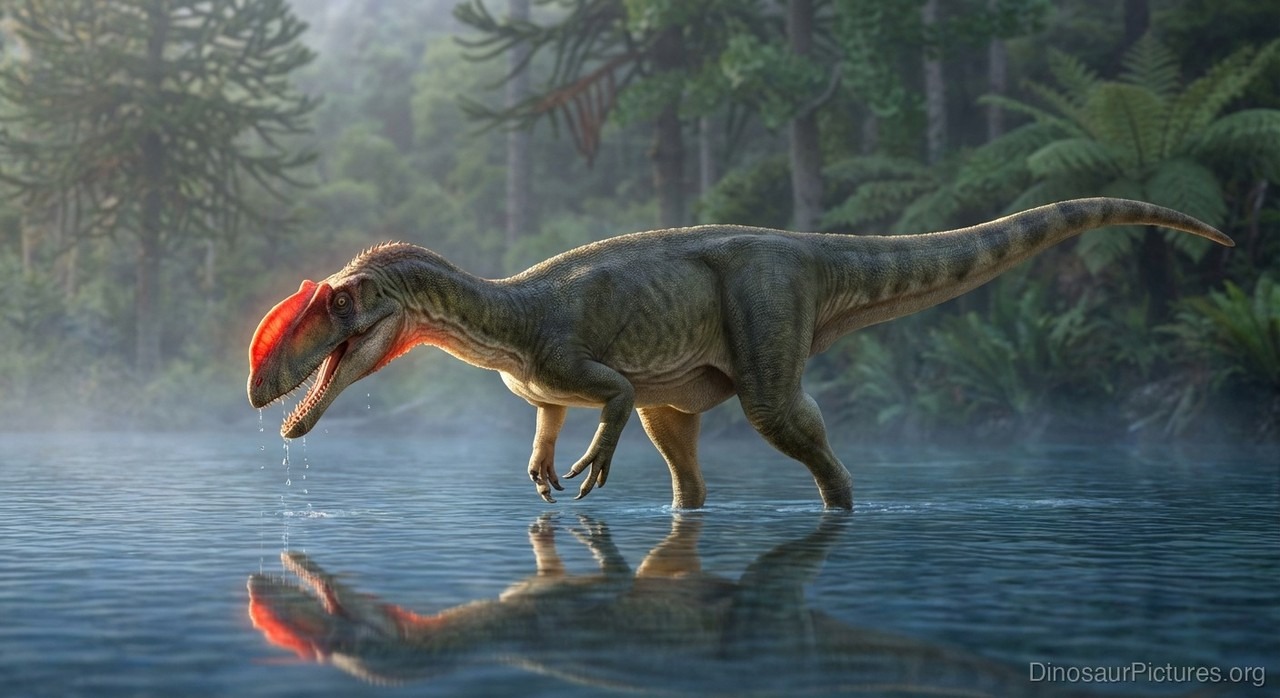
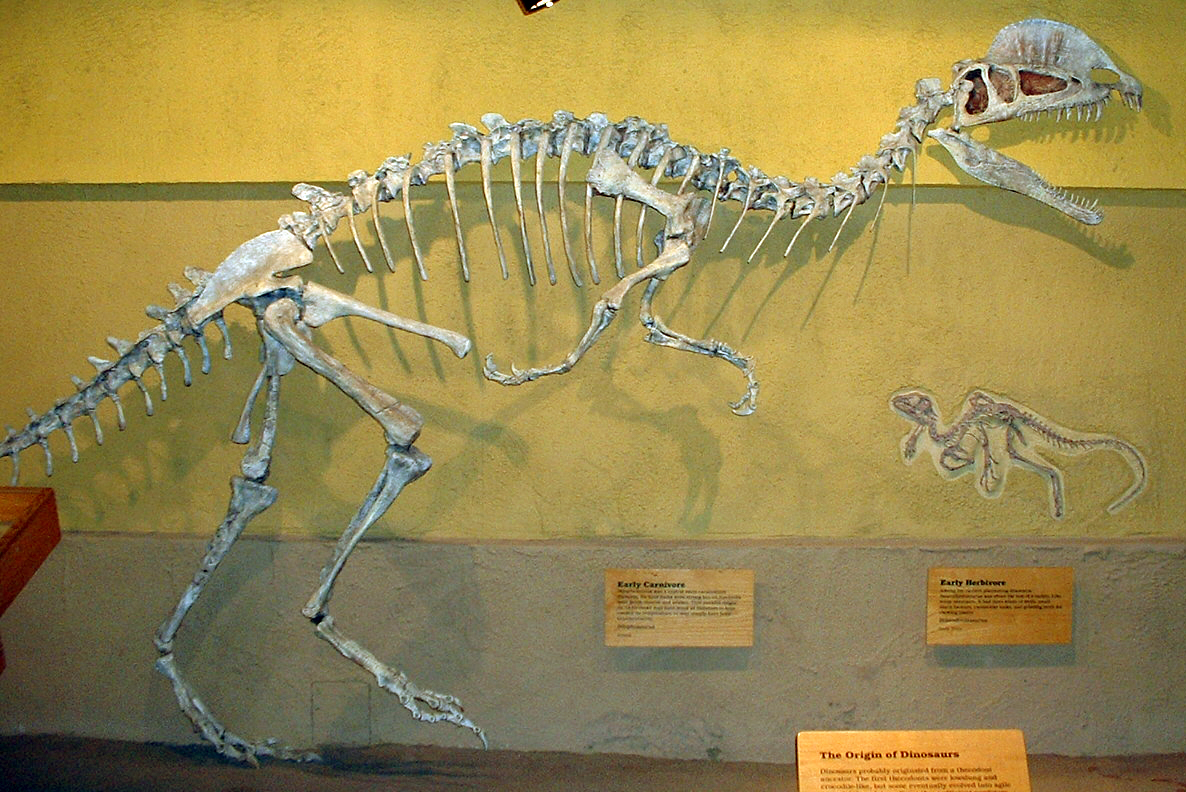
Holotype IVPP V84019 of Monolophosaurus jiangi on display at the Paleozoological Museum of China, Beijing. The specimen includes skull, lower jaws and vertebral column.
BleachedRice — CC BY-SA 4.0
Ecology and behavior
Habitat
Monolophosaurus inhabited a warm, seasonally dry alluvial plain in Middle-Late Jurassic Xinjiang, China, approximately 164 to 161 million years ago. The climate was semi-arid with alternating wet and dry periods, and the landscape included seasonal rivers, marshlands and well-drained floodplains with occasional volcanic ash deposition. The ecosystem was shared with sauropods like Mamenchisaurus and Bellusaurus, the basal tyrannosauroid Guanlong, the carnosaur Sinraptor and small theropods such as Aorun and Zuolong.
Feeding
As a medium-sized carnivorous theropod (~475 kg), Monolophosaurus likely preyed on juvenile sauropods (such as Bellusaurus) and other medium-sized dinosaurs available in the Shishugou Formation. Its serrated, laterally compressed teeth were efficient for cutting flesh. Isotopic analyses of formation teeth (Wings et al., 2015) indicate a C3-plant ecosystem, suggesting herbivore abundance. The presence of possible bite marks on the holotype's dentary may indicate intraspecific antagonistic behavior beyond predation.
Behavior and senses
Fossil evidence from the holotype suggests Monolophosaurus was a combative animal: the tenth and eleventh dorsal vertebrae show healed and fused fractures, the result of severe trauma suffered in adulthood from which the animal survived. The right dentary shows possible tooth marks on its lateral surface, interpreted as evidence of intraspecific combat or aggressive interactions. The pneumatized cranial crest likely served visual recognition among conspecifics, possibly with a role in territorial disputes or sexual selection.
Physiology and growth
Monolophosaurus was almost certainly endothermic (warm-blooded), following the pattern of most theropods. At 475 kg and ~5.5 m length, it had proportions typical of a nimble medium-sized predator. The cranial crest, formed by pneumatized nasals and premaxillae, was internally hollow and connected to the skull air sac system by foramina. This structure combined visual display with minimal mass. Healed vertebral fractures indicate recovery capacity and sufficient longevity to survive severe trauma, characteristics consistent with elevated metabolism.
Paleogeography
Continental configuration

Ron Blakey · CC BY 3.0 · Jurassic, ~90 Ma
During the Caloviano (~166–161 Ma), Monolophosaurus jiangi inhabited the fragmenting Pangea. North America and Europe were still close, and the North Atlantic was just beginning to open. Climate was warm and humid globally, with no polar ice caps.
Inventário de Ossos
The holotype IVPP V84019 includes the skull, lower jaws, vertebral column and pelvis, but lacks the rear tail, shoulder girdle and limbs. It is the only known specimen of the species, likely representing an adult or subadult individual.
Found elements
Inferred elements
Scientific Literature
15 papers in chronological order — from the original description to recent research.
A large crested theropod from the Jurassic of Xinjiang, People's Republic of China
Zhao, X. & Currie, P.J. · Canadian Journal of Earth Sciences
The founding paper describing holotype IVPP V84019, collected from the Junggar Basin of Xinjiang, establishing the genus and species Monolophosaurus jiangi. Zhao and Currie describe in detail the midline cranial crest formed mainly by the nasal and lacrimal bones, with foramina connecting its hollow interior to the antorbital fossa. The skull measured 80 cm in length and was exceptionally well preserved. The crest function remains uncertain but likely served intraspecific recognition. The authors place the animal as a large Middle Jurassic theropod from China, comparing it to Sinraptor and other carnosaurs. This work is the mandatory starting point for any research on the species.
The skull of Monolophosaurus jiangi (Dinosauria: Theropoda) and its implications for early theropod phylogeny and evolution
Brusatte, S.L., Benson, R.B.J., Currie, P.J. & Zhao, X. · Zoological Journal of the Linnean Society
Complete redescription of the Monolophosaurus jiangi skull, regarded as one of the most complete and well-preserved basal tetanuran skulls known. Brusatte et al. identify numerous cranial autapomorphies: pneumatized nasals and jugals, I-shaped lacrimal, rectangular frontals (unique among Theropoda). Phylogenetic analysis recovers Monolophosaurus as a basal tetanuran outside Neotetanurae, challenging earlier analyses placing it in Allosauroidea. The authors review cranial characters used to diagnose Allosauroidea and show many have a much wider distribution across Theropoda. This paper is the definitive anatomical reference for the species skull.
The postcranial skeleton of Monolophosaurus jiangi (Dinosauria: Theropoda) from the Middle Jurassic of Xinjiang, China, and a review of Middle Jurassic Chinese theropods
Zhao, X., Benson, R.B.J., Brusatte, S.L. & Currie, P.J. · Geological Magazine
Redescription of the postcranial anatomy of Monolophosaurus jiangi, complementing the skull study published simultaneously. Zhao et al. describe the preserved vertebral column, pelvis and limb elements, identifying features confirming tetanuran affinities. Primitive traits such as a double-faceted pubic peduncle and a hood-like supracetabular crest suggest a basal position within Tetanurae. The authors also review Middle Jurassic Chinese theropods, contextualizing Monolophosaurus within the paleofaunistic diversity of the Shishugou Formation. Published together with the skull redescription, this article completes the anatomical description of the holotype.
The phylogeny of Tetanurae (Dinosauria: Theropoda)
Carrano, M.T., Benson, R.B.J. & Sampson, S.D. · Journal of Systematic Palaeontology
Comprehensive phylogenetic analysis of 61 Tetanurae taxa using 280 characters providing improved resolution for basal tetanurans. Carrano, Benson and Sampson recover Megalosauroidea, Allosauroidea and Coelurosauria as successive monophyletic clades. Crucially for Monolophosaurus, the 2012 study places it and Chuandongocoelurus as a group outside more derived clades at the base of Tetanurae, corroborating the basal hypothesis of Brusatte et al. (2010) and rejecting its placement within Allosauroidea. This work represents the most comprehensive analysis of Tetanurae phylogeny published to that date.


The Shishugou Fauna of the Middle-Late Jurassic Transition Period in the Junggar Basin of Western China
Xu, X., Clark, J.M., Eberth, D.A. & Currie, P.J. · Acta Geologica Sinica (English Edition)
Comprehensive review of the Shishugou Formation fauna, where Monolophosaurus was discovered, radiometrically dated to approximately 159–164 Ma. Xu et al. document that the Shishugou Formation contains one of the most diverse Middle to Late Jurassic theropod faunas, including multiple theropod lineages (among them Guanlong, Zuolong, Sinraptor and Monolophosaurus), sauropods and primitive ceratopsians. The paper describes the paleoenvironment as an alluvial plain with rivers, marshlands, seasonal drought and occasional volcanic ash deposition. Climate was warm and seasonally dry.


Dinosaur teeth from the Jurassic Qigu and Shishugou Formations of the Junggar Basin (Xinjiang/China) and their paleoecologic implications
Wings, O., Tütken, T., Fowler, D.W. et al. · Paläontologische Zeitschrift
Study of isolated dinosaur teeth from the Qigu and Shishugou Formations of the Junggar Basin, providing direct paleoecological data from Monolophosaurus's habitat. Wings et al. describe theropod, sauropod and stegosaur teeth, analyzing carbon and oxygen isotopes to infer that the ecosystem was dominated by C3 plants under continental conditions. Large theropod teeth from the Shishugou Formation are compatible with predators like Monolophosaurus and Sinraptor. The study offers direct evidence on the feeding ecology of formation theropods and environmental conditions during the Middle-Late Jurassic of northwestern China.

The anatomy and taxonomic status of Chuandongocoelurus primitivus (Dinosauria: Theropoda) from the Middle Jurassic of China
Brusatte, S.L., Benson, R.B.J. & Novas, F.E. · Historical Biology
Re-examination of Chuandongocoelurus primitivus, a Middle Jurassic basal tetanuran from China that several phylogenetic analyses recover as a close relative of Monolophosaurus. Brusatte et al. review the diagnostic elements of both species and assess the taxonomic validity of Chuandongocoelurus. The work is relevant for understanding the diversity of Middle Jurassic basal tetanurans from China and the position of Monolophosaurus within that context. By establishing the relationship between these forms, the study illuminates the biogeography and early diversification of Tetanurae in East Asia during the Middle Jurassic.

A basal tyrannosauroid dinosaur from the Late Jurassic of China
Xu, X., Clark, J.M., Mo, J. et al. · Nature
Description of Guanlong wucaii, a basal tyrannosauroid from the Shishugou Formation at Wucaiwan, Xinjiang, the same locality and formation as Monolophosaurus jiangi. This paper is fundamental for understanding the shared ecosystem of both predators: Guanlong was a smaller predator (~3 m) while Monolophosaurus occupied the medium-sized predator niche. Xu et al. describe adult and juvenile Guanlong specimens and contextualize them within the Middle-Late Jurassic Junggar Basin fauna. The coexistence of multiple theropods of different sizes in the same formation indicates an ecologically diverse community with niche partitioning.


A long-snouted, multihorned tyrannosaurid from the Late Cretaceous of Mongolia and the evolution of tyrannosaurid crests
Brusatte, S.L., Carr, T.D., Erickson, G.M., Bever, G.S. & Norell, M.A. · Proceedings of the National Academy of Sciences
Description of Alioramus altai and analysis of cranial crest evolution among theropods, with explicit comparison to Monolophosaurus. Brusatte et al. examine the functional significance of cranial ornamentation in theropods and discuss how similar structures evolved independently in distinct groups (evolutionary convergence). For Monolophosaurus, the work is relevant in demonstrating that theropod cranial crests generally served intraspecific recognition and sexual selection rather than hunting functions. The comparative analysis includes morphological and ontogenetic growth data, suggesting ornamental crests were adult characters visible to conspecifics.


A new theropod dinosaur from the Callovian Balabansai Formation of Kyrgyzstan
Rauhut, O.W.M., Pol, D. & Becerra, M.G. · Zoological Journal of the Linnean Society
Description of a new theropod from the Callovian of Kyrgyzstan (Balabansai Formation), published in 2024 in the Zoological Journal of the Linnean Society. The phylogenetic analysis discusses the position of early-diverging tetanurans including Monolophosaurus, placing it as a basal tetanuran or early megalosauroid depending on analysis parameters. The study is relevant to Middle Jurassic Asian biogeography and demonstrates theropod diversity in this region during the Callovian-Oxfordian. The presence of related forms in both Kyrgyzstan and China reinforces faunal connectivity across Central Asia in the Middle Jurassic.


Cranial anatomy of Bellusaurus sui (Dinosauria: Eusauropoda) from the Middle-Late Jurassic Shishugou Formation of northwest China and a review of sauropod cranial ontogeny
Moore, A.J., Mo, J., Clark, J.M. & Xu, X. · PeerJ
Detailed description of the cranial anatomy of Bellusaurus sui, a sauropod from the Shishugou Formation that coexisted with Monolophosaurus. Moore et al. review sauropod cranial ontogeny within the faunal context of the Shishugou Formation, providing data on the ecosystem Monolophosaurus inhabited. Bellusaurus is one of the likely prey items for medium-sized predators like Monolophosaurus, given that many Bellusaurus specimens are juveniles of smaller size. This open-access work (PeerJ) contributes to understanding the diversity and ecological interactions of the Middle-Late Jurassic fauna of northwestern China.


Rates of dinosaur body mass evolution indicate 170 million years of sustained ecological innovation on the avian stem lineage
Benson, R.B.J., Campione, N.E., Carrano, M.T. et al. · PLOS Biology
Macroevolutionary analysis of body mass evolution in dinosaurs across 170 million years, published in PLOS Biology. The study includes Middle Jurassic tetanuran theropods such as Monolophosaurus, showing that medium-sized forms like this theropod (475 kg) represented a crucial intermediate link during sustained ecological diversification. Benson et al. show that theropods on the avian lineage maintained exceptionally high rates of ecological innovation throughout the Mesozoic era. Placing Monolophosaurus in this macroevolutionary context helps understand the role of mid-sized theropods in the Middle Jurassic and the evolutionary trajectory toward birds.


A bonebeds database: classification, biases, and patterns of occurrence
Eberth, D.A., Shannon, M. & Noland, B.G. · Paleontological Society Papers
Analysis of dinosaur bonebed occurrences including material from the Shishugou Formation where Monolophosaurus was discovered. Eberth et al. classify and analyze preservation patterns and taphonomic trends, with data relevant for understanding why the Monolophosaurus holotype preserved skull and axial elements but not limbs or complete tail. The work provides context for interpreting the preservation state of the only known specimen and burial conditions in the alluvial environment of the Junggar Basin during the Middle Jurassic.


New Jurassic sauropod and theropod dinosaurs from Patagonia: new insights on the Gondwana/Laurasia faunal exchanges
Novas, F.E., Ezcurra, M.D., Agnolin, F.L., Pol, D. & Ortiz, R. · Naturwissenschaften
Description of new Jurassic theropods from Patagonia and analysis of Gondwana-Laurasia faunal exchanges during the Jurassic. Novas et al. provide global phylogenetic context for basal tetanurans including Monolophosaurus within worldwide theropod diversification. The study demonstrates that multiple large-bodied theropod lineages emerged independently in different Middle Jurassic regions, with Monolophosaurus representing the Asian lineage of cranially ornamented theropods. The biogeographic analysis reveals dispersal patterns connecting the Junggar Basin fauna with forms from other regions of the fragmenting Pangea supercontinent.

Abelisauridae (Dinosauria: Theropoda) from the Late Jurassic of Portugal and dentition-based phylogeny as a contribution for the identification of isolated theropod teeth
Hendrickx, C. & Mateus, O. · Zootaxa
Study of theropod tooth morphology for identifying isolated teeth, including comparative analysis of basal tetanurans such as Monolophosaurus. Hendrickx and Mateus develop a dentition-based phylogeny and methodology for identifying isolated theropod teeth, relevant to tooth studies from the Shishugou Formation (Wings et al., 2015). The work describes diagnostic tooth characters of Monolophosaurus in comparison with other theropods, providing a tool for recognizing contributions of predators like this one in fragmented fossil samples.


Espécimes famosos em museus
IVPP V84019 (Holótipo)
Museu Paleozoológico da China, Beijing
The only known specimen of Monolophosaurus jiangi, discovered in 1984 during stratigraphic exploration at Wucaiwan, Junggar Basin, Xinjiang. It includes the 80 cm skull with characteristic crest, lower jaws, vertebral column and pelvis. It likely represents an adult or subadult individual.
Réplica (Wyoming Dinosaur Center)
Wyoming Dinosaur Center, Thermopolis, Wyoming, EUA
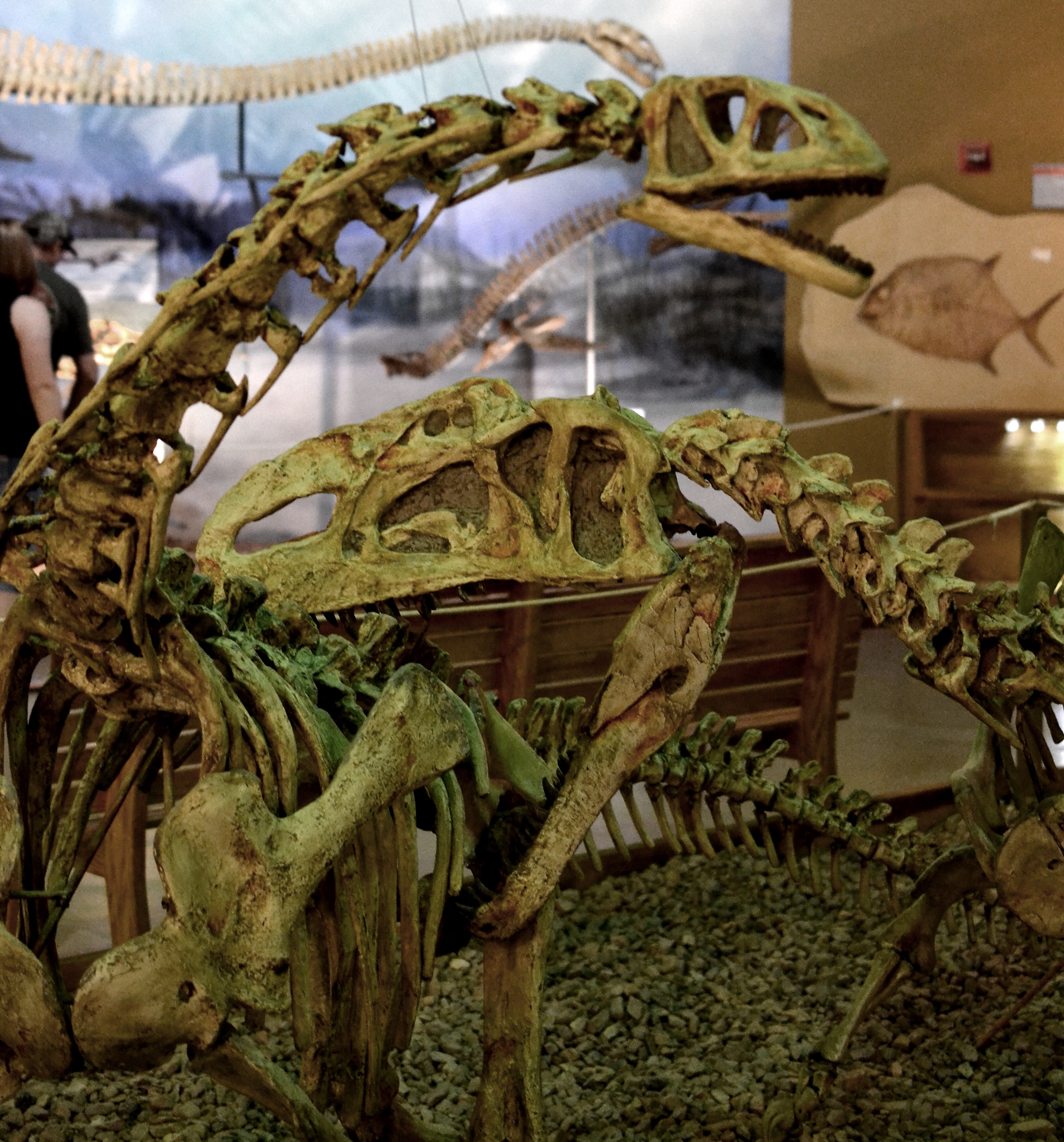
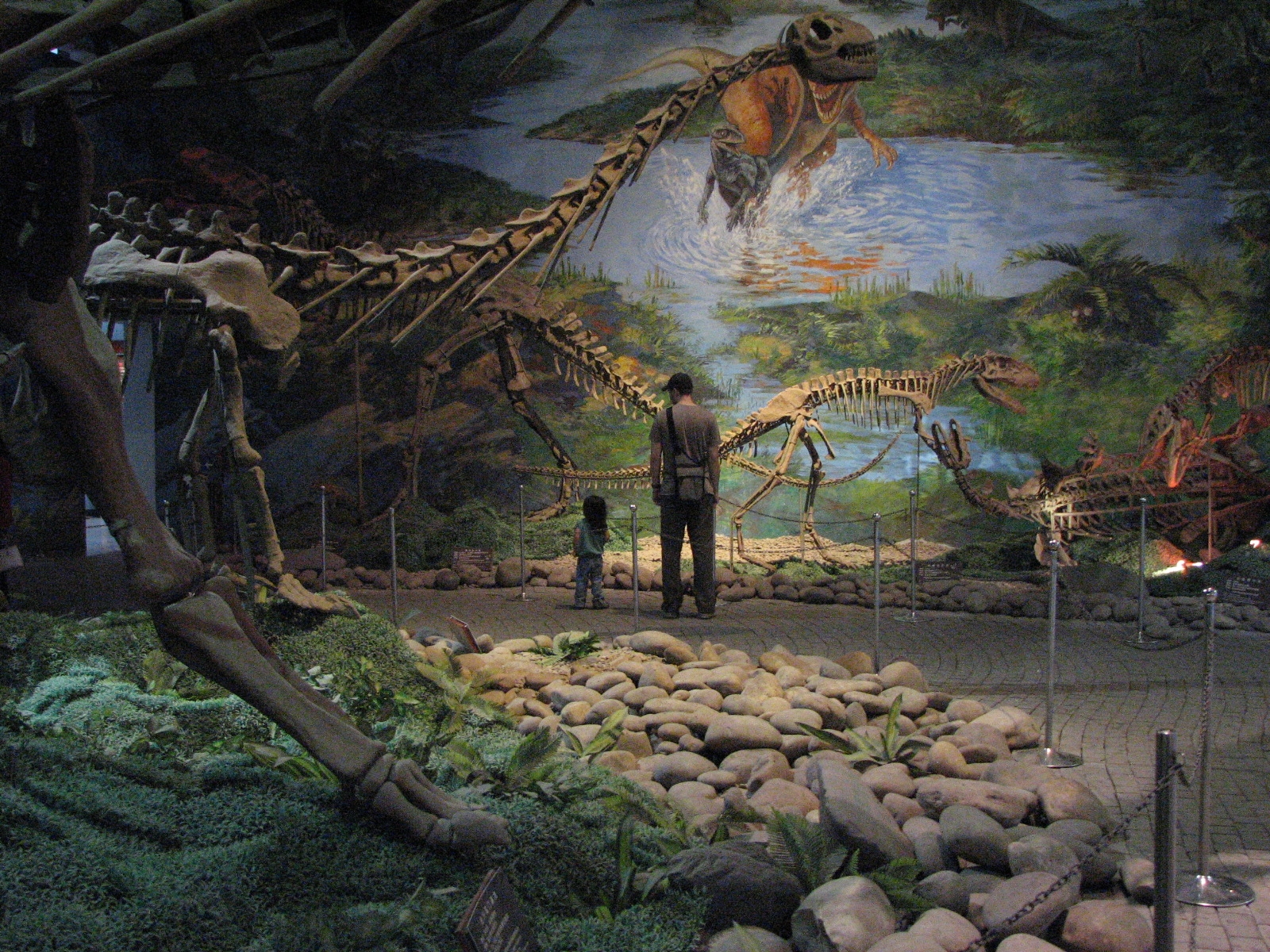
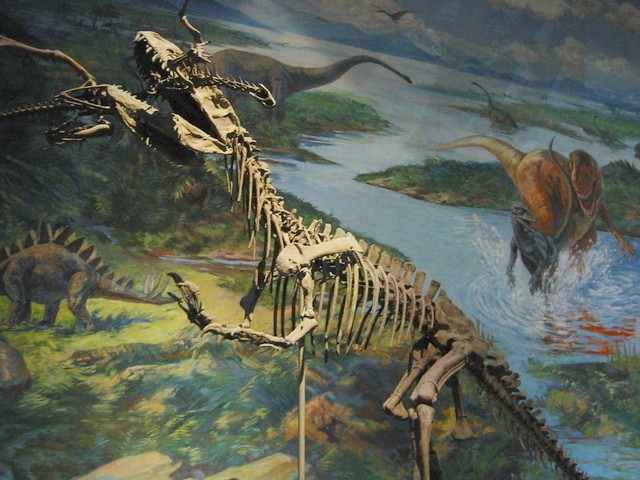
Reconstructed replica of the Monolophosaurus jiangi skeleton displayed at the Wyoming Dinosaur Center, mounted alongside Bellusaurus. The complete reconstruction fills in elements missing from the holotype (limbs, shoulders, posterior tail) based on close relatives, allowing visualization of the animal's full size.
In cinema and popular culture
Monolophosaurus jiangi remained off pop culture's radar for nearly three decades after its scientific description in 1993. Unlike Velociraptor or Spinosaurus, it never appeared in the original Jurassic Park films and only reached the franchise in 2021, when it was included in Netflix's animated series Jurassic World: Camp Cretaceous as a Season 3 antagonist. The debut was impactful: initially presented as a solitary hunter, the series Monolophosaurus surprises by hunting in packs, creating one of the show's tensest conflicts. The general design with cranial crest is recognizable, but coloration and behavior were adapted for dramatic purposes. The animal also appears in multiple Jurassic World franchise games, including the mobile game and Jurassic World: Alive, and in 2014 it solo-starred in the low-budget film Jurassic City. Despite growing media presence, Monolophosaurus remains a niche species, appreciated primarily by dinosaur enthusiasts who value its singular cranial morphology and its role as one of the most complete windows into Middle Jurassic Asian theropod diversity.

Classificação


Descoberta
Curiosidade
The skull of Monolophosaurus jiangi is one of the largest and most complete of any Middle Jurassic basal theropod: at 80 cm long, the head represented nearly 15% of the animal's total length. The unique cranial crest was not solid: it was hollow inside and connected to the respiratory system by small openings, like a wind instrument that used the skull itself as a resonance chamber.