
The Cretaceous vacuum cleaner
Nigersaurus taqueti
"Taquet's Niger lizard"
Sobre esta espécie
Nigersaurus taqueti was a rebbachisaurid sauropod from the Middle Cretaceous, discovered in the Elrhaz Formation of Niger in the Sahara. At about 9 meters long and 4 tonnes, it was small by sauropod standards. Its most striking feature was a wide, flat mouth directed straight downward, packed with over 500 replaceable teeth arranged in dental batteries. This extraordinary anatomy allowed it to graze low vegetation with maximum efficiency, like a Cretaceous lawnmower. Formally described by Paul Sereno in 1999, Nigersaurus became one of the most anatomically peculiar dinosaurs ever discovered.
Geological formation & environment
The Elrhaz Formation is part of the Tegama Group and outcrops in the Gadoufaoua region of the Ténéré Desert, Niger. Deposited during the Aptian-Albian (125-112 Ma), it consists mainly of medium- to coarse-grained fluvial sandstones, representing meandering river deposits on floodplains. The environment was humid subtropical, with vegetation of ferns, horsetails, and conifers. The fauna is extraordinarily diverse: giant crocodylomorphs like Sarcosuchus imperator, theropods like Suchomimus and Eocarcharia, ornithopods like Ouranosaurus and Lurdusaurus, and Nigersaurus itself as the dominant sauropod.
Image gallery

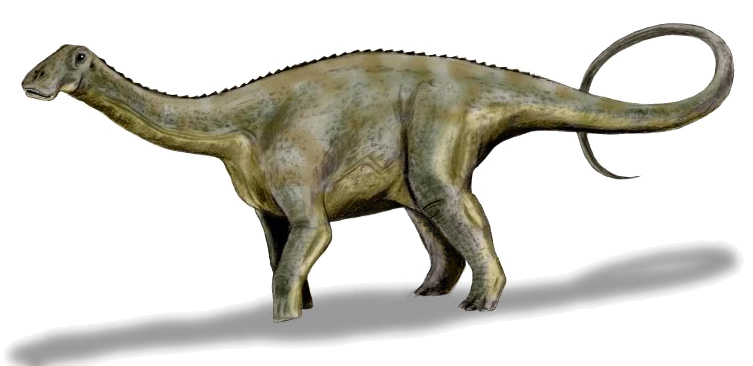


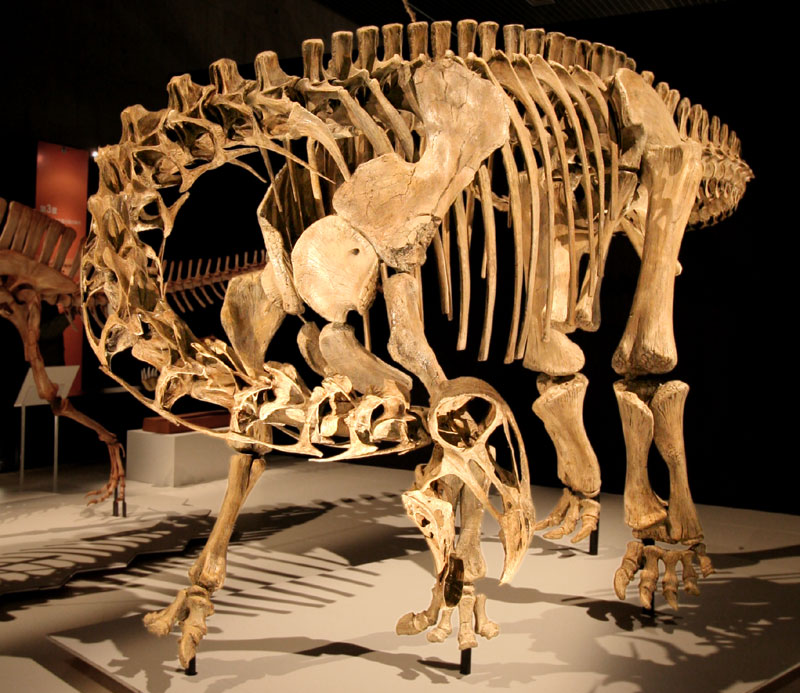


Complete skeletal reconstruction of Nigersaurus taqueti, published by Sereno et al. (2007) in PLOS ONE. White elements indicate preserved bones; gray outline indicates inferred elements.
Carol Abraczinskas, Sereno et al. / PLOS ONE — CC BY 2.5
Ecology and behavior
Habitat
Nigersaurus lived on the inland floodplains of what is today the Sahara, 115-105 million years ago. The environment was radically different from the current desert: wide rivers, forests of ferns, horsetails, and conifers, with a humid tropical climate. The Elrhaz Formation at Gadoufaoua, composed mainly of fluvial sandstones, records a rich ecosystem with giant crocodilians like Sarcosuchus, theropods like Suchomimus and Eocarcharia, and other large herbivores like Ouranosaurus and Lurdusaurus.
Feeding
Nigersaurus was a non-selective ground-level grazer, feeding on soft low vegetation such as ferns, horsetails, and primitive angiosperms. The wide, square mouth with teeth concentrated at the front edge of the jaws functioned like a continuous lawn mower: the animal scraped vegetation by moving its head from side to side. The tooth replacement rate of one new tooth every 14 days is the highest known in any dinosaur, compensating for rapid wear caused by ground-level vegetation abrasion. Its bite was one of the weakest among sauropods.
Behavior and senses
Based on fossil evidence, Nigersaurus was likely gregarious: it is the second most common vertebrate in the Elrhaz Formation after the ornithopod Lurdusaurus. Its visual field was approximately 360°, with eyes positioned above the snout, providing good predator vigilance while grazing. Head posture during feeding was likely downward-facing (67° per Sereno et al. 2007, though contested), enabling efficient ground-level feeding without great muscular effort. There is no evidence of territorial behavior or parental care.
Physiology and growth
Nigersaurus had an extraordinarily pneumatic skeleton: presacral vertebrae contained more air space than bone by volume, drastically reducing trunk weight. Studies from 2023 revealed that even limb bones had surprisingly thin cortices, suggesting fleshy foot pads and thick articular cartilage absorbed some impact forces. Metabolism was likely endothermic (warm-blooded), like most dinosaurs, which would be necessary to sustain the high tooth replacement rate and continuous growth. The olfactory bulb was underdeveloped, suggesting smell was not the primary sense.
Paleogeography
Continental configuration

Ron Blakey · CC BY 3.0 · Cretáceous, ~90 Ma
During the Aptiano-Albiano (~115–105 Ma), Nigersaurus taqueti inhabited Laramidia, the western half of present-day North America, separated from the east by the Western Interior Seaway, a shallow sea dividing the continent. The continents were in very different positions: India was drifting toward Asia, Antarctica was still connected to Australia, and South America was an isolated island.
Inventário de Ossos
The holotype MNN GAD512 consists of a partial skull and cervical vertebrae. Additional specimens (MNN GAD513, GAD515-518) provided postcranial elements. No fully articulated skeleton has been found, as the highly pneumatic bones are extremely fragile and rarely preserved intact.
Found elements
Inferred elements
Scientific Literature
15 papers in chronological order — from the original description to recent research.
Cretaceous sauropods from the Sahara and the uneven rate of skeletal evolution among dinosaurs
Sereno, P.C. et al. · Science
The founding paper formally naming Nigersaurus taqueti. Paul Sereno and colleagues describe specimens collected during 1997 Niger expeditions and establish the genus and species within Rebbachisauridae. The work describes the main diagnostic characters: an extremely lightweight skull with enormous fenestrae, dental batteries with over 500 teeth organized at the anterior edge of the jaws, and highly pneumatic presacral vertebrae. The authors place Nigersaurus within diplodocoids and discuss the uneven rate of skeletal evolution among dinosaur groups. The paper also describes other Saharan sauropods like Jobaria tiguidensis, expanding knowledge of African Cretaceous fauna.
Géologie et paléontologie du gisement de Gadoufaoua (Aptien du Niger)
Taquet, P. · Cahiers de Paléontologie
Pioneering work by Philippe Taquet establishing the geology and paleontology of the Gadoufaoua site in the Ténéré Desert, Niger. The French geologist documents the stratigraphy of the Elrhaz Formation (Aptian), describes the fluvial and sandy sediments preserving the fauna, and first mentions sauropod remains later named Nigersaurus taqueti by Sereno in 1999. Taquet initially classifies these remains as dicraeosaurids, a classification later revised. The work also honors Taquet himself: the specific epithet 'taqueti' was chosen by Sereno in recognition of Taquet's contributions to African paleontology, including the first large-scale expeditions to Niger in the 1960s-70s.


Structural extremes in a Cretaceous dinosaur
Sereno, P.C. et al. · PLOS ONE
The most detailed monograph ever published on Nigersaurus taqueti. Sereno and colleagues use high-resolution CT scanning, stereolithography, and molding techniques to reconstruct the extremely fragile skull, generating the first sauropod brain endocast preserving olfactory bulbs and cerebellum. Findings include: vertebrae with more air space than bone by volume; teeth replaced every 14 days (the highest rate known for any dinosaur); mouth with 68 tooth columns in the upper jaw and 60 in the lower; head posture 67° downward, confirmed by inner ear analysis. The work positions Nigersaurus as a low-level vegetation grazer, refuting earlier hypotheses that long-necked sauropods browsed high in trees.
Structure and evolution of a sauropod tooth battery
Wilson, J.A. & Sereno, P.C. · The Sauropods: Evolution and Paleobiology (eds. Curry Rogers & Wilson)
Jeffrey Wilson and Paul Sereno present the first detailed analysis of the structure and evolution of sauropod tooth batteries, with particular emphasis on the unique dental system of Nigersaurus taqueti. The work documents how Nigersaurus evolved a radically different dental arrangement from other sauropods: while most concentrated teeth along much of the jaw, Nigersaurus concentrated all teeth at the front edge of the jaws, creating a rapidly-replacing 'battery' functioning like a continuous lawnmower. The authors analyze dental replacement mechanisms, enamel asymmetry (10x thicker on the outer side), and discuss the evolutionary implications of this system unique among tetrapods.
Inferences of diplodocoid (Sauropoda: Dinosauria) feeding behavior from snout shape and microwear analyses
Whitlock, J.A. · PLOS ONE
John Whitlock analyzes snout shape and dental microwear of diplodocoids, including Nigersaurus, to infer feeding strategies. The methodology combines geometric morphometrics of snout shapes with scanning electron microscopy dental microwear analysis. For Nigersaurus, the square snout and high pit-to-scratch ratio indicate non-selective ground-level browsing, confirming the animal fed on vegetation at ground level without specific preferences. The study establishes that different diplodocoid clades adopted distinct feeding strategies, with Nigersaurus at the extreme 'ground-level grazer' end, opposite Dicraeosaurus, which shows evidence of selective mid-height browsing.
Evolution of high tooth replacement rates in sauropod dinosaurs
D'Emic, M.D.; Whitlock, J.A. et al. · PLOS ONE
D'Emic, Whitlock and colleagues examine histological sections of teeth from various sauropods to measure tooth replacement rates and investigate their evolution. The technique involves counting daily incremental lines in enamel and dentine to calculate how long each tooth took to develop before replacing its predecessor. The most striking finding is that Nigersaurus had the highest replacement rate of any sauropod: a new tooth every 14 days, compared to 62 days in Camarasaurus and 35 days in Diplodocus. The authors demonstrate that elevated replacement rates evolved independently in different sauropod lineages as an adaptation to feeding regimes causing high dental wear.
First rebbachisaurid sauropod dinosaur from Asia
Averianov, A. & Sues, H-D. · PLOS ONE
Averianov and Sues describe the first Asian rebbachisaurid, Dzharatitanis kingi, from the Upper Cretaceous of Uzbekistan. The work presents a phylogenetic analysis placing the new taxon within Nigersaurinae in a polytomy with Nigersaurus, Rayososaurus, Rebbachisaurus, Demandasaurus, and others. The phylogenetic analysis is fundamental for understanding the evolutionary relationships of Nigersaurus and rebbachisaurid biogeography. The published cladogram shows Nigersaurus's position within the group and the clade's geographic range. The study demonstrates rebbachisaurids had a much wider distribution than previously recognized.
Head and neck posture in sauropod dinosaurs inferred from extant animals
Taylor, M.P.; Wedel, M.J. & Naish, D. · Acta Palaeontologica Polonica
Taylor, Wedel and Naish analyze neck and head posture in living animals (mammals, turtles, lizards, crocodilians, and birds) and demonstrate that none of them habitually hold their neck in the osteological neutral position: all raise the neck substantially. Based on this principle, they challenge Sereno et al.'s (2007) reconstruction of Nigersaurus with a 67-degree downward head posture as habitual. They argue such a posture would be an extreme exception to the universal amniote pattern. The work does not deny that Nigersaurus may have fed at ground level, but questions whether this was its resting posture.
The variability of inner ear orientation in saurischian dinosaurs: testing the use of semicircular canals as a reference system for comparative anatomy
Marugán-Lobón, J.S.; Chiappe, L.M. & Farke, A.A. · PeerJ
Marugán-Lobón, Chiappe and Farke quantitatively test the validity of the lateral semicircular canal as a reference for inferring cranial posture in saurischian dinosaurs, using geometric morphometrics (Procrustes Analysis). The result is critical for Nigersaurus paleobiology: lateral semicircular canal orientation variability is approximately 50° and likely unpredictable, making it an inconsistent reference system. This directly undermines the methodology used by Sereno et al. (2007) to conclude Nigersaurus habitually held its head 67° downward. The authors suggest Nigersaurus head posture may have been more horizontal, similar to other sauropods.
What's inside a sauropod limb? First three-dimensional investigation of the limb long bone microanatomy of a sauropod dinosaur, Nigersaurus taqueti
Lefebvre, R.; Allain, R. & Houssaye, A. · Palaeontology
Lefebvre, Allain and Houssaye conduct the first three-dimensional investigation of limb long bone microanatomy in a sauropod, using Nigersaurus taqueti as the study object. Analysis of virtual sections of six limb bone types reveals thin cortices in all cases despite weight-bearing function. Cortical thickness variation along the shaft is small, suggesting bone stress was minimized by multiple mechanisms: columnar limbs, extensive skeletal pneumaticity, fleshy foot pads, and thick articular cartilage. Results imply sauropods like Nigersaurus may have been lighter than previous estimates based solely on skeletal dimensions.
A new sauropod dinosaur from the Early Cretaceous of Tunisia with extreme avian-like pneumatization
Fanti, F.; Cau, A.; Hassine, M. & Contessi, M. · Nature Communications
Fanti and colleagues describe Tataouinea hannibalis, a new rebbachisaurid sauropod from the Early Cretaceous of Tunisia, with extreme avian-like postcranial pneumatization never before documented in non-avian dinosaurs. Phylogenetic analysis places Tataouinea within Nigersaurinae as a close relative of Nigersaurus. The work is directly important for understanding Nigersaurus because: (1) it demonstrates that extreme pneumatization was a basal feature of the entire Nigersaurinae clade, not just Nigersaurus; (2) it provides a close outgroup for anatomical comparison; (3) it suggests North African rebbachisaurids formed a coherent biogeographic group during the Early Cretaceous.


Osteology of Rebbachisaurus garasbae Lavocat, 1954, a diplodocoid (Dinosauria, Sauropoda) from the early Late Cretaceous-aged Kem Kem beds of southeastern Morocco
Wilson, J.A. & Allain, R. · Journal of Vertebrate Paleontology
Wilson and Allain present the most comprehensive osteological description ever published for Rebbachisaurus garasbae, the type genus of Rebbachisauridae, from the Kem Kem beds of Morocco. The work is directly important for Nigersaurus because it establishes with greater precision the phylogenetic relationships within Rebbachisauridae: analysis confirms Rebbachisaurus is closer to Nigersaurus and North African taxa than to South American limaysaurines. The study documents synapomorphies defining Rebbachisauridae against other diplodocoids, many present in Nigersaurus.
A new rebbachisaurid (Sauropoda: Diplodocoidea) from the middle Cretaceous of northern Brazil
Lindoso, R.M. et al. · Cretaceous Research
Lindoso and colleagues describe a new rebbachisaurid from the Middle Cretaceous of Maranhão, Brazil (Alcântara Formation), named Itapeuasaurus cajualensis. This work is directly important for understanding Nigersaurus and Nigersaurinae biogeography: it extends the group's known distribution to South America, suggesting connections between Africa and Brazil via the South Atlantic were still possible during the Middle Cretaceous (or that dispersal occurred before final separation). Phylogenetic analysis places Itapeuasaurus within Nigersaurinae, making it Nigersaurus's closest South American relative.

Basal abelisaurid and carcharodontosaurid theropods from the Lower Cretaceous Elrhaz Formation of Niger
Sereno, P.C. & Brusatte, S.L. · Acta Palaeontologica Polonica
Sereno and Brusatte describe two new theropods from the Elrhaz Formation of Niger: Kryptops palaios (basal abelisaurid) and Eocarcharia dinops (basal carcharodontosaurid). Both co-existed with Nigersaurus taqueti in the same Gadoufaoua ecosystem during the Aptian-Albian. The work is relevant for understanding Nigersaurus because it details the predators sharing its habitat: Kryptops and Eocarcharia were the major large theropods of the region, along with Suchomimus. The Elrhaz Formation ecosystem was dominated by large herbivores (Lurdusaurus, Nigersaurus, Ouranosaurus) and a diverse predator guild, including large crocodylomorphs like Sarcosuchus.


A test of the lateral semicircular canal correlation to head posture, diet and other biological traits in 'ungulate' mammals
Benoit, J. et al. · Scientific Reports
Benoit and colleagues quantitatively test the hypothesis that lateral semicircular canal orientation reliably predicts habitual head posture, using data from over 100 ungulate mammal species. The study is directly relevant to Nigersaurus because the species is explicitly cited as an extreme case: its 67° reconstructed cranial orientation (Sereno et al. 2007) is compared to that of the Grevy's zebra, the ungulate with the greatest downward head tilt in the dataset (66°). The authors find that the correlation between semicircular canal and head posture exists, but is mediated by diet and habitat, not a simple universal relationship. The more cautious conclusion: head posture inferences in dinosaurs using only semicircular canals should be treated as probabilistic estimates, not anatomical certainties, reinforcing the debate about Nigersaurus's actual posture.
Espécimes famosos em museus
MNN GAD512 (Holótipo)
Museu Nacional do Níger (Musée National Boubou Hama), Niamey
Official holotype of Nigersaurus taqueti, consisting of a partial skull and neck vertebrae. The skull bones are so thin that strong light passes through them. It is the reference specimen for all cranial anatomy of the species.
Molde do crânio (exposição permanente)
Royal Ontario Museum, Toronto, Canadá
Replica of the Nigersaurus taqueti skull on permanent display at the Royal Ontario Museum, Toronto. The original skull was digitally reconstructed by CT scanning and reproduced in durable material, as the original bones are too fragile for direct display.
Montagem esquelética (reconstituição composta)
National Geographic Society, Washington D.C., EUA
Skeletal mount of Nigersaurus taqueti presented to the public during a press conference at the National Geographic Society in 2007, when Sereno described the animal as the most unusual dinosaur he had ever seen. The mount combines elements from multiple specimens collected during the 1997 and 2000 expeditions.
In cinema and popular culture
Nigersaurus taqueti has a relatively modest presence in popular culture compared to other dinosaurs, but its unique appearance earned it a special niche in the public imagination since it was formally described in 1999 and widely publicized in 2007. Paleontologist Paul Sereno directly contributed to its popularization by presenting the reconstructed skeleton live at the National Geographic Society in Washington D.C. and by using memorable comparisons: the mouth was called a 'vacuum cleaner,' the skull a 'Darth Vader helmet,' and the teeth 'sharpened piano keys.' The documentary Bizarre Dinos (2009) on National Geographic Channel was the animal's first major television appearance. In gaming, Nigersaurus found its largest audience through the Jurassic World Evolution franchise, appearing in the first game as part of a herbivore DLC in 2019 and included in the second game's base content in 2021. In gaming, it is notable for being the only sauropod that feeds at ground level, accurately reflecting its real biology. The internet periodically rediscovers Nigersaurus in waves of popularity, particularly linked to the viral meme 'which dinosaur has 500 teeth,' transforming this African herbivore from scientific niche into a digital culture phenomenon.

Classificação
Descoberta
Curiosidade
Nigersaurus replaced each tooth every 14 days, the fastest rate of any known dinosaur. Over its lifetime, a single Nigersaurus may have produced and shed over 500 teeth per year, totaling tens of thousands of teeth throughout its existence. Paul Sereno, when describing it in 2007, compared the skull to Darth Vader's helmet and the mouth to a vacuum cleaner.