
Pachyrhinosaurus canadensis
Pachyrhinosaurus canadensis
"Thick-nosed lizard of Canada"
Sobre esta espécie
Pachyrhinosaurus canadensis is a Late Cretaceous ceratopsian that broke the rules of its group: instead of a nasal horn, it bore an enormous flattened bony mass called a boss over its nose and eyes. Discovered in the Horseshoe Canyon Formation of Alberta, Canada, and described by Charles Mortram Sternberg in 1950, the animal measured 6 to 8 meters and weighed approximately 3.5 tons. Its enormous bonebeds, containing hundreds of accumulated bones, suggest gregarious behavior in large herds, making it one of the ceratopsians with the strongest evidence for collective social life.
Geological formation & environment
The Horseshoe Canyon Formation, in the Red Deer River valley of Alberta, Canada, represents one of the world's best-documented Late Cretaceous paleoecosystems. Dated between 73.1 and 68.0 Ma (Campanian-Maastrichtian), the formation records a striking climatic transition from warm, wet deltaic environments to cooler, more seasonal coastal plains around 71.5 Ma. Sediments include carbonaceous shales, sandstones, and coal, deposited in an alluvial plain environment with river channels and marshy zones. In addition to Pachyrhinosaurus, the fauna included Albertosaurus, Edmontosaurus, Hypacrosaurus, Saurolophus, Anodontosaurus, and Ornithomimus.
Image gallery



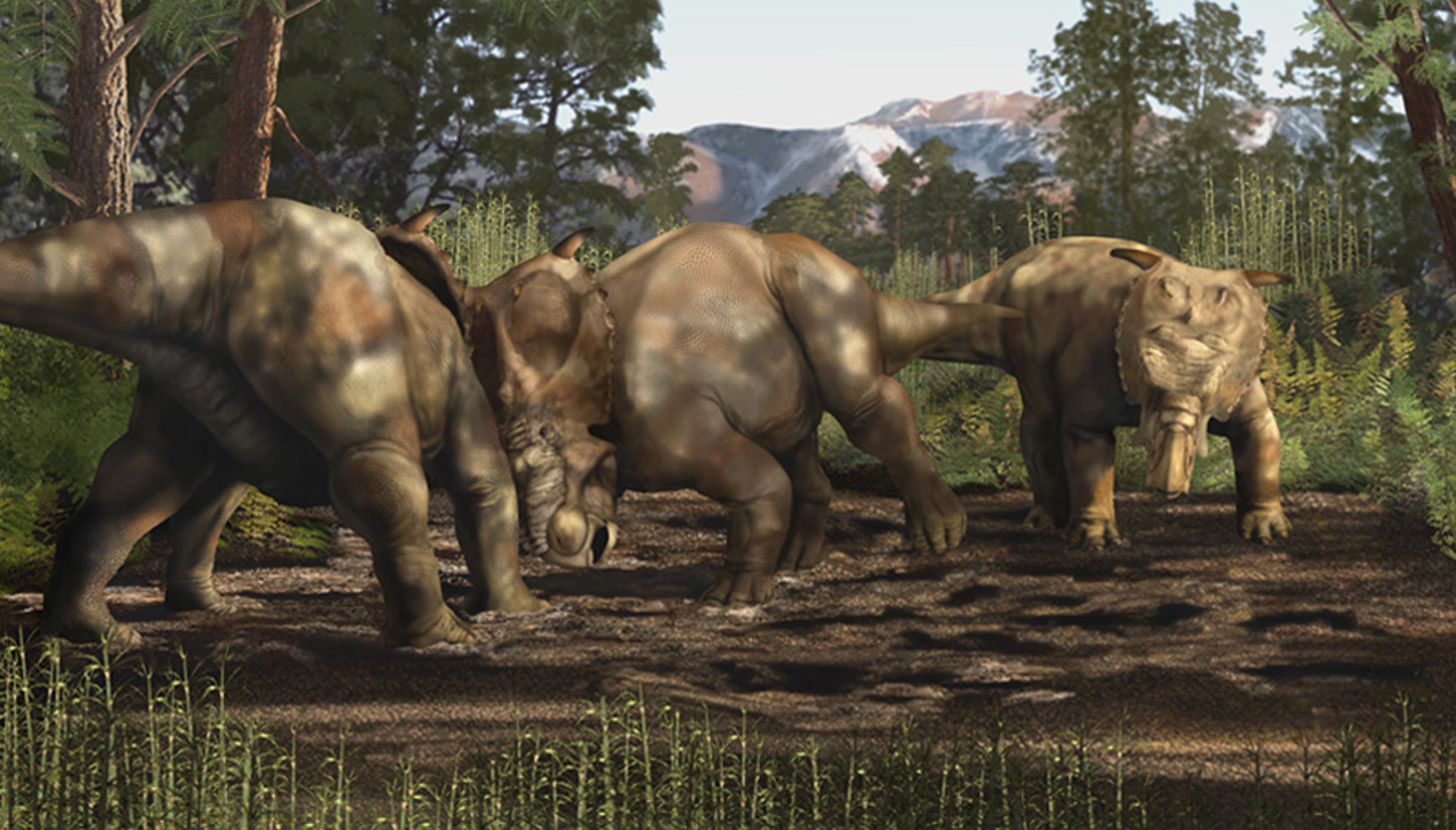


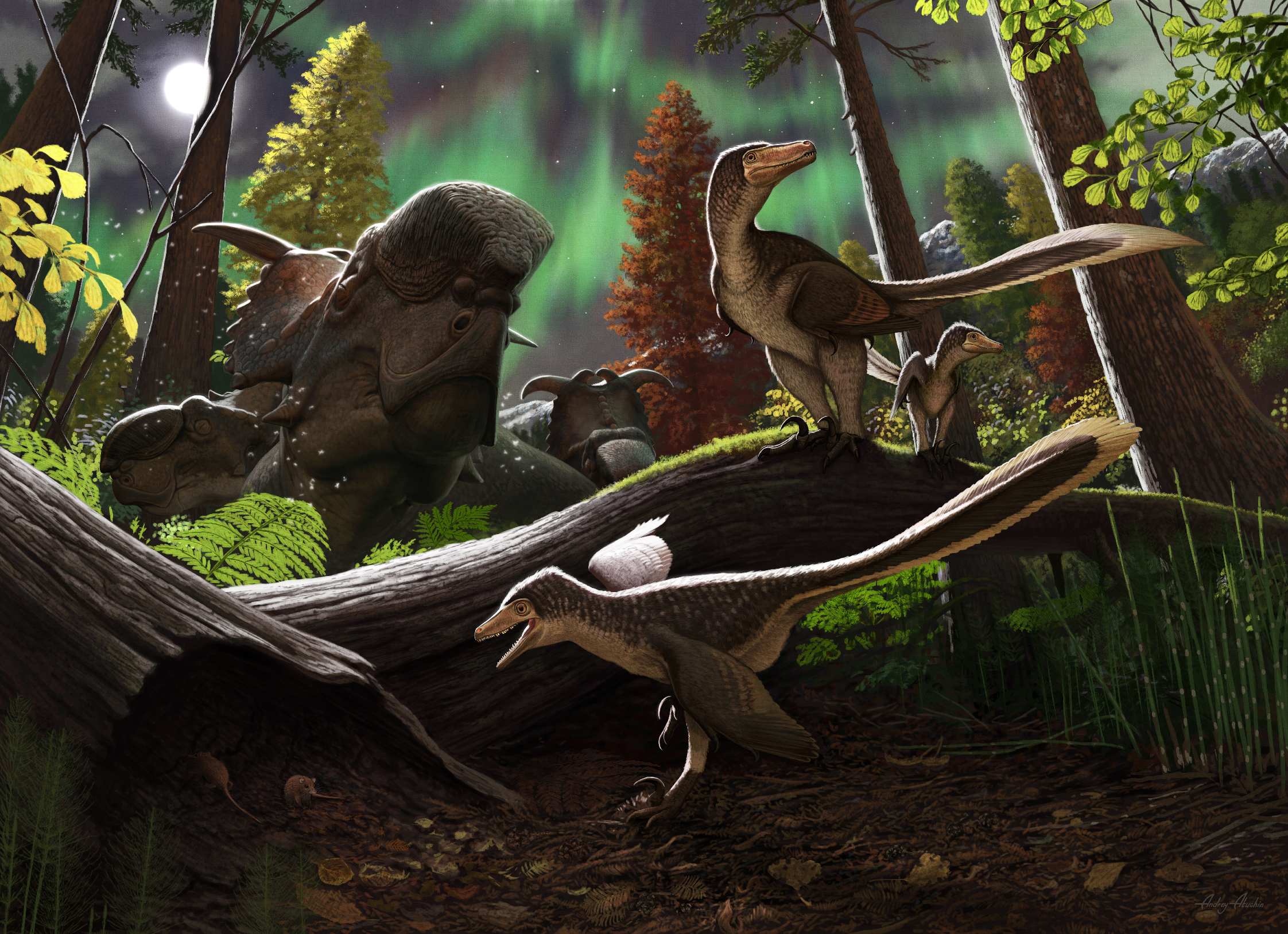
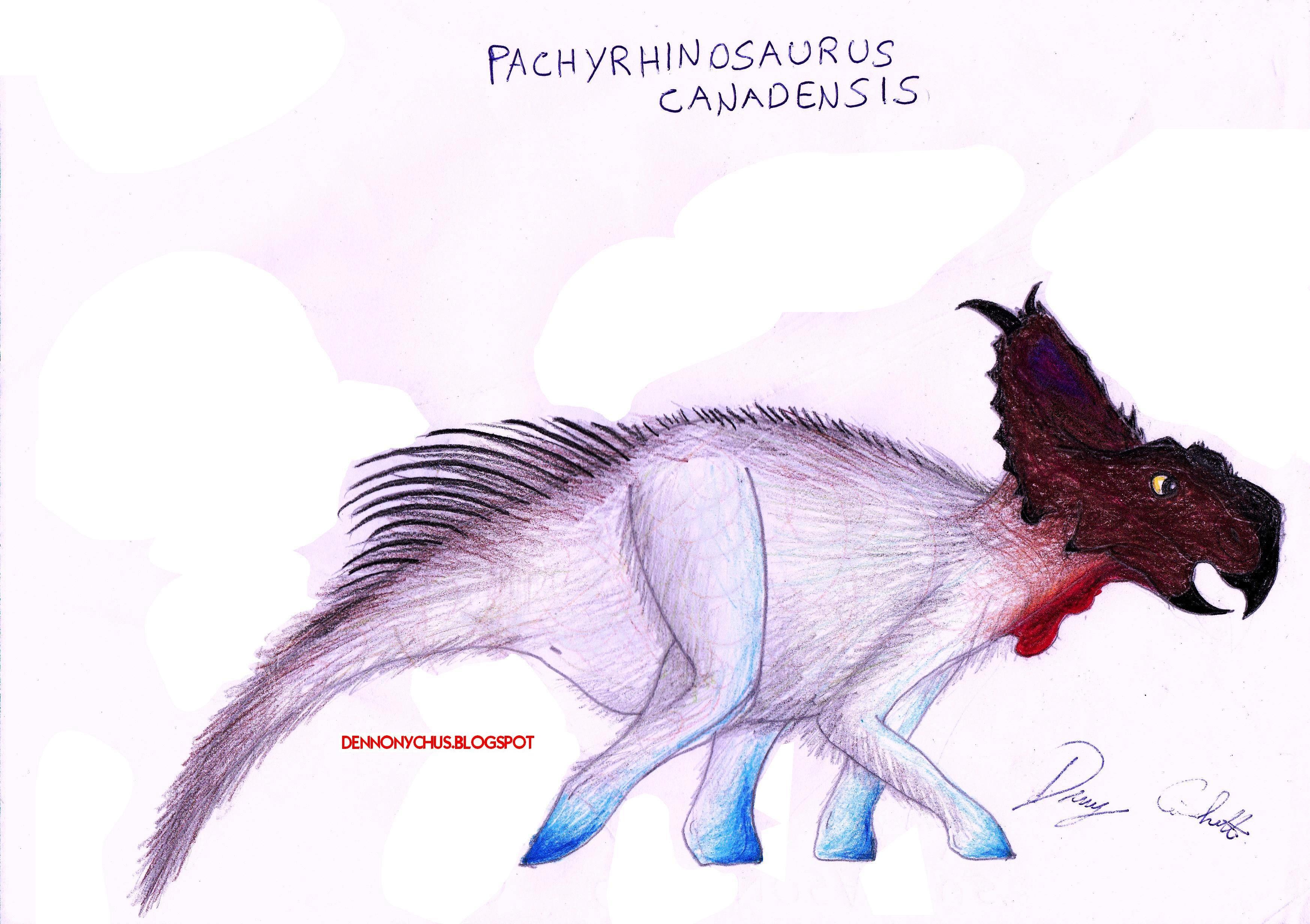
Scientific reconstruction of Pachyrhinosaurus canadensis by Connor Ashbridge (2025), showing the massive nasal boss, the frill with curved hornlets, and the integument with scales confirmed by fossils.
Connor Ashbridge (Ddinodan), CC BY 4.0
Ecology and behavior
Habitat
Pachyrhinosaurus canadensis inhabited the coastal plains and deltaic-forest transition zones of Late Cretaceous Alberta, in the region now known as the Horseshoe Canyon Formation (~73-69 Ma). The environment was an alluvial plain with coastal influence, a mosaic of angiosperm forests, shrubs, marshy zones, and meandering rivers. From ~71.5 Ma onward, the climate became cooler and more seasonal, with dry periods alternating with monsoons. The associated fauna included Albertosaurus (dominant predator), Edmontosaurus, Saurolophus, Anodontosaurus, Ornithomimus, and Troodon.
Feeding
Pachyrhinosaurus was an herbivore with a robust horny beak and complex dental batteries adapted to process fibrous and resistant vegetation. The depth of the mandibles and biomechanics of the temporomandibular joints indicate a bite specialized in ground-level vegetation: palm leaves, ferns, woody shrubs, and possibly angiosperm stems. Finite element analysis of mandibles reveals that centrosaurines like Pachyrhinosaurus were adapted to resist greater torsional forces than chasmosaurines, suggesting a coarser, more fibrous diet.
Behavior and senses
The enormous Pachyrhinosaurus bonebeds, with hundreds to thousands of bones from individuals of all ages, provide the strongest evidence of gregarious behavior among all ceratopsians. Taphonomic analysis of bonebeds suggests mass mortality from river flooding during seasonal migrations. The uniquely ossified nasal boss was likely used in intraspecific pushing confrontations, analogous to the behavior of modern bovines and ovines, establishing social dominance and access to reproductive partners. Sexual dimorphism in boss and frill morphology suggests males and females had distinct social roles.
Physiology and growth
Osteohistological analyses of Pachyrhinosaurus nasal bosses reveal accelerated growth in the juvenile phase, with less expressed growth bands early on becoming more visible as the animal approaches maturity. The pattern is consistent with elevated metabolism (endothermy), typical of large ornithischian dinosaurs. The nasal boss reached maximum development when the animal was approximately 73% of adult size, coinciding with the onset of sexual maturity. The estimated body mass of 3 to 4 tons, combined with evidence of long-distance migration, implies high metabolic demand and possibly behavioral thermoregulation mechanisms.
Paleogeography
Continental configuration

Ron Blakey · CC BY 3.0 · Cretáceous, ~90 Ma
During the Campaniano-Maastrichtiano (~73–69 Ma), Pachyrhinosaurus canadensis inhabited Laramidia, the western half of present-day North America, separated from the east by the Western Interior Seaway, a shallow sea dividing the continent. The continents were in very different positions: India was drifting toward Asia, Antarctica was still connected to Australia, and South America was an isolated island.
Inventário de Ossos
Based on multiple specimens. The holotype NMC 8867, collected in 1946, is an incomplete skull. Additional material from the St. Mary River Formation (NMC 21863, 21864, 10669) supplements the record. Bonebeds from the Wapiti Formation yielded hundreds of additional elements, especially skulls and appendicular bones, at various ontogenetic stages.

Found elements
Inferred elements
Scientific Literature
15 papers in chronological order — from the original description to recent research.
Pachyrhinosaurus canadensis, representing a new family of the Ceratopsia, from southern Alberta
Sternberg, C.M. · National Museum of Canada Bulletin
Charles Mortram Sternberg describes Pachyrhinosaurus canadensis based on two incomplete skulls collected from the Horseshoe Canyon Formation, Alberta, in 1945 and 1946. The holotype NMC 8867 and paratype NMC 8866 reveal the most distinctive feature of the genus: instead of the typical nasal horn of ceratopsians, the animal bore an enormous ossified, flattened boss over the nasal and frontal region. Sternberg initially proposed a new family (Pachyrhinosauridae) to accommodate the unique morphology, though later work placed the genus as a derived centrosaurine. This founding paper establishes the diagnostic characters of the taxon and is the mandatory starting point for all research on the species.
The thick-headed ceratopsian dinosaur Pachyrhinosaurus (Reptilia: Ornithischia), from the Edmonton Formation near Drumheller, Canada
Langston, W. · Canadian Journal of Earth Sciences
Langston describes new Pachyrhinosaurus material from the Edmonton Formation near Drumheller, Alberta. An incomplete skull, better preserved than Sternberg's earlier specimens, provides new anatomical details on the nasal boss and the occipital frill. The paper is the first major systematic revision after the 1950 original description and confirms the genus's placement within Ceratopsidae as a taxon unique in lacking a nasal horn. Langston discusses intraspecific variability observed across specimens and the possible presence of keratin over the boss, analogous to that seen in modern bovines.

The ceratopsian dinosaurs and associated lower vertebrates from the St. Mary River Formation (Maestrichtian) at Scabby Butte, southern Alberta
Langston, W. · Canadian Journal of Earth Sciences
Langston expands the Pachyrhinosaurus record with material from the St. Mary River Formation at Scabby Butte, southern Alberta. Specimens NMC 21863, NMC 21864, and NMC 10669 are assigned to the genus, extending its geographic and stratigraphic range. The paper discusses the Maastrichtian faunal associations of Alberta, including non-dinosaurian vertebrates that coexisted with Pachyrhinosaurus, and provides one of the first paleoenvironmental analyses of the genus's habitat. The sedimentological context indicates alluvial plain environments with coastal influence and marked seasonality.

Two new horned dinosaurs from the Upper Cretaceous Two Medicine Formation of Montana, with a phylogenetic analysis of the Centrosaurinae
Sampson, S.D. · Journal of Vertebrate Paleontology
Sampson describes two new centrosaurine ceratopsids from the Two Medicine Formation and presents the first comprehensive phylogenetic analysis of centrosaurines, including 12 genera. The analysis places Pachyrhinosaurus as a derived member of a clade characterized by nasal bosses, in contrast to traditional horns. This paper is the first to formally identify the tribe Pachyrhinosaurini and describe the synapomorphies uniting the boss-bearing species. Sampson's phylogeny decisively influenced subsequent interpretation of ceratopsian diversification from the Campanian to the Maastrichtian of North America.


A new Maastrichtian species of the centrosaurine ceratopsid Pachyrhinosaurus from the North Slope of Alaska
Fiorillo, A.R. & Tykoski, R.S. · Acta Palaeontologica Polonica
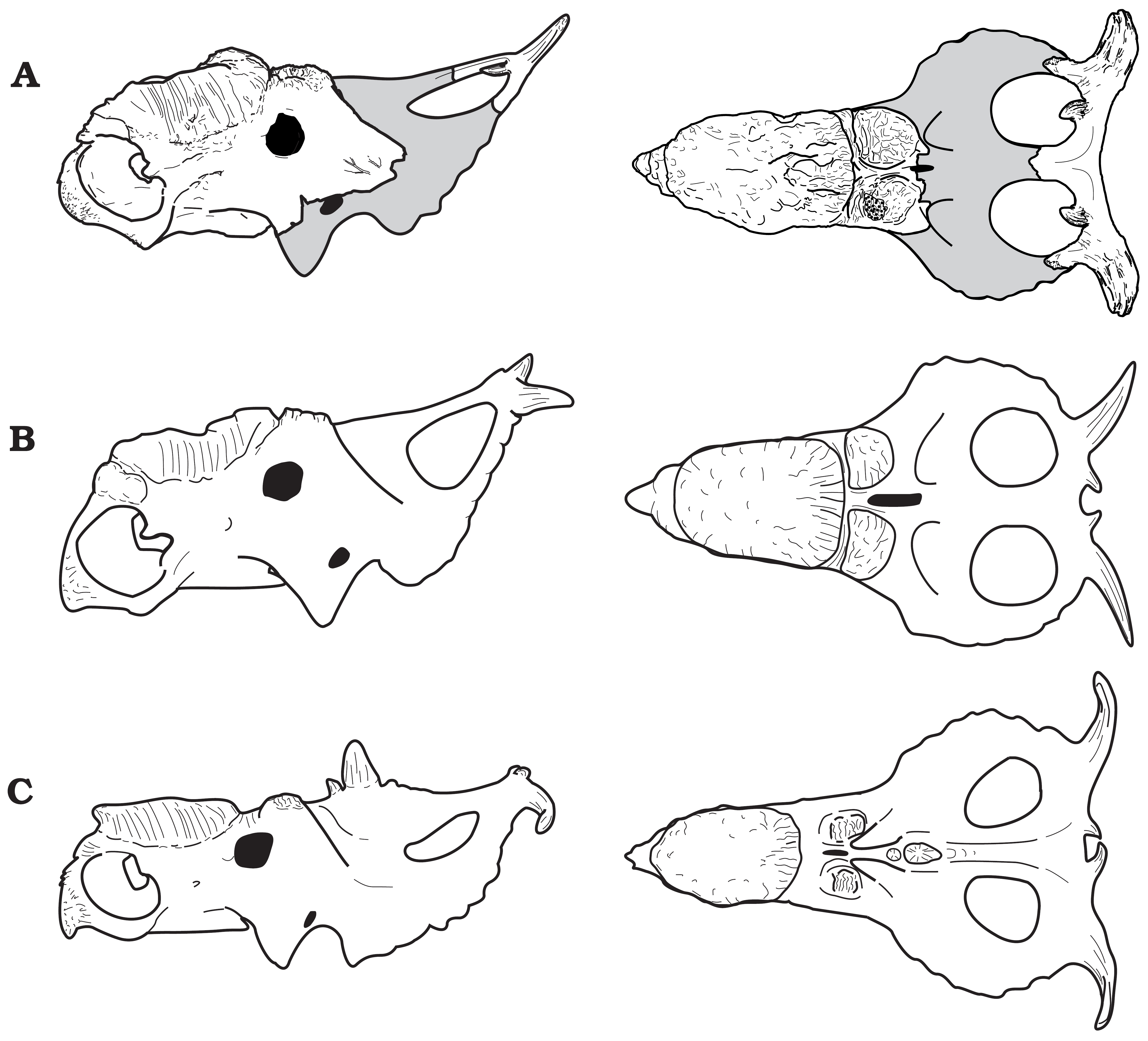
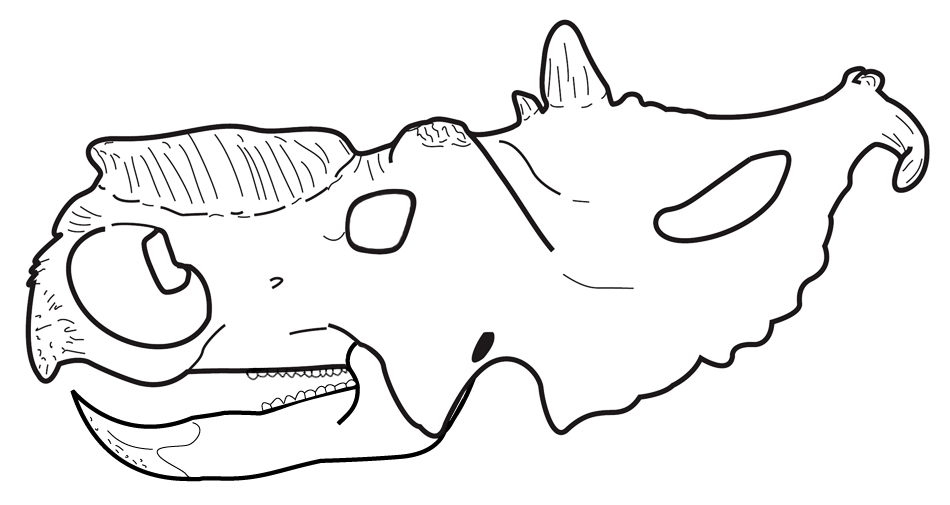
Fiorillo and Tykoski describe Pachyrhinosaurus perotorum, a new species from the Prince Creek Formation on the North Slope of Alaska, the most northerly known locality for any Pachyrhinosaurus. The phylogenetic analysis includes all three members of the genus and recovers a monophyletic Pachyrhinosaurus, with P. perotorum as the most derived species. The paper includes detailed cranial diagrams of all three species, discusses morphological differences in bosses and frill ornamentation, and presents a centrosaurine cladogram with Pachyrhinosaurus in a terminal position. The discovery at Arctic latitudes implies the genus could exploit seasonally cold, high-latitude environments.

An immature Pachyrhinosaurus perotorum (Dinosauria: Ceratopsidae) nasal reveals unexpected complexity of craniofacial ontogeny and integument in Pachyrhinosaurus
Fiorillo, A.R. & Tykoski, R.S. · PLOS ONE
A juvenile nasal specimen of Pachyrhinosaurus perotorum from Alaska reveals three ontogenetic stages in nasal boss development. Histological analysis shows the boss ossifies intramembranously as an outgrowth of the nasal bone, not through metaplasia as suspected. The specimen preserves cutaneous impressions interpreted as scales covering the frill region, providing the first direct evidence of Pachyrhinosaurus integument. Boss development follows nearly isometric growth to ~two-thirds of adult size, followed by accelerated lateral expansion — a pattern consistent with a sexual display function that becomes prominent as the animal approaches maturity.

Variation in the shape and mechanical performance of the lower jaws in ceratopsid dinosaurs (Ornithischia, Ceratopsia)
Maiorino, L. et al. · Journal of Anatomy
Maiorino and colleagues analyze lower jaws of 58 specimens representing 21 ceratopsoid taxa using geometric morphometrics and 2D finite element analysis. The study includes Pachyrhinosaurus and demonstrates that centrosaurines differ from chasmosaurines in jaw depth with correlated differences in resistance to bending and torsional stresses. These data suggest ecological niche partitioning between the two subfamilies: centrosaurines like Pachyrhinosaurus were better adapted to bite fibrous and tough vegetation at ground level, while chasmosaurines could feed on higher plants. The phylogenetic analysis included in the paper places all Pachyrhinosaurus as a coherent clade within Centrosaurinae.


Taphonomy, age, and paleoecological implication of a new Pachyrhinosaurus (Dinosauria: Ceratopsidae) bonebed from the Upper Cretaceous (Campanian) Wapiti Formation of Alberta, Canada
Fanti, F., Currie, P.J. & Burns, M.E. · Canadian Journal of Earth Sciences
Fanti, Currie, and Burns describe a new Pachyrhinosaurus bonebed from the Wapiti Formation, dated at 71.89 ± 0.14 Ma by 40Ar/39Ar. The site extends 107 meters and was excavated over 40 m² with bone density of 30 to 50 elements per square meter. Material includes individuals of different ontogenetic stages, consistent with gregarious behavior in mixed herds. Taphonomic analysis indicates a mass mortality event, possibly associated with river flooding — an event similar to that documented in the Pipestone Creek bonebed. Age distribution in the bonebed suggests Pachyrhinosaurus lived and moved in multigenerational social groups.


Insights into the ecology and evolutionary success of crocodilians revealed through the dental outcrops
Erickson, G.M. et al. · Scientific Reports
Osteohistological analysis of ceratopsid bone tissues, including Pachyrhinosaurus, provides growth rate data and ontogenetic staging criteria. Growth band analysis confirms that large ceratopsians reached adult size within approximately 20 years. The development of cranial structures like the Pachyrhinosaurus boss occurred when the animal was approximately 73% of adult size, consistent with a sexual selection function. The study indicates Pachyrhinosaurus displayed rapid growth in youth followed by gradual deceleration as it approached maturity, a pattern typical of large ornithischian dinosaurs.


Revised geochronology, correlation, and dinosaur stratigraphic ranges of the Santonian-Maastrichtian (Late Cretaceous) formations of the Western Interior of North America
Fowler, D.W. · PLOS ONE
Fowler presents a revised stratigraphic framework for the Campanian-Maastrichtian of the Western Interior of North America, based on updated radiometric dating and fossil occurrences. The revision confirms the temporal range of Pachyrhinosaurus canadensis in the lower Horseshoe Canyon Formation at approximately 73 to 71 Ma. The paper provides the most precise chronological context for the Late Cretaceous ceratopsian fauna of North America, including correlations between Canadian and American formations. Revised stratigraphic ranges help understand the biogeographic relationships between Pachyrhinosaurus and other contemporaneous ceratopsians.
Lokiceratops rangiformis gen. et sp. nov. (Ceratopsidae: Centrosaurinae) from the Campanian Judith River Formation of Montana reveals rapid regional radiations and extreme endemism within centrosaurine dinosaurs
Loewen, M.A. et al. · PeerJ
Loewen and colleagues describe Lokiceratops rangiformis, a new centrosaurine from Montana, and present the most comprehensive centrosaurine phylogenetic analysis through 2024, with 288 equally parsimonious trees. The analysis firmly positions Pachyrhinosaurus within the clade Pachyrostra, which diversified exclusively in northern Laurasia. A central result is that centrosaurines underwent extremely rapid regional radiations with marked endemism, with different clades restricted to distinct geographic areas of North America. For Pachyrhinosaurus, the analysis confirms the genus was geographically restricted to the north, exploiting high-latitude environments that other ceratopsians did not colonize.
A new Pachyrhinosaurus-like ceratopsid from the upper Dinosaur Park Formation (Late Campanian) of southern Alberta, Canada
Fanti, F. et al. · Journal of Vertebrate Paleontology
Fanti and colleagues describe a new pachyrhinosaur-like ceratopsid from the upper Dinosaur Park Formation of Alberta. The new taxon exhibits intermediate features between pachyrhinosaurs and other centrosaurines, illuminating the evolutionary origin of the nasal boss in Pachyrhinosaurus. The specimen is older than known Pachyrhinosaurus, suggesting the transition from nasal horn to massive boss occurred gradually across Campanian lineages. The paper has direct implications for understanding cranial macroevolution in centrosaurines.

Faunal assemblages from the upper Horseshoe Canyon Formation, an early Maastrichtian cool-climate assemblage from Alberta, with special reference to the Albertosaurus sarcophagus bonebed
Brown, C.M. et al. · Canadian Journal of Earth Sciences
Brown and colleagues document the faunal assemblages from the upper Horseshoe Canyon Formation, which include Pachyrhinosaurus among the dominant herbivores. The fauna represents an early Maastrichtian cool-climate ecosystem, with a transition from warm-wet deltaic to cooler, seasonally dry coastal plain conditions at approximately 71.5 Ma. The absence of warm-climate taxa like crocodilians and diverse turtles, and the presence of northern-affinity forms like Troodon and toothed birds, suggests Pachyrhinosaurus lived in a considerably cooler and more seasonal environment than its Campanian relatives.
A new species of Pachyrhinosaurus (Dinosauria, Ceratopsidae) from the Upper Cretaceous of Alberta, Canada
Currie, P.J., Langston, W. & Tanke, D.H. · A New Horned Dinosaur from an Upper Cretaceous Bone Bed in Alberta (NRC Research Press)
Currie, Langston, and Tanke describe Pachyrhinosaurus lakustai based on the Pipestone Creek bonebed (Wapiti Formation, ~73 Ma). With over 3,500 bones and 14 skulls from dozens of individuals at different ontogenetic stages, the Pipestone Creek bonebed is one of the richest ceratopsian deposits ever discovered. The phylogenetic analysis places P. lakustai as the most basal Pachyrhinosaurus. The paper documents intraspecific variability in boss and frill ornamentation, and provides fundamental ontogenetic data on cranial development in the genus. The Pipestone Creek bonebed remains the world's primary source of Pachyrhinosaurus material.


Paleobiological inferences from paleopathological occurrences in the Arctic ceratopsian Pachyrhinosaurus perotorum
Fiorillo, A.R. et al. · The Anatomical Record
Fiorillo and colleagues describe paleopathological lesions in Pachyrhinosaurus perotorum specimens from Alaska, including the specimen known as 'Harvey' (TMP 1989.055.1234), which showed severe skull lesions but survived for a period. The study deduces that the animal's survival despite its severe condition indicates that gregarious behavior and group care provided individual protection. Metacarpals with abnormalities are also described. This is the most recent and comprehensive study on the paleobiology and health of Pachyrhinosaurus, providing unprecedented data on disease, recovery, and the social dynamics of the genus.


Espécimes famosos em museus
NMC 8867 (Holótipo)
Canadian Museum of Nature, Ottawa, Canadá
Holotype of Pachyrhinosaurus canadensis. Incomplete skull collected from the sandy clay of the Horseshoe Canyon Formation in 1946, basis of Sternberg's 1950 original description. It is the reference specimen for the genus type species.
TMP 2002.076.0001
Royal Tyrrell Museum of Palaeontology, Drumheller, Alberta, Canadá
Specimen collected in Dinosaur Provincial Park (Alberta), dated to ~74.5 Ma. One of the most complete Pachyrhinosaurus specimens with post-cranial material associated with the skull, allowing more precise body proportion estimates than isolated skulls.
Bonebed de Pipestone Creek (múltiplos espécimes, P. lakustai)
Philip J. Currie Dinosaur Museum, Grande Prairie, Alberta, Canadá
The largest Pachyrhinosaurus bonebed ever discovered, excavated between 1986 and 1989. Represents P. lakustai, the sister species of P. canadensis. With up to 100 bones per square meter and 14 skulls of different ages, it provides the most complete data on population biology, ontogeny, and gregarious behavior of the genus.
In cinema and popular culture
Pachyrhinosaurus gained major cultural prominence primarily through the animated film 'Walking with Dinosaurs 3D' (2013) by BBC Earth, in which it is the absolute protagonist: the character Patchi, a young Pachyrhinosaurus with a hole in its frill caused by a Troodon bite, guides the viewer through the entire survival and migration narrative. The film brought a ceratopsian other than Triceratops to center stage in popular entertainment for the first time. In 2022, Apple TV+'s 'Prehistoric Planet' series presented the animal with unprecedented scientific accuracy in audiovisual media, with the 'Ice Worlds' episode showing herds facing Nanuqsaurus in the Arctic. The documentary 'The Journey North' (2025) deepened the portrayal of the genus's social and migratory behavior. Across this arc of appearances, the depiction evolved from a merely exotic flat-nosed animal to a nuanced portrait of sociability, parental care, and adaptation to high-latitude environments.

Classificação

Descoberta
Curiosidade
Pachyrhinosaurus canadensis had no nasal horn: instead, it bore an enormous solid bony boss over its nose, possibly covered by keratin like a rhinoceros horn. Paleontologists believe it used this boss to push rivals in dominance duels, much like modern musk oxen, and that herds of hundreds of individuals migrated seasonally across the Canadian Arctic.