
Parasaurolophus
Parasaurolophus walkeri
"Lizard with a crest parallel to Saurolophus (walkeri species)"
Sobre esta espécie
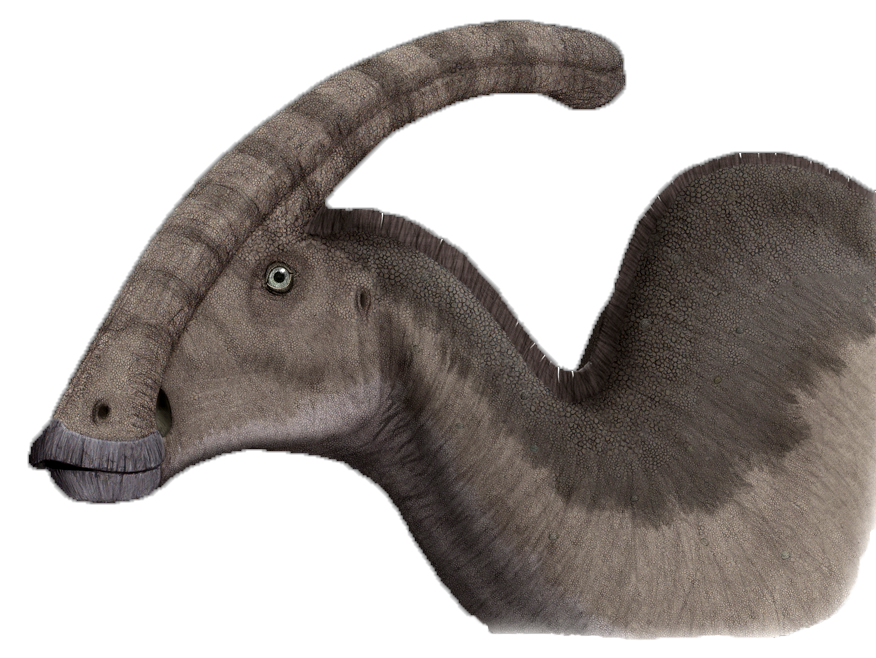
Parasaurolophus walkeri is one of the most recognizable dinosaurs of the Late Cretaceous, famous for the extraordinary hollow tubular crest that projected backward from the skull, potentially exceeding one meter in length. A social herbivore with compact rows of hundreds of replacement teeth, it lived in herds on the coastal plains of North America approximately 75 million years ago. The crest likely functioned as an acoustic resonating chamber, enabling low-frequency vocalizations for intraspecific communication. Facultatively bipedal, it alternated between upright stance and four-legged locomotion.
Geological formation & environment
Parasaurolophus walkeri is found mainly in the Dinosaur Park Formation (Campanian, ~76–75 Ma), exposed in the badlands of Alberta, especially at Dinosaur Provincial Park, a UNESCO World Heritage Site. The formation represents a fluvial delta environment with meandering channels, conifer forests, and floodplains. Other Parasaurolophus species occur in the Kirtland and Fruitland Formations of New Mexico (P. tubicen and P. cyrtocristatus) and the Kaiparowits Formation of Utah (Parasaurolophus sp., including RAM 14000). All these formations belong to the Campanian and represent different parts of the paleoenvironmental mosaic of western Laramidia, the large island continent that occupied western North America during the Late Cretaceous.
Image gallery
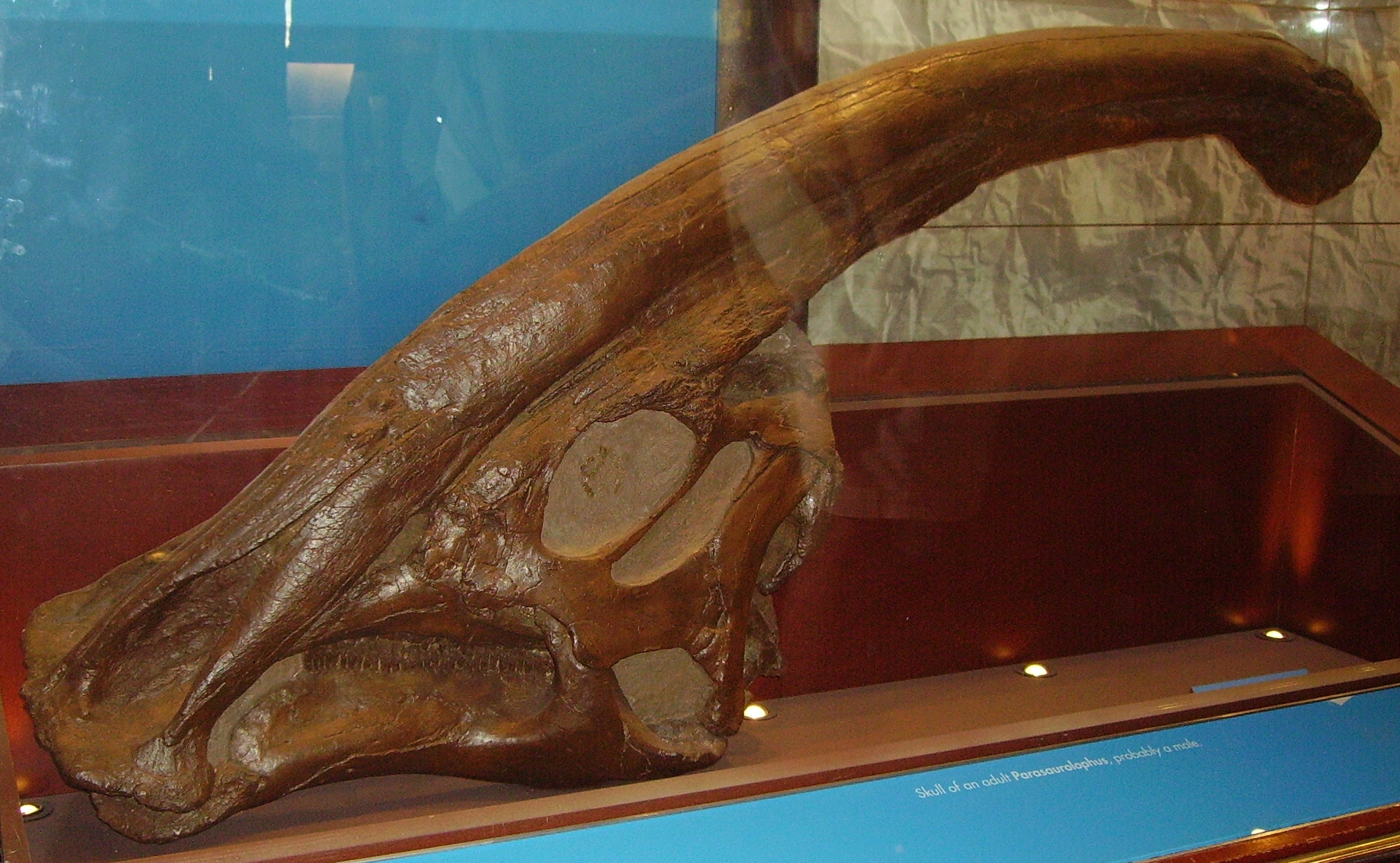
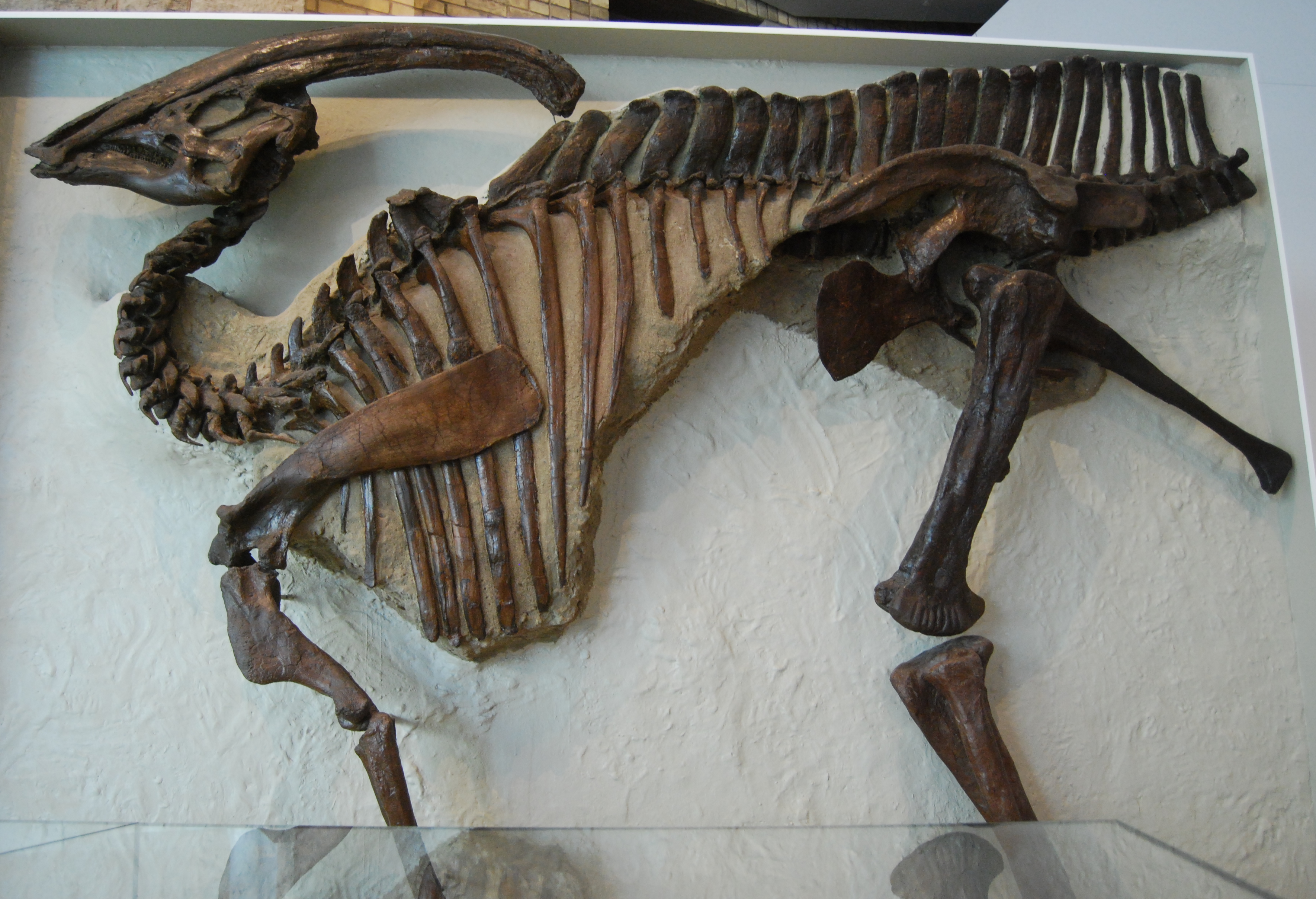


Skull of Parasaurolophus walkeri at the Natural History Museum, London, showing the characteristic tubular crest in detail. The hollow crest contains convoluted nasal passages that enabled low-frequency sound production.
Ballista, CC BY-SA 3.0
Ecology and behavior
Habitat
Parasaurolophus walkeri inhabited the subtropical coastal plains of western Laramidia during the Campanian (~76–73 Ma). The Dinosaur Park Formation of Alberta represents a fluvial delta environment with meandering channels, swamps, ponds, and dense riparian forests of conifers and angiosperms. Climate was warm and humid, with an estimated mean annual temperature of ~15–18°C. Contemporaries of P. walkeri in the Dinosaur Park fauna included Corythosaurus, Lambeosaurus, Gryposaurus, Centrosaurus, Styracosaurus, Chasmosaurus, Euoplocephalus, Stegoceras, and predators Gorgosaurus and Daspletosaurus. Parasaurolophus was relatively rare in this fauna compared to Corythosaurus and Lambeosaurus, possibly reflecting preference for specific microhabitats within the coastal ecosystem.
Feeding
Parasaurolophus was a specialized herbivore with one of the most sophisticated dental adaptations of any dinosaur. It possessed tooth batteries composed of hundreds of functional teeth organized in compact rows, with replacement teeth always present below. This system enabled efficient grinding of tough vegetation: branches, leaves, pine cones, and conifer needles. The jaw adorned with keratinous tissue functioned as a scraping beak. In quadrupedal posture, the animal browsed the middle vegetation layer, while in bipedal posture it accessed taller plants. Dental wear mark studies and fossil stomach content analyses from related hadrosaurids indicate a diverse diet of plant materials, including tough fibrous material that other herbivores could not efficiently process.
Behavior and senses
Parasaurolophus was a gregarious animal that lived in herds, as evidenced by the presence of multiple adult and juvenile specimens at associated excavation sites and phylogenetic inference from related hadrosaurid behaviors. The hollow tubular crest was likely used for acoustic communication: studies by Weishampel (1981) and Lin (2024) demonstrated the structure was capable of producing sounds at species-specific frequencies, useful for recognizing conspecifics in dense vegetation, predator alerting, and reproductive behaviors. The presence of paleopathologies in the holotype (Bertozzo et al., 2020) indicates P. walkeri was an active animal with robust cervical biomechanics. Alternation between bipedal and quadrupedal locomotion likely depended on activity: bipedalism during fleeing or foraging for tall plants, quadrupedalism during grazing.
Physiology and growth
As a hadrosaurid, Parasaurolophus was likely endothermic or mesothermic, with a relatively rapid growth rate compared to ectothermic reptiles. The juvenile specimen RAM 14000 (Farke et al., 2013) demonstrated that P. walkeri grew from 2.5 m at birth to over 9 m at maturity, a substantial growth rate implying elevated metabolism. Bone histology of the juvenile specimen shows fibrolamellar bone tissue of rapid growth, characteristic of animals with accelerated growth. The tooth battery with hundreds of continuously replaced teeth is one of the most efficient of any vertebrate, processing large volumes of fibrous vegetation daily. The estimated weight of adults (5,000 kg) implies high energy demand satisfied by a high-quantity vegetation diet. The robust forelimbs allowed body weight support during four-legged feeding.
Paleogeography
Continental configuration

Ron Blakey · CC BY 3.0 · Cretáceous, ~90 Ma
During the Campaniano (~76.5–73 Ma), Parasaurolophus walkeri inhabited Laramidia, the western half of present-day North America, separated from the east by the Western Interior Seaway, a shallow sea dividing the continent. The continents were in very different positions: India was drifting toward Asia, Antarctica was still connected to Australia, and South America was an isolated island.
Inventário de Ossos
The holotype ROM 768, held at the Royal Ontario Museum in Toronto, preserves the skull and substantial portions of the postcranial skeleton, but is incomplete. Additional specimens from the Kirtland and Kaiparowits formations complement anatomical knowledge of the genus.
Found elements
Inferred elements
Scientific Literature
15 papers in chronological order — from the original description to recent research.
Parasaurolophus walkeri: a new genus and species of crested trachodont dinosaur
Parks, W.A. · University of Toronto Studies, Geological Series
Founding paper establishing the genus and species Parasaurolophus walkeri based on holotype ROM 768, collected in 1920 near the Red Deer River in Alberta. Parks details the cranial morphology, emphasizing the hollow tubular crest projecting backward from the nasals and frontals. The name was chosen for being 'parallel to Saurolophus', a solid-crested hadrosaurid described earlier. Parks interpreted the crest as a possible nasal sac or neck muscle support structure, hypotheses later contested by subsequent research. The description includes detailed crest measurements (approximately 1.64 m total head length), body size estimates, and comparisons with other hadrosaurids of the time. This paper is the mandatory starting point for any research on the species.


Hadrosaurian Dinosaurs of North America
Lull, R.S. & Wright, N.E. · Geological Society of America Special Papers
A 272-page monograph establishing the taxonomic framework for North American hadrosaurids for decades. Lull and Wright review all known specimens, including the Parasaurolophus walkeri holotype, and provide expanded diagnoses, discussions of crest function, and systematic comparisons with Corythosaurus, Lambeosaurus, and other lambeosaurines. The work remained the fundamental reference for understanding hadrosaurid morphological diversity and was the primary source of comparative data for virtually all subsequent research on the group until the late 20th century. Comparative skeletal illustrations constitute a valuable anatomical resource still consulted by researchers.
The evolution of cranial display structures in hadrosaurian dinosaurs
Hopson, J.A. · Paleobiology
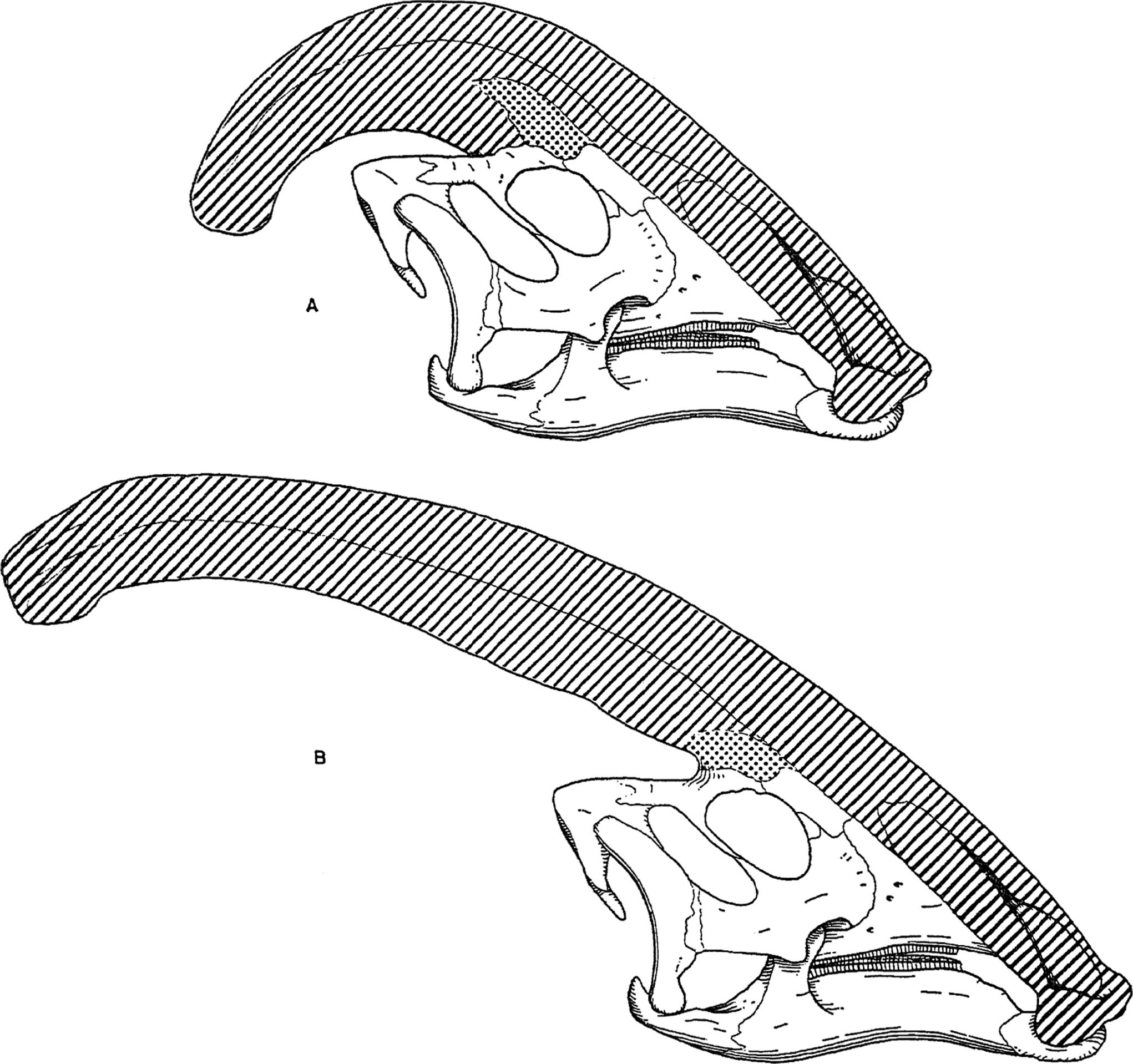
Pioneering study by James Hopson applying sexual selection theory to hadrosaurids, proposing that the hollow crests of lambeosaurines, including Parasaurolophus, were visual and acoustic display structures functioning as reproductive isolating mechanisms between species. Hopson argues that morphological differences between the crests of P. walkeri, P. tubicen, and P. cyrtocristatus may reflect sexual dimorphism or ontogenetic variation within a single species rather than distinct species. The paper introduces the idea that crests produced species-specific frequency calls serving as recognition signals for potential mates. Though speculative at the time, this hypothesis was broadly confirmed by Weishampel's (1981) subsequent acoustic studies and CT analyses.

Acoustic analyses of potential vocalization in lambeosaurine dinosaurs (Reptilia: Ornithischia)
Weishampel, D.B. · Paleobiology
First rigorous acoustic study applied to lambeosaurine hadrosaurids. Weishampel models the internal nasal passages of the Parasaurolophus crest as resonating tubes and calculates natural resonance frequencies using acoustic tube physics. For P. walkeri with a crest approximately 1.64 m long, the model predicts fundamental frequencies around 55 Hz with integer multiple harmonics, covering part of the vocalization spectrum of contemporary vertebrates. The work establishes that the Parasaurolophus crest was physically capable of producing low-frequency sounds with species-distinctive characteristics, transforming the debate from speculation into testable hypothesis. The calculated frequencies suggest Parasaurolophus could produce sounds capable of penetrating dense vegetation, useful for long-range communication within herds.
Parasaurolophus cyrtocristatus, a crested hadrosaurian dinosaur from New Mexico
Ostrom, J.H. · Fieldiana: Geology
John Ostrom describes Parasaurolophus cyrtocristatus based on specimens from the Fruitland Formation of New Mexico, the third recognized species of the genus. The crest of P. cyrtocristatus is notably shorter and more curved compared to P. walkeri, and Ostrom discusses whether this difference reflects sexual dimorphism, ontogenetic variation, or true specific distinction. The work includes a detailed anatomical comparison of the three crest morphotypes, contributing to the debate on the systematics of the genus. Ostrom argues the differences are sufficient to sustain three valid species, a position still broadly accepted, though their relationship continues to be studied. The crest comparison diagram became a mandatory visual reference in subsequent studies of the genus.

Global phylogeny of Hadrosauridae (Dinosauria: Ornithopoda) using parsimony and Bayesian methods
Prieto-Márquez, A. · Zoological Journal of the Linnean Society
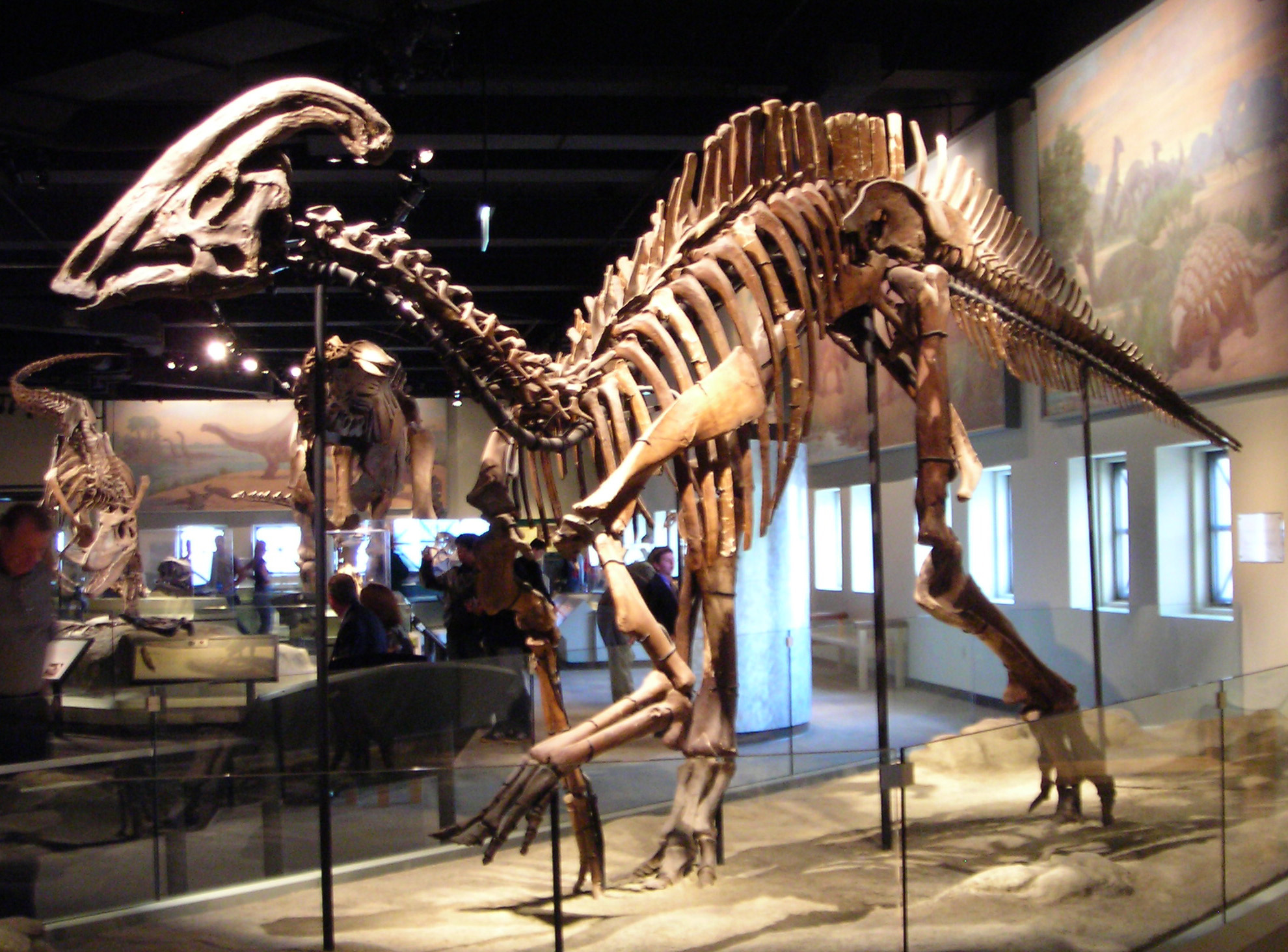
The most comprehensive phylogenetic analysis of hadrosaurids published to that date, sampling taxa from North America, Europe, and Asia using parsimony and Bayesian approaches. Prieto-Márquez consistently positions Parasaurolophus as the sister taxon of Charonosaurus jiayinensis within Lambeosaurinae, indicating phylogenetic affinity between the North American tube-crested form and the similar-crested Asian form. The work establishes formal phylogenetic definitions for Hadrosaurinae and Lambeosaurinae, and contributes to understanding hadrosaurid biogeography, suggesting at least one dispersal or vicariance event between North America and Asia during the Campanian. Bayesian analyses converge with parsimony results, reinforcing the robustness of recovered clades.
A juvenile Parasaurolophus (Ornithischia: Hadrosauridae) braincase from Dinosaur Provincial Park, Alberta
Evans, D.C., Reisz, R.R. & Dupuis, K. · Journal of Vertebrate Paleontology
Evans, Reisz, and Dupuis describe a juvenile Parasaurolophus braincase (TMP 1966.4.1) from the Dinosaur Park Formation, Alberta, providing the first direct evidence of how the crest developed through ontogeny. The juvenile specimen lacks the developed crest of adults, confirming the structure grew progressively with maturity. Anatomical comparison with other juvenile lambeosaurines reveals that braincase proportions change substantially during growth, with implications for field identification of juvenile specimens. The work contributes to the debate on whether crest differences between P. walkeri, P. tubicen, and P. cyrtocristatus might reflect ontogenetic variation within one species, concluding the anatomical differences are sufficiently substantial to sustain specific distinctions.


An unusual hadrosaurid braincase from the Dinosaur Park Formation and the biostratigraphy of Parasaurolophus (Ornithischia: Lambeosaurinae) from southern Alberta
Evans, D.C., Bavington, R. & Campione, N.E. · Canadian Journal of Earth Sciences
Evans, Bavington, and Campione describe an unusual braincase from the Dinosaur Park Formation, Alberta, representing the third and largest cranial specimen of the Parasaurolophus genus from that formation. Biostratigraphic analysis of Parasaurolophus occurrences throughout the Dinosaur Park Formation reveals a significant temporal distribution, with implications for lambeosaurine diversification and extinction patterns during the Campanian. The work finds Parasaurolophus was a rare element of the Dinosaur Park Formation fauna compared to Corythosaurus and Lambeosaurus, possibly reflecting habitat preferences within the coastal plain ecosystem. Phylogenetic analysis positions the specimen within Parasaurolophus and discusses its possible specific attribution.

Ontogeny in the tube-crested dinosaur Parasaurolophus (Hadrosauridae) and heterochrony in hadrosaurids
Farke, A.A., Chok, D.J., Herrero, A., Scolieri, B. & Werning, S. · PeerJ
Paper describing RAM 14000 (nicknamed 'Joe'), a juvenile Parasaurolophus specimen from the Kaiparowits Formation of Utah, representing one of the youngest known individuals of the genus. Bone histology reveals the animal died at approximately one year of age and measured only 2.5 m in length, contrasting with the 9–10 m adults. Ontogenetic analysis demonstrates the crest began developing early but was absent or rudimentary in the youngest individuals. Heterochronic comparisons with other hadrosaurids reveal Parasaurolophus exhibited a crest development pattern distinct from Corythosaurus and Lambeosaurus, suggesting different life history strategies. The work also provides bone histology and growth data allowing comparison of Parasaurolophus development rates with other herbivorous dinosaurs.
A new basal hadrosauroid dinosaur (Dinosauria: Ornithopoda) with transitional features from the Late Cretaceous of Henan Province, China
Xing, H., Wang, D., Han, F., Sullivan, C., Ma, Q., He, Y., Hone, D.W.E., Yan, R., Du, F. & Xu, X. · PLOS ONE
Xing and colleagues describe Zhanghenglong yangchengensis, a new basal hadrosauroid from the Late Cretaceous of Henan Province, China, with features transitional between non-hadrosaurid hadrosauroids and Hadrosauridae. The phylogenetic analysis uses Parasaurolophus walkeri as one of the anchor taxa for defining Hadrosauroidea, defined as 'the least inclusive taxon containing Equijubus normani and Parasaurolophus walkeri'. The work contributes to understanding the origins and early diversification of hadrosaurids in Asia, revealing the anatomical transition from pre-hadrosaurid dentition to the typical hadrosaurid tooth battery was more gradual than previously thought. The inclusion of Parasaurolophus as a phylogenetic anchor demonstrates its importance as a taxonomic reference for the entire clade.

Description and rediagnosis of the crested hadrosaurid (Ornithopoda) dinosaur Parasaurolophus cyrtocristatus on the basis of new cranial remains
Gates, T.A., Evans, D.C. & Sertich, J.J.W. · PeerJ
Gates, Evans, and Sertich formally rediagnose Parasaurolophus cyrtocristatus based on new cranial material, clarifying its distinction from other species of the genus. The paper presents a revised list of diagnostic characters separating P. cyrtocristatus from P. walkeri and P. tubicen, contributing to taxonomic stability of the genus. The rediagnosis also evaluates historical specimen referrals to P. cyrtocristatus, identifying incorrect attributions and restricting the valid material of the species. The study uses modern morphological and statistical methods to quantify crest differences between species, providing a more rigorous basis for future identifications. Phylogenetic and biogeographic implications of the three valid Parasaurolophus species are discussed in the Campanian paleogeographic context.


Description and etiology of paleopathological lesions in the type specimen of Parasaurolophus walkeri (Dinosauria: Hadrosauridae), with proposed reconstructions of the nuchal ligament
Bertozzo, F., Manucci, F., Dempsey, M., Tanke, D.H., Evans, D.C., Ruffell, A. & Murphy, E. · Journal of Anatomy
Bertozzo and colleagues examine the holotype ROM 768 of Parasaurolophus walkeri and identify multiple paleopathological lesions at the dorsal spinous processes and ligament attachment sites. Analysis of the lesions, including enthesophytes (bone ossifications at tendon attachment points), allows reconstruction of the nuchal ligament system, a soft tissue structure never directly preserved. The work demonstrates that P. walkeri possessed a robust nuchal ligament comparable to that of modern heavy-necked ungulates, consistent with the considerable weight of the head and crest. Individual lesion etiologies are discussed in terms of neck biomechanics and the animal's behavior in life. It is the first study to examine paleopathologies specifically in the P. walkeri holotype, adding soft tissue anatomy data from bony evidence.


Acoustic characteristics of Parasaurolophus crest: Experimental results from a physical model
Lin, H. · Journal of the Acoustical Society of America
Lin constructs a full-scale physical model of the internal nasal passages of the Parasaurolophus crest and performs acoustic experiments to characterize resonance properties. Results demonstrate a fundamental frequency of approximately 800 Hz with peaks at harmonic multiples, suggesting the crest structure could function as a resonating chamber for acoustic communication. This study provides direct experimental evidence complementing earlier computational acoustic models, especially Weishampel (1981), using a different methodology and finding higher frequencies. The difference in frequency estimates between the two studies may reflect differences in assumed internal tube geometries. The work confirms the Parasaurolophus crest was physically capable of producing audible sounds with distinct characteristics allowing intraspecific recognition.

Does mutual sexual selection explain the evolution of head crests in pterosaurs and dinosaurs?
Hone, D.W.E., Naish, D. & Cuthill, I.C. · Lethaia
Hone, Naish, and Cuthill evaluate the mutual sexual selection hypothesis for the evolution of elaborate head structures in pterosaurs and dinosaurs, including lambeosaurines such as Parasaurolophus. The study applies criteria from modern evolutionary biology to test whether Parasaurolophus crests and those of elaborate-crested pterosaurs are best explained by sexual selection, species recognition, or thermoregulation. The authors conclude that while sexual selection is a plausible mechanism, the available fossil evidence does not conclusively distinguish between the competing hypotheses. The work advances methodologically by directly comparing the morphological patterns of ornamental structures in two independent groups of flying and running reptiles, testing specific predictions of each adaptive hypothesis.

The smallest known Triceratops skull and the identification and significance of ontogenetic changes in Triceratops and other ceratopsids
Goodwin, M.B., Clemens, W.A., Horner, J.R. & Padian, K. · Journal of Vertebrate Paleontology
Though primarily focused on ceratopsians, this work by Goodwin, Clemens, Horner, and Padian presents comparative ontogenetic data from herbivorous dinosaurs including hadrosaurids such as Parasaurolophus. Analysis of the smallest known Triceratops skull illustrates methodologies for distinguishing ontogenetic from taxonomic variation, a problem directly relevant to the Parasaurolophus genus, where three species were historically distinguished by crest morphology potentially influenced by age. The methodological implications of the work, especially development of criteria for identifying juvenile specimens in the field and in collections, apply directly to Parasaurolophus systematics. The paper was published during a particularly active period of debate about the valid number of Parasaurolophus species.


Espécimes famosos em museus

ROM 768 (Holótipo)
Royal Ontario Museum, Toronto, Canadá
The holotype and most famous P. walkeri specimen, collected near the Red Deer River, Alberta. Preserves the skull with nearly complete crest and substantial postcranial elements. Described by Parks in 1922, it is the specimen upon which all taxonomy of the species was built.
ROM 41
Royal Ontario Museum, Toronto, Canadá
Additional P. walkeri specimen also collected from the Red Deer River banks, Alberta, the year after the holotype. The postcranial material of this specimen complemented anatomical knowledge of the species and was exhibited at the Royal Ontario Museum for decades.
RAM 14000 ('Joe')
Raymond Alf Museum of Paleontology, Claremont, Califórnia, EUA
The most complete juvenile Parasaurolophus specimen ever found, approximately one year old at death and 2.5 m long. Discovered by a high school student during a school field expedition to the Kaiparowits Formation, Utah. Described by Farke et al. (2013) in PeerJ.
In cinema and popular culture
Parasaurolophus is one of the most recognizable herbivorous dinosaurs in popular culture, widely associated with the Jurassic Park franchise where it appears in virtually all films as part of the park's megafauna. Its distinctive silhouette, dominated by the impressive tubular crest projecting backward from the skull, made it immediately identifiable even to non-specialists. Its first major cinematic appearance was in Disney's Fantasia (1940) in 'The Rite of Spring' segment, where it was shown in groups consistent with its gregarious behavior. Major popular exposure came with Spielberg's Jurassic Park (1993), appearing in the famous panoramic island arrival scene. The documentary Walking with Dinosaurs (BBC, 1999) was pioneering in exploring the acoustic function of the crest for a large audience, showing the animal vocalizing, a detail fiction films have never adequately developed. In the more recent Jurassic World franchise productions, Parasaurolophus remains present but stays a secondary character without the narrative depth that using the crest for communication could inspire. In paleontology communicated to the general public, it is frequently cited as an example of an anatomical structure whose function is still debated, making it a particularly interesting dinosaur for science education.

Classificação

Descoberta
Curiosidade
The hollow crest of Parasaurolophus functioned as a natural musical instrument: over 1 meter long with convoluted nasal passages inside, it produced low-frequency sounds that could penetrate dense vegetation, functioning as a true 75-million-year-old trombone.