
Patagotitan
Patagotitan mayorum
"Titan of Patagonia of Mayo (honoring the Mayo family, owners of the farm where it was discovered)"
Sobre esta espécie
Patagotitan mayorum is one of the largest land animals that ever existed, a colossal titanosaur discovered in 2010 in Argentine Patagonia. With estimates of up to 37 meters in length and 69 tonnes in weight, it rivaled or surpassed Argentinosaurus for the title of largest dinosaur of all time. Six partial skeletons were excavated between 2013 and 2015 from the Cerro Barcino Formation in Chubut, providing one of the most complete fossil records of a giant titanosaur. Formally described by Carballido et al. in 2017, the animal belongs to the clade Lognkosauria and lived approximately 101 million years ago.
Geological formation & environment
The Cerro Barcino Formation (Cerro Castaño Member) is a Lower-Middle Cretaceous sedimentary unit of the Neuquén Basin, outcropping in Chubut Province, Patagonia, Argentina. Sediments were deposited in continental environments: floodplains, meandering rivers, and shallow lakes in a warm, humid climate. U-Pb zircon dating fixed the age of the Patagotitan-bearing strata at 101.62 ± 0.12 Ma, corresponding to the Late Albian. The formation also preserves pollen of primitive angiosperms, conifers, and remains of crocodilians and turtles, reconstructing a diverse ecosystem dominated by giant titanosaurs. The La Flecha site, where Patagotitan was found, represents an exceptional accumulation of individuals that possibly perished together during a drought or flood event.
Image gallery

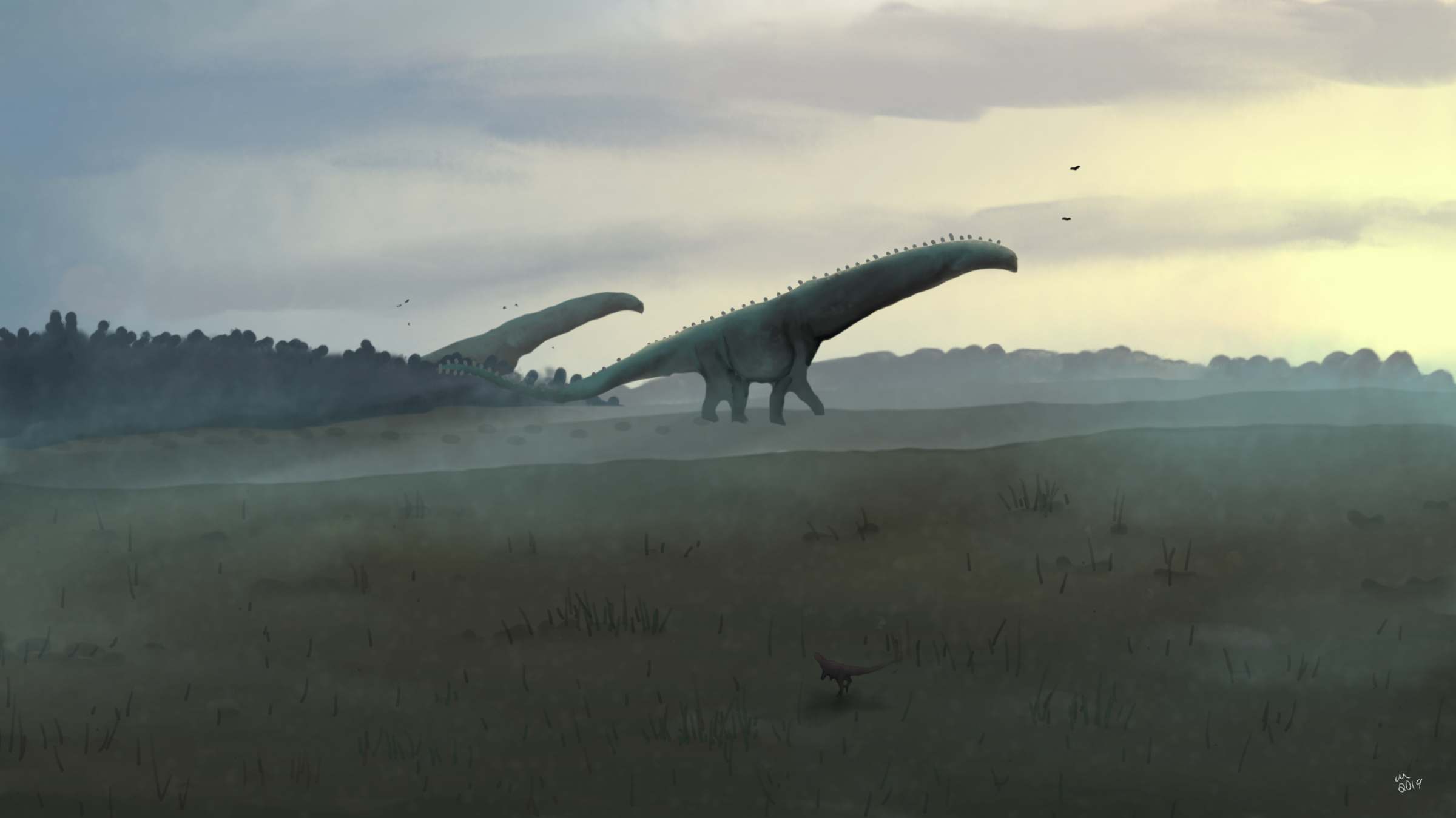
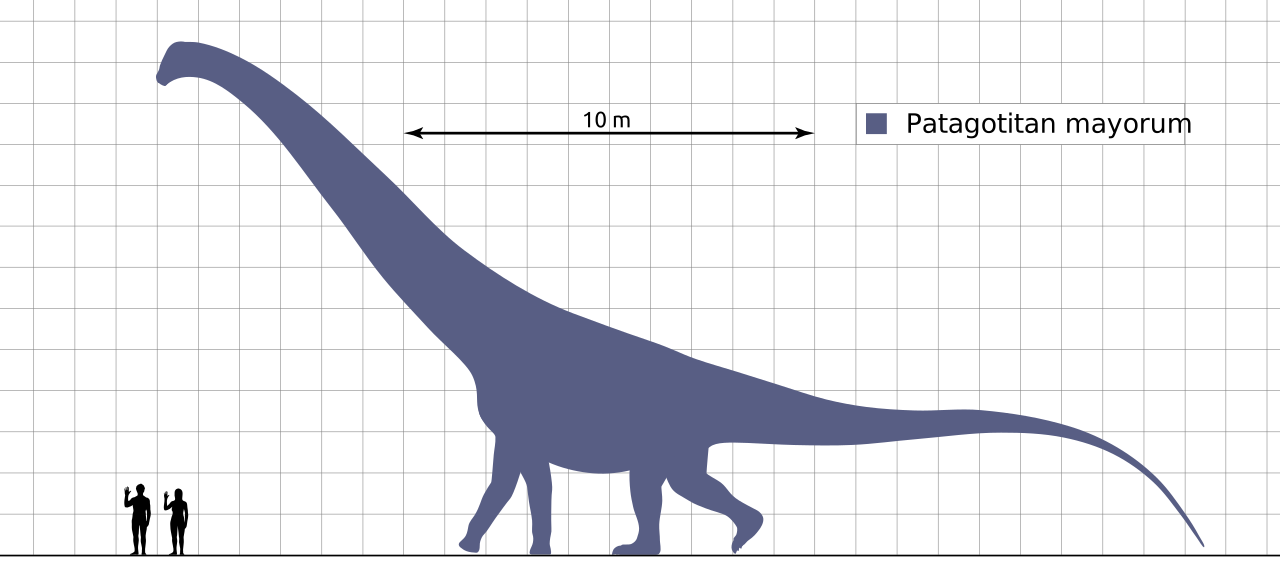
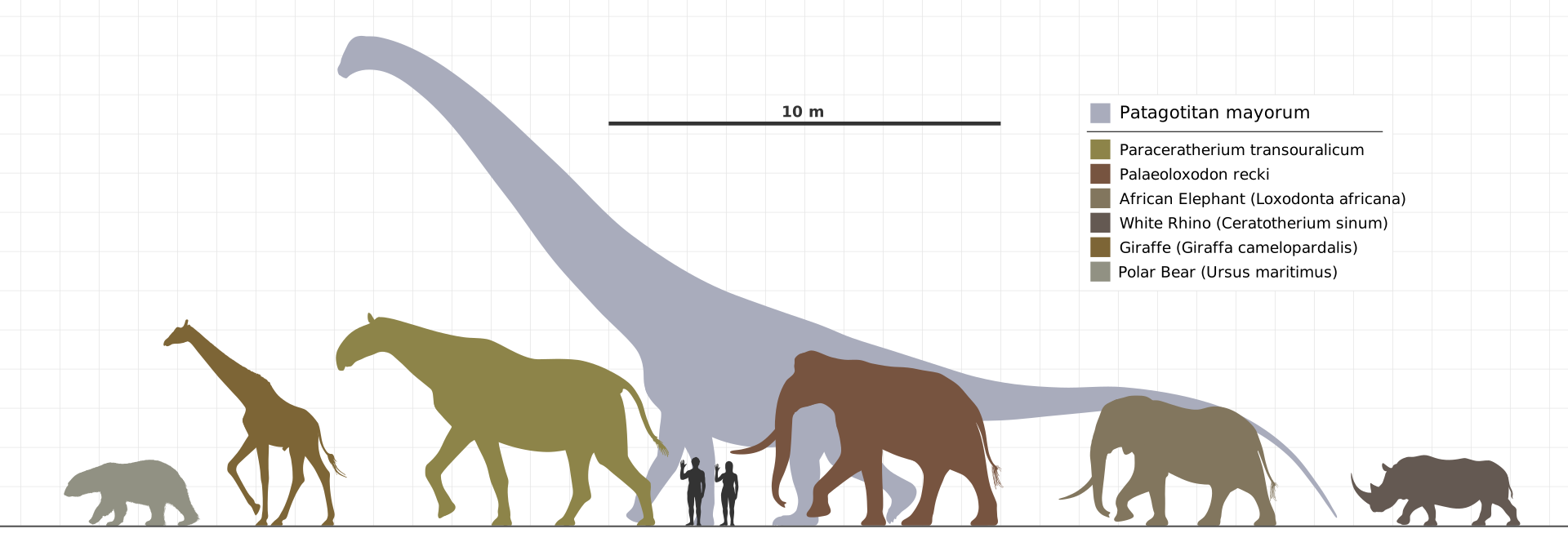



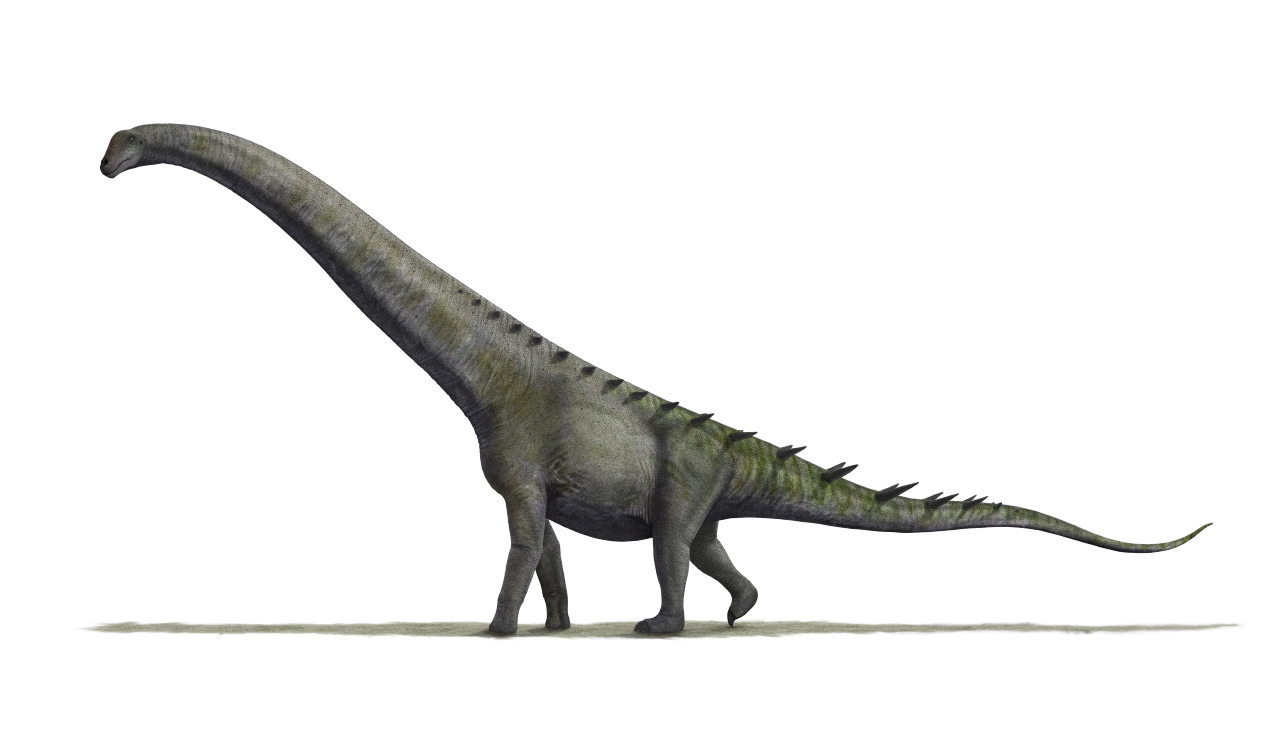
Scientific reconstruction of Patagotitan mayorum by Mario Lanzas (2019), based on the six specimens collected between 2013 and 2015 from the Cerro Barcino Formation, Chubut, Argentina.
Mario Lanzas (Mariolanzas) / CC BY-SA 4.0
Ecology and behavior
Habitat
Patagotitan inhabited coastal floodplains and meandering river systems of central Patagonia during the Late Albian, approximately 101 million years ago. The paleoclimate was warm and humid, with estimated average annual temperature of 18-22°C. Dominant vegetation included conifers, cycads, tree ferns, and primitive angiosperms beginning to radiate. The environment was seasonal, with flood and dry periods creating different feeding zones for the giant. Shallow lakes and swamps provided access to water and aquatic vegetation, while dense riparian forests offered food abundance along watercourses.
Feeding
As an extreme-mass herbivore, Patagotitan needed to consume between 200 and 400 kg of vegetation daily to sustain its metabolism. The long neck allowed horizontal sweeping of large areas without moving the heavy body, optimizing energy balance. Dentition was of the peg-like type, suitable for stripping foliage from conifers and tall vegetation. Biomechanical studies indicate the animal likely could not raise its neck above 45 degrees, concentrating on medium to low vegetation. Intestinal cellulose fermentation was essential, suggesting voluminous digestive chambers compatible with the animal's size.
Behavior and senses
The discovery of six individuals at the same excavation site in La Flecha strongly suggests gregarious behavior, with groups of Patagotitans living and moving together. Ontogenetic analyses reveal that all collected specimens were young adults, suggesting possible age segregation in groups. There is no direct evidence of reproductive behavior, but related titanosaurs like Saltasaurus nested in colonies, and the same behavior is plausible for Patagotitan. The absence of predator marks on bones indicates that full-size adults were likely beyond the reach of any predator contemporary with the Cerro Barcino Formation.
Physiology and growth
Osteohistology reveals extremely accelerated growth during the juvenile phase, with fibrolamellar bone deposition and plexiform vascular canals indicating high metabolic rates. Estimates suggest growth of several kilograms per day during peak development. Extensive bone pneumatization in cervical and dorsal vertebrae reduced skeletal weight by up to 20%, enabling support of body mass. The elevated and stable body temperature inferred from histological patterns suggests partial endothermy (mesothermy), unlike modern ectothermic reptiles. The studied specimens were still growing when they died, indicating that fully mature adults could have been even larger.
Paleogeography
Continental configuration

Ron Blakey · CC BY 3.0 · Cretáceous, ~90 Ma
Fóssil sites

Milenioscuro / CC BY-SA 3.0
During the Albiano (~102–100 Ma), Patagotitan mayorum inhabited Laramidia, the western half of present-day North America, separated from the east by the Western Interior Seaway, a shallow sea dividing the continent. The continents were in very different positions: India was drifting toward Asia, Antarctica was still connected to Australia, and South America was an isolated island.
Inventário de Ossos
Six partial skeletons were recovered, each representing between 20% and 40% of the complete skeleton. The collective material covers most body regions, including cervical, dorsal, and caudal vertebrae, ribs, sternum, scapula, hind limb bones, and pelvis. The skull and forelimbs remain highly fragmentary, with gaps filled by inference from close relatives such as Futalognkosaurus and Mendozasaurus.
Found elements
Inferred elements
Scientific Literature
15 papers in chronological order — from the original description to recent research.
A new giant titanosaur sheds light on body mass evolution among sauropod dinosaurs
Carballido, J.L., Pol, D., Otero, A., Cerda, I.A., Salgado, L., Garrido, A.C., Ramezani, J., Cúneo, N.R., Krause, J.M. · Proceedings of the Royal Society B: Biological Sciences
Founding paper formally naming and describing Patagotitan mayorum based on six partial skeletons found at La Flecha, Chubut. The authors use phylogenetic analysis to place the species within the clade Lognkosauria and calculate body mass at approximately 69 tonnes, making the animal one of the largest in the history of terrestrial life. The work includes U-Pb radiometric dating that fixed the age of the sediments at 101.62 million years, in the late Albian of the Cretaceous. The osteological analysis details robust dorsal vertebrae with air chambers that reduced skeletal weight without compromising structural resistance.
The appendicular osteology of Patagotitan mayorum (Dinosauria, Sauropoda)
Otero, A., Carballido, J.L., Pérez Moreno, A. · Journal of Vertebrate Paleontology
Work dedicated to the exhaustive description of the limb bones and pectoral and pelvic girdles of Patagotitan. The authors document ontogenetic variations among the six collected individuals, all representing young adults not yet fully mature. The study identifies unique anatomical characters in the hind limbs, particularly in femur and foot morphology, that inform the animal's locomotor biomechanics. Analyses reveal that Patagotitan likely had a more horizontal vertebral posture than some relatives, with implications for estimates of locomotor speed and energy consumption.


The osteology of Chubutisaurus insignis Del Corro, 1975 (Dinosauria: Neosauropoda) from the 'middle' Cretaceous of central Patagonia, Argentina
Carballido, J.L., Pol, D., Cerda, I.A., Salgado, L. · Journal of Vertebrate Paleontology
Redescription study of Chubutisaurus insignis, a Cretaceous titanosaur from the same Cerro Barcino Formation where Patagotitan would subsequently be found. The paper establishes the paleontological context of the sauropod fauna of central Patagonia during the middle Cretaceous, identifying diagnostic characters that distinguish Patagonian titanosaurs. The phylogenetic analysis positions Chubutisaurus near other basal forms, creating a fundamental comparative reference for the later description of Patagotitan. Carballido and colleagues' work in this study prepared the methodological groundwork for the major giant titanosaur description projects that would follow.


Evolution of titanosaurid sauropods. I: Phylogenetic analysis based on the postcranial evidence
Salgado, L., Coria, R.A., Calvo, J.O. · Ameghiniana
Seminal work establishing the first systematic phylogenetic analysis of titanosaurs based on post-cranial characters, creating the taxonomic framework that anchors all subsequent analyses of the group, including that which positions Patagotitan. Salgado, Coria, and Calvo formally define Titanosauria and propose relationships among families that still inform contemporary research. The emphasis on post-cranial skeleton as phylogenetic data is methodologically relevant for Patagotitan, whose cranial material remains scarce. The results of this analysis were largely confirmed by subsequent morphological studies, solidifying its value as a fundamental reference.

A gigantic new dinosaur from Argentina and the evolution of the sauropod hind foot
González Riga, B.J., Lamanna, M.C., Ortiz David, L.D., Calvo, J.O., Coria, J.P. · Scientific Reports
Description of Notocolossus gonzalezparejasi, another colossal titanosaur from Argentine Patagonia, with analysis of the evolution of the sauropod hind foot across their evolutionary history. The work includes a phylogenetic analysis of Titanosauria that positions Patagotitan relative to other Patagonian giants. The section on hind limb biomechanics is directly relevant to Patagotitan, discussing how animals of extreme mass sustained their body weight. The paper also establishes that simplification of foot structure in giant titanosaurs represents convergent adaptation to extreme gigantism, a pattern that applies to Patagotitan.


A gigantic, exceptionally complete titanosaur sauropod dinosaur from southern Patagonia, Argentina
Lacovara, K.J., Lamanna, M.C., Ibiricu, L.M., Poole, J.C., Schroeter, E.R., Ullmann, P.V., Voegele, K.K., Boles, Z.M., Carter, A.M., Fowler, E.K., Egerton, V.M., Moyer, A.E., Coughenour, C.L., Schein, J.P., Harris, J.D., Martínez, R.D., Novas, F.E. · Scientific Reports
Formal description of Dreadnoughtus schrani, a ~26-tonne titanosaur from the Late Cretaceous of Patagonia, with phylogenetic analysis including the lognkosaurs closest to Patagotitan. The study provides body mass estimates using multiple methods, creating a methodological protocol that would be applied to Patagotitan. The phylogenetic analysis positions Dreadnoughtus within Lognkosauria close to Patagotitan, Futalognkosaurus, and Mendozasaurus. The paper also describes osteological traits shared with Patagotitan, such as dorsal vertebra morphology and the pneumatic structure of spinous processes, evidencing the convergent evolution of extreme gigantism within the clade.
A new Cretaceous terrestrial ecosystem from Gondwana with the description of a new sauropod dinosaur
Calvo, J.O., Porfiri, J.D., González-Riga, B.J., Kellner, A.W.A. · Anais da Academia Brasileira de Ciências
Description of Futalognkosaurus dukei, a giant lognkosaur from the Late Cretaceous of Neuquén, Argentina, along with analysis of the Gondwanan Cretaceous paleoecosystem that shares affinities with Patagotitan's environment. The work documents the fauna associated with Futalognkosaurus, including theropods, pterosaurs, and crocodiles, providing an analogy for reconstructing the ecosystem in which Patagotitan lived. The phylogenetic analysis positions Futalognkosaurus as a close relative of Patagotitan within Lognkosauria. The authors discuss the evolution of gigantism in Patagonian titanosaurs and the ecological pressures that may have favored size increase, contributing directly to understanding Patagotitan.

Osteohistology of the lognkosaurian sauropod Patagotitan mayorum from the Upper Cretaceous Cerro Barcino Formation, Patagonia, Argentina
Cerda, I.A., Carballido, J.L., Garrido, A., Chiappe, L.M. · Journal of Vertebrate Paleontology
Osteohistological study investigating the bone microstructure of Patagotitan, revealing an extraordinarily rapid and continuous growth pattern, without pronounced growth cessation lines during the first years of life. Histological sections show fibrolamellar bone with plexiform vascular canals, indicative of accelerated bone deposition. The authors estimate that Patagotitan grew at a rate of several kilograms per day during the juvenile growth phase. The analysis indicates that the six collected specimens were all young adults still growing, suggesting that fully mature adults could have been even larger than the studied specimens.
March of the titans: The locomotor capabilities of sauropod dinosaurs
Sellers, W.I., Margetts, L., Coria, R.A., Manning, P.L. · PLOS ONE
Pioneering study using computational biomechanical simulation to investigate the locomotor capabilities of giant sauropods. Although Patagotitan had not yet been formally described, conclusions about biomechanics of extreme-mass titanosaurs are directly applicable. The authors conclude that giant sauropods were incapable of trotting or galloping, moving exclusively in walk with estimated maximum speed of 5-8 km/h. The analysis also demonstrates that locomotion in organisms of this mass was possible thanks to bone pneumatization, which reduced skeletal weight by up to 20%, an aspect particularly relevant for Patagotitan with its highly pneumatized vertebrae.


Extinction of large-bodied dinosaurs at the end-Cretaceous: new insights from Argentina
Pol, D., Ramezani, J., Gomez, K., Carballido, J.L., Carabajal, A.P., Rauhut, O.W.M., Escapa, I.H., Cúneo, N.R. · Cretaceous Research
Study on the diversity and extinction of large Argentine dinosaurs at the end of the Cretaceous, providing crucial temporal and biogeographic context for understanding the evolutionary lineage of Patagotitan. The work uses high-precision radiometric dating to calibrate the Argentine fossil record, establishing a more robust timeline for the evolution of Patagonian titanosaurs. The authors discuss how Patagonia functioned as a center of diversification for lognkosaurs during the Cretaceous, with Patagotitan representing the peak of gigantism in this clade. The analysis of extinction patterns reveals that giant titanosaurs declined before the K-Pg event, likely due to ecological and climatic pressures.
Estratigrafía del Grupo Neuquén, Cretácico Superior de la Cuenca Neuquina (Argentina): nueva propuesta de ordenamiento litoestratigráfico
Garrido, A.C. · Revista del Museo Argentino de Ciencias Naturales
Comprehensive stratigraphic revision of the Neuquén Group, which includes the Late Cretaceous formations of the Neuquén Basin where Patagonian giant titanosaurs were found. The author proposes new lithostratigraphic ordering that clarifies relationships between different formations, including the Cerro Barcino, where Patagotitan was discovered. The work is an essential reference for geologically contextualizing Patagotitan finds in Chubut, providing the basis for radiometric dates used in the 2017 description paper. The revision also identifies depositional environments: meandering fluvial systems, floodplains, and shallow lakes, which characterized the landscape inhabited by titanosaurs.
Osteology of the Late Jurassic Portuguese sauropod dinosaur Lusotitan atalaiensis (Macronaria) and the evolutionary history of basal titanosauriforms
Mannion, P.D., Upchurch, P., Barnes, R.N., Mateus, O. · Zoological Journal of the Linnean Society
Comprehensive analysis of the evolutionary history of titanosauriforms, the group encompassing Patagotitan and all titanosaurs. The work traces the clade's origins from the Jurassic and maps the evolutionary radiation that resulted in the Cretaceous giants. The phylogenetic analysis includes 76 taxa and 279 characters, representing one of the broadest matrices available for calibrating Patagotitan's position in the tree of life. The authors discuss the synapomorphies defining Titanosauria and Titanosauriformes, including dorsal vertebra characters particularly relevant for comparison with Patagotitan material. The historical biogeography traced in the paper also illuminates how Patagotitan's ancestors arrived in Patagonia.


Why sauropods had long necks; and why giraffes have short necks
Taylor, M.P., Wedel, M.J. · PeerJ
Influential study analyzing the adaptive functions of sauropod's extremely long necks, with direct implications for Patagotitan's feeding ecology. The authors argue that the long neck allowed horizontal sweeping of large vegetation areas without moving the heavy body, a critical metabolic advantage for 50-70 tonne animals. The model explains how Patagotitan could process the enormous amount of vegetation needed to sustain its body mass. The analysis of neck pneumatization and its relationship to structural lightness is particularly relevant, as Patagotitan exhibits extreme pneumatization in cervical vertebrae, reducing head and neck weight in extreme-mass animals.
High-precision U-Pb zircon geochronology of the Late Triassic Chinle Formation, Petrified Forest National Park (Arizona, USA): temporal constraints on the early evolution of dinosaurs
Ramezani, J., Hoke, G.D., Fastovsky, D.E., Bowring, S.A., Therrien, F., Dworkin, S.I., Atchley, S.C., Nordt, L.C. · Geological Society of America Bulletin
Seminal methodological study on high-precision U-Pb dating of zircons from dinosaur-bearing formations. The method developed in this work was subsequently applied to date the sediments of the Cerro Barcino Formation where Patagotitan was found, producing the precise age of 101.62 Ma reported by Carballido et al. (2017). The high-precision radiometric dating technique transformed Cretaceous paleostratigraphy, enabling correlations between different sedimentary basins and robust calibration of evolutionary analyses. Without this methodological advance, it would not be possible to precisely establish when Patagotitan lived and how it relates temporally to other sauropod giants.


A new basal rebbachisaurid (Sauropoda, Diplodocoidea) from the Early Cretaceous of the Neuquén Basin; evolution and biogeography of the group
Carballido, J.L., Salgado, L., Pol, D., Canudo, J.I., Garrido, A. · Historical Biology
Paper by the team led by Carballido describing a basal rebbachisaurid from the Neuquén Basin, the same region where Patagotitan would be discovered a few years later. The work demonstrates the systematic paleontological research methodology that the MEF team was developing in Patagonia, mapping sites and collecting samples that would eventually lead to the discovery of Patagotitan. The biogeographic analysis of Neuquén Basin sauropods provides context for understanding how different sauropod lineages coexisted in Cretaceous Patagonia, including Patagotitan's ancestors. The work also refines understanding of phylogenetic relationships among South American sauropods, essential for positioning Patagotitan.

Espécimes famosos em museus
MPEF-PV 3400 (Holótipo)
Museo Paleontológico Egidio Feruglio (MEF), Trelew, Chubut, Argentina
Official holotype of Patagotitan mayorum, consisting of three cervical vertebrae, six dorsal vertebrae, six caudal vertebrae, chevrons, ribs, sternal plates, scapulocoracoid, pubic bones, and femora. The MEF maintains the original material in its laboratory and permanent exhibition, becoming one of the most visited paleontological museums in South America.
Molde composto (AMNH 1401)
American Museum of Natural History, Nova York, EUA
The AMNH displays a composite cast of Patagotitan made from 84 bones from multiple individuals, measuring 37 meters in length. The animal is so large that its head protrudes beyond the Hall of Vertebrate Life into the museum's main corridor. This exhibition made Patagotitan the museum's most famous dinosaur and helped introduce the species to a global public.
Molde do Field Museum (FMNH PR 3968)
Field Museum of Natural History, Chicago, Illinois, EUA
The Field Museum of Chicago received a full-scale cast of Patagotitan mayorum in 2018, displayed in the museum's main hall. The exhibition includes educational panels on the biology and discovery of the species, becoming one of the museum's most visited. The University of Chicago and the Field Museum collaborated with the MEF in the research process.
In cinema and popular culture
Patagotitan mayorum debuted in popular culture even before being formally described by science. In January 2016, the documentary 'Attenborough and the Giant Dinosaur' (BBC) brought David Attenborough to the Museo Egidio Feruglio, transmitting to the world the first images of the colossal bones and making the species a global sensation. Since then, the animal has become a constant presence in natural history documentaries, with particular prominence in the series 'Prehistoric Planet' (Apple TV+, 2022), which uses state-of-the-art visual effects to recreate the Patagonian Cretaceous environment. The placement of the 84-bone cast at the American Museum of Natural History and Field Museum transformed Patagotitan into a museological icon, with the AMNH specimen's head literally sticking out through the door of the vertebrates hall. In science fiction, Patagotitan's shadow looms over productions like 'Jurassic World Dominion' (2022), whose prehistoric scenes with colossal titanosaurs are clearly inspired by the discovery that redefined our understanding of the limits of terrestrial gigantism.

Classificação
Descoberta
Curiosidade
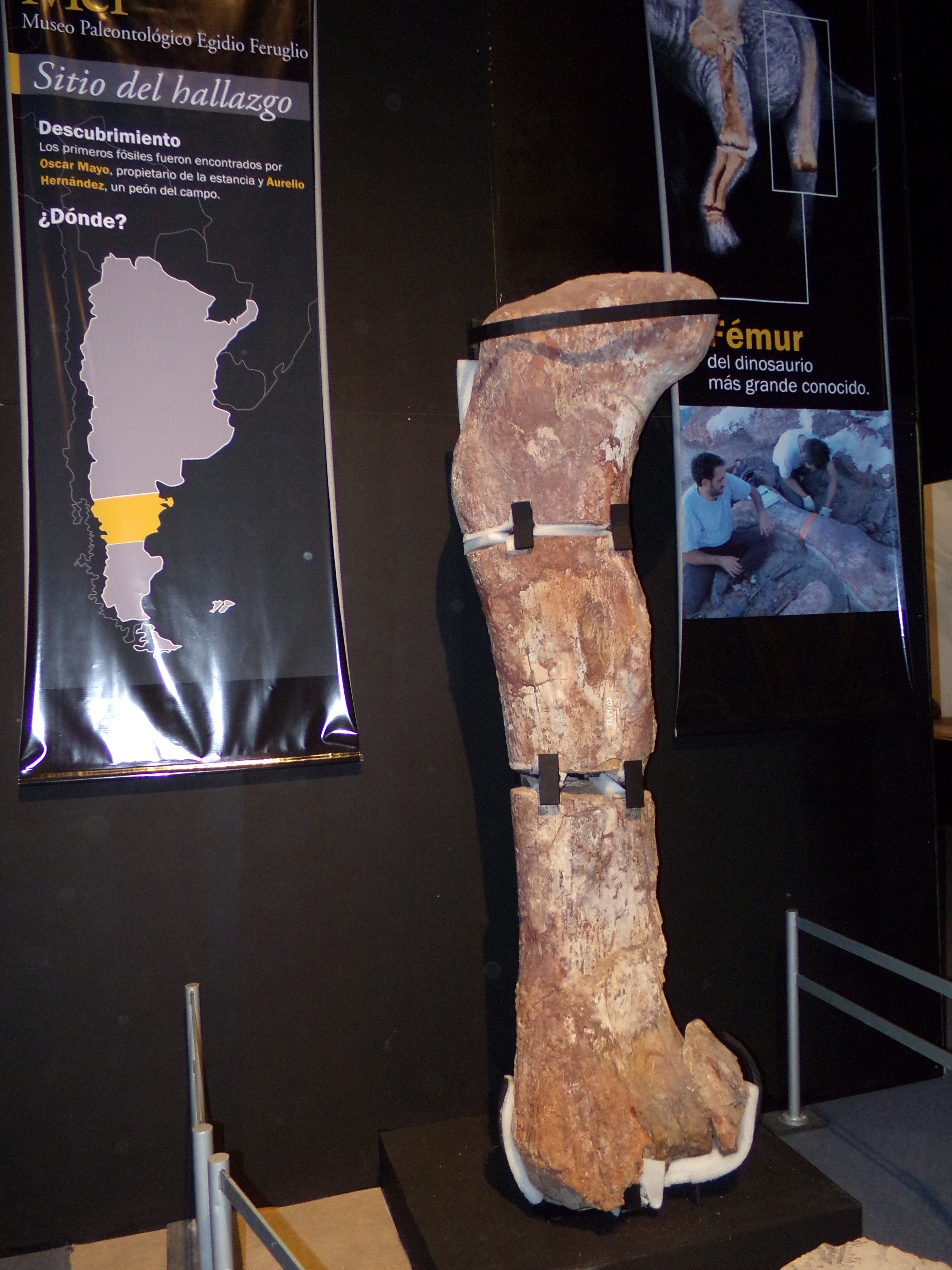
The femur of Patagotitan mayorum is over two meters long, taller than most humans. To excavate the six skeletons from the La Flecha site in Chubut, the Museo Egidio Feruglio team required 190 plaster blocks, each weighing more than a ton, and helicopter trips to remove the material from the remote Patagonian desert.