
Quetzalcoatlus northropi
Quetzalcoatlus northropi
"Northrop's feathered sky serpent (honoring the Aztec sky god Quetzalcóatl and aircraft designer Jack Northrop)"
Sobre esta espécie
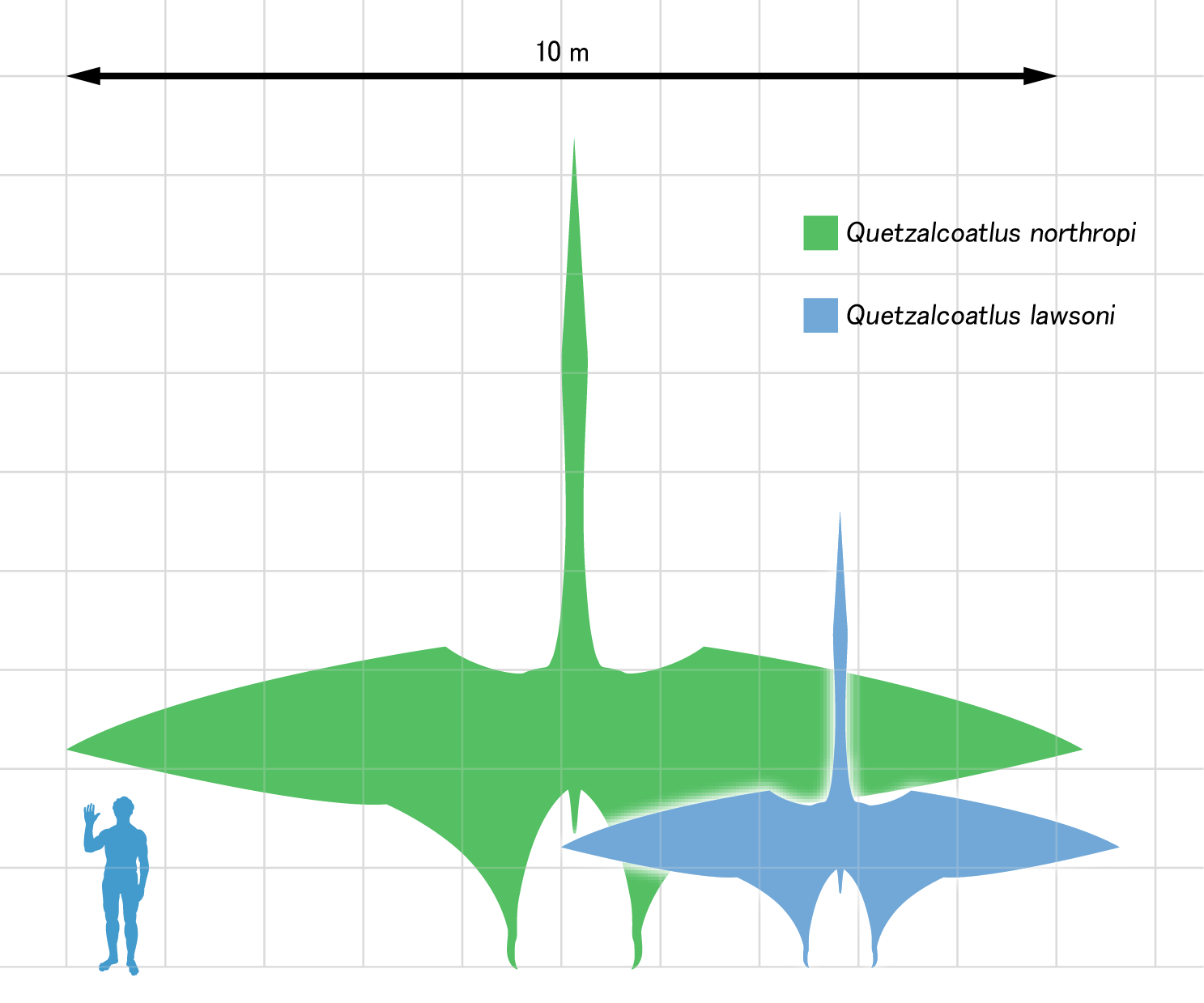
Quetzalcoatlus northropi is the largest known pterosaur and one of the largest flying animals in Earth's history. With a wingspan estimated at 10 to 11 meters, it was as wide as a single-engine aircraft. It lived during the late Maastrichtian, 68 to 66 million years ago, in the Javelina Formation of Texas, in the basin of what is now Big Bend National Park. Despite its colossal size, it weighed only 150 to 250 kg thanks to hollow bones reinforced with internal struts. Biomechanical studies show it was capable of active flight, taking off with a quadrupedal vault using its forelimbs. On land, it walked quadrupedally and hunted small vertebrates in the manner of a giant stork.
Geological formation & environment
The Javelina Formation is part of the Tornillo Group in Big Bend National Park, Texas, and dates to the Upper Maastrichtian (70 to 66.5 Ma). Its reddish-purple fluvial sandstone layers preserve a diverse fauna: the sauropod Alamosaurus sanjuanensis, ceratopsids Bravoceratops polyphemus and Torosaurus, hadrosaurids, ankylosaurs, tyrannosaurids, dromaeosaurids, and pterosaurs Quetzalcoatlus northropi and Wellnhopterus brevirostris. Fossil pollen and wood indicate an angiosperm and hardwood forest. The environment was a subtropical alluvial plain with meandering rivers, close to the retreating Western Interior Seaway. The formation represents one of the last Mesozoic ecosystems before the K-Pg extinction.
Image gallery






Life reconstruction of Quetzalcoatlus northropi by Connor Ashbridge (2025) — depiction based on current scientific consensus, with pycnofibers and terrestrial quadrupedal posture.
Connor Ashbridge (Ddinodan), CC BY 4.0
Ecology and behavior
Habitat
Quetzalcoatlus northropi inhabited the alluvial plain of the Javelina Formation, in what is now Big Bend National Park in Texas, 68 to 66 million years ago. The environment was an angiosperm and cycad forest cut through by meandering rivers, with a warm subtropical climate and no polar ice caps. Associated fauna included the sauropod Alamosaurus sanjuanensis, the ceratopsid Bravoceratops polyphemus, hadrosaurids, ankylosaurs, tyrannosaurids, and turtles. Rivers and estuaries near the Cretaceous interior seaway (Western Interior Seaway) provided abundant small vertebrates. Quetzalcoatlus was the largest aerial predator in the ecosystem, with no competition from comparable-sized birds.
Feeding
The dominant feeding model for Quetzalcoatlus northropi is the terrestrial stalking hypothesis (Witton and Naish, 2008): the animal walked in a quadrupedal posture over open terrain, capturing small vertebrates such as lizards, mammals, and juvenile dinosaurs, in the manner of modern storks and ground hornbills. The long, stiff neck combined with the narrow, toothless beak was ideal for precise capture movements near the ground. Biomechanical analyses rule out surface skimming fish capture and scavenging as primary strategies: cervical morphology is incompatible with the flexibility needed for skim-feeding, and body size would make competition with terrestrial scavengers inefficient.
Behavior and senses
Based on phylogenetic analogies with crocodilians and birds (the two groups closest to living pterosaurs), Quetzalcoatlus likely displayed nest and offspring parental care. The large body size of Q. northropi suggests solitary behavior or small groups, contrasting with the gregarious behavior inferred for Q. lawsoni. Quadrupedal takeoff, demonstrated by Habib (2008) and Witton and Habib (2010), involved simultaneous thrust from all four limbs, allowing the animal to gain altitude rapidly despite its size. Fossil trackways attributed to azhdarchids (Haenamichnus, South Korea) show quadrupedal footprints with limbs positioned directly under the body.
Physiology and growth
Quetzalcoatlus northropi had completely hollow bones, with walls less than 2 mm thick reinforced internally by trabecular bone struts, combining extreme lightness with structural resistance. Body covering consisted of pycnofibers, hair-like filamentous structures that provided thermal insulation, evidence of endothermic or mesothermic metabolism. The notarium, fusion of four dorsal vertebrae, stabilized the shoulder region during wing flapping. Cruising speed estimates calculated by Habib (2008) suggest up to 130 km/h and a flight range of 13,000 to 19,000 km without stopping, making Quetzalcoatlus one of the greatest long-distance travelers in animal history.
Paleogeography
Continental configuration

Ron Blakey · CC BY 3.0 · Cretáceous, ~90 Ma
During the Maastrichtiano (~68–66 Ma), Quetzalcoatlus northropi inhabited Laramidia, the western half of present-day North America, separated from the east by the Western Interior Seaway, a shallow sea dividing the continent. The continents were in very different positions: India was drifting toward Asia, Antarctica was still connected to Australia, and South America was an isolated island.
Inventário de Ossos
The holotype TMM 41450-3 consists of forelimb fragments (humerus, ulna, radius, and wing phalanges). No Q. northropi skull has ever been found. Cranial anatomy is inferred from the smaller relative Q. lawsoni, whose skull is known. The material is fragmentary, making Q. northropi one of the largest flying animals least known anatomically.
Found elements
Inferred elements
Scientific Literature
15 papers in chronological order — from the original description to recent research.
Pterosaur from the Latest Cretaceous of West Texas: Discovery of the Largest Flying Creature
Lawson, D.A. · Science
The founding paper describing the discovery of Quetzalcoatlus northropi by graduate student Douglas Lawson in the Javelina Formation of Texas. Based on forelimb fragments (holotype TMM 41450-3), Lawson estimates a wingspan of 11 to 15 meters, identifying the animal as the largest flying creature ever discovered. The genus name honors the Aztec deity Quetzalcóatl, the feathered sky serpent; the specific epithet honors aviation pioneer Jack Northrop. The work inaugurates an entire field of research on giant latest Cretaceous pterosaurs and establishes the Javelina Formation as a globally significant site. Size estimates were later revised to 10 to 11 meters, but the scientific and cultural impact of the announcement remains unparalleled in pterosaur paleontology.
Cranial remains of Quetzalcoatlus (Pterosauria, Azhdarchidae) from Late Cretaceous sediments of Big Bend National Park, Texas
Kellner, A.W.A. & Langston, W. Jr. · Journal of Vertebrate Paleontology
Kellner and Langston describe fragmentary cranial material from the Javelina Formation tentatively referred to Quetzalcoatlus, the first effort to characterize the skull morphology of this giant pterosaur from direct evidence. The work identifies diagnostic features of the rostrum and describes the nasoantorbital fenestra, typical of azhdarchids. The cranial morphology reveals a long, narrow, toothless beak similar to modern storks. The study paves the way for understanding Quetzalcoatlus feeding anatomy and supports the terrestrial foraging hypothesis over surface skimming. The described material became the comparison baseline for all subsequent giant azhdarchid studies.
A reappraisal of azhdarchid pterosaur functional morphology and paleoecology
Witton, M.P. & Naish, D. · PLOS ONE
Witton and Naish present the terrestrial stalking hypothesis for azhdarchids, including Quetzalcoatlus northropi. Analyzing neck, limb, and beak morphology, the authors reject previous hypotheses of surface skimming and scavenging. The stiff neck and long beak are incompatible with fish capture in flight; robust limbs and ungulate-like proportions suggest efficient quadrupedal locomotion. The proposed model is that of a predator walking long distances on land, capturing small vertebrates like a giant stork. Published in PLOS ONE, this paper became one of the most cited references in pterosaur paleoecology, fundamentally transforming the scientific view of the largest flying animals' lifestyle.
On the size and flight diversity of giant pterosaurs, the use of birds as pterosaur analogues and comments on pterosaur flightlessness
Witton, M.P. & Habib, M.B. · PLOS ONE
Witton and Habib refute the hypothesis that giant pterosaurs like Quetzalcoatlus were incapable of flight. Analyzing humeral bending strength, they demonstrate that pterosaur bone structure was far more robust than equivalent-mass birds, supporting forces required for active flight. They estimate body mass of 200 to 250 kg and wingspan of 10 to 11 meters. Crucially, they propose a quadrupedal launch mechanism in which the forelimbs provided most of the launch energy, unlike birds that rely on hindlimbs. The paper refutes decades of passive glider speculation and establishes Quetzalcoatlus as an active long-range flying animal.
A new small-bodied azhdarchoid pterosaur from the Lower Cretaceous of England and its implications for pterosaur anatomy, diversity and phylogeny
Naish, D., Simpson, M. & Dyke, G. · PLOS ONE
Naish, Simpson, and Dyke describe Vectidraco daisymorrisae, a new small-bodied azhdarchoid pterosaur from the Lower Cretaceous of England. Phylogenetic analysis places the taxon within Azhdarchoidea and elucidates interrelationships of the clade that includes Quetzalcoatlus. The work demonstrates that small-bodied azhdarchoids coexisted with other pterosaur lineages in Early Cretaceous western Europe, suggesting diversity patterns may reflect differential preservation rather than actual absence. The published phylogenetic tree is one of the rare open-access cladograms positioning Quetzalcoatlus within Azhdarchidae, serving as a reference for group diversity and biogeography studies.


Late Maastrichtian pterosaurs from North Africa and mass extinction of Pterosauria at the Cretaceous-Paleogene boundary
Longrich, N.R., Martill, D.M. & Andres, B. · PLOS Biology
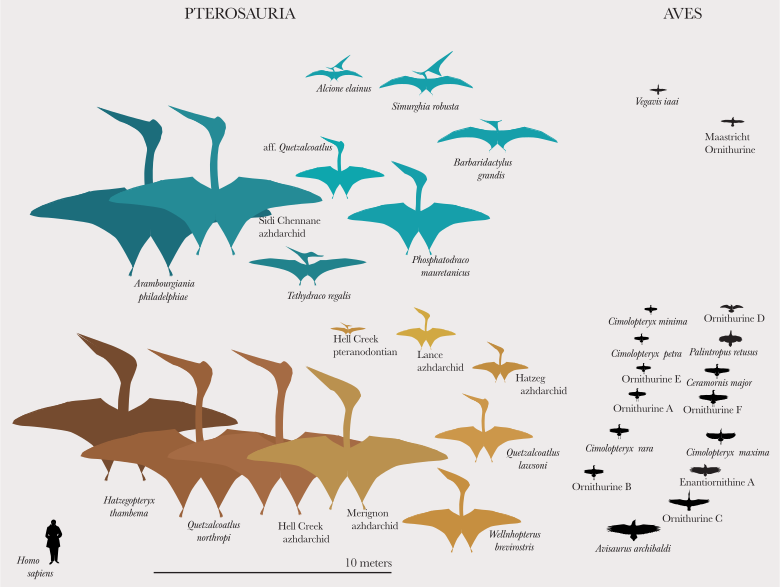
Longrich, Martill, and Andres describe a diverse Maastrichtian pterosaur assemblage from Morocco containing at least seven species across three families, including azhdarchids. The discovery refutes the view of gradual pterosaur decline before extinction: the record indicates high diversity and varied niche occupation up to the K-Pg boundary. Azhdarchids like Quetzalcoatlus coexisted with smaller pterosaurs and with expanding birds, outcompeting the latter at large body sizes. The work is essential for contextualizing Quetzalcoatlus extinction as part of a global catastrophic event, not a long-term trend. Includes phylogenetic analysis and size disparity comparison between pterosaurs and contemporary birds.
Pterosaur body mass estimates from three-dimensional mathematical slicing
Henderson, D.M. · Journal of Vertebrate Paleontology
Henderson applies three-dimensional mathematical slicing to reconstructed pterosaur body models to estimate body mass. For Quetzalcoatlus northropi, he obtains an estimate of approximately 544 kg, more than twice previous estimates of 200 to 250 kg. The result sparked intense debate: if correct, it would cast doubt on active flight capability in Q. northropi, potentially making it a passive glider or even flightless. Henderson's estimates were challenged by Witton and Habib (2010) based on bone robustness analyses. The debate over Quetzalcoatlus mass remains open and illustrates the difficulties of mass estimation in extinct animals with few preserved bones.
Constraining the air giants: limits on size in flying animals as an example of constraint-based biomechanical theories of form
Habib, M.B. · Biological Journal of the Linnean Society
Habib analyzes physical constraints on size in flying animals, focusing on pterosaurs, establishing upper limits based on bone strength and muscle output. Quetzalcoatlus northropi is examined as a near-limit case for powered flight. The study demonstrates that quadrupedal launch, in which the forelimbs provide most of the takeoff energy, is biomechanically feasible for giant pterosaurs. Habib calculates that Q. northropi could achieve a takeoff speed of approximately 15 km/h with muscle energy compatible with its anatomy, reach altitudes of 4,600 meters, and cruise at speeds up to 130 km/h. The paper is a fundamental reference for understanding the flight biomechanics of the largest flying animals in history.

A functional analysis of flying and walking in pterosaurs
Padian, K. · Paleobiology
Padian provides a seminal functional analysis of pterosaur locomotion, examining bipedal walking and flight mechanics including azhdarchids. The work establishes foundational interpretations of wing bone mechanics and terrestrial posture in pterosaurs that shaped decades of subsequent debate. Padian argues pterosaurs had upright posture and were efficient bipeds, contrasting with the sprawling view then prevalent. Although some conclusions were later revised by trackway and biomechanical studies, the paper remains a mandatory historical reference for understanding the evolution of interpretations about giant pterosaur locomotion like Quetzalcoatlus.


Lone Star pterosaurs
Andres, B. & Myers, T.S. · Earth and Environmental Science Transactions of the Royal Society of Edinburgh
Andres and Myers conduct a comprehensive survey of Texas pterosaur diversity, including material from the Javelina Formation, describing new specimens and revising the taxonomy of Texas pterosaurs with emphasis on Quetzalcoatlus. The work documents the presence of at least two distinct pterosaur morphologies in Late Cretaceous Texas, paving the way for the later recognition of Q. lawsoni as a valid species. The analysis includes rediscovery and redescription of material that had been neglected since Langston's original expeditions. A fundamental study for understanding the paleogeographic distribution and local diversity of azhdarchids in the North American Maastrichtian.

Anatomy and phylogenetic relationships of Quetzalcoatlus Lawson 1975 (Pterosauria: Azhdarchidae)
Andres, B., Langston, W. Jr. et al. · Journal of Vertebrate Paleontology, Memoir 19
The most comprehensive and definitive redescription of Quetzalcoatlus, published as a monograph in the Journal of Vertebrate Paleontology in 2021, consolidating decades of fieldwork and laboratory analysis. Andres, Langston Jr. (posthumously), and collaborators review all known specimens from the Javelina Formation and recognize two species: Q. northropi (large, holotype TMM 41450-3) and Q. lawsoni sp. nov., a smaller species with a more complete skeleton. Phylogenetic analysis confirms Quetzalcoatlus as a member of Azhdarchidae and positions it within a new subfamily, Quetzalcoatlinae. The publication results from an ICZN petition approved in 2019 to stabilize the genus nomenclature. This is the definitive anatomical reference on the species.

Pterosaurs: Natural History, Evolution, Anatomy
Witton, M.P. · Princeton University Press
Comprehensive synthesis of pterosaur natural history by Mark Witton, covering anatomy, evolution, behavior, and ecology of all major groups, with in-depth treatment of azhdarchids and Quetzalcoatlus northropi. The work consolidates decades of research in a format accessible to both specialists and the general public. The chapters on body size, flight biomechanics, and terrestrial ecology of Quetzalcoatlus synthesize conclusions from Witton and Habib (2010) and Witton and Naish (2008), presenting the animal as an active terrestrial predator and long-range flier. An indispensable reference for any study of the largest flying animals in Earth's history.

Was dinosaurian physiology inherited by birds? Reconciling slow growth in Archaeopteryx
Erickson, G.M. et al. · PLOS ONE
Erickson and collaborators study Archaeopteryx bone histology and compare with non-avian dinosaurs and pterosaurs, revealing variation in growth rates across the Avemetatarsalia lineage. The work is relevant to Quetzalcoatlus because it establishes the physiological context of pterosaurs within Avemetatarsalia: pterosaurs apparently had elevated growth rates and endothermic or near-endothermic metabolism, which would have been necessary to sustain growth to Q. northropi's colossal size. The analysis demonstrates that advanced physiological features including rapid growth were shared by pterosaurs and dinosaurs before the emergence of modern birds.

A new Maastrichtian species of the centrosaurine ceratopsid Pachyrhinosaurus from the North Slope of Alaska
Fiorillo, A.R. & Tykoski, R.S. · Acta Palaeontologica Polonica
Fiorillo and Tykoski describe a new Pachyrhinosaurus species from the Maastrichtian of Alaska, providing paleoecological context for high-latitude Late Cretaceous faunas. The work is relevant to Quetzalcoatlus because it documents the North American Maastrichtian faunas with which azhdarchids co-occurred, evidencing environmental conditions and faunal diversity at the end of the Cretaceous. High-latitude faunas show that different Maastrichtian communities shared general diversity patterns while azhdarchids like Quetzalcoatlus dominated lower-latitude ecosystems such as the Javelina Formation of Texas.


A medium-sized robust-necked azhdarchid pterosaur (Pterosauria, Azhdarchidae) from the Maastrichtian of Pui (Haeg Basin, Transylvania, Romania)
Vremir, M. et al. · American Museum Novitates
Vremir and collaborators describe a new medium-sized azhdarchid from the Maastrichtian of Romania with robust cervical vertebrae, unusual for the group. The discovery demonstrates greater ecological diversity within Azhdarchidae than previously recognized, suggesting the family was not composed exclusively of gracile terrestrial predators. The work has direct implications for Quetzalcoatlus northropi paleoecology: if azhdarchids could occupy varied ecological niches, Q. northropi may have had more diverse feeding strategies than the exclusive giant stork model proposed by Witton and Naish (2008). The Hateg island context, with its insular dwarfism fauna, contrasts with the open continental environments where Quetzalcoatlus lived.


Espécimes famosos em museus
TMM 41450-3 (holótipo)
Texas Natural Science Center, University of Texas at Austin, Austin, Texas
Official holotype of Quetzalcoatlus northropi: fragments of humerus, ulna, and left wing phalanges. Despite being fragmentary, this material established the largest wingspan of any flying animal ever discovered. No Q. northropi skull has been found to date.
Skeletal mount (composto)
Houston Museum of Natural Science, Houston, Texas
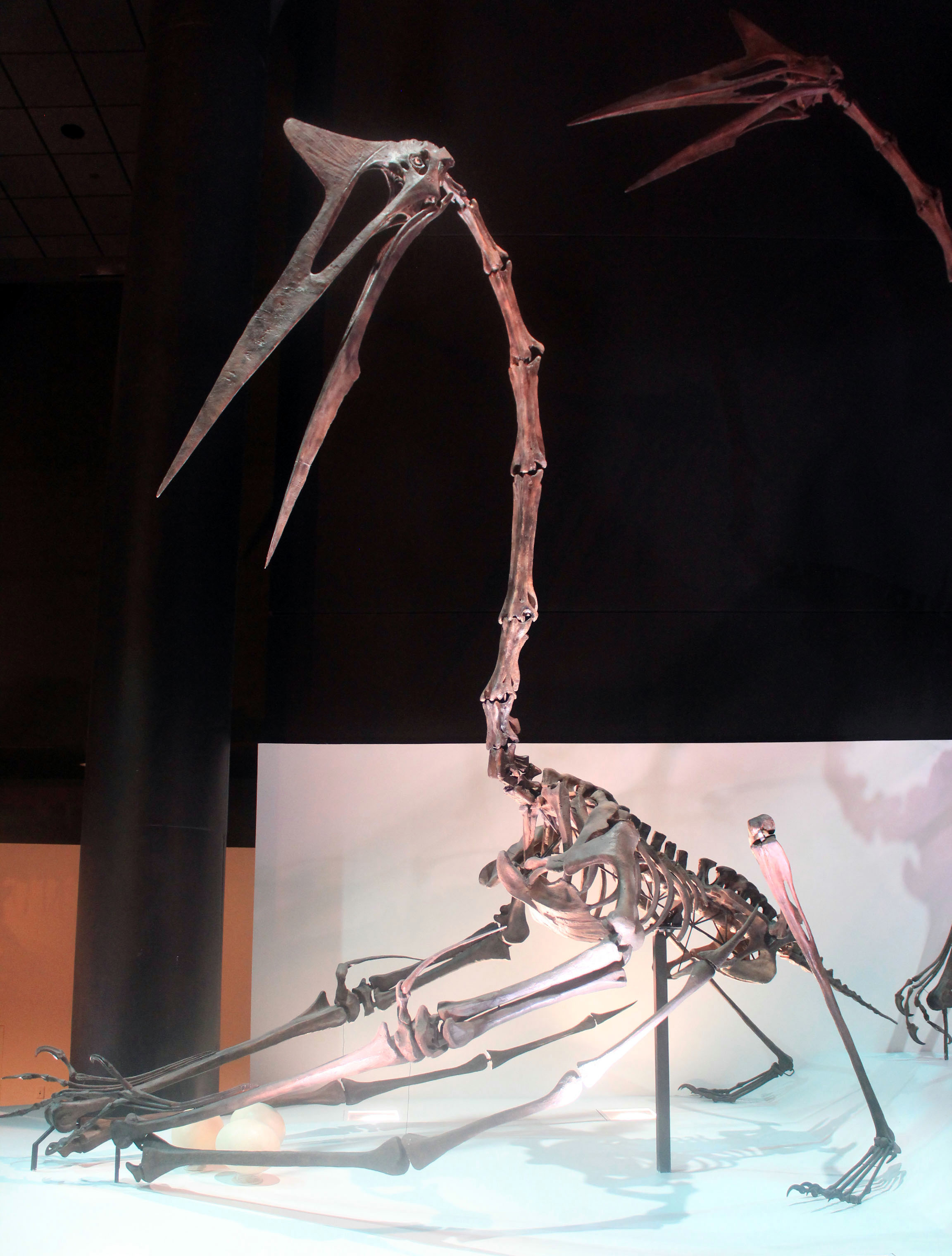
Skeletal mount of Quetzalcoatlus northropi reconstructed based on the holotype and referred material, with missing elements inferred from Q. lawsoni and other azhdarchids. It is one of the most visited mounts in the world for the species, showing the animal in a terrestrial quadrupedal posture.
Skeletal mount (voo)
Perot Museum of Nature and Science, Dallas, Texas
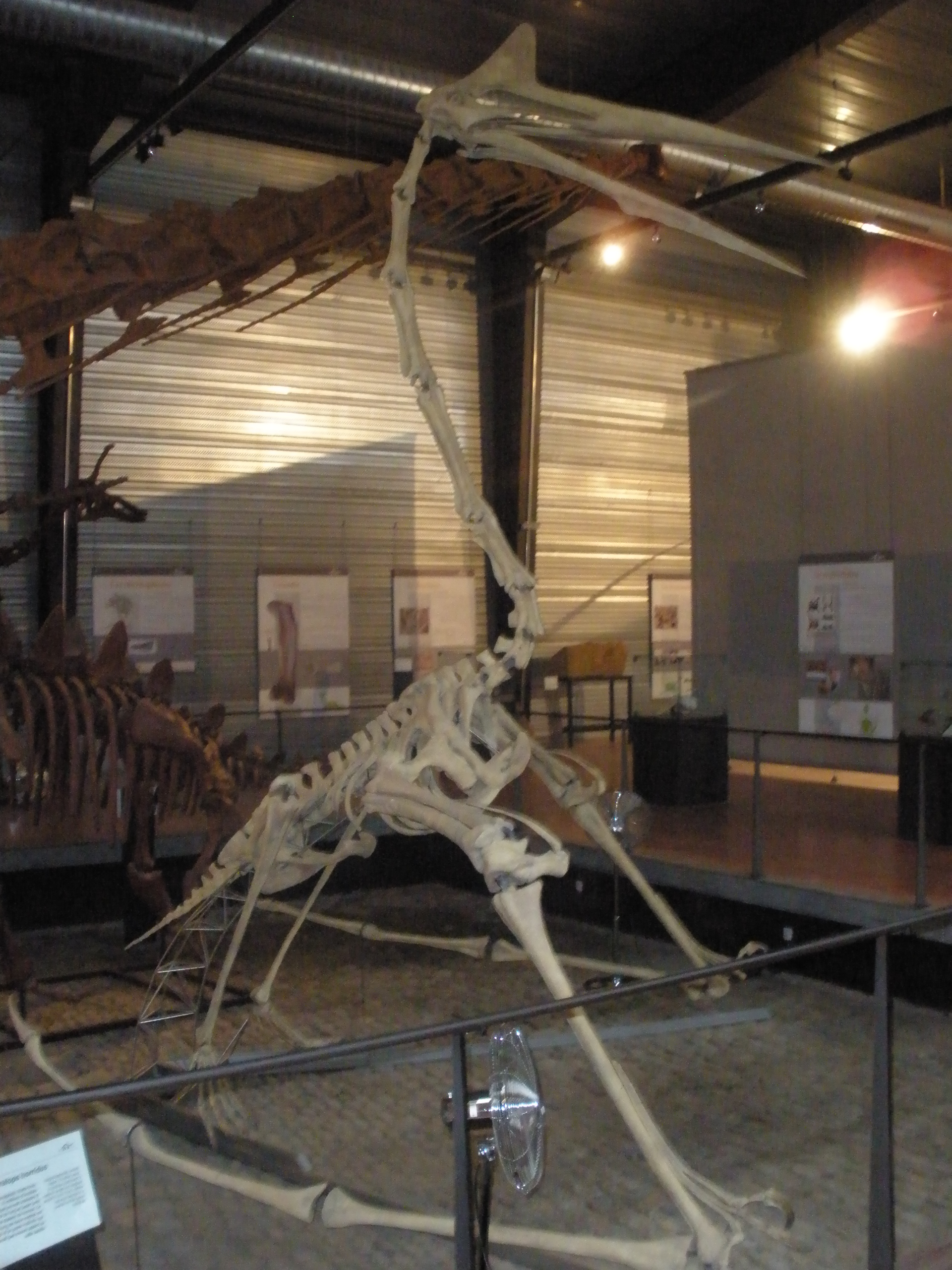
Skeletal mount of Quetzalcoatlus northropi suspended in a flight posture, with Nanuqsaurus in the background. One of the most spectacular displays of the animal, allowing visitors to appreciate the full 10 to 11 meter wingspan from multiple angles.
In cinema and popular culture
Quetzalcoatlus northropi has occupied a singular space in popular culture since the moment of its discovery in 1975: the idea of a flying creature larger than any small aircraft captured the public imagination immediately. Aeronautical engineer Paul MacCready built a mechanized replica with a 5.5-meter wingspan in the 1980s, funded by the Smithsonian and NASA, which flew in exhibitions and an IMAX film, making the animal not just a scientific subject but also an engineering feat. In science fiction, Quetzalcoatlus reached the general public mainly through Jurassic World: Dominion (2022), where it attacks a plane in an aerial action scene. The depiction is dramatized and inaccurate: the real animal likely did not attack large objects in flight, but hunted small prey on the ground. The documentary Prehistoric Planet (Apple TV+, 2022) offered the most accurate representation to date, incorporating pycnofibers, quadrupedal takeoff, and terrestrial foraging based on Witton and Naish's research. The exhibition Pterosaurs: Flight in the Age of Dinosaurs, created by the American Museum of Natural History and toured through world museums, placed Quetzalcoatlus at the center of public debate about flight biomechanics, making the creature a symbol of how much prehistoric life still surprises modern science.

Classificação

Descoberta
Curiosidade
Quetzalcoatlus northropi had a wingspan equivalent to a Cessna 172 aircraft, but weighed only 200 kg. Its bones were so hollow that the walls were less than 2 mm thick, and studies indicate it flew at up to 130 km/h at 4,600 meters altitude, capable of crossing an ocean without stopping.