
Rajasaurus narmadensis
Rajasaurus narmadensis
"Regal lizard from the Narmada"
Sobre esta espécie
Rajasaurus narmadensis was the apex terrestrial predator of the Indian subcontinent during the Late Cretaceous. It lived between 69 and 66 million years ago in what is now Gujarat state, northwestern India, in an arid-to-semi-arid environment crossed by seasonal rivers and punctuated by the volcanic episodes of the Deccan Traps. The only Indian abelisaurid with well-preserved postcranial remains, it was distinguished by a median sagittal crest atop the skull, unique among Indian abelisaurids. Its placement within Majungasaurinae confirms the biogeographic connection between India and Madagascar in the Late Cretaceous.
Geological formation & environment
The Lameta Formation is a Maastrichtian (Late Cretaceous, ~69-66 Ma) sedimentary unit outcropping in Gujarat, Madhya Pradesh, Maharashtra and adjacent states of central and western India. It consists of alternating claystones, siltstones and sandstones deposited under fluvial and lacustrine conditions in a semi-arid to tropical wet-dry climate. The formation is internationally recognized for its extraordinary richness in titanosaur sauropod nests and eggs (nine oospecies described), as well as abelisaurid remains including Rajasaurus, Rahiolisaurus and Indosuchus. Deposited immediately below the Deccan Traps basalts, the formation marks the last terrestrial environments before the Cretaceous-Paleogene mass extinction in the region.
Image gallery
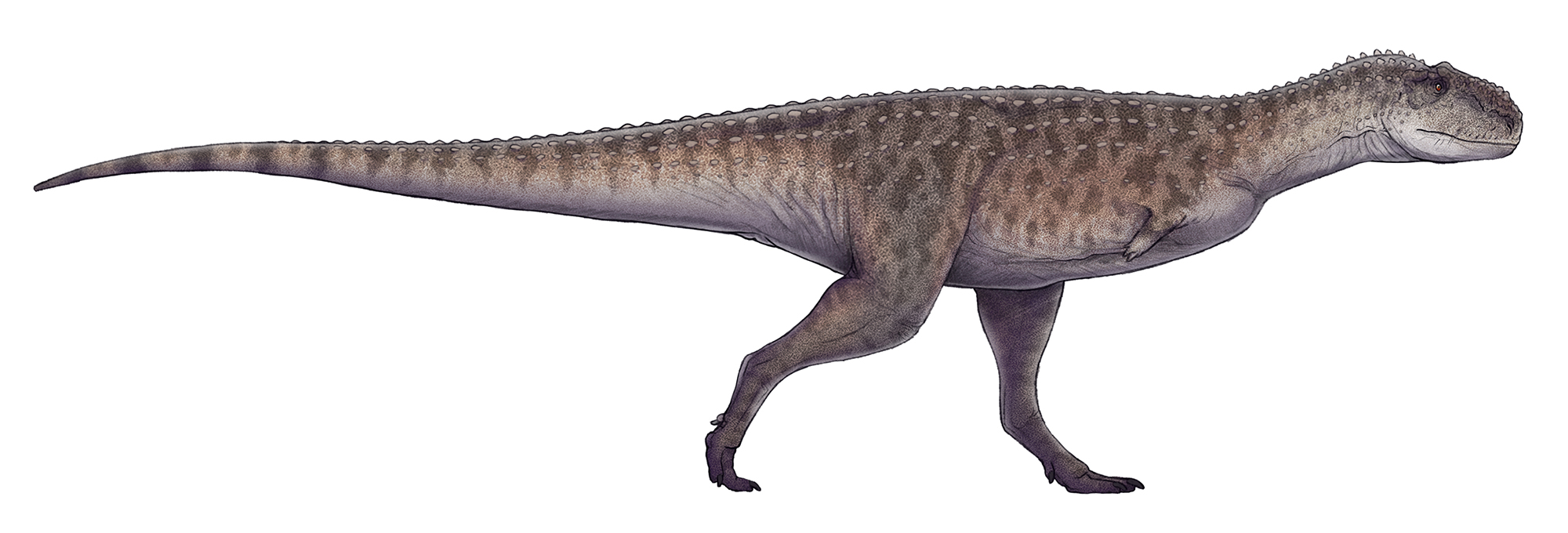




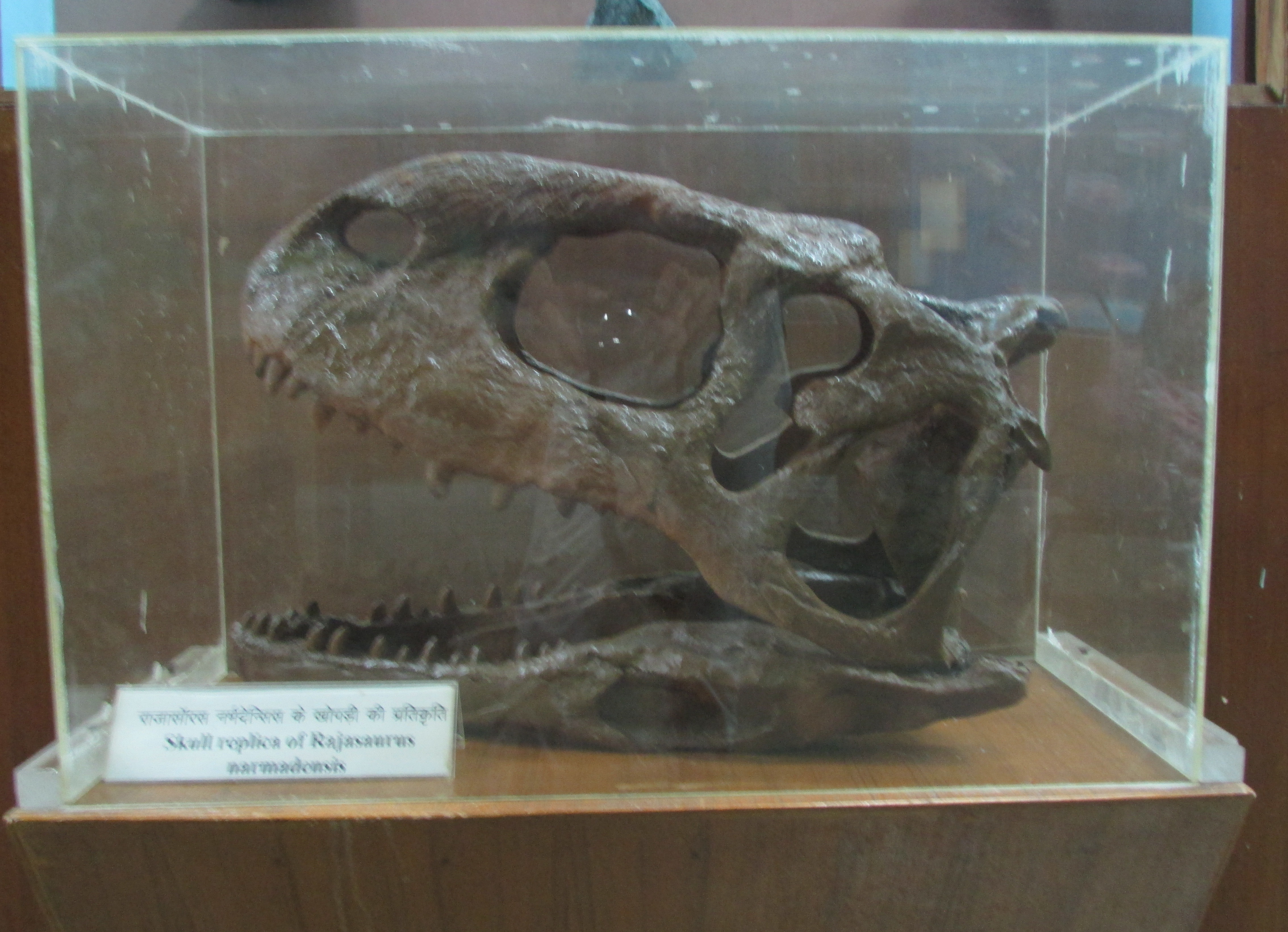




Life restoration of Rajasaurus narmadensis based on holotype GSI 21141/1-33, by Paleocolour (2017). Lateral view showing the body proportions of the only well-described Indian abelisaurid.
Paleocolour, CC BY-SA 3.0
Ecology and behavior
Habitat
Rajasaurus inhabited the Narmada River basin in what is now Gujarat, northwestern India, during the late Maastrichtian (69-66 Ma). The environment was an arid-to-semi-arid alluvial plain with seasonal rivers and ephemeral lakes, interspersed by intense volcanic episodes from the emergent Deccan Traps. Vegetation was dominated by primitive vascular plants including evolving grasses, ferns and conifers. It shared the ecosystem with titanosaurs like Isisaurus colberti, the best-known Indian sauropod.
Feeding
Apex predator of the Lameta Formation ecosystem, Rajasaurus likely hunted adult and subadult titanosaurs, newly hatched sauropod hatchlings from nesting grounds, and potentially other medium-sized reptiles. The short, robust skull of abelisaurids suggests a bite focused on vertical-axis force rather than longitudinal cutting. The powerful neck musculature, inferred from vertebral anatomy, allowed gripping and controlling large prey. The scene of hunting Isisaurus hatchlings in the Deccan, reconstructed in Prehistoric Planet, is biologically plausible.
Behavior and senses
Direct behavioral evidence is scarce given Rajasaurus's limited fossil record. The median skull crest may have functioned for intraspecific recognition or as a display structure in individual interactions — a hypothesis proposed by Delcourt (2018) for abelisaurids generally. The presence of at least two other abelisaurids (Rahiolisaurus and Indosuchus) in the same geological formation suggests possible niche stratification or prey differentiation among coexisting predators.
Physiology and growth
As a derived abelisaurid, Rajasaurus likely had elevated metabolism similar to other large Cretaceous theropods, with relatively rapid growth inferred by comparison with well-studied relatives like Majungasaurus. The forelimbs were extremely reduced, as in all abelisaurids, and likely did not actively participate in predation. The relatively short, tall skull with powerful neck musculature suggests the neck and head were the primary tools for attacking and manipulating prey.
Paleogeography
Continental configuration

Ron Blakey · CC BY 3.0 · Cretáceous, ~90 Ma
During the Maastrichtiano (~69–66 Ma), Rajasaurus narmadensis inhabited Laramidia, the western half of present-day North America, separated from the east by the Western Interior Seaway, a shallow sea dividing the continent. The continents were in very different positions: India was drifting toward Asia, Antarctica was still connected to Australia, and South America was an isolated island.
Inventário de Ossos
The holotype GSI 21141/1-33 preserves maxillae, premaxillae, braincase, quadrate, one cervical vertebra, 11 partial dorsal vertebrae, six sacrals, three caudals, ilium, fibula and metatarsals. It is the only Indian abelisaurid with significant postcranial remains, making it extremely valuable despite its incompleteness.
Found elements
Inferred elements
Scientific Literature
15 papers in chronological order — from the original description to recent research.
A new abelisaurid (Dinosauria, Theropoda) from the Lameta Formation (Cretaceous, Maastrichtian) of India
Wilson, J.A., Sereno, P.C., Srivastava, S., Bhatt, D.K., Khosla, A. & Sahni, A. · Contributions from the Museum of Paleontology, University of Michigan
The founding paper formally describing Rajasaurus narmadensis based on holotype GSI 21141/1-33, excavated from the Lameta Formation in Gujarat. Wilson, Sereno and colleagues identify the animal as the first Indian theropod with well-preserved postcranial remains, enabling an anatomical characterization unprecedented for Indian theropods. The skull preserves the median sagittal crest formed by the frontal and nasal bones, a feature shared with Madagascar's Majungasaurus. The paper establishes Rajasaurus's phylogenetic position within Carnotaurinae, suggesting biogeographic connection between India and Madagascar before final continental separation. The formal diagnosis and comparison with other Gondwanan abelisaurids made this paper the primary reference for any study on the genus.
The phylogeny of Ceratosauria (Dinosauria: Theropoda)
Carrano, M.T. & Sampson, S.D. · Journal of Systematic Palaeontology
Comprehensive phylogenetic analysis of all Ceratosauria, including all major taxa known by 2008. Carrano and Sampson revise the diagnostic characters of the group and present a revised topology placing Rajasaurus firmly within Abelisauridae as a close relative of Madagascar's Majungasaurus. The study maps the geographic and temporal distribution of ceratosaurs, confirming the presence of these predators across all Gondwanan continents. The analysis includes cranial and postcranial characters, allowing Rajasaurus, with its partially preserved postcranial elements, to be more robustly integrated into the data matrix than in previous studies.
Rahiolisaurus gujaratensis, n. gen. n. sp., a new abelisaurid theropod from the Late Cretaceous of India
Novas, F.E., Chatterjee, S., Rudra, D.K. & Datta, P. · New Aspects of Mesozoic Biodiversity (Lecture Notes in Earth Sciences, vol. 132)
Formal description of a new abelisaurid from the Lameta Formation, Rahiolisaurus gujaratensis, excavated near the same Rahioli locality where Rajasaurus was found. Novas and colleagues describe remains of at least seven individuals, making Rahiolisaurus one of the best-documented Indian abelisaurids. The paper is fundamental for understanding abelisaurid diversity in Cretaceous India: Rajasaurus and Rahiolisaurus coexisted in the same ecosystem, suggesting ecological niche differentiation or temporal specialization between the two predators. The study's phylogenetic analysis comparing both genera reinforces the connection between Indian abelisaurids and their Gondwanan relatives in South America and Madagascar.

Ceratosaur palaeobiology: new insights on evolution and ecology of the southern rulers
Delcourt, R. · Scientific Reports
Comprehensive study of ceratosaur palaeobiology with specific anatomical and phylogenetic analysis of Southern Hemisphere abelisaurids. Delcourt examines specifically that both Majungasaurus and Rajasaurus narmadensis bear a single median crest, formed by different bones in each genus (frontal in Majungasaurus, nasofrontal in Rajasaurus), with implications for soft tissue reconstruction of the skull surface. The paper proposes abelisaurids had specialized soft tissues on the cranial surface, possibly related to intraspecific recognition or display. The study describes two main body plans in ceratosaurs — Noasauridae and Etrigansauria (Ceratosauridae + Abelisauridae) — and places Rajasaurus within a long-standing Gondwanan biogeographic pattern.

Allometry and body length of abelisauroid theropods: Pycnonemosaurus nevesi is the new king
Grillo, O.N. & Delcourt, R. · Cretaceous Research
Systematic allometric study reevaluating body length estimates for all abelisauroids based on robust correlations between skeletal elements and total body dimensions. Grillo and Delcourt use bivariate equations and 40 skull, vertebrae and appendicular measurements to estimate Rajasaurus narmadensis body length from preserved elements. The study revises downward earlier Rajasaurus estimates (which reached 11 meters in popular publications), establishing a more conservative estimate of 6.6 meters based on femur size to total length correlation. This allometric revision is the most quantitatively solid basis available for Rajasaurus body size.
Predation upon hatchling dinosaurs by a new snake from the Late Cretaceous of India
Wilson, J.A., Mohabey, D.M., Peters, S.E. & Head, J.J. · PLOS Biology
Description of a new 3.5-meter snake from the Maastrichtian of India (Sanajeh indicus), extraordinarily preserved inside a sauropod nest, coiled around an egg adjacent to hatchling remains. The paper documents non-dinosaurian predation on sauropod hatchlings in the Lameta Formation — the same ecosystem inhabited by Rajasaurus. This discovery illuminates the ecological dynamics of the Indian Cretaceous environment: the titanosaur nests that Isisaurus laid along river banks were subject to multiple predators, both theropods like Rajasaurus and opportunistic reptiles like the snake Sanajeh. Wilson et al.'s (2010) study is fundamental for understanding the palaeobiological context in which Rajasaurus hunted.
Palaeoenvironments of the dinosaur-bearing Lameta Beds (Maastrichtian), Narmada Valley, Central India
Tandon, S.K., Sood, A., Andrews, J.E. & Dennis, P.F. · Palaeogeography, Palaeoclimatology, Palaeoecology
Comprehensive sedimentological and geochemical analysis of the Lameta Beds, the stratigraphic unit encompassing the Lameta Formation where Rajasaurus was found. Tandon and colleagues identify four mappable units in the Jabalpur region: basal Green Sandstone (braided stream deposit), Lower Limestone (subaerially exposed palustrine flat), Mottled Nodular Beds (pedogenically modified alluvial plain deposits), and Upper Sandstone (sheet flood deposit). Carbon and oxygen isotope analyses confirm terrestrial soil-zone environments. The reconstructed picture is of an arid-to-semi-arid alluvial plain with seasonal rivers — the actual habitat of Rajasaurus, hunting in this environment swept by Deccan volcanic episodes.

Microflora from sauropod coprolites and associated sediments of Late Cretaceous (Maastrichtian) Lameta Formation of Nand-Dongargaon basin, Maharashtra
Sonkusare, H., Samant, B. & Mohabey, D.M. · Journal of the Geological Society of India
Palynological study of sauropod coprolites and associated sediments from the Lameta Formation in the Nand-Dongargaon basin in Maharashtra, revealing the composition of flora consumed by herbivorous sauropods that inhabited the same ecosystem as Rajasaurus. The analysis documents pollen, spores, algal remains, fungi and well-preserved Poaceae cuticles, plus testate amoebae. This composition suggests Lameta Formation sauropods consumed primitive grasses and other vascular plants within a semi-arid environment. Understanding sauropod diet is essential for understanding Rajasaurus ecology: these herbivores were the potential prey of the Indian abelisaurid.
Cretaceous theropods from India: a review of specimens described by Huene and Matley (1933)
Novas, F.E., Agnolin, F. & Bandyopadhyay, S. · Revista del Museo Argentino de Ciencias Naturales
Review of historical Cretaceous theropod specimens from India originally described by Huene and Matley in 1933. Novas, Agnolin and Bandyopadhyay reanalyze materials of Indosaurus matleyi, Indosuchus raptorius, Laevisuchus indicus and other historical taxa in light of modern abelisaurid anatomy. The work contextualizes Rajasaurus narmadensis within a more diverse Indian abelisaurid fauna than previously recognized, establishing the taxonomic framework for understanding the ecological role of these predators in the Lameta Formation. Reassignment of various historical specimens and analysis of their diagnostic characters are fundamental for understanding theropod diversity coexisting with Rajasaurus.


Paleoenvironment and paleoecology of Majungasaurus crenatissimus (Theropoda: Abelisauridae) from the Late Cretaceous of Madagascar
Rogers, R.R., Krause, D.W., Curry Rogers, K., Rasoamiaramanana, A.H. & Rahantarisoa, L. · Journal of Vertebrate Paleontology (Memoir 8)
Reconstruction of the paleoenvironment and paleoecology of Majungasaurus crenatissimus, the closest relative of Rajasaurus narmadensis, from the Maevarano Formation of northwestern Madagascar. Rogers and colleagues describe semi-arid conditions with seasonal fluvial activity — an environment remarkably parallel to the Lameta Formation inhabited by Rajasaurus. This comparison is of fundamental biogeographic importance: Madagascar and India shared not only related abelisaurids (Majungasaurus and Rajasaurus) but also similar paleoenvironmental conditions, suggesting these predators occupied ecologically equivalent ecosystems on both separated landmasses. The study includes analysis of taphonomy, stratigraphy and associated fauna of the Maevarano.

Building a predator: macroevolutionary patterns in the skull of abelisaurid dinosaurs
Pereyra, E.E.S., Ezcurra, M.D., Paschetta, C. & Méndez, A.H. · Proceedings of the Royal Society B: Biological Sciences
Macroevolutionary analysis of patterns of modularity, integration and morphological disparity in the abelisaurid skull, including Rajasaurus, using two-dimensional geometric morphometrics. Pereyra and colleagues identify the neurocranium as the main region responsible for proportional cranial height increase in abelisaurids throughout the group's evolution. High disparity and evolutionary rates are found in the occipital, squamosal, quadratojugal, lacrimal and postorbital regions — exactly the regions related to Rajasaurus's cranial crest. The study concludes feeding specialization was probably the main driver of cranial evolution in abelisaurids, with some cranial features subsequently co-opted for sociosexual display, such as Rajasaurus's median crest.


New approaches on the biogeography and phylogeny of abelisaurid theropods
Novas, F.E. & Bandyopadhyay, S. · VII International Symposium on Mesozoic Terrestrial Ecosystems, Buenos Aires
Conference paper preceding the formal description of Rajasaurus that establishes the biogeographic and phylogenetic framework for Gondwanan abelisaurids, including Indian material later formalized. Novas and Bandyopadhyay discuss evolutionary connections between Indian and Madagascan abelisaurids, proposing that the final separation of these two landmasses occurred after the establishment of a shared abelisaurid fauna. This work conceptually prepared the field for Wilson et al.'s (2003) formal publication and established the biogeographic framework within which Rajasaurus is interpreted as a representative of the evolutionary isolation of the Indian plate during the Late Cretaceous.


New theropod remains from Lameta Formation (Maastrichtian) of Jabalpur, India
Srivastava, S., Bhatt, D.K. & Khosla, A. · Current Science
Preliminary report on new theropod remains from the Lameta Formation of Jabalpur, representing part of the material subsequently formally described as Rajasaurus narmadensis in 2003. Srivastava, Bhatt and Khosla describe vertebrae and hindlimb elements that form the core of the future holotype collection. This work represents the first systematic documentation of the material that would lead to the formal discovery of Rajasaurus, and is fundamental for understanding the collection history of the specimen between the 1982-1984 excavation campaigns and the 2003 formal description. The authors recognize the abelisaurid affinity of the material but without sufficient cranial material for a complete formal description at that time.


Rajasaurus narmadensis: a new Indian dinosaur
Wilson, J.A. · Current Science
Brief scientific communication announcing the formal description of Rajasaurus narmadensis for the Indian scientific community, published in Current Science — India's main broad-spectrum scientific journal. Wilson summarizes the diagnostic characters of the new abelisaurid and contextualizes its phylogenetic position among Gondwanan theropods. This paper played a fundamental role in disseminating the discovery to the Indian scientific community and general public, contributing to Rajasaurus's recognition as one of the most important species in Indian paleontology. The visibility generated by this communication was central to the subsequent establishment of a dinosaur park at Rahioli and the erection of a statue of the animal at the discovery site.


The 'face' of the Triassic: an exceptional case of convergence in basal iguanodontians
Sales, M.A.F., Lacerda, M.B., Horn, B.L.D., de Oliveira, I.A.P. & Schultz, C.L. · PLOS ONE
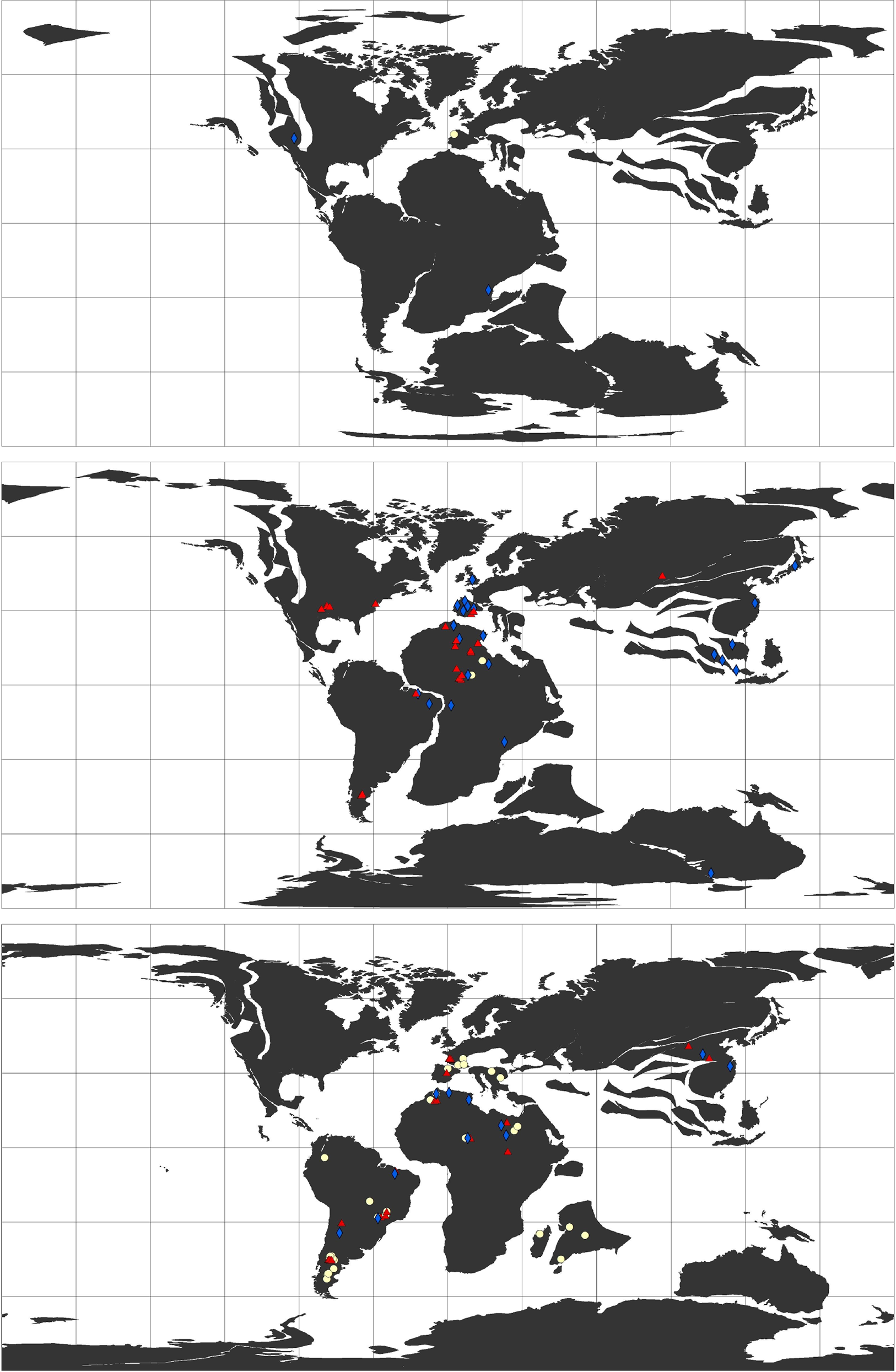
Analysis of the global distribution of three theropod families — Abelisauridae, Carcharodontosauridae and Spinosauridae — across three time periods, mapping the paleogeographic distribution of these families on paleocontinental maps of the Late Jurassic, Early Cretaceous and Late Cretaceous. The Indian occurrence of Rajasaurus narmadensis represents a key data point for understanding abelisaurid dispersal from Gondwana. The study demonstrates that abelisaurids maintained a Gondwana-centered distribution throughout the Cretaceous, with the isolation of the Indian plate during the Late Cretaceous resulting in an endemic lineage culminating in Rajasaurus.


Espécimes famosos em museus
GSI 21141/1-33 (Holótipo)
Geological Survey of India, Jaipur / Regional Museum of Natural History, Bhopal
Holotype GSI 21141/1-33, excavated at Rahioli, Gujarat between 1982 and 1984, is the only formal specimen of Rajasaurus narmadensis and represents the first Indian theropod with significant postcranial remains. It includes parts of the skull, vertebrae, hip and hindlimbs.
Réplica exposta (Regional Museum of Natural History)
Regional Museum of Natural History, Bhopal, Madhya Pradesh, Índia
A complete replica of Rajasaurus is on permanent display at the Regional Museum of Natural History in Bhopal, Madhya Pradesh. The museum exhibits both the skeleton replica and life models, making it one of the main centers for disseminating Indian Cretaceous paleontology to the public.
In cinema and popular culture
Rajasaurus narmadensis had a cultural representation trajectory marked by initial anonymity and late recognition. For two decades after its formal description in 2003, the dinosaur remained nearly invisible in global popular culture, despite being the largest predator ever discovered in the Indian subcontinent. Its most significant television debut came only in 2023, in the 'Badlands' episode of Prehistoric Planet (Apple TV+), where it was depicted with a dramatic red-and-black coloration adapted to the volcanic Deccan Traps environment — a bold artistic choice that quickly became the most recognized image of the species. In India, Rajasaurus plays a different cultural role: it is a symbol of national paleontological pride, with a dedicated attraction at Adlabs Imagica park and a statue at the discovery site in Rahioli, Gujarat. The games Jurassic World Evolution 2 and mobile Jurassic World Alive popularized the name for gaming audiences globally. The biogeographic connection with Madagascar's Majungasaurus, widely documented, made Rajasaurus a recurring character in discussions about continental drift and convergent evolution in science documentaries.

Classificação

Descoberta
Curiosidade
Rajasaurus was the only Indian abelisaurid with a median cranial crest — a unique bony protuberance above the snout formed by the nasofrontal bones. When India was a drifting island in the ocean heading toward Asia, this singular predator evolved in isolation for millions of years, becoming a distant relative of Madagascar's Majungasaurus and Argentina's Carnotaurus — all Gondwanan cousins separated by continental drift.