Sinosauropteryx prima
Sinosauropteryx prima
"First Chinese reptile wing"
Sobre esta espécie
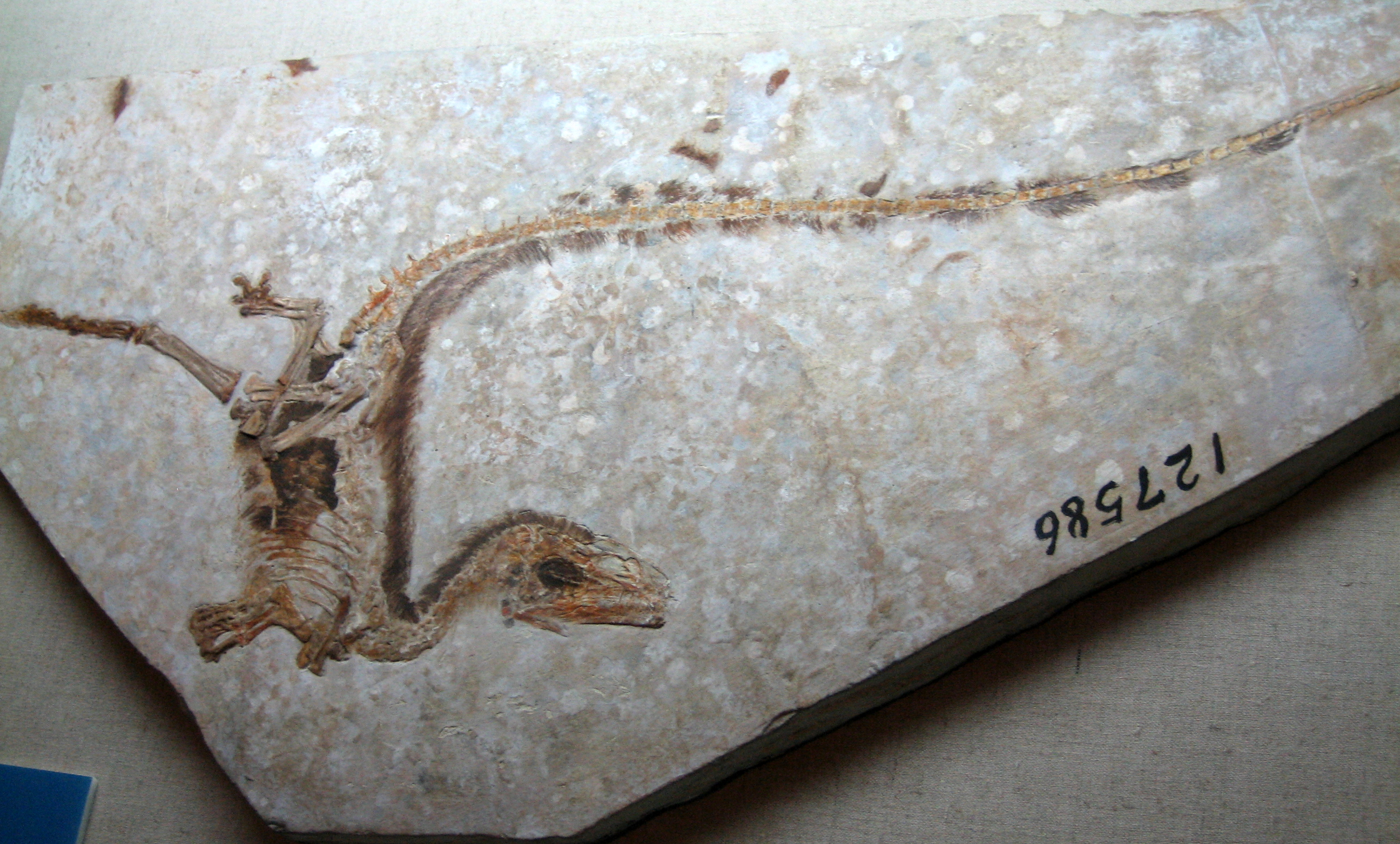
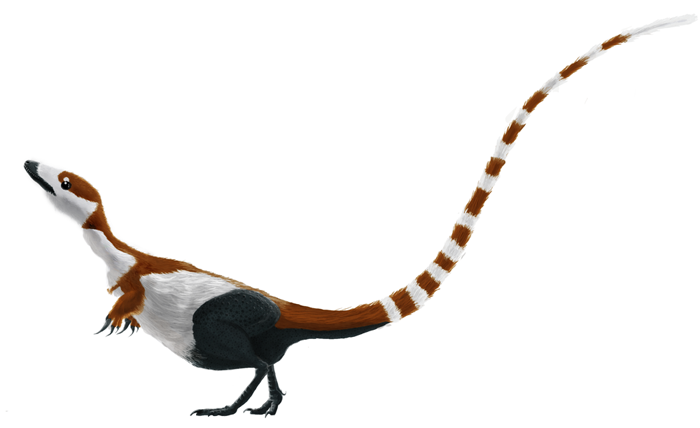
Sinosauropteryx prima is one of the most revolutionary dinosaurs in the history of paleontology. Discovered in 1996 in the Yixian Formation of Liaoning, China, it was the first confirmed non-avian dinosaur with feather-like structures. At only 1.07 meters long and less than 600 grams, it was an agile predator of small lizards and mammals. In 2010, it became the first dinosaur to have its true colors scientifically confirmed: ginger and white stripes on the tail and a dark mask around the eyes, revealed through analysis of fossilized melanosomes.
Geological formation & environment
The Yixian Formation is one of the world's most important geological formations for paleontology. Deposited during the Early Cretaceous (Barremian-Aptian, 130-120 Ma) in northeastern China, it preserves the Jehol Biota, an exceptional ecosystem with thousands of fossils of birds, feathered dinosaurs, mammals, pterosaurs, plants, and insects with soft tissue preservation. The environment was dominated by volcanic lakes with anoxic bottoms, where periodic eruptions killed large groups of animals and rapidly deposited them in lacustrine sediments, resulting in extraordinary preservation. Sinosauropteryx prima is one of the most basal members of this formation's fauna.
Image gallery


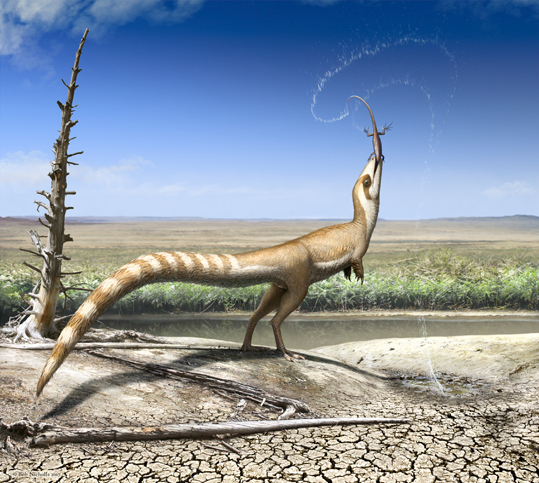



Scientific reconstruction of Sinosauropteryx prima with coloration confirmed by melanosome analysis: ginger and white tail stripes, countershading, and dark facial mask. Illustration created for Smithwick et al. (2017).
Robert Nicholls / Smithwick et al. 2017 — CC BY 4.0
Ecology and behavior
Habitat
Sinosauropteryx prima inhabited the lake and forest ecosystems of the Jehol Biota in the Early Cretaceous of China, approximately 122 to 125 million years ago. The environment was temperate, with an average annual temperature of about 10°C and distinct dry and wet seasons. The landscape was dominated by volcanic lakes surrounded by gymnosperm forests (conifers, ginkgos, and cycads), with the first angiosperms emerging. Periodic volcanic eruptions caused mass mortality events, resulting in the extraordinary fossil preservation.
Feeding
Sinosauropteryx was an active predator of small vertebrates. Direct diet evidence comes from specimen NIGP 127587, which preserves the remains of a Dalinghosaurus lizard in the stomach. Specimens attributed to the genus were also found with mammal remains (Zhangheotherium and Sinobaatar). The simple, small, unserrated teeth were suited for capturing and killing lizards and small mammals, but not for processing large prey. The disproportionately robust first manual digit may have been used to hold live prey.
Behavior and senses
Based on fossil evidence, Sinosauropteryx was likely a solitary ambush predator in open habitat. The countershading pattern and tail stripes, analyzed by Smithwick et al. (2017), indicate camouflage optimized for well-lit environments, not dense forests. The dark facial mask around the eyes, similar to modern predators like raccoons and raptors, may have reduced light glare in the eyes during hunting. Preservation of a female with two eggs in specimen NIGP 127587 confirms bipedal posture and oviparous reproduction with paired eggs.
Physiology and growth
Sinosauropteryx's filamentous proto-feathers likely served primarily as thermal insulation, helping maintain elevated body temperature in an animal of only 0.55 kg. In very small animals, the unfavorable surface-to-volume ratio makes temperature control more challenging, which would favor the development of insulation. Metabolism was likely elevated, as in other coelurosaurs. Evidence of melanosomes indicates a complex pigmentation system, suggesting proto-feathers already served visual signaling functions beyond simple insulation, even at this basal stage of feather evolution.
Paleogeography
Continental configuration

Ron Blakey · CC BY 3.0 · Cretáceous, ~90 Ma
During the Barremiano-Aptiano (~125–122 Ma), Sinosauropteryx prima inhabited Laramidia, the western half of present-day North America, separated from the east by the Western Interior Seaway, a shallow sea dividing the continent. The continents were in very different positions: India was drifting toward Asia, Antarctica was still connected to Australia, and South America was an isolated island.
Inventário de Ossos
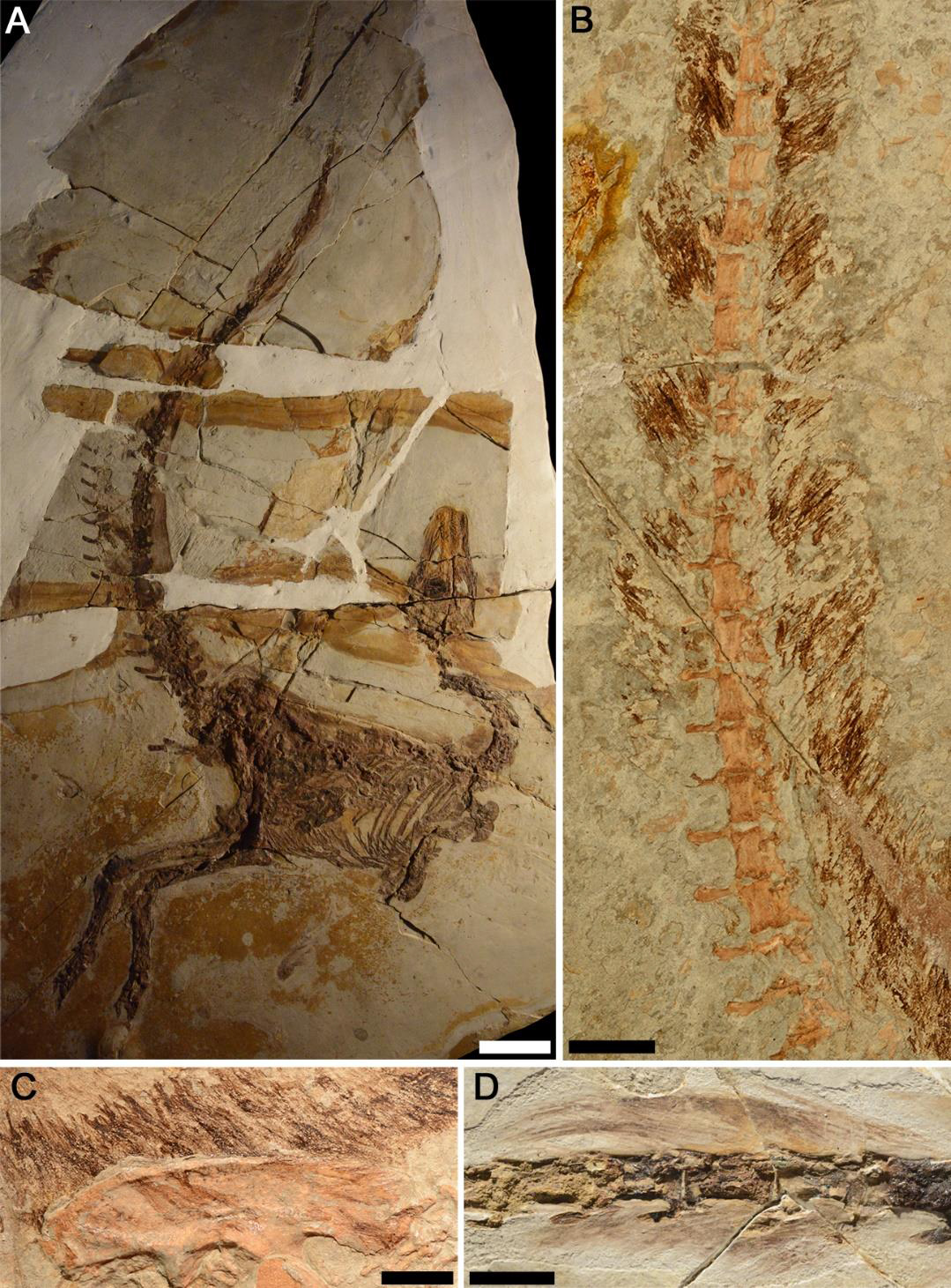
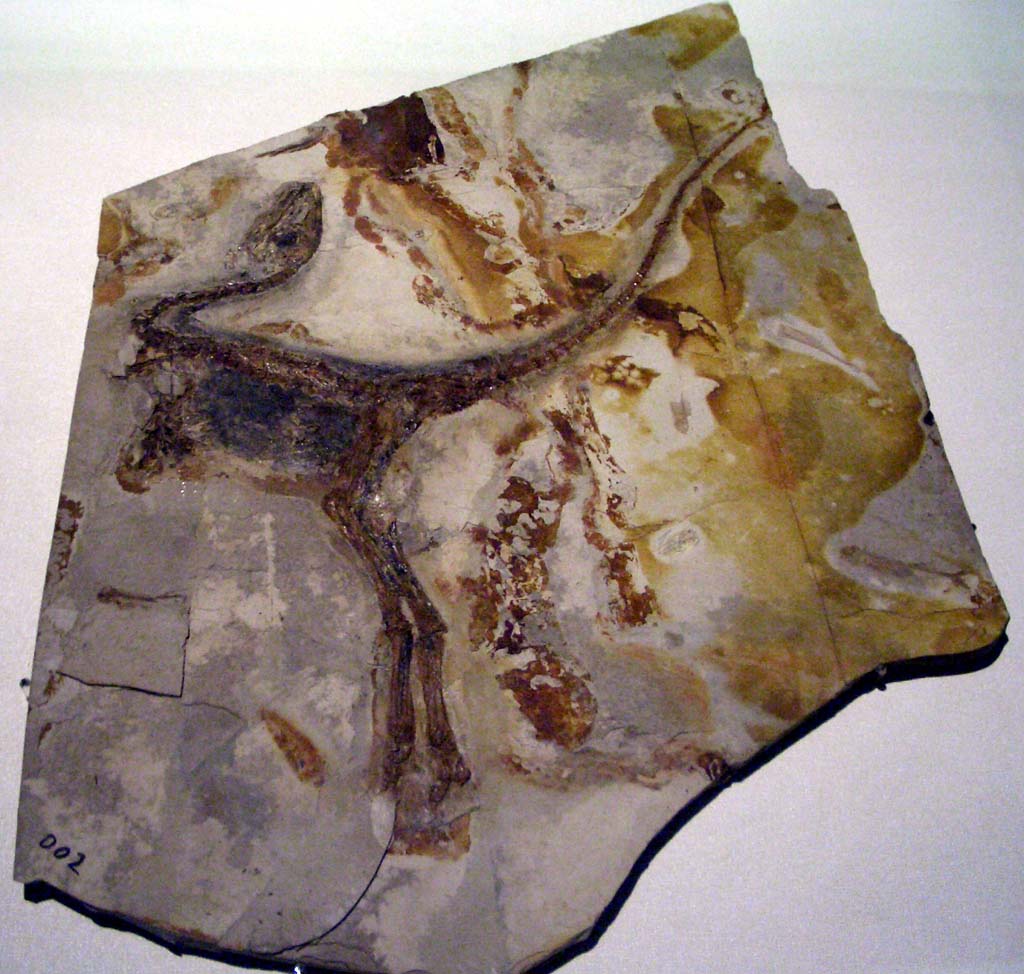
Based on three main specimens. The holotype GMV 2123 (and counter-slab NIGP 127586) and specimen NIGP 127587 are well preserved, with impressions of filamentous structures along nearly the entire body. Specimen NIGP 127587 preserves gut contents (a lizard) and two unlaid eggs.
Found elements
Inferred elements
Scientific Literature
15 papers in chronological order — from the original description to recent research.
On the discovery of the earliest bird fossil in China (Sinosauropteryx gen. nov.) and the origin of birds
Ji, Q. & Ji, S. · Chinese Geology
Founding paper of the species, published in September 1996 by Ji Qiang and Ji Shu-an in Chinese in Chinese Geology. Ji & Ji describe the holotype GMV 2123, collected by farmer Li Yumin in Beipiao, Liaoning. The specimen is notable for the filamentous structures covering its back, neck, tail, and parts of its limbs. The authors initially interpret the animal as a primitive bird, naming it Sinosauropteryx prima ('first Chinese reptile wing'). The discovery generates immediate controversy: was the specimen a bird or a non-avian theropod with feathers? The resolution of this debate, in favor of non-avian theropod nature with proto-feather structures, would transform understanding of bird origins and feather evolution in the following decades.

An exceptionally well-preserved theropod dinosaur from the Yixian Formation of China
Chen, P., Dong, Z. & Zhen, S. · Nature
First detailed English-language description of Sinosauropteryx prima, published in Nature by Chen, Dong, and Zhen. The work describes two exceptionally preserved specimens from the Yixian Formation and definitively confirms the animal is a non-avian theropod dinosaur, close to Compsognathus, not a primitive bird as Ji & Ji (1996) had suggested. The authors detail the unusually long tail (64 vertebrae), short forelimbs, and simple unserrated teeth. The filamentous structures are interpreted as primitive feather precursors, providing the first robust evidence that feather-like structures evolved in dinosaurs before the appearance of birds. This Nature paper establishes Sinosauropteryx as the most important paleontological discovery of the 1990s.


Anatomy of Sinosauropteryx prima from Liaoning, northeastern China
Currie, P.J. & Chen, P. · Canadian Journal of Earth Sciences
Definitive anatomical monograph on Sinosauropteryx prima, published in the Canadian Journal of Earth Sciences by Philip Currie and Pei-Ji Chen. The authors systematically describe each skeletal element from the three known specimens, comparing them with Compsognathus longipes and other compsognathids. The work documents the extraordinarily long tail with 64 caudal vertebrae, the longest of any non-avian theropod relative to body size. Analyses reveal that the first manual digit was disproportionately larger and more robust than the others, possibly adapted for prey-grasping. Specimen NIGP 127587 is described with preserved gut contents (a lizard of the genus Dalinghosaurus) and two unlaid eggs, confirming the female sex of the specimen. Phylogenetic analysis places Sinosauropteryx in family Compsognathidae within Coelurosauria.

A new Chinese specimen indicates that 'protofeathers' in the Early Cretaceous theropod dinosaur Sinosauropteryx are degraded collagen fibres
Lingham-Soliar, T., Feduccia, A. & Wang, X. · Proceedings of the Royal Society B: Biological Sciences
Controversial paper challenging the dominant interpretation of Sinosauropteryx's filamentous structures as proto-feathers. Lingham-Soliar, Feduccia, and Wang examine a new Chinese specimen and argue the structures are degraded dermal collagen fibers, not feather precursors. The authors identify an organized pattern of parallel fibers in preserved areas that they argue is inconsistent with primitive feather morphology and more consistent with structural collagen organization that provides rigidity to modern reptile skin. The hypothesis generated intense debate in the paleontological community. A subsequent study by Smithwick et al. (2017) would use more sophisticated analysis to definitively reject the collagen hypothesis, firmly establishing the feathery nature of the structures.
Fossilized melanosomes and the colour of Cretaceous dinosaurs and birds
Zhang, F., Kearns, S.L., Orr, P.J., Benton, M.J., Zhou, Z., Johnson, D., Xu, X. & Wang, X. · Nature
Transformative paper making Sinosauropteryx prima the first dinosaur to have its true colors scientifically confirmed. Zhang et al. examine melanosomes, the intracellular organelles responsible for pigmentation in modern birds, preserved in fossil filamentous structures. By comparing fossil melanosome morphology with those of modern birds of known colors, the authors infer that Sinosauropteryx had a chestnut-to-reddish-brown ('ginger') coloration in the dark tail stripes, while the light stripes were probably white. Analysis reveals only phaeomelanosomes were present in the dark stripes, indicating orange-brown hues. The discovery, published in Nature in 2010, ends decades of speculation about dinosaur pigmentation and opens a new frontier in paleontology: paleochromatics, the study of extinct animal colors.
Countershading and Stripes in the Theropod Dinosaur Sinosauropteryx Reveal Heterogeneous Habitats in the Early Cretaceous Jehol Biota
Smithwick, F.M., Nicholls, R., Cuthill, I.C. & Vinther, J. · Current Biology
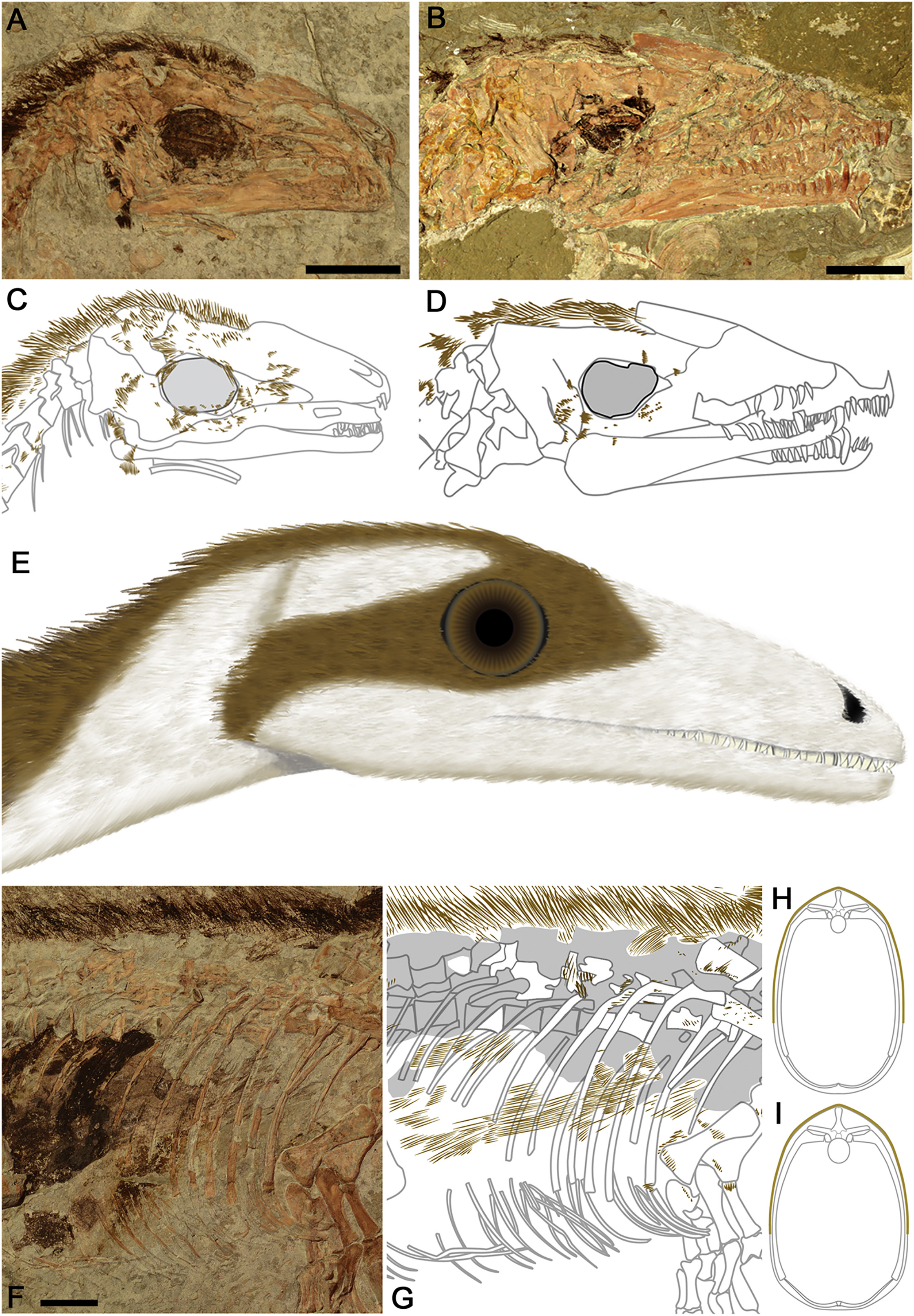
Study deepening knowledge of Sinosauropteryx coloration, refining the work of Zhang et al. (2010). Smithwick et al. reconstruct the complete color pattern using melanosome analysis and 3D models illuminated under different light conditions (direct versus diffuse). Results reveal countershading (dark back, light belly), tail stripes, and a 'bandit mask' facial marking around the eyes, similar to a raccoon. The 3D model shows the countershading pattern is most consistent with an animal living in open, well-lit habitats, not the dense riparian forests previously assumed for the entire Jehol Biota. This implies the different dinosaurs of this formation inhabited distinct ecosystems with greater habitat heterogeneity than thought. The study definitively rejects the collagen fiber hypothesis of Lingham-Soliar et al. (2007).
On the purported presence of fossilized collagen fibres in an ichthyosaur and a theropod dinosaur
Smithwick, F.M. · Palaeontology
Paper definitively ending the debate on the nature of Sinosauropteryx's filamentous structures. Smithwick examines specimens with scanning electron microscopy (SEM) and demonstrates that the 'diagnostics' of collagen fibers presented by Lingham-Soliar et al. (2007) are actually preservation artifacts: shadows formed by scratches in the rock or irregular sediment deposition. SEM analysis confirms the presence of melanosomes morphologically consistent with feather structures, not collagen. The study ends over a decade of controversy and consolidates the scientific position that Sinosauropteryx's structures are proto-feathers, making it definitively the first non-avian dinosaur with confirmed evidence of plumage.


Two new compsognathid-like theropods show diversified predation strategies in theropod dinosaurs
Qiu, R., Wang, X., Jiang, S., Meng, J. & Zhou, Z. · National Science Review
Study published in 2025 describing two new theropod species from the Early Cretaceous of China and phylogenetically repositioning Sinosauropteryx within a new family: Sinosauropterygidae. Qiu et al. demonstrate that the 'compsognathids' of the Early Cretaceous Jehol Biota form a distinct monophyletic group, separate from the classic Jurassic compsognathids. Analysis of stomach contents from different species in this family reveals three distinct predation strategies among coeval species: small prey predation (Sinosauropteryx), large prey predation (Sinocalliopteryx), and possibly omnivory. The work demonstrates that the destruction of the North China Craton in the Early Cretaceous created isolated basins that promoted the ecological diversification of this group.


Spatiotemporal evolution of the Jehol Biota: Responses to the North China craton destruction in the Early Cretaceous
Zhou, Z., Meng, Q., Zhu, R. & Wang, M. · Proceedings of the National Academy of Sciences
PNAS study examining how the Jehol Biota, the ecosystem where Sinosauropteryx prima lived, evolved over time in response to the tectonic destruction of the North China Craton in the Early Cretaceous. Zhou et al. document three evolutionary stages of the Jehol Biota (JBS I, II, and III), spanning approximately 135 to 120 million years ago. Sinosauropteryx prima belongs primarily to JBS I and II (Yixian Formation). The authors demonstrate that the spatiotemporal distribution pattern of the biota coincides with the progressive development of rift basins associated with Paleo-Pacific plate subduction. This process created enclosed lakes with exceptional preservation conditions (bottom anoxia, rapid volcanic ash deposition) resulting in the extraordinary fossil quality of Liaoning.

The remarkable fossils from the Early Cretaceous Jehol Biota of China and how they have changed our knowledge of Mesozoic life
Benton, M.J., Zhou, Z., Orr, P.J., Zhang, F. & Kearns, S.L. · Proceedings of the Geologists' Association
Comprehensive review of the Jehol Biota, the Early Cretaceous ecosystem that preserved Sinosauropteryx prima and hundreds of other species in exceptional detail. Benton et al. review the three main formations (Dabeigou, Yixian, and Jiufotang) and document how Liaoning's fossil record has revolutionized understanding of Mesozoic life. The Jehol Biota preserved the first known birds with modern flight structures, the first placental mammals, the first dinosaurs with confirmed feathers (including Sinosauropteryx), and the first angiosperms. The authors discuss mechanisms of exceptional preservation: lakes with anoxic bottoms, periodic volcanic eruptions that rapidly killed large groups of animals and deposited them in lacustrine sediments with minimal post-mortem disturbance.
A new troodontid dinosaur from China with avian-like sleeping posture
Xu, X. & Norell, M.A. · Nature
Although focused on the troodontid Mei long, this Nature study is essential for the ecological and paleobiological context of Sinosauropteryx prima. Xu & Norell describe a Yixian Formation specimen preserved in an avian resting posture, with its head tucked under a forelimb. The discovery demonstrates that typically avian behaviors, like sleeping posture, were present in non-avian dinosaurs from the same formation as Sinosauropteryx. The work contextualizes the Jehol Biota as an evolutionary laboratory where avian characteristics arose independently in different theropod lineages, with Sinosauropteryx representing the most basal extreme with proto-feathers but without other advanced avian characteristics.


Abdominal Contents from Two Large Early Cretaceous Compsognathids (Dinosauria: Theropoda) Demonstrate Feeding on Confuciusornithids and Dromaeosaurids
Xing, L., Bell, P.R., Persons, W.S., Ji, S., Miyashita, T., Burns, M.E., Ji, Q. & Currie, P.J. · PLOS ONE
Fundamental study on feeding strategies among Early Cretaceous compsognathids, the family including Sinosauropteryx. Xing et al. analyze two Sinocalliopteryx gigas specimens with preserved abdominal contents, revealing this larger relative of Sinosauropteryx consumed avian and dromaeosaurid prey. Comparison with Sinosauropteryx gut contents (small lizards and mammals) reveals remarkable ecological niche partitioning among coeval compsognathids: Sinosauropteryx, at only 1 meter length, specialized in small, low-mobility prey, while the larger Sinocalliopteryx pursued proportionally larger prey including birds and other dinosaurs. This resource partitioning is evidence that the small predator community of the Jehol Biota was more ecologically structured than previously thought.


The evolution of the feather: Sinosauropteryx, a colourful tail
Theagarten, L.S. · Journal of Ornithology
Lingham-Soliar paper continuing the debate on the nature of Sinosauropteryx structures, focusing specifically on the tail. The author argues that the visible tail markings correspond to alternating scales, not feather filaments, and proposes that the striped pattern resulted from alternating light and dark scales of a snake or lizard rather than colored proto-feathers. The study also offers an alternative interpretation of the opisthotonus posture frequently observed in Sinosauropteryx fossils, with the head and tail strongly arched backward, suggesting it results from taphonomic processes. Although the scale hypothesis was widely rejected by subsequent melanosome studies, the article contributed to the rigor of scientific debate on the origin and nature of proto-feathers.

Two feathered dinosaurs from northeastern China
Ji, Q., Currie, P.J., Norell, M.A. & Ji, S. · Nature
High-impact paper describing two new feathered dinosaurs from the Yixian Formation, Protarchaeopteryx robusta and Caudipteryx zoui, comparing them directly with Sinosauropteryx. While Sinosauropteryx had simple filamentous structures, these two new taxa had true feathers with calamus, rachis, and barbs comparable to modern birds. The discovery, published in Nature in 1998, demonstrates that true feathers evolved in non-avian dinosaurs multiple times and that a spectrum of plumage complexity existed within the Jehol Biota. Sinosauropteryx, being phylogenetically more basal than Caudipteryx and Protarchaeopteryx within Coelurosauria, represents an earlier stage in feather evolution: simple filaments without complex internal structure.

A basal dromaeosaurid and size evolution preceding avian flight
Turner, A.H., Pol, D., Clarke, J.A., Erickson, G.M. & Norell, M.A. · Science
Science study describing a new feathered-winged basal dromaeosaurid and analyzing body size evolution trends in paravian theropods, the group including Sinosauropteryx, dromaeosaurids, and birds. The analysis reveals a clear miniaturization trend along the lineage leading to avian flight: bird ancestors progressively became smaller over tens of millions of years. Sinosauropteryx, at only 0.55 kg, represents one of the smallest ends of this size reduction spectrum. The study is relevant to understanding why Sinosauropteryx developed filamentous structures: miniaturization increases the surface-to-volume ratio, making thermoregulation more difficult and favoring the development of thermal insulation in the form of proto-feathers.


Espécimes famosos em museus
GMV 2123 / NIGP 127586 (holótipo)
Museu Geológico Nacional da China, Beijing
The holotype of Sinosauropteryx prima, comprising the main slab GMV 2123 and its counter-slab NIGP 127586. Preserves the first filamentous structures identified in a non-avian dinosaur, with visible impressions along the back, tail, and neck. It is the specimen that initiated the Jehol Biota revolution in paleontology.
NIGP 127587
Instituto de Geologia e Paleontologia de Nanquim, Nanquim
Female specimen preserving two unlaid eggs in the abdominal cavity, confirming that Sinosauropteryx had dual ovaries and laid eggs in pairs, like other avian theropods. Also preserves stomach contents (a Dalinghosaurus lizard), providing direct evidence of its diet. It is the most paleobiologically informative specimen.
GMV 2124 (réplica no Museu de Karlsruhe)
Museu de Ciências Naturais de Karlsruhe, Karlsruhe, Alemanha
Specimen initially attributed to Sinosauropteryx prima that preserves the remains of a mammal (Zhangheotherium) in the stomach. It was later reclassified as Huadanosaurus, but the replica remains on display in Karlsruhe and is widely photographed. The specimen contributed to the debate on dietary diversity among compsognathids.
In cinema and popular culture
Sinosauropteryx prima never achieved the cinematic fame of Velociraptor or T. rex, but its presence in popular culture grew significantly after 2010, when it became the first dinosaur with scientifically proven colors. Scientific documentaries like Planet Dinosaur (BBC, 2011) used Sinosauropteryx as the emblematic example of how the Jehol Biota revolutionized understanding of bird evolution. In the digital gaming world, the species gained prominence in Jurassic World Evolution 2 (2022), in the 'Feathered Species Pack' DLC, where it is represented with remarkable scientific accuracy: the ginger coloration with white stripes and proto-feather covering are faithful to melanosome research. It also appears in Jurassic World: The Game and Jurassic World Alive. Its scientific narrative, of a tiny animal that proved dinosaurs had feathers and vibrant colors, has growing appeal in science outreach content, children's science programs, and museum exhibitions worldwide. The 'Cretaceous raccoon', as it has been informally nicknamed for its facial mask, has become an icon of modern paleontology.

Classificação


Descoberta
Curiosidade
In 2010, Sinosauropteryx prima became the first dinosaur in history to have its true colors scientifically confirmed: ginger and white stripes on the tail and a dark mask around the eyes. Before that, all dinosaur colors in books and films were pure artistic speculation.