
Tenontosaurus
Tenontosaurus tilletti
"Tillett's sinew lizard"
Sobre esta espécie
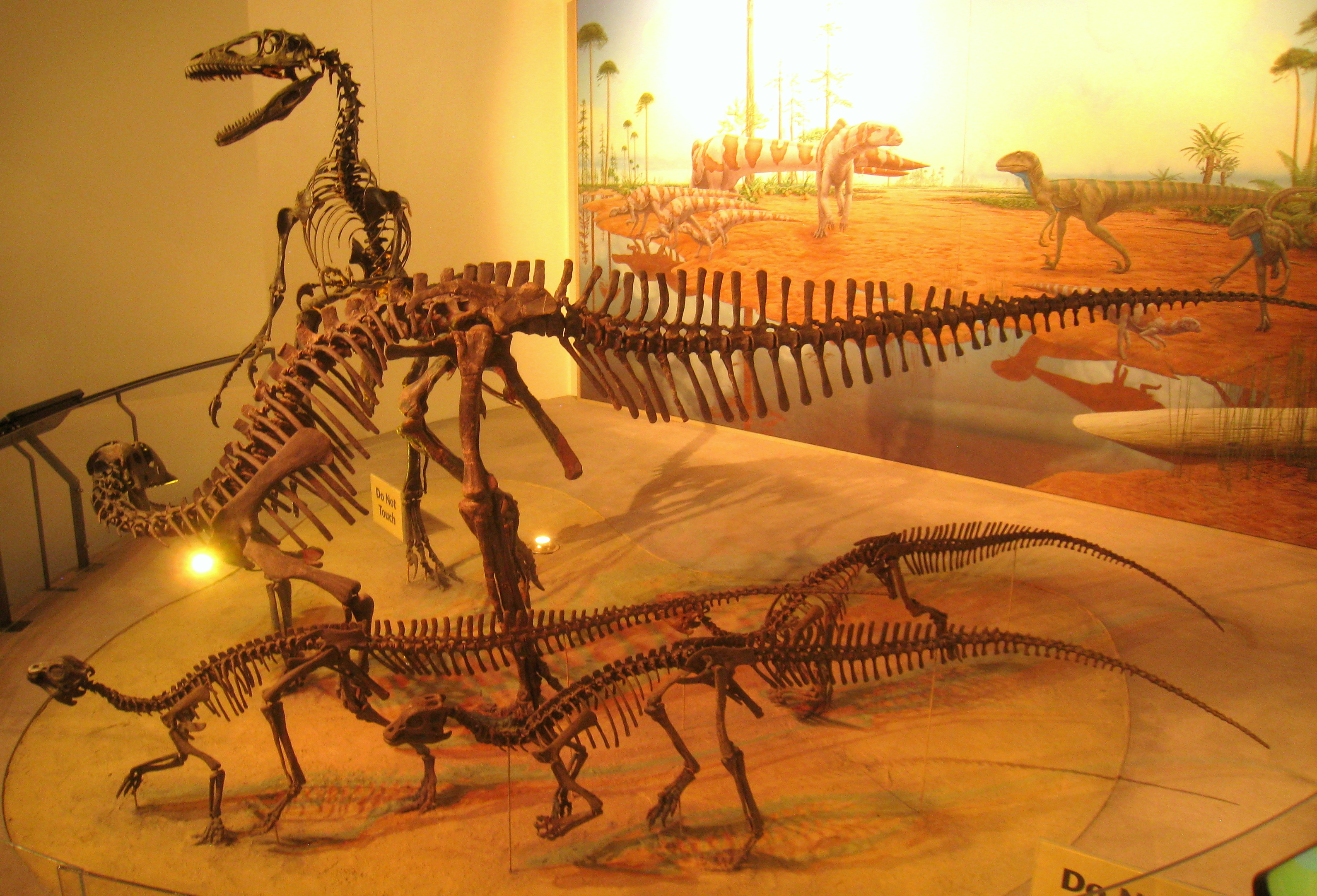
Tenontosaurus tilletti was a medium-sized iguanodontian ornithopod that lived during the Aptian-Albian of the Early Cretaceous, approximately 115 to 108 million years ago, in what is now the western United States. At 6 to 7.5 meters in length and estimated body mass of 700 to 1,000 kg, it was one of the most common and abundant herbivores of its time and region. The genus is morphologically distinct from other ornithopods by its extraordinarily long and robust tail, which in adults could represent more than half the total length of the animal. The caudal vertebrae are reinforced by ossified tendons, hence the name 'sinew lizard', which provided rigidity to the tail and possibly functioned as a counterweight to maintain balance during bipedal or quadrupedal locomotion. Tenontosaurus was capable of moving both on two and four legs depending on speed and terrain. The paleontological importance of Tenontosaurus extends far beyond its intrinsic morphology: the animal is the center of the longest and most influential debate in paleontology about cooperative predatory behavior in dinosaurs. When John Ostrom described Deinonychus antirrhopus in 1969 and 1970, he based much of his argument about pack hunting on the recurring spatial association of multiple Deinonychus teeth with Tenontosaurus carcasses in the Cloverly Formation. Ostrom inferred that groups of Deinonychus cooperatively attacked much larger Tenontosaurus individuals, similarly to the behavior of modern lions. This hypothesis became enormously influential and directly inspired the representation of Velociraptors as cooperative hunters in Jurassic Park (1993). However, subsequent analyses questioned the cooperative hunting interpretation. Roach and Brinkman (2007) argued that the association of Deinonychus with Tenontosaurus carcasses is more consistent with competitive scavenging behavior, like that observed in modern Komodo dragons feeding on the same carcass without true cooperation and frequently attacking each other during the feast. Evidence of multiple dead Deinonychus at the same localities as Tenontosaurus would suggest Tenontosaurus was capable of actively defending itself, killing some of its attackers. This debate about cooperative hunting versus competitive feeding in Deinonychus, centered on Tenontosaurus carcasses, remains without definitive resolution and continues to be one of the most stimulating problems in dinosaur behavior.
Geological formation & environment
The Cloverly Formation is an Early Cretaceous (Aptian-Albian, ~115-108 Ma) stratigraphic unit outcropping mainly in Wyoming and Montana, United States. It was formed by fluvial floodplain deposits of meandering rivers flowing through what was then the interior of the North American continent, before the full formation of the Cretaceous Interior Seaway. The formation is composed of fluvial sandstones, siltstones, and clays, with braided and meandering river channels, natural levee deposits, and oxbow lakes. The reddish color of many strata indicates oxidizing conditions during deposition, consistent with a seasonal climate with marked dry periods. The Cloverly Formation is famous for two main reasons: the abundance of Tenontosaurus tilletti, the most common herbivore, and the presence of Deinonychus antirrhopus, the most iconic predator, both described by Ostrom in 1969-1970 from material collected in his expeditions. The Cloverly Formation fauna also includes the nodosaurid Sauropelta edwardsorum, chelonians, crocodyliforms, and lizards. Oklahoma and Texas's Antlers Formation is correlated in age and fauna, having produced the second species of Tenontosaurus (T. dossi). Together, the Cloverly and Antlers formations document the Early Cretaceous fauna of the North American interior before the Interior Seaway transgression that would fragment the continent in the Albian-Cenomanian.
Image gallery




Life reconstruction of Tenontosaurus tilletti by Nobu Tamura, white background. Lateral view showing the robust body plan and exceptionally long tail of this ornithopod from the Cloverly Formation.
CC BY-SA 3.0
Ecology and behavior
Habitat
Tenontosaurus tilletti inhabited subtropical and semi-arid river plains of the North American interior during the Early Cretaceous, when the continent's interior was divided by the nascent Cretaceous Interior Seaway, creating a strip of coastal and riparian habitat at low altitude. The Cloverly Formation and Antlers Formation preserve evidence of a fluvial floodplain paleoenvironment with meandering rivers, seasonal lakes and ponds, and riparian vegetation of ferns, cycads, and conifers. The climate was seasonal, with a pronounced rainy season followed by a drier period. Tenontosaurus probably migrated seasonally in groups along the river plains in search of fresh vegetation during the wet season, and concentrated near rivers and lakes during dry seasons.
Feeding
Tenontosaurus was a generalist herbivore capable of consuming vegetation at different heights, from low pteridophyte plants on the ground to shrubs and small trees up to 3 to 4 meters tall, using bipedal posture to reach higher foliage. Dental morphology, with moderately developed batteries and spoon-shaped teeth, indicates preference for moderately tough plants like large ferns, cycads, and young conifer leaves. Unlike more derived hadrosaurs, Tenontosaurus did not have the hyper-densified dentition needed to process extremely tough plant material, suggesting selection for relatively high nutritional quality plants.
Behavior and senses
Tenontosaurus probably lived in groups or herds of variable size, behavior inferred from the presence of multiple individuals of different sizes in the same fossiliferous deposits. Group size would be an effective defense against predators like Deinonychus: younger and more vulnerable animals would be protected at the center of the group by larger adults. Tenontosaurus's long, robust tail, with ossified tendons that made it relatively rigid, could have been used as an active defensive weapon against predators, striking laterally with considerable force. Evidence of multiple dead Deinonychus at the same localities as Tenontosaurus carcasses suggests adults could kill attackers.
Physiology and growth
Bone histology of Tenontosaurus reveals a pattern of rapid growth during the first years of life, with marked deceleration at sexual maturity, a pattern intermediate between ectothermic reptiles and endothermic birds. The animal probably had higher metabolism than modern crocodiles, allowing sustained daytime activity. The ossified caudal tendons indicate Tenontosaurus's tendon system was highly modified for efficient locomotion, with the rigid tail serving as a mechanical counterweight during bipedal running. Running speed estimates, based on limb morphology and gravitational mass ratio, suggest maximum speed of 20 to 30 km/h for adults.
Paleogeography
Continental configuration

Ron Blakey · CC BY 3.0 · Cretáceous, ~90 Ma
During the Aptiano-Albiano (~115–108 Ma), Tenontosaurus tilletti inhabited Laramidia, the western half of present-day North America, separated from the east by the Western Interior Seaway, a shallow sea dividing the continent. The continents were in very different positions: India was drifting toward Asia, Antarctica was still connected to Australia, and South America was an isolated island.
Inventário de Ossos
Tenontosaurus tilletti is represented by dozens of specimens collected from the Cloverly Formation (Montana, Wyoming) and Antlers Formation (Oklahoma, Texas). Material includes complete skulls, partially articulated adult and juvenile skeletons, and abundant isolated post-cranial material. No single specimen is complete, but combining multiple individuals allows very accurate reconstruction of complete anatomy. The holotype YPM 5456, collected by Ostrom in the 1964-1966 expedition, is the most complete individual specimen.

Found elements
Inferred elements
Scientific Literature
9 papers in chronological order — from the original description to recent research.
Stratigraphy and paleontology of the Cloverly Formation (Lower Cretaceous) of the Bighorn Basin area, Wyoming and Montana
Ostrom, J.H. · Bulletin of the Peabody Museum of Natural History
Monumental publication by John Ostrom formally describing Tenontosaurus tilletti as a new genus and species based on material collected by Yale Peabody Museum expeditions from 1964 to 1966 in the Cloverly Formation of Wyoming and Montana. The study also describes Deinonychus antirrhopus in the same volume, making it one of the most important publications in 20th-century paleontology. Ostrom provides a detailed anatomical description of Tenontosaurus, characterizing the extraordinarily long tail with ossified tendons, cranial morphology with distinct dental formula, and limbs adapted for facultatively bipedal or quadrupedal locomotion. The name Tenontosaurus is derived from Greek 'tendon' referring to the ossified tail tendons, and tilletti honors Buster Tillett, owner of the ranch where the first specimens were collected.
Osteology of Deinonychus antirrhopus, an unusual theropod from the Lower Cretaceous of Montana
Ostrom, J.H. · Bulletin of the Peabody Museum of Natural History
Formal description of Deinonychus antirrhopus, a new dromaeosaurid from the Cloverly Formation found in direct association with Tenontosaurus remains. The paper is fundamental to Tenontosaurus history because it contains the first formal proposal of pack hunting behavior: Ostrom observes that multiple Deinonychus teeth and, in at least one case, skeletal parts of several Deinonychus, were associated with a Tenontosaurus carcass. The author infers that groups of Deinonychus cooperatively hunted much larger Tenontosaurus individuals, using the sickle claw of the second toe as the main attack weapon. This pack hunting proposal profoundly influenced public perception of dinosaurs and was the model for the Velociraptors of Jurassic Park, which were in reality based on Deinonychus.
A reevaluation of cooperative pack hunting and gregariousness in Deinonychus antirrhopus and other nonavian theropod dinosaurs
Roach, B.T., Brinkman, D.L. · Bulletin of the Peabody Museum of Natural History
Roach and Brinkman reanalyze the taphonomic evidence from Deinonychus-Tenontosaurus associations in the Cloverly Formation and propose that Ostrom's cooperative pack hunting hypothesis is not the most parsimonious explanation for the data. Instead, the authors argue that competitive feeding behavior observed in modern Komodo dragons better explains the taphonomic pattern: multiple Deinonychus would be attracted to Tenontosaurus carcasses opportunistically, competing with each other for food without true cooperation. The presence of Deinonychus skeletons alongside Tenontosaurus carcasses would be explained by adult Tenontosaurus actively defending themselves and killing some of the attacking dromaeosaurids. The paper generated intense reaction in the paleontological community and remains the main counterpoint to Ostrom's classic pack hunting hypothesis.
Taphonomy and paleobiological implications of Tenontosaurus-Deinonychus associations
Maxwell, W.D., Ostrom, J.H. · Journal of Vertebrate Paleontology
Maxwell and Ostrom perform detailed taphonomic study of multiple Tenontosaurus-Deinonychus assemblage sites in the Cloverly Formation, providing quantitative analysis of bone distribution and orientation. The work documents that the distribution of Tenontosaurus skeletal elements in the associations is not random, but follows patterns consistent with progressive disarticulation during active feeding episodes. The authors identify tooth marks on Tenontosaurus bones consistent with the size and shape of Deinonychus teeth, and document the presence of isolated Deinonychus teeth distributed around Tenontosaurus carcasses. The study concludes that the evidence is more consistent with active feeding by multiple Deinonychus than with accidental deposition.

A new species of Tenontosaurus (Dinosauria: Ornithopoda) from the Early Cretaceous of Texas
Winkler, D.A., Murry, P.A., Jacobs, L.L. · Journal of Vertebrate Paleontology
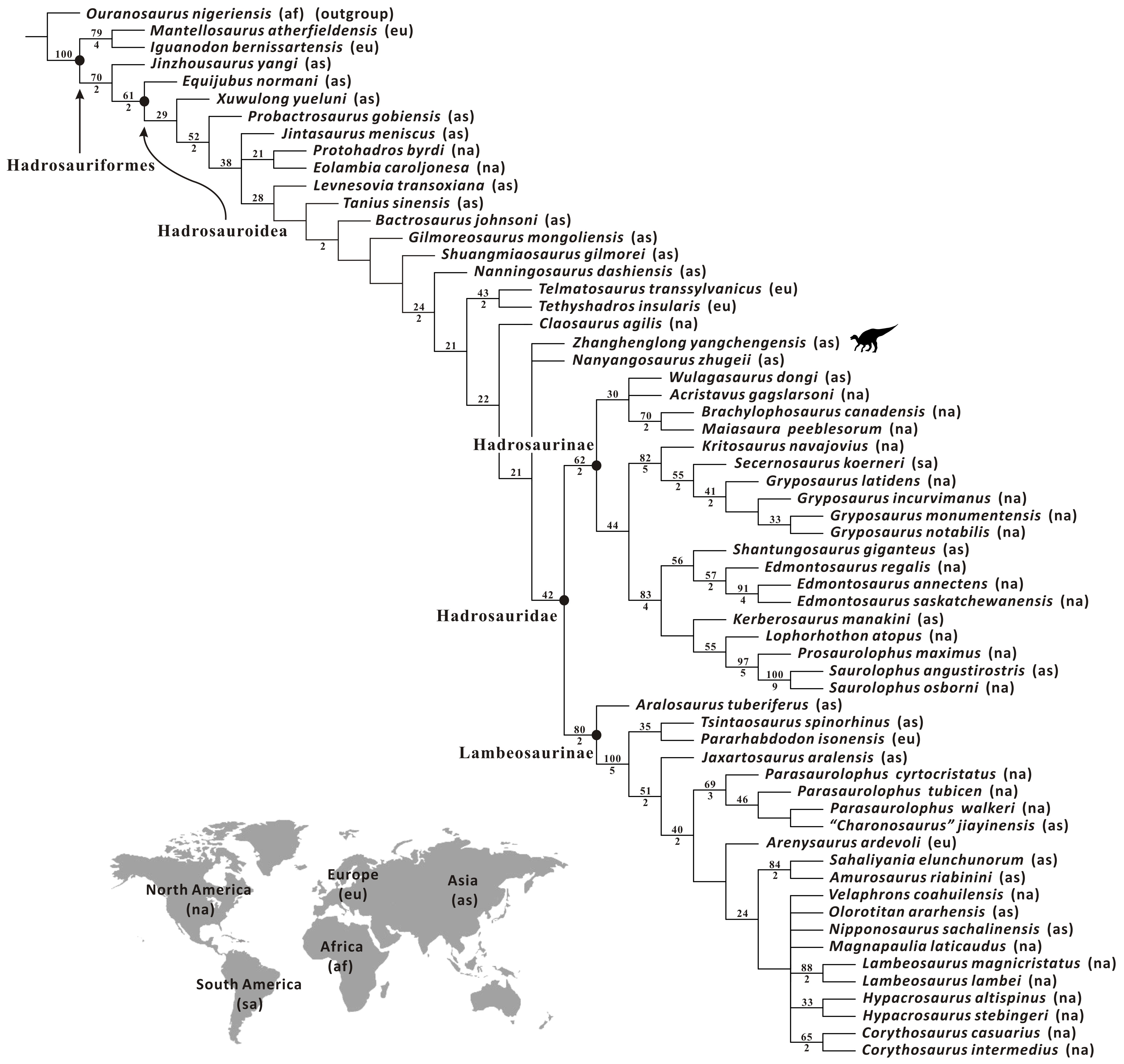
Winkler, Murry and Jacobs describe Tenontosaurus dossi, the second species of the genus, from the Antlers Formation of Texas. The distinction of T. dossi from T. tilletti is based on morphological differences in the skull and pelvis: T. dossi presents a relatively broader skull and teeth with slightly different morphology. The discovery demonstrates Tenontosaurus had a wide geographic distribution in the Early Cretaceous North American interior. The paper discusses the phylogenetic relationships of T. dossi with T. tilletti and other Cretaceous iguanodontian ornithopods, positioning the genus as one of the most basal members of Iguanodontia.

The cranial morphology and systematics of Tenontosaurus tilletti (Dinosauria: Ornithopoda)
Forster, C.A. · Journal of Vertebrate Paleontology
Forster performs comprehensive redescription and phylogenetic analysis of the cranial morphology of Tenontosaurus tilletti, providing revised diagnosis and placing the genus in a basal position within Iguanodontia. The work analyzes the skull of multiple specimens of different sizes, documenting ontogenetic variation in cranial morphology and establishing which features are diagnostic versus ontogenetic. Forster concludes Tenontosaurus is more derived than hypsilophodontids but less derived than true iguanodontids, positioning the genus as a basal iguanodontian. Analysis of dental morphology reveals Tenontosaurus had moderately developed dental batteries, consistent with herbivory of tough plants.


A new name for the dinosaur Claosaurus agilis Marsh
Hatcher, J.B. · Annals of the Carnegie Museum
Hatcher mentions ornithopod material from Wyoming that decades later would be recognized as belonging to the genus Tenontosaurus, providing the first documented occurrence of the taxon in paleontological literature. The material cited by Hatcher was initially attributed to other ornithopod genera known at the time, demonstrating the taxonomic confusion that prevailed before Ostrom's formal description in 1970. Hatcher's paper is historically important because it demonstrates that the Tenontosaurus record in the Cloverly Formation dates to the early 20th century, well before the Yale expeditions that produced the holotype material.


Late Pleistocene herpetofauna of the southern High Plains and an Early Cretaceous fauna from the Antlers Formation, Oklahoma
Winkler, D.A., Murry, P.A., Jacobs, L.L., Downs, W.R. · Journal of Vertebrate Paleontology
Winkler and collaborators describe the fauna of the Antlers Formation of Oklahoma, including Tenontosaurus specimens documenting the southernmost occurrences of the genus. The study demonstrates Tenontosaurus had a very wide distribution in the Early Cretaceous North American interior, extending from Montana and Wyoming south to Oklahoma and Texas. Antlers Formation specimens are morphologically similar to those from the Cloverly Formation but show some differences that led to the later description of T. dossi as a second species. The work contextualizes Tenontosaurus as the dominant medium-sized herbivore in the Early Cretaceous ecosystem of the North American interior.


A comparative embryological study of two ornithischian dinosaurs
Horner, J.R., Weishampel, D.B. · Nature
Horner and Weishampel perform a comparative study of embryonic and hatchling ornithischian dinosaurs, including material attributed to Tenontosaurus, revealing high early growth rates and precocial development. The study demonstrates Tenontosaurus hatchlings were relatively capable from early on, with well-ossified bones at hatching, suggesting they did not depend on intensive parental care for survival. This conclusion contrasts with Horner's contemporary studies on Maiasaura, which evidence extensive parental care. The authors propose Tenontosaurus' reproductive strategy was high egg production with relatively self-sufficient hatchlings, different from the K-strategy of hadrosaurs.

Espécimes famosos em museus

YPM 5456 (holótipo)
Yale Peabody Museum of Natural History, New Haven, Estados Unidos
Holotype of Tenontosaurus tilletti, collected in Ostrom's 1964-1966 expeditions in the Cloverly Formation of Wyoming. Includes partial cranial elements, cervical and dorsal vertebrae, ribs, pelvic girdle, and hindlimbs. It is the most complete specimen of a single adult individual of T. tilletti.
AMNH 3040
American Museum of Natural History, Nova York, Estados Unidos
Referred specimen of Tenontosaurus tilletti at the American Museum of Natural History, including well-preserved post-cranial elements from the Cloverly Formation. The AMNH holds several Tenontosaurus specimens collected in Montana and Wyoming expeditions, forming an important ontogenetic series for growth studies.
MOR 682
Museum of the Rockies, Bozeman, Estados Unidos
Specimen of Tenontosaurus tilletti at the Museum of the Rockies in Bozeman, Montana, collected from the Cloverly Formation. The museum holds multiple Tenontosaurus specimens representing different ontogenetic stages, important for understanding growth in the genus.
OMNH 10168
Oklahoma Museum of Natural History, Norman, Estados Unidos
Tenontosaurus specimen from the Antlers Formation of Oklahoma at the Oklahoma Museum of Natural History, representing the southernmost distribution of the genus. Antlers Formation material was fundamental to the description of T. dossi as a second species of the genus.
In cinema and popular culture
Tenontosaurus tilletti occupies a unique place in the relationship between paleontology and popular culture: it is the animal that, without appearing directly in any big-budget film, most influenced the cinematic representation of dinosaurs over the past three decades. When Ostrom proposed in 1969 and 1970 that groups of Deinonychus cooperatively hunted much larger Tenontosaurus individuals, he launched the hypothesis that Michael Crichton and Steven Spielberg would transform into one of the most impactful concepts in science fiction cinema: dinosaurs that hunt in packs like wolves, coordinating attacks with collective intelligence. The 'Velociraptors' of Jurassic Park (1993) are morphologically based on Deinonychus and behaviorally based on Ostrom's hypothesis about Tenontosaurus hunts. The film's extraordinary cultural success, which redefined public perception of dinosaurs from slow and stupid animals to agile, intelligent, and dangerous creatures, was largely built on the Deinonychus-Tenontosaurus hypothesis. Ironically, later research by Roach and Brinkman (2007) seriously questioned whether this cooperative hunting actually occurred. In the scientific community, Tenontosaurus is celebrated as 'the most important dinosaur you've never heard of': the central pivot of the longest debate in behavioral paleontology, the bridge between the old view of dinosaurs as slow reptiles and the dinosaur renaissance that transformed our understanding of these animals.

Classificação
Descoberta
Curiosidade
Tenontosaurus tilletti is the dinosaur that, without ever appearing in a film, most influenced the cinematic representation of dinosaurs in history. The Velociraptors of Jurassic Park, which defined the popular image of intelligent cooperative predatory dinosaurs for an entire generation, are based on the pack hunting hypothesis that Ostrom proposed specifically to explain the association of Deinonychus with Tenontosaurus carcasses. Without Tenontosaurus, there would probably be no Velociraptors as we see them in cinema.