Therizinosaurus
Therizinosaurus cheloniformis
"Reaping lizard with turtle-like form"
Sobre esta espécie
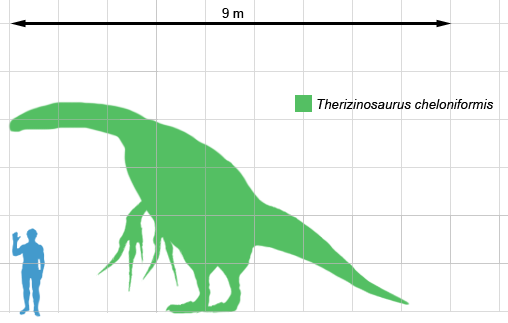
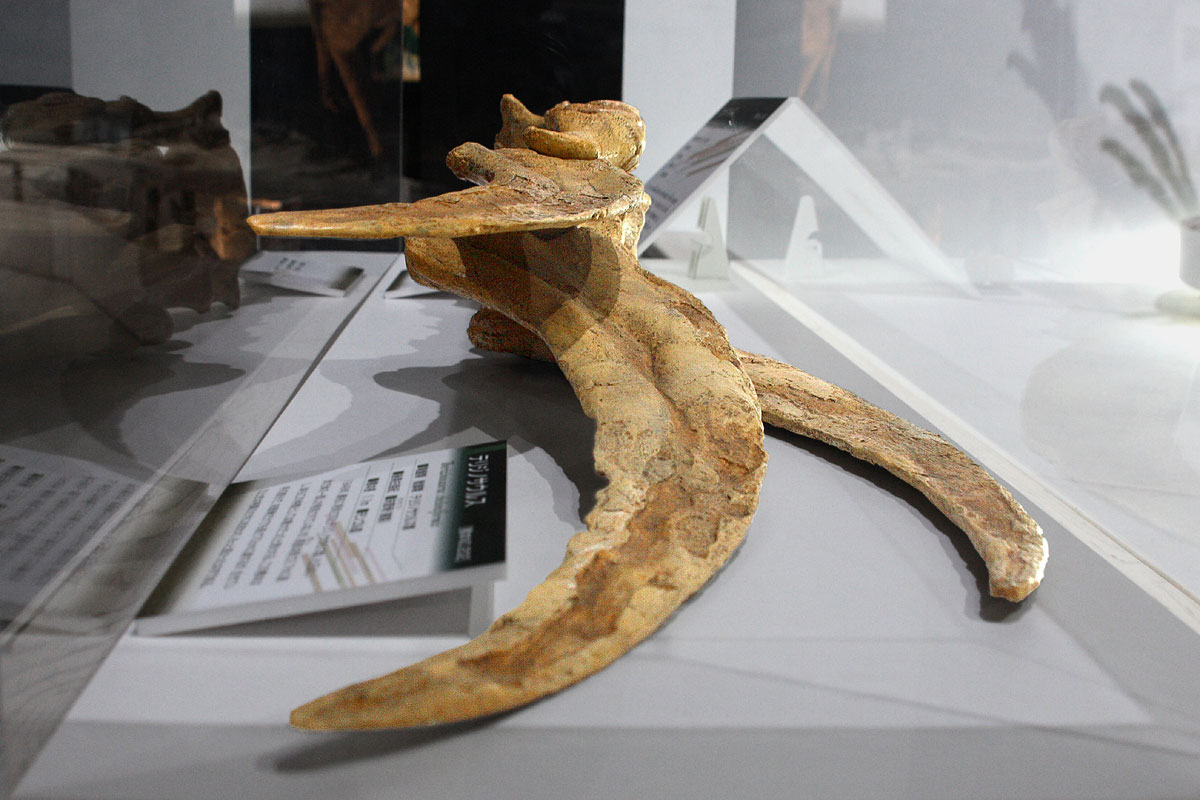
Therizinosaurus cheloniformis is one of the most bizarre dinosaurs ever discovered. It was a herbivorous theropod that lived during the Late Cretaceous, approximately 70 million years ago, in present-day Mongolia. Reaching up to 10 meters in length and weighing around 5 tonnes, its most striking feature was the enormous claws on its forelimbs, which could reach 70 cm in length, the largest of any known animal. Despite belonging to the same group as velociraptors and T. rex (Theropoda), Therizinosaurus was herbivorous, using its claws to pull down branches and feed on foliage. It was initially described as a giant turtle by Evgeny Maleev in 1954, and it took decades before paleontologists understood its true nature as a theropod dinosaur.
Geological formation & environment
Therizinosaurus cheloniformis is found in the Nemegt Formation, exposed in the Gobi Desert, southwestern Mongolia. The formation dates to the Campanian-Maastrichtian (~72-69 Ma) and is composed of sandstones and mudstones deposited by meandering and braided rivers. The environment was a temperate alluvial plain with monsoons, covered by dense araucarian forests with closed canopies, ginkgos, bald cypresses, and aquatic vegetation. There were no polar ice caps and sea levels were higher than today. The fauna was extraordinarily diverse: the apex predator Tarbosaurus bataar, the gigantic Deinocheirus and Therizinosaurus, hadrosaurs like Saurolophus, titanosaurs like Nemegtosaurus, ankylosaurids, pachycephalosaurids, ornithomimosaurs, oviraptorosaurs, dromaeosaurids, troodontids, crocodilians, turtles, and primitive birds. The Nemegt Formation is considered one of the richest fossil vertebrate deposits in Asia.
Image gallery

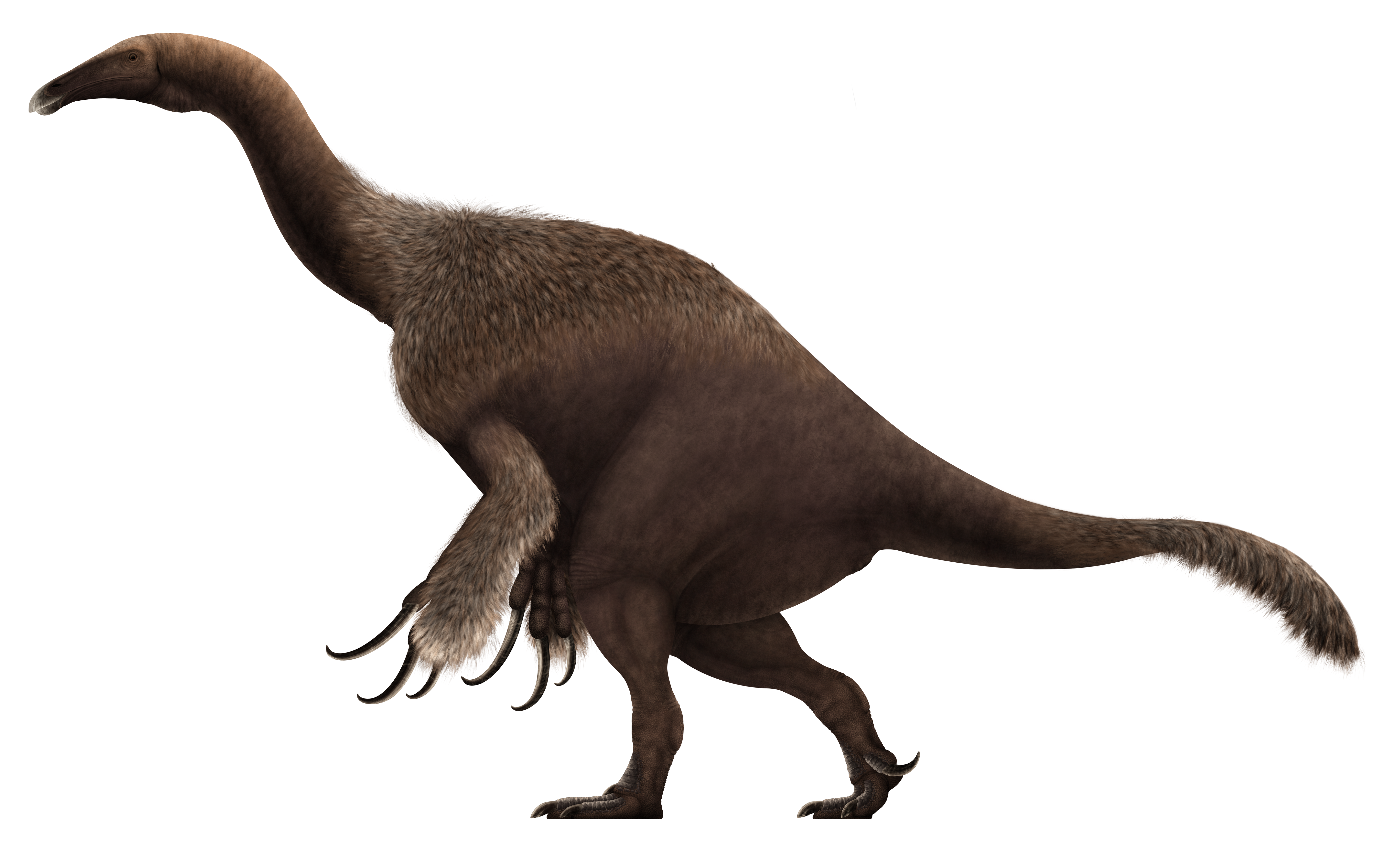


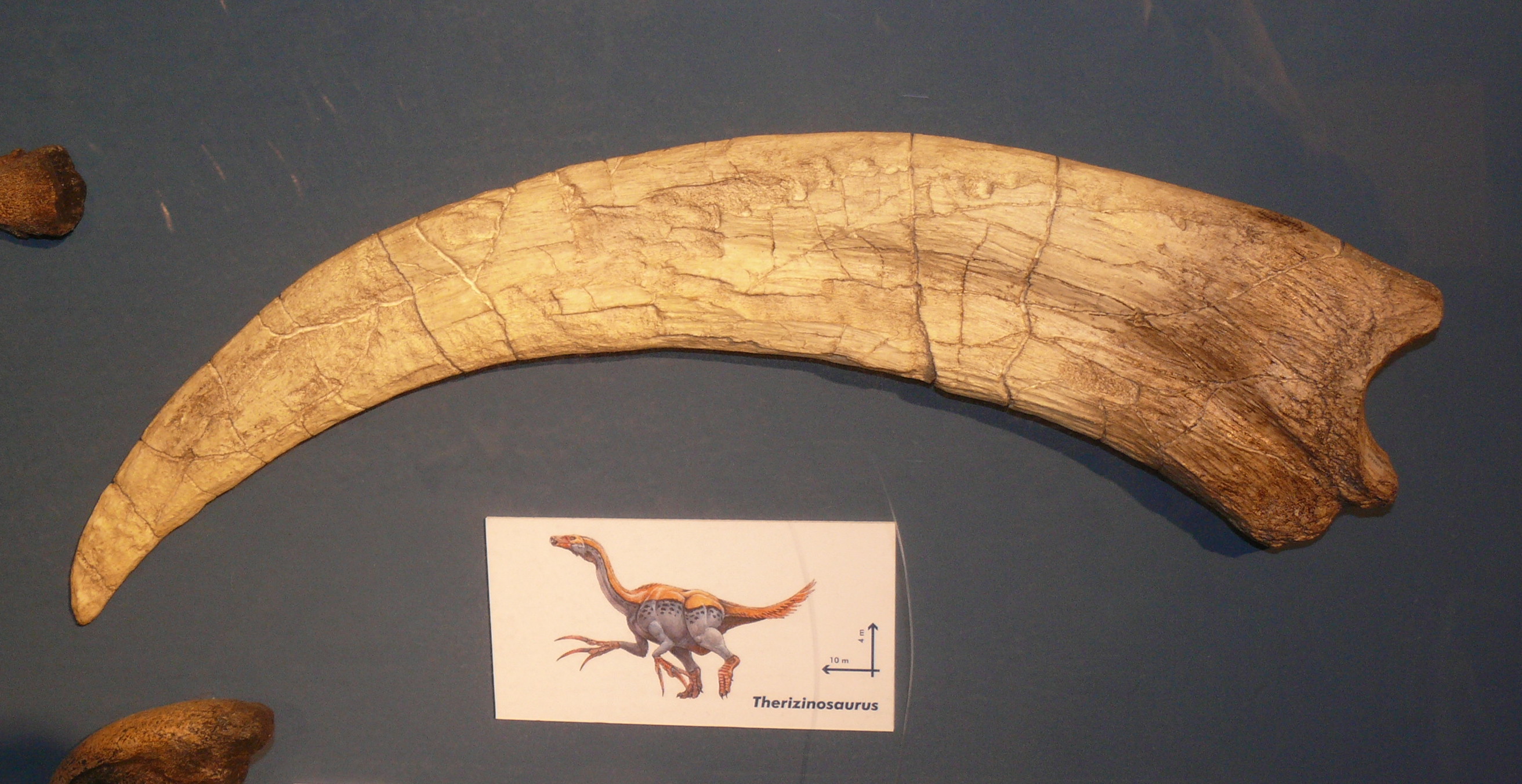

Life restoration of Therizinosaurus cheloniformis, showing the animal with dense plumage and elongated claws used for pulling branches.
Wikimedia Commons, CC BY-SA 4.0
Ecology and behavior
Habitat
Therizinosaurus inhabited the alluvial plains and forests of the Nemegt Formation in present-day Gobi Desert, southwestern Mongolia, 72 to 69 million years ago. The climate was relatively temperate (mean annual temperature between 7.6 and 8.7 degrees Celsius) with monsoons: cold, dry winters and hot, rainy summers, with mean annual precipitation between 775 and 835 mm. The landscape featured meandering and braided rivers with extensive forests dominated by araucarian conifers forming closed canopies. Flora included ginkgos, reed grasses, cycad-like plants, sycamores, bald cypresses, lotuses, and aquatic plants. The Nemegt ecosystem was one of the richest of the Late Cretaceous, hosting dozens of dinosaur species including the apex predator Tarbosaurus bataar, hadrosaurs like Saurolophus, titanosaurs like Nemegtosaurus, ankylosaurids like Saichania, ornithomimosaurs like Gallimimus and Deinocheirus, and oviraptorosaurs like Rinchenia.
Feeding
Therizinosaurus was a tall, long-necked herbivore equipped with a rhamphotheca (horny beak) and manual claws up to 70 cm in length. Biomechanical analyses by Lautenschlager (2014) demonstrated the claws were better suited for pulling down branches and tall vegetation than for combat or digging. Zanno and Makovicky (2011) documented that herbivory in therizinosaurs represents one of six independent dietary transition events in theropods. Therizinosaurus likely preferred riparian areas along river systems for foraging, functioning as a Cretaceous giraffe, reaching tree canopies other herbivores could not access. Lautenschlager (2017) demonstrated that different therizinosaurs occupied distinct feeding niches, with Therizinosaurus at the extreme end of the spectrum as a specialist in tall, fibrous vegetation.
Behavior and senses
Therizinosaurus was likely a solitary animal or lived in small groups, feeding in forested areas along rivers. Lautenschlager (2012) analyzed digital endocasts of therizinosaur brains and revealed relatively acute senses of smell and vision, with the vestibular apparatus indicating a habitual head-down posture consistent with low and mid-level browsing. When standing, an adult Therizinosaurus reached sufficient height that a large Tarbosaurus could not bite higher than the thighs or belly, suggesting that size and enormous claws functioned as predator deterrents. The claws may also have been used in courtship displays or territorial disputes between conspecifics.
Physiology and growth
As a member of Maniraptora, Therizinosaurus was almost certainly endothermic (warm-blooded) with elevated metabolism similar to modern birds. Indirect evidence comes from the presence of feathers in close relatives like Beipiaosaurus (Xu et al., 1999), implying the need for active thermoregulation. The animal reached up to 10 meters in length and weighed between 5 and 10 tonnes, with 2.4-meter arms and claws up to 70 cm. The opisthopubic pelvis (with the pubis directed backwards) increased digestive tract capacity, an adaptation necessary for processing large volumes of vegetation. The neck measured approximately 2.2 meters, and the foot was tetradactyl (four-toed), unlike the three toes typical of more derived theropods.
Paleogeography
Continental configuration

Ron Blakey · CC BY 3.0 · Cretáceous, ~90 Ma
During the Campaniano-Maastrichtiano (~76–69 Ma), Therizinosaurus cheloniformis inhabited Laramidia, the western half of present-day North America, separated from the east by the Western Interior Seaway, a shallow sea dividing the continent. The continents were in very different positions: India was drifting toward Asia, Antarctica was still connected to Australia, and South America was an isolated island.
Inventário de Ossos
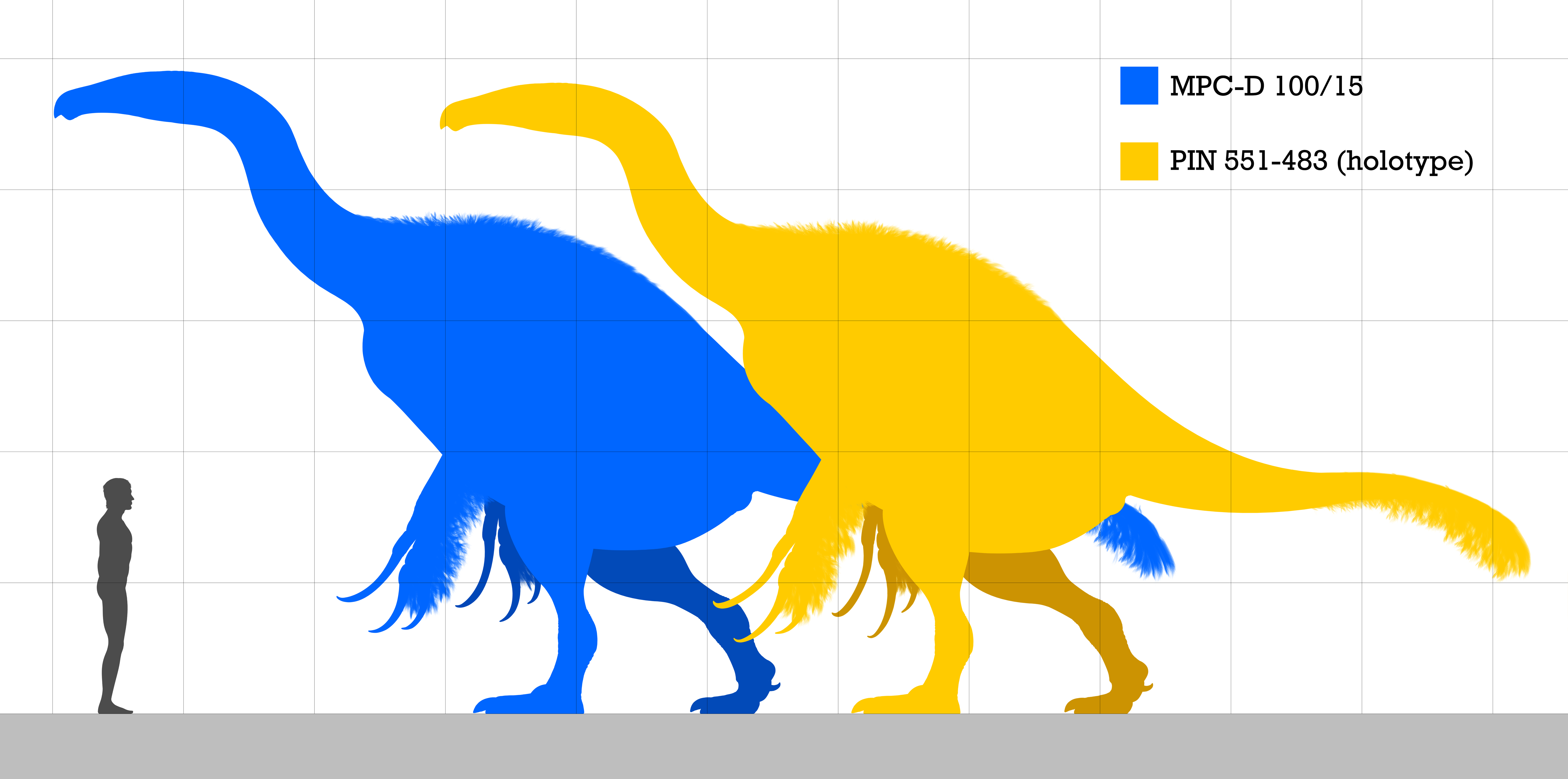
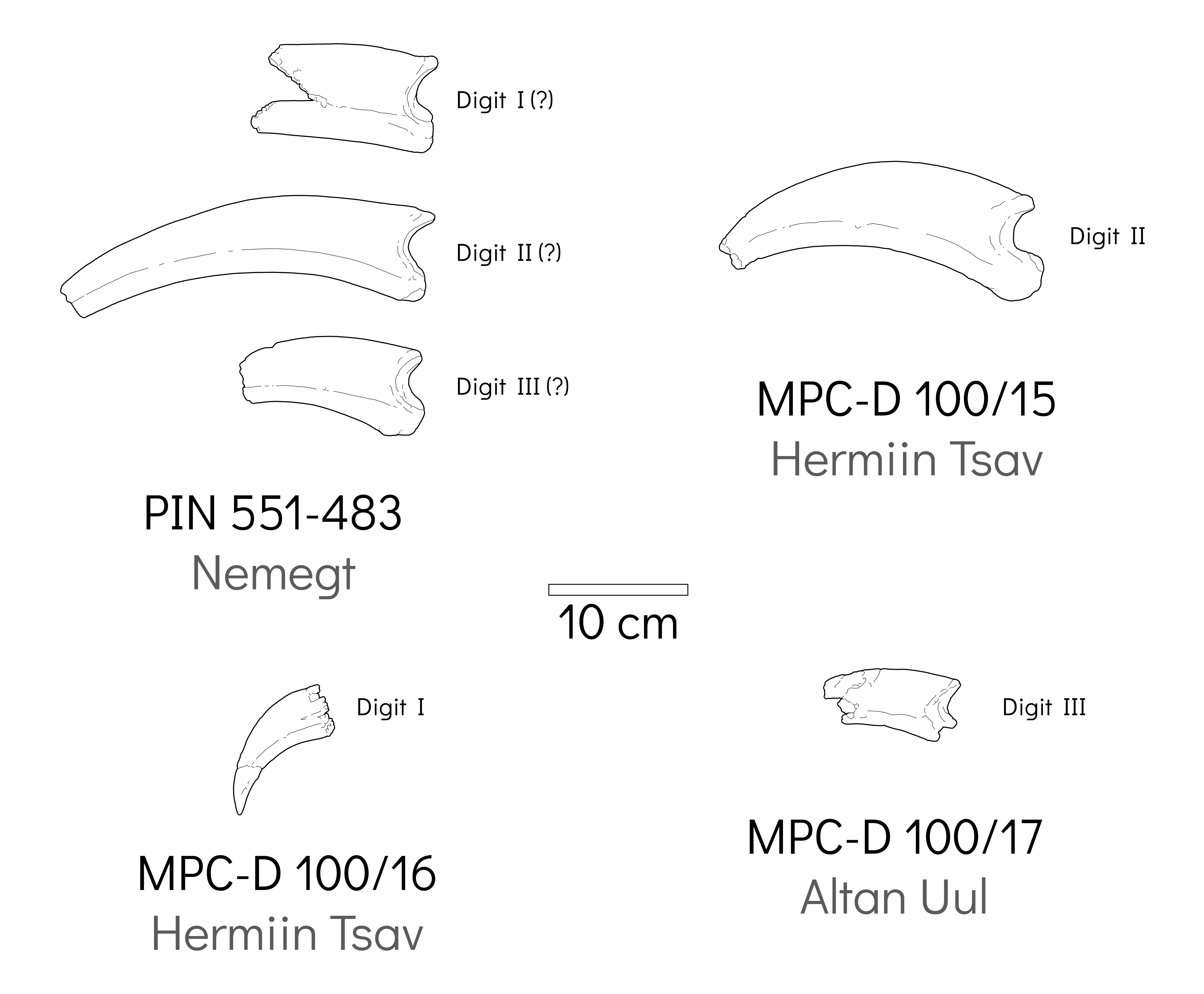
Based on multiple fragmentary specimens. The holotype (PIN 551-483) consists of three partial manual unguals with metacarpal and rib fragments. The most complete specimen (MPC-D 100/15), collected in 1973, includes both arms with scapulocoracoids, humeri, ulnae, radius, carpals, and metacarpus. Specimen MPC-D 100/45 preserves hindlimb elements. Skull anatomy is inferred from close relatives such as Erlikosaurus.

Found elements
Inferred elements
Scientific Literature
15 papers in chronological order — from the original description to recent research.
New turtle-like reptile in Mongolia
Maleev, E.A. · Priroda
The founding paper that formally describes Therizinosaurus cheloniformis based on specimen PIN 551-483, three partial manual unguals collected from the Nemegt Formation of Mongolia during the 1948 Soviet-Mongolian Paleontological Expedition. Maleev interprets the animal as a marine turtle-like reptile approximately 4.5 meters long that used its enormous claws to harvest seaweed. The generic name Therizinosaurus (reaping lizard) refers to the claw shape, while the specific epithet cheloniformis (turtle-shaped) reflects Maleev's erroneous interpretation. The claws were the largest ever found on any animal, measuring up to 52 cm in bone alone. Published in Russian in the journal Priroda, this paper established one of the greatest mysteries of 20th-century paleontology: what kind of animal could have such enormous claws?
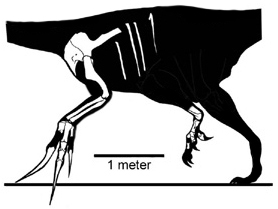
On the giant claws of enigmatic Mesozoic reptiles
Rozhdestvensky, A.K. · Paleontological Journal
This paper marks the beginning of Therizinosaurus reclassification. Rozhdestvensky re-examines the giant claws described by Maleev and compares them with the forelimb material of Chilantaisaurus, a theropod from China. Morphological analysis reveals significant structural similarities between the claws of both animals, suggesting that Therizinosaurus was not a turtle but rather a theropod dinosaur of extraordinary proportions. This proposal was revolutionary for its time and met resistance from the scientific community, who considered it impossible for a theropod with such large claws to be herbivorous. Despite the resistance, Rozhdestvensky's work planted the seed that would lead to the definitive reclassification of the animal in the following decades.


New data on Therizinosaurus (Therizinosauridae, Theropoda)
Barsbold, R. · Paleontology and Biostratigraphy of Mongolia
Barsbold describes new Therizinosaurus material, including specimen MPC-D 100/15, the most complete found at the time, with both arms preserved including scapulocoracoids, humeri, ulnae, radius, carpals, and metacarpus. Detailed morphological analysis definitively confirms theropod affinities for the genus, refuting the original turtle classification. The work reveals that Therizinosaurus arms were extremely long (2.4 meters) and robust, with claws reaching up to 70 cm including the keratin sheath. Barsbold recognizes that while the animal is a theropod, its morphology is radically different from any known theropod, suggesting a completely distinct lifestyle from the typical carnivores of the group.


Segnosauridae, a new family of theropod dinosaurs from the Late Cretaceous of Mongolia
Perle, A. · Transactions of the Joint Soviet-Mongolian Paleontological Expedition
Perle describes the family Segnosauridae based on Segnosaurus galbinensis from the Bayan Shireh Formation of Mongolia. This family would later be recognized as part of the same group as Therizinosaurus. Segnosaurus revealed crucial features for understanding therizinosaur biology: a broad opisthopubic pelvis (with the pubis directed backwards, as in ornithischians), robust forelimbs, and teeth adapted for herbivory. For the first time, it became clear that an entire group of herbivorous theropods existed in Upper Cretaceous Asia. The description of Segnosaurus provided the first clues about the general body anatomy missing from the fragmentary record of Therizinosaurus, allowing more accurate reconstructions.
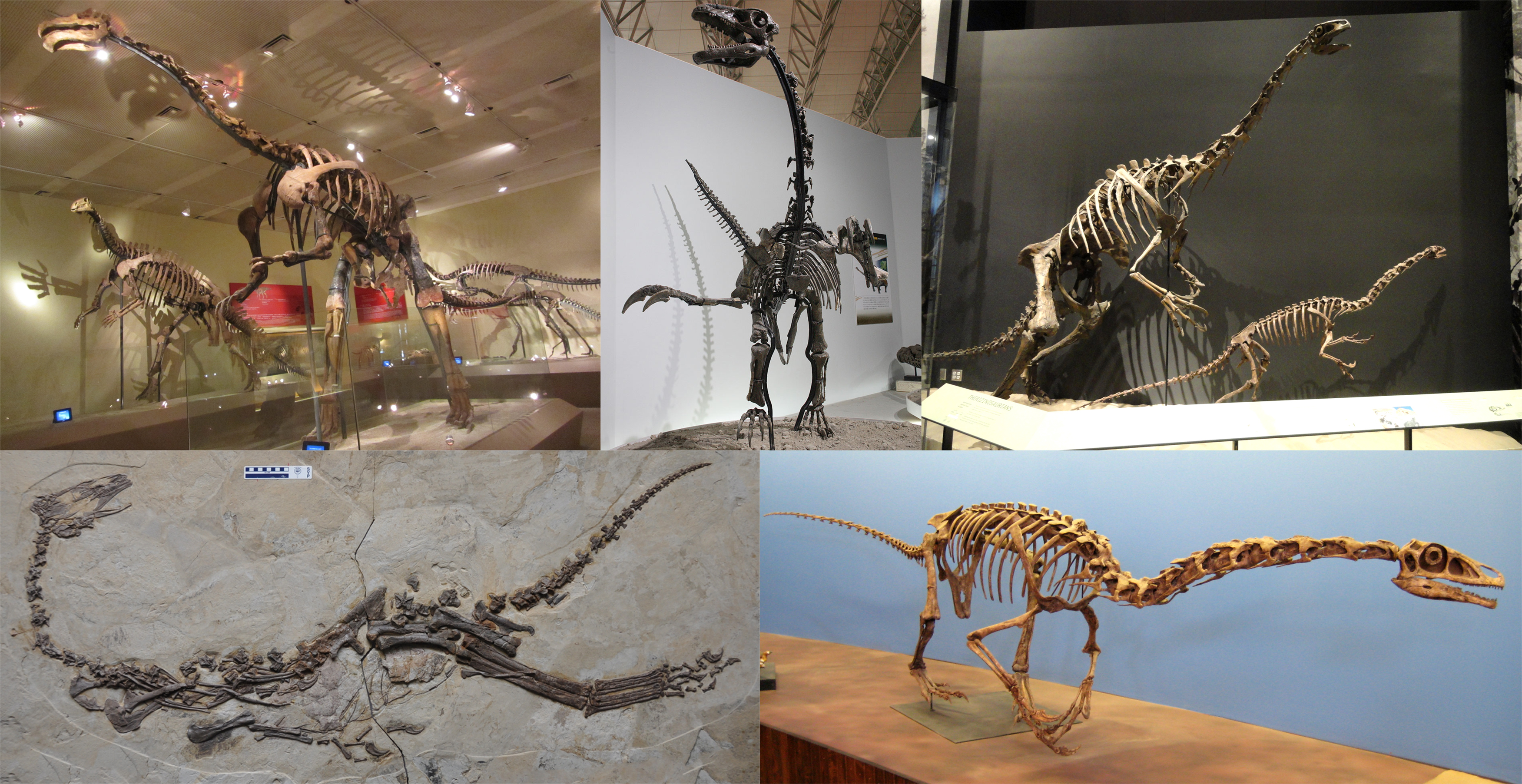
Segnosauria, a new infraorder of carnivorous dinosaurs
Barsbold, R. & Perle, A. · Acta Palaeontologica Polonica
Barsbold and Perle formally establish the infraorder Segnosauria to accommodate the unusual theropod dinosaurs from the Late Cretaceous of Mongolia, including Segnosaurus, Erlikosaurus, and Therizinosaurus. The work is fundamental because for the first time it unites these enigmatic animals into a single taxonomic group, recognizing that they share a unique combination of theropod, ornithischian, and sauropodomorph characteristics. The classification as 'carnivorous' in the title reflects the prevailing view of the era that all theropods were predators. The infraorder Segnosauria would later be replaced by Therizinosauria (Russell, 1997), but the concept of a unified clade remains valid to this day.


A nearly complete skeleton of a new troodontid dinosaur from the Early Cretaceous of the Ordos Basin, Inner Mongolia, People's Republic of China
Russell, D.A. & Dong, Z. · Canadian Journal of Earth Sciences
Russell and Dong describe Alxasaurus elesitaiensis from the Early Cretaceous of Inner Mongolia, China. The nearly complete skeleton was a revelation: for the first time, a therizinosaur was known from sufficient material to reconstruct the entire body. The discovery allowed recognition that Segnosauridae and Therizinosauridae formed a single clade, Therizinosauroidea. Alxasaurus revealed the transition between more typical theropods and highly derived therizinosaurs like Therizinosaurus: long forelimb with large but not extreme claws, opisthopubic pelvis, and teeth adapted for herbivory. The paper redefined understanding of Cretaceous theropod diversity, showing that herbivory evolved multiple times independently in the group.
The skull of Erlicosaurus andrewsi, a Late Cretaceous 'Segnosaur' (Theropoda: Therizinosauridae) from Mongolia
Clark, J.M., Perle, A. & Norell, M.A. · American Museum Novitates
Clark, Perle, and Norell redescribe the skull of Erlikosaurus andrewsi, the only well-preserved skull known for any therizinosaurid. The work is fundamental for two reasons: first, it definitively confirms therizinosaurs as maniraptoran theropods, ending decades of debate about their affinities; second, it provides the first detailed cranial anatomy for the group, revealing a keratinous beak (rhamphotheca) and leaf-shaped teeth adapted for herbivory. The phylogenetic analysis places therizinosaurs within Maniraptora, as relatives of oviraptorosaurs and dromaeosaurids. The skull of Erlikosaurus remains to this day the primary reference for reconstructing the head of Therizinosaurus, whose skull remains unknown.
A therizinosauroid dinosaur with integumentary structures from China
Xu, X., Tang, Z. & Wang, X. · Nature
Xu, Tang, and Wang describe Beipiaosaurus inexpectus from the Yixian Formation (Early Cretaceous) of Liaoning, China, with filamentous integumentary structures interpreted as primitive feathers. This discovery is revolutionary because it provides the first direct evidence that therizinosauroids possessed feather-like coverings. Beipiaosaurus definitively confirms the placement of therizinosaurs within Theropoda and specifically Maniraptora, since feathers are a characteristic of this group. The discovery had direct impact on visual reconstruction of Therizinosaurus: artists and scientists began depicting the animal with plumage instead of scales. Published in Nature, this is one of the most cited papers in feathered dinosaur paleontology.


First definitive therizinosaurid (Dinosauria; Theropoda) from North America
Kirkland, J.I. & Wolfe, D.G. · Journal of Vertebrate Paleontology
Kirkland and Wolfe describe Nothronychus mckinleyi from the mid-Cretaceous of New Mexico, USA, the first therizinosaurid found outside Asia. The discovery demolished the idea that therizinosaurs were exclusively Asian and demonstrated the group had global distribution. Nothronychus preserves substantial skeletal material including vertebrae, pelvis, and limbs, providing crucial data on therizinosaurid general anatomy that complements the fragmentary record of Therizinosaurus. The presence of a therizinosaurid in North America indicates the group crossed the land bridge between Asia and North America during the Cretaceous, dispersing across both continents.


A primitive therizinosauroid dinosaur from the Early Cretaceous of Utah
Kirkland, J.I. et al. · Nature
Kirkland and colleagues describe Falcarius utahensis from the Cedar Mountain Formation (Early Cretaceous) of Utah, the most basal therizinosauroid known. Falcarius is extraordinary because it documents the transition from carnivory to herbivory within theropods: its teeth are intermediate between the serrated ones of carnivores and the leaf-shaped ones of herbivores, and its gut was larger than typical carnivorous theropods. Published in Nature, the paper demonstrates that herbivory evolution in therizinosaurs was gradual, with basal forms retaining features of their carnivorous ancestors. Falcarius provides the missing link between carnivorous maniraptorans and herbivorous therizinosaurs like Therizinosaurus.


A taxonomic and phylogenetic re-evaluation of Therizinosauria (Dinosauria: Maniraptora)
Zanno, L.E. · Journal of Systematic Palaeontology
Zanno publishes the most comprehensive taxonomic and phylogenetic re-evaluation ever conducted for Therizinosauria, incorporating all known taxa as of 2010. The new phylogenetic analysis recovers a fully resolved topology for the clade, placing Therizinosaurus as the most derived member of the family Therizinosauridae. The work clarifies the taxonomy of several problematic taxa and provides the most robust phylogenetic framework for the group to date. Zanno also revises the synapomorphies (shared derived characteristics) defining each node of the cladogram, allowing precise diagnosis of different taxonomic levels. This paper is the standard reference for any phylogenetic study of therizinosaurs.


Herbivorous ecomorphology and specialization patterns in theropod dinosaur evolution
Zanno, L.E. & Makovicky, P.J. · Proceedings of the National Academy of Sciences
Zanno and Makovicky analyze the evolution of herbivory across all theropods and reveal that dietary shifts from carnivory to herbivory or omnivory occurred at least six times independently. Therizinosaurs represent one of the most extreme cases of herbivorous specialization, with morphological adaptations including enlarged gut capacity (broad pelvis), reduced dentition, elongated forelimbs, and development of a keratinous beak. The study demonstrates that herbivory evolution was a recurrent and successful phenomenon in theropods, contradicting the traditional view that the group was exclusively carnivorous. Therizinosaurus is cited as the most extreme example of this evolutionary trend.

The endocranial anatomy of Therizinosauria and its implications for sensory and cognitive function
Lautenschlager, S. · PLOS ONE
Lautenschlager uses CT scanning to create digital endocasts of therizinosaur braincases, revealing relatively large brains compared to body size, well-developed olfactory bulbs, and optic lobes suggesting acute senses of smell and vision. The vestibular apparatus indicates a habitual head-down posture consistent with low-browsing herbivory. The study suggests therizinosaurs possessed more sophisticated sensory and cognitive capabilities than expected for large-bodied herbivores. The analysis is applied to Erlikosaurus andrewsi and extrapolated to Therizinosaurus, providing the first inferences about the neuroanatomy and sensory behavior of the group.

Morphological and functional diversity in therizinosaur claws and the implications for specific adaptation
Lautenschlager, S. · Proceedings of the Royal Society B
Lautenschlager applies finite element analysis (FEA) and digital biomechanical modeling to therizinosaur claws to investigate their functions. The study tests competing hypotheses: defense against predators, digging into termite mounds, or feeding. Results show that the enormous claws of Therizinosaurus cheloniformis were better suited for pulling down branches and tall vegetation, like a natural hook, than for combat or digging. Different therizinosaur species showed functional diversity in their claws, suggesting the group exploited different ecological niches. Therizinosaurus, with the largest claws of any known animal, was the most extreme specialist in high browsing, functioning like a Cretaceous giraffe.


Functional niche partitioning in Therizinosauria provides new insights into the evolution of theropod herbivory
Lautenschlager, S. · Palaeontology
Lautenschlager publishes a computational biomechanical analysis of the skull, jaw, and feeding apparatus of multiple therizinosaur taxa, revealing functional niche partitioning within the clade. Different species occupied distinct feeding niches: from generalist herbivores like Falcarius to extreme high-browse specialists like Therizinosaurus. Mandibular stress analysis and chewing motion modeling shows that more derived forms could process tougher, more fibrous vegetation. Therizinosaurus, at the extreme end of the spectrum, combined branch-pulling claws with a feeding apparatus optimized for processing tough foliage. This study demonstrates that therizinosaurs did not compete with each other for food, occupying complementary ecological niches.


Espécimes famosos em museus
PIN 551-483 (Holótipo)
Paleontological Institute, Russian Academy of Sciences, Moscou
Holotype consisting of three partial manual unguals with metacarpal and rib fragments. First Therizinosaurus material ever discovered, collected from the Nemegt Formation.
MPC-D 100/15
Institute of Paleontology, Mongolian Academy of Sciences, Ulan Bator
Most complete specimen ever found: both arms with scapulocoracoids, humeri, ulnae, radius, carpals, metacarpus with complete digit II, ribs, and gastralia. Collected at Hermiin Tsav.
In cinema and popular culture
Therizinosaurus remained relatively unknown to the general public until 2022, when it appeared in two major productions almost simultaneously. In Jurassic World: Dominion, the animal was portrayed as a blind, terrifying creature that hunts by sound, with feathers and enormous claws. While the plumage was an advance for the franchise, the aggressive predatory behavior contradicts everything we know about the animal's herbivorous diet. The lake scene with Claire Dearing became iconic and introduced Therizinosaurus to millions of viewers. In the documentary Prehistoric Planet (Apple TV+, 2022), narrated by David Attenborough, the animal received the most scientifically accurate depiction in history, shown as a peaceful herbivore using its claws to pull down branches. Before that, Therizinosaurus had appeared in Chased by Dinosaurs (BBC, 2003) and Dinosaur Revolution (Discovery Channel, 2011), always as a giant herbivore but without the plumage that would only be widely accepted after the discovery of Beipiaosaurus in 1999. The trajectory in audiovisual media reflects the evolution of scientific knowledge: from mysterious, poorly understood creature to one of the most fascinating and visually distinctive dinosaurs of the Cretaceous.

Classificação

Descoberta
Curiosidade
When Evgeny Maleev described Therizinosaurus in 1954, he thought the giant claws belonged to a sea turtle that harvested seaweed. It took over 20 years for paleontologists to realize it was actually a herbivorous theropod dinosaur: the animal with the largest claws of any creature that ever lived on Earth.