
Tsintaosaurus spinorhinus
Tsintaosaurus spinorhinus
"Tsingtao lizard with nasal spine"
Sobre esta espécie
Tsintaosaurus spinorhinus was a Campanian hadrosaurid from China, described by Yang Zhongjian in 1958 based on fossils collected at Laiyang, Shandong. Approximately 8.3 meters long and weighing 2.5 tonnes, it was a large herbivore that moved between bipedal and quadrupedal postures. Its most distinctive feature is the nasal crest: long described as a vertical unicorn-like spike, a 2013 analysis by Prieto-Márquez and Wagner revealed it to be the rear portion of a broader, lobate cranial structure formed by the nasal and premaxillary bones. The crest likely functioned in species recognition and acoustic communication within the herd.
Geological formation & environment
Tsintaosaurus spinorhinus comes from the Jingangkou Formation, the most recent layer of the Wangshi Group, which crops out in the Laiyang region of Shandong, China. The formation dates to the Upper Campanian, approximately 77 to 73.5 million years ago, deposited in a subtropical alluvial plain environment with meandering rivers. The Wangshi Group is exceptionally rich in dinosaur remains and fossil eggs, having also yielded Shantungosaurus giganteus, Laiyangosaurus youngi, Zhuchengtyrannus magnus, and Sinoceratops zhuchengensis. Eggshell studies document a climatic transition from humid to drier conditions through the regional Campanian. Floodplain sedimentation favored preservation of large hadrosaurid carcasses.
Image gallery


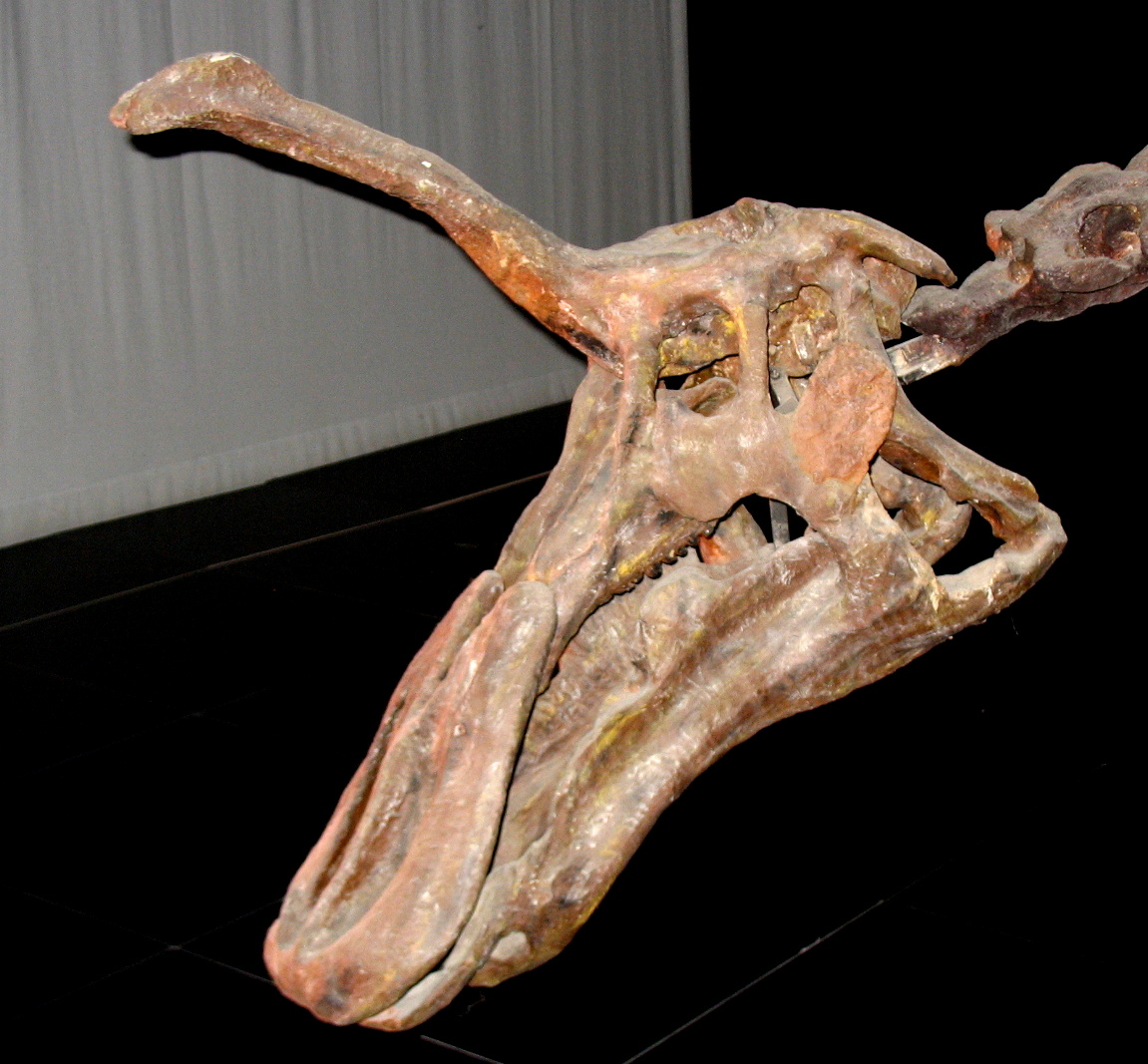




Modern scientific reconstruction of Tsintaosaurus spinorhinus, showing the lobate nasal crest as reinterpreted by Prieto-Márquez and Wagner (2013). The animal is shown in lateral quadrupedal posture, with coloring based on modern hadrosaurid relatives.
Connor Ashbridge (Ddinodan), CC BY-SA 4.0
Ecology and behavior
Habitat
Tsintaosaurus spinorhinus inhabited the coastal plains and forests of the Campanian in Shandong Province, eastern China, approximately 77 to 73.5 million years ago. The Jingangkou Formation environment was a subtropical alluvial plain with meandering rivers and nearby coastal zones. The climate was warmer and more humid than today, with moderate seasonality; fossil egg studies indicate a transition to progressively drier conditions through the Campanian. Vegetation included conifers, cycads, pteridophytes, and growing angiosperm diversity. The ecosystem hosted other large dinosaurs such as Shantungosaurus, and Shandong's fossil strata have produced one of the most diverse hadrosaurid faunas in Asia.
Feeding
As a hadrosaurid, Tsintaosaurus possessed a highly complex dental battery with hundreds of teeth compacted in multiple rows, forming a continuous and efficient chewing surface. Erickson et al. (2012) demonstrated that hadrosaurids evolved up to six distinct dental tissues — the most elaborate composition of any vertebrate — creating grinding surfaces comparable to modern herbivorous mammals. Tsintaosaurus grazed on tough vegetation such as conifer leaves, fibrous stems, and possible low-growing angiosperms. It likely transitioned between bipedal posture (to reach higher foliage) and quadrupedal (to graze low vegetation). The tooth position and snout shape suggest selective feeding with the horny beak tip.
Behavior and senses
Evidence from hadrosaurids in general suggests Tsintaosaurus likely lived in herds, providing protection against predators such as Shantungosaurus and possible Asian tyrannosaurids. The cranial crest was a fundamental social structure: Weishampel (1981) proposed acoustic function, but Wang et al. (2020) revealed that Tsintaosaurus's nasal process is internally solid, reducing acoustic efficiency and suggesting the primary function was visual display for species recognition and dominance exhibition. Colony nesting behavior is plausible by analogy with other hadrosaurids, for which there is evidence of parental care and communal nesting.
Physiology and growth
As a derived hadrosaurid, Tsintaosaurus likely possessed mesothermic to endothermic metabolism, with growth rates substantially higher than modern ectothermic reptiles. Bone histology studies of hadrosaurids such as Maiasaura and Hypacrosaurus reveal lines of arrested growth (LAGs) indicating ages of 7 to 15 years to reach adult size. The large body size of ~8.3 meters and ~2.5 tonnes implies substantial longevity, likely decades. The primarily quadrupedal posture of adults was supported by three-toed functional feet and forelimbs proportionally smaller than hindlimbs. The presence of an elaborate nasal crest suggests sexual dimorphism, with more developed crests in dominant individuals.
Paleogeography
Continental configuration

Ron Blakey · CC BY 3.0 · Cretáceous, ~90 Ma
During the Campaniano (~77–73 Ma), Tsintaosaurus spinorhinus inhabited Laramidia, the western half of present-day North America, separated from the east by the Western Interior Seaway, a shallow sea dividing the continent. The continents were in very different positions: India was drifting toward Asia, Antarctica was still connected to Australia, and South America was an isolated island.
Inventário de Ossos
The holotype IVPP AS V725 consists of a partial skeleton with skull, including the distinctive nasal process. The paratype IVPP V818 is the skull roof. Additional material includes a crest fragment (IVPP V829) and humerus (IVPP V729). The postcranium is incomplete, with many elements still not formally described.
Found elements
Inferred elements
Scientific Literature
15 papers in chronological order — from the original description to recent research.
The dinosaurian remains of Laiyang, Shantung
Young, C.-C. · Palaeontologia Sinica, New Series C
The founding paper establishing the genus and species Tsintaosaurus spinorhinus. Yang Zhongjian describes holotype specimen IVPP AS V725, collected in 1950 during excavations at Laiyang, Shandong. The diagnosis includes the unique vertical nasal process, which for decades defined the popular image of the animal as a 'unicorn dinosaur'. Young also describes postcranial elements: vertebrae, limb bones, and pectoral girdle elements. The Jingangkou Formation of the Wangshi Group is identified as the producing stratigraphic unit, dated to the Campanian. This work is the taxonomic foundation for all subsequent research on the species and remains the obligatory reference for any anatomical or phylogenetic study involving Tsintaosaurus.
Tsintaosaurus spinorhinus Young and Tanius sinensis Wiman: a preliminary comparative study of two hadrosaurs (Dinosauria) from the Upper Cretaceous of China
Buffetaut, E. & Tong, H. · Comptes Rendus de l'Académie des Sciences Paris, Série II
The first formal comparative study between Tsintaosaurus spinorhinus and its contemporary Tanius sinensis, both from the Wangshi Group of Shandong. Buffetaut and Tong analyze fundamental anatomical differences between the two taxa: Tsintaosaurus with its prominent nasal crest and affinities with hollow-crested lambeosaurines; Tanius as a flat-headed hadrosaur (saurolophine). The work examines the taxonomic validity of both genera, which for decades were imprecisely grouped in the literature. The paper is important for establishing that Tsintaosaurus and Tanius represent distinct phylogenetic groups within Hadrosauridae, with implications for the biogeography of Campanian Asian hadrosaurids.
Nasal cavity homologies and cranial crest function in lambeosaurine dinosaurs
Weishampel, D.B. · Paleobiology
David Weishampel's seminal work examining the internal anatomy of nasal cavities in lambeosaurines and acoustically modeling their hollow cranial crests. The analysis demonstrates that crests functioned as resonating chambers capable of amplifying and modulating low-frequency sounds for intraspecific communication — analogous to medieval wind instruments such as the crumhorn. Although centered on North American taxa like Parasaurolophus, the work is directly relevant to Tsintaosaurus: the 2013 reinterpretation of the crest by Prieto-Márquez and Wagner confirmed it was hollow and lobate, compatible with acoustic function. The paper founded the field of functional studies of lambeosaurine crests and remains a central reference in any discussion of the group's biology.
Diversity, Relationships, and Biogeography of the Lambeosaurine Dinosaurs from the European Archipelago, with Description of the New Aralosaurin Canardia garonnensis
Prieto-Márquez, A., Dalla Vecchia, F.M., Gaete, R. & Galobart, A. · PLOS ONE
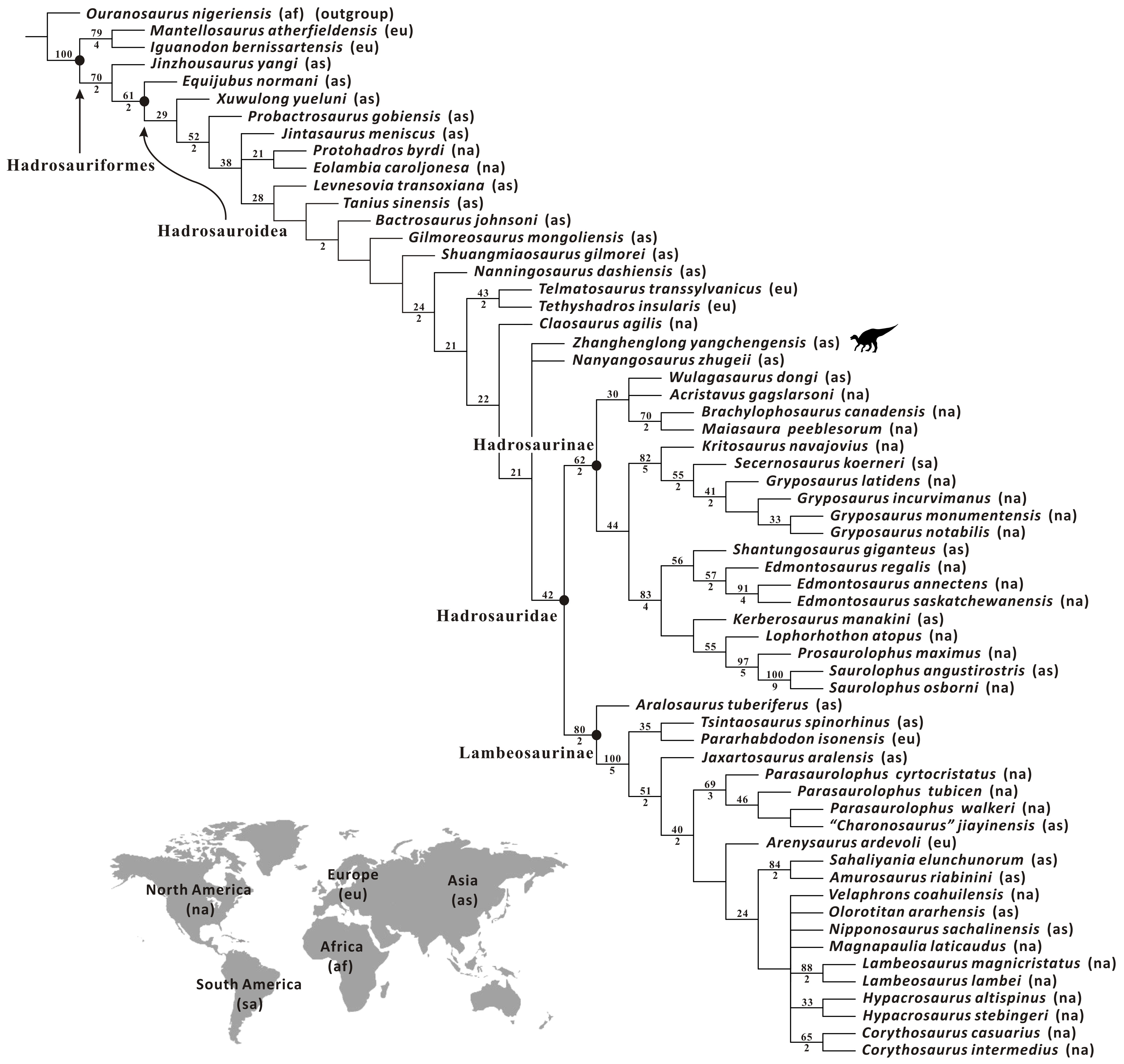
This study describes the new lambeosaurine hadrosaurid Canardia garonnensis from the Upper Maastrichtian of France, but its main contribution to understanding Tsintaosaurus is the comprehensive phylogenetic analysis including 39 hadrosaurids. The analysis recovers Tsintaosaurus spinorhinus as a member of the clade Tsintaosaurini, sister group to Pararhabdodon isonensis from the Iberian Peninsula. The biogeographical reconstruction suggests tsintaosaurins dispersed from Asia to Europe during the Maastrichtian, making Tsintaosaurus a key link for understanding the radiation of lambeosaurines on a global scale. The work reinforces Tsintaosaurus as a basal lambeosaurine with plesiomorphic cranial morphology relative to more derived North American taxa.
The 'Unicorn' Dinosaur That Wasn't: A New Reconstruction of the Crest of Tsintaosaurus and the Early Evolution of the Lambeosaurine Crest and Rostrum
Prieto-Márquez, A. & Wagner, J.R. · PLOS ONE
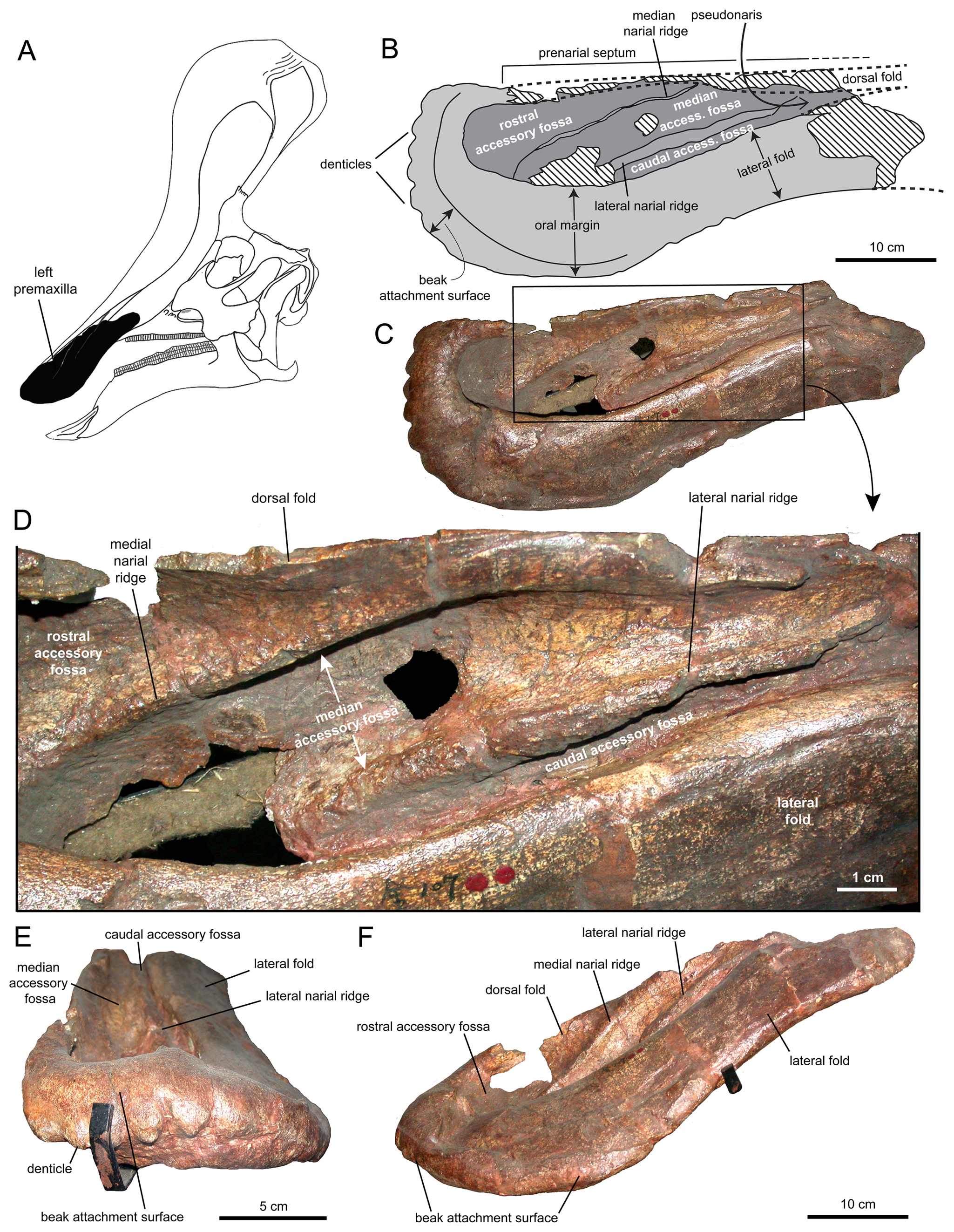
The most impactful paper on Tsintaosaurus in the modern era. Prieto-Márquez and Wagner reexamine the holotype and paratype at the IVPP and propose a radically different crest reconstruction: no longer a simple spike, but a tall, lobate, hollow structure projecting dorsally, composed of the nasal and premaxillary bones together. The paper documents multiple autapomorphies of Tsintaosaurus and discusses how facial morphology differs from more derived lambeosaurines, suggesting the ancestral lambeosaurine rostrum more closely resembled that of saurolophines. The study includes detailed analysis of articulations between the crest bones and skull, with tomographic evidence and histological comparison. The work ended decades of debate about Tsintaosaurus's actual morphology and redefined its image for the public and for paleontology.
Complex Dental Structure and Wear Biomechanics in Hadrosaurid Dinosaurs
Erickson, G.M., Krick, B.A., Hamilton, M., Bourne, G.R., Norell, M.A., Lilleodden, E. & Sawyer, W.G. · Science
Revolutionary study published in Science analyzing the dental structure of hadrosaurids — the group to which Tsintaosaurus belongs. The research reveals that the hadrosaurid dental battery evolved up to six distinct dental tissues (enamel, dentine, cementum, and variants) — the most complex composition known in any vertebrate, surpassing even the dentition of modern herbivorous mammals such as horses and cattle. Three-dimensional wear models show how these tissues interacted to create an extraordinarily efficient grinding surface. The key evolutionary innovation was the ability to retain old tooth roots and incorporate them into the active occlusal surface. For Tsintaosaurus, this data is fundamental: the sophisticated dental battery allowed processing of tough vegetation such as conifer leaves and fibrous stems abundant in the Campanian of Shandong.
Endocranial anatomy of lambeosaurine hadrosaurids (Dinosauria: Ornithischia): a sensorineural perspective on cranial crest function
Evans, D.C. · The Anatomical Record
David Evans analyzes the endocast anatomy of lambeosaurines — internal molds of the cranial cavity that preserve the approximate brain shape. The study compares endocasts of multiple taxa and identifies developed neurological regions: prominent olfactory bulbs, elaborate acoustic processing, and well-developed cerebellar flocculi (associated with balance and visual coordination). These data are directly relevant to Tsintaosaurus: the lobate nasal crest identified by Prieto-Márquez and Wagner (2013) required compatible neurological infrastructure for display and vocalization functions. Evans demonstrates that lambeosaurines possessed this infrastructure. The work connects macroscopic anatomy, comparative neurology, and functional biology in an integrated analysis of the group.


Dinosaur diversity transition evidence from eggshells, Wangshi Group, Shandong, China
Zhao, Z., Zhang, S., Wang, Q. & Wang, X. · Chinese Science Bulletin
Study analyzing dinosaur eggs and eggshells from successive layers of the Wangshi Group, Shandong, including the Jingangkou Formation where Tsintaosaurus was discovered. The authors document a progressive faunal transition across the layers, with changes in taxon diversity and egg morphology reflecting paleoclimatic changes. Oxygen isotope analysis of eggshells indicates a shift from relatively humid to drier conditions during the transition from the Jiangjunding to the Jingangkou Formation. This data is crucial for contextualizing Tsintaosaurus: the animal inhabited an environment in climatic transition, with diversified vegetation but a climate trending toward aridity, which influenced resource availability and the structure of the Campanian ecosystem of Shandong.

Osteological Re-Assessment and Taxonomic Revision of 'Tanius laiyangensis' (Ornithischia: Hadrosauroidea) from the Upper Cretaceous of Shandong, China
Zhang, Y., Xing, H. & Wang, X. · The Anatomical Record
Taxonomic revision of hadrosaurid material from the Jingangkou Formation, Shandong, previously attributed to Tanius laiyangensis. The study demonstrates the material is an indeterminate kritosaurin and does not belong to the genus Tanius. The relevance to Tsintaosaurus is direct: the authors reassess the diversity of hadrosaurids in the same geological formation that produced the Tsintaosaurus holotype, clarifying which taxa truly coexisted with it in the Campanian of Shandong. The work exemplifies the ongoing process of taxonomic revision applied to the Wangshi Group fauna and contributes to a more accurate picture of the Campanian ecosystem of the region.

Internal morphology of nasal spine of Tsintaosaurus spinorhinus (Ornithischia: Lambeosaurinae) from the upper cretaceous of Shandong, China
Wang, Z., Wang, Q., Xu, X., Wang, X., Zhao, Z. & Zhang, S. · Historical Biology
A 2020 study that definitively resolves the question of the internal structure of Tsintaosaurus's nasal process using high-resolution CT scanning. For decades, debate centered on whether the crest was hollow (like North American lambeosaurines, functioning as an acoustic resonator) or solid. CT analysis reveals a solid 'sandwich' structure, different from the hollow tubular composition previously described. Additionally, the authors identify a significant fracture between the nasal process and the nasal base, indicating that in life the spine was more inclined rostrally than preserved in the fossil. This data substantially modifies understanding of crest function: a solid structure would not amplify sound the same way as a hollow one, suggesting the primary function was visual display rather than acoustic.


Morphological innovation and the evolution of hadrosaurid dinosaurs
Stubbs, T.L., Benton, M.J., Elsler, A. & Prieto-Márquez, A. · Paleobiology
Macroevolutionary analysis of rates of morphological change in skull and postcranium of hadrosaurids, using phylogenetic comparative methods. The study reveals patterns of asymmetric evolution: a burst of cranial diversification early in the lambeosaurine radiation, combined with relative postcranial stasis. Tsintaosaurus is identified as a basal lambeosaurine with plesiomorphic postcranial morphology, making it crucial for calibrating evolutionary models of the clade. This result suggests that cranial crest diversification occurred more rapidly and independently of general body shape, indicating strong selective pressure on characters related to display and species recognition.


Global phylogeny of Hadrosauridae (Dinosauria: Ornithopoda) using parsimony and Bayesian methods
Prieto-Márquez, A. · Zoological Journal of the Linnean Society
Prieto-Márquez's global phylogenetic analysis of Hadrosauridae, using parsimony and Bayesian methods with 39 hadrosaurid taxa — the most comprehensive available when published. Tsintaosaurus spinorhinus is recovered as a basal lambeosaurine, possibly forming a clade with Pararhabdodon isonensis from Europe. The study establishes the phylogenetic framework that serves as the basis for all subsequent work on the group, including the 2013 papers by the same author revising Tsintaosaurus crest morphology. The time-calibrated Bayesian analysis produces divergence estimates that contextualize Tsintaosaurus's position in the Campanian radiation of lambeosaurines in Asia.


A New Basal Hadrosauroid Dinosaur (Dinosauria: Ornithopoda) with Transitional Features from the Late Cretaceous of Central China
Xing, H., Wang, D., Han, F., Sullivan, C., Ma, Q., He, Y., Hone, D.W.E., Yan, R., Du, F. & Xu, X. · PLOS ONE
Description of Nanyangosaurus zhugeii, a new basal hadrosauroid from the Late Cretaceous of central China. The study is relevant to Tsintaosaurus because it includes a comprehensive phylogenetic analysis of Hadrosauroidea, positioning Tsintaosaurus as a member of Lambeosaurinae. The analysis provides important data on the early evolution of hadrosaurids in Asia during the Cretaceous, with implications for understanding how Tsintaosaurus and its Asian relatives diversified from basal hadrosauroid forms. The richness of basal hadrosauroids in China suggests the region was an evolutionary center for the group before its dispersal to North America and Europe.


Dinosaur senescence: a hadrosauroid with age-related diseases brings a new perspective of 'old' dinosaurs
Pinheiro, F.L. & Rodrigues, T. · Scientific Reports
Study on senescence in a hadrosauroid specimen displaying multiple age-related pathologies including septic arthritis, osteomyelitis, and diffuse idiopathic skeletal hyperostosis (DISH). The specimen represents the oldest known record of aging-related diseases in a non-avian dinosaur, providing a unique perspective on longevity and physiology in hadrosauroids. Relevance to Tsintaosaurus is indirect but significant: the study demonstrates that hadrosauroids lived long enough to develop degenerative diseases of late adulthood, confirming substantial longevity — likely decades. This type of paleopathological analysis is fundamental for understanding the physiological limits and quality of life of large herbivorous dinosaurs like Tsintaosaurus.


Revised diagnoses and identification of two species of Corinthosaurus and Tsintaosaurus from the Campanian of China
Prieto-Márquez, A. · Acta Palaeontologica Polonica
Prieto-Márquez's diagnostic revision reexamining the diagnostic characters of Tsintaosaurus spinorhinus and related taxa from the Campanian of China. The study provides a revised diagnosis based on synapomorphies and autapomorphies identified in the skull and postcranial elements, clarifying the validity and phylogenetic position of the genus. Published in Acta Palaeontologica Polonica, the paper is a direct precursor to the more comprehensive 2013 works by the same author on crest morphology. It refines which characters are genuinely diagnostic of Tsintaosaurus versus those shared with other basal lambeosaurines, contributing to the taxonomic stability of the species.


Espécimes famosos em museus
IVPP AS V725 (holótipo)
Instituto de Paleontologia e Paleoantropologia de Vertebrados (IVPP), Pequim, China
The holotype includes the partial skull with the distinctive nasal process, vertebrae, and limb elements. It is the most important specimen for understanding the species and was the subject of the CT scanning analyses of Wang et al. (2020), which revealed the solid internal structure of the nasal process.
Réplica do esqueleto (Dinópolis)
Dinópolis — Fundación Conjunto Paleontológico de Teruel, Teruel, Espanha
Replica of the Tsintaosaurus spinorhinus skeleton on permanent display at Dinópolis, the palaeontological museum of Teruel, Spain. Dinópolis was one of the first European museums to exhibit Tsintaosaurus, highlighting its importance as an example of Asian Late Cretaceous fauna and the evolutionary connection between Asian and European lambeosaurines.
In cinema and popular culture
Tsintaosaurus never achieved the same cinematic visibility as T. rex or Velociraptor, but built a discreet and consistent presence in global popular culture, especially in children's media and video games. In the 2010s, South Korean animated films Dino King and its sequel Dino King 3D: Journey to Fire Mountain introduced Tsintaosaurus to Asian and international audiences, depicting it as a large herbivore in the Asian Cretaceous ecosystem, with the unicorn crest that was scientifically obsolete but remained iconically recognizable. In the Dinosaur King game franchise, active between 2005 and 2008 in arcades and as an anime series, Tsintaosaurus gained a Grass attribute card and appeared in the derivative anime, being exposed to generations of children across Asia. The video game Jurassic World Evolution and its sequels incorporated Tsintaosaurus as a playable dinosaur, introducing it to millions of players as a Campanian herd herbivore. The major shift in public perception came in 2013, when National Geographic widely covered the Prieto-Márquez and Wagner study under the headline 'Unicorn No More', abandoning the isolated spine image and introducing the lobate crest to popular imagination. Despite not being a blockbuster star, Tsintaosaurus has cultivated a loyal fan base among Asian dinosaur enthusiasts and serves as a perfect didactic example of how scientific discoveries can completely transform the image of an animal that seemed well understood.

Classificação
Descoberta
Curiosidade
For decades, Tsintaosaurus was called the 'unicorn dinosaur' because of its supposed single nasal spine. In 2013, researchers discovered that this 'spike' was just the rear portion of a much larger, lobate cranial crest — similar to that of Corythosaurus or Parasaurolophus — and not an isolated protrusion. Paleontology's unicorn never actually existed.