
Velociraptor
Velociraptor mongoliensis
"Swift thief of Mongolia"
Sobre esta espécie
Velociraptor mongoliensis was a small dromaeosaurid dinosaur approximately two meters long and under 20 kg, living during the late Campanian stage of the Cretáceous, 75 to 71 million years ago, in Mongolia. Unlike its depiction in Jurassic Park, it was roughly turkey-sized. It had confirmed feathers, evidenced by quill knobs on the ulna, a sickle-shaped enlarged claw on the second toe, and was likely an agile hunter of small vertebrates in the arid sand-dune environment of the Djadochta Formation.
Geological formation & environment
The Djadochta Formation (sometimes transliterated as Djadokhta) is a Late Campanian (~75-71 Ma) geológical unit located in southern Mongolia and Inner Mongolia, China. It represents an aeolian desert environment with sand dunes and intermittent fluvial streams, semi-arid and warm. It is one of the world's richest Late Cretáceous fóssil formations, preserving Velociraptor mongoliensis, Protoceratops andrewsi, Oviraptor philoceratops, Pinacosaurus grangeri, and numerous mammals and lizards. The famous Bayn Dzak site ('Flaming Cliffs') is where the Velociraptor holotype (1923) and Protoceratops (1922) were discovered. Rapid aeolian sedimentation, such as dune collapses, is responsible for the exceptional preservation of specimens like the Fighting Dinosaurs.
Image gallery


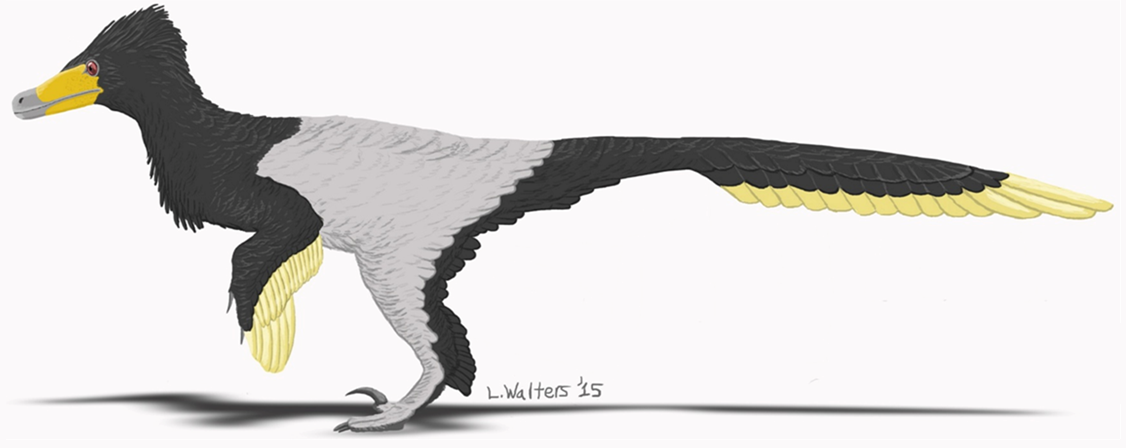


Scientific restoration of Velociraptor mongoliensis by Fred Wierum (2017), showing complete feather coverage, correct horizontal posture, and sickle claw raised on the second toe.
Fred Wierum — CC BY-SA 4.0
Ecology and behavior
Habitat
Velociraptor mongoliensis inhabited the arid and semi-arid environments of the Djadochta Formation, in the present-day Gobi Desert, Mongolia, 75-71 million years ago. The environment was dominated by aeolian dunes with constant winds, intermittent fluvial streams, and sparse vegetation of drought-resistant shrubs and plants. Temperatures were higher than the current regional average. Associated fauna included Protoceratops andrewsi, Oviraptor philoceratops, Pinacosaurus grangeri, Zalambdalestes (mammal), and various lizards. The environment was very different from the lush jungles shown in Jurassic Park.
Feeding
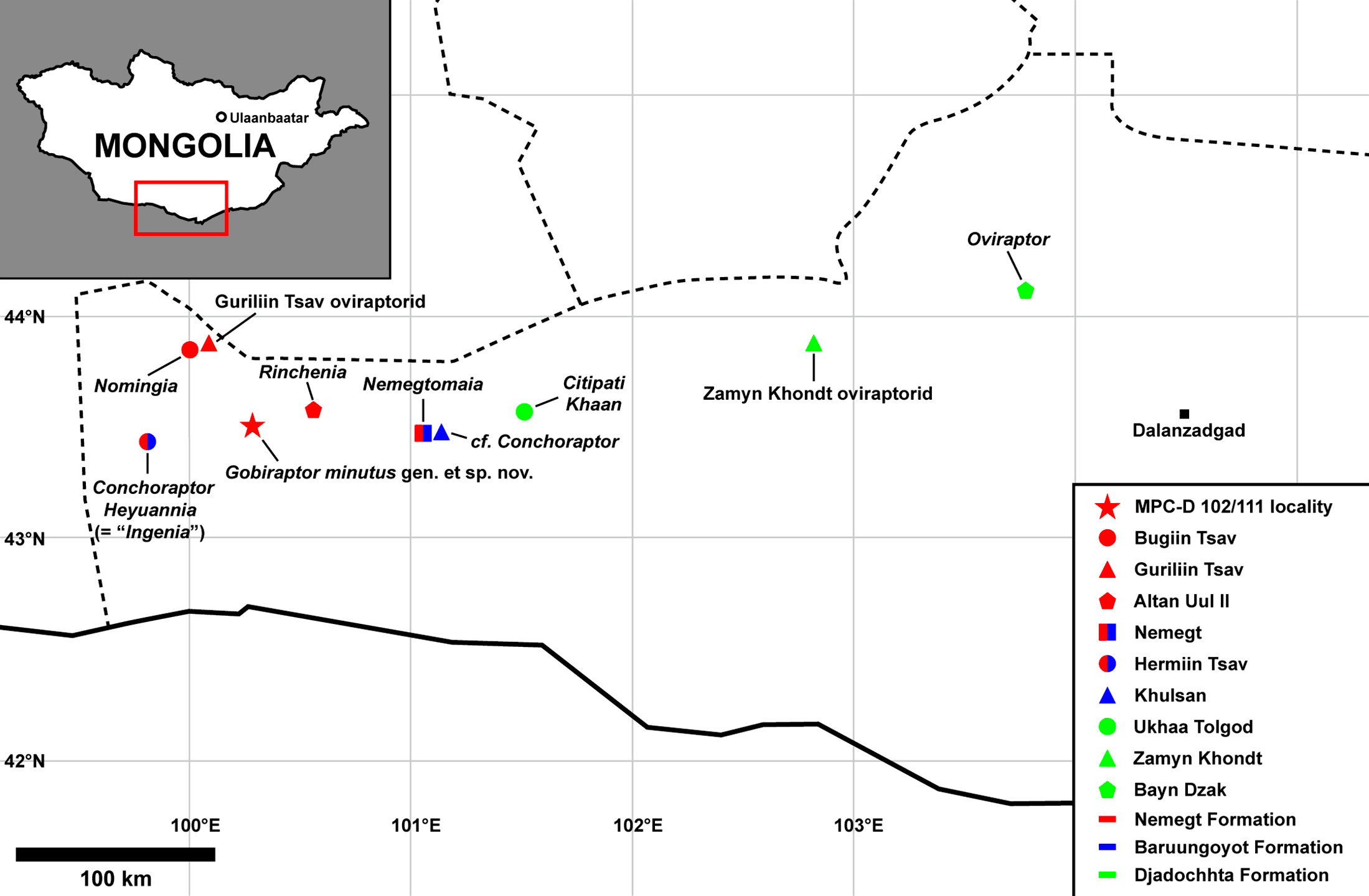
Velociraptor was an active predator of small vertebrates: lizards, small mammals, eggs, and possibly juvenile Protoceratops. The Fighting Dinosaurs specimen demonstrates it attacked prey of similar or equal size, using the sickle claw to grip and body weight to pin prey — not for evisceration, as recent biomechanical analyses indicate. The recurved serrated teeth were adapted for cutting meat. Evidence of Velociraptor teeth associated with tooth-marked Protoceratops bones (Hone et al. 2010) suggests it also consumed carcasses of larger animals.
Behavior and senses
Direct behavioral evidence includes the Fighting Dinosaurs specimen (predation) and quill knobs (feathers for possible mantling or display). Unlike the Jurassic Park depiction, there is no evidence of coordinated pack hunting — this behavior is extrapolation. The presence of feathers suggests possible nest-warming behavior analogous to modern birds. The olfactory bulbs and inner ear labyrinth, analyzed by King et al. (2020), indicate acute olfaction and hearing, consistent with a crepuscular or nocturnal hunter in the desert environment.
Physiology and growth
Velociraptor was almost certainly endothermic ('warm-blooded'), with elevated metabolism similar to modern birds. Dromaeosaurid bone histology shows fibrolamellar bone tissue with rapid growth, indicative of endothermy. The presence of feathers, confirmed by quill knobs, primarily served for thermoregulation (insulation) in the arid environment with large daily thermal variations. The small size (~20 kg) permitted active and possibly accelerated metabolism. The brain structure revealed by micro-CT (King et al. 2020) is closer to birds than reptiles in terms of relative proportions of sensory centers.
Paleogeography
Continental configuration

Ron Blakey · CC BY 3.0 · Cretáceous, ~90 Ma
Fóssil sites

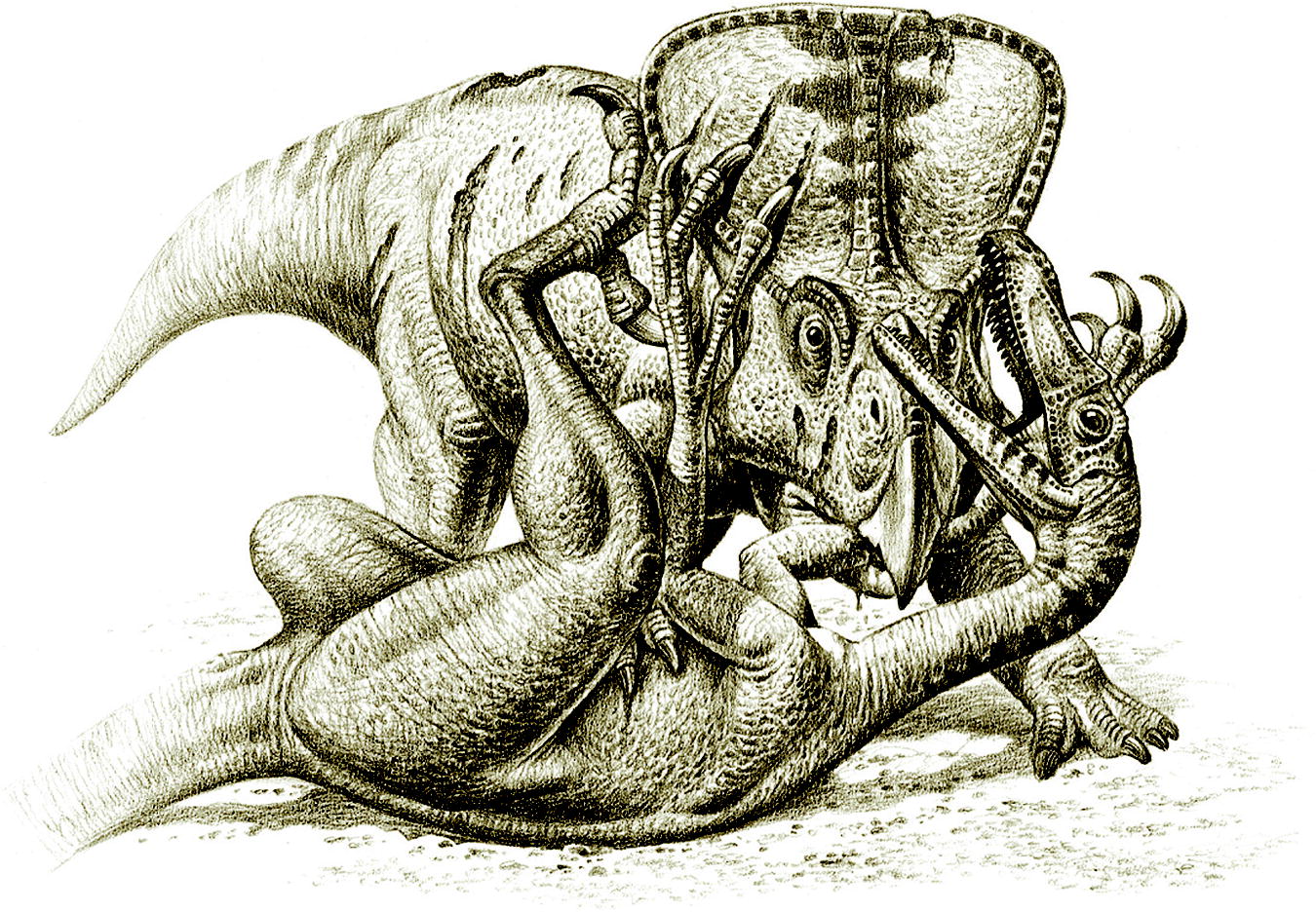
Tsogtbaatar, Weishampel, Evans & Watabe — CC BY 2.5
During the Campaniano (~75–71 Ma), Velociraptor mongoliensis inhabited Laramidia, the western half of present-day North America, separated from the east by the Western Interior Seaway, a shallow sea dividing the continent. The continents were in very different positions: India was drifting toward Asia, Antarctica was still connected to Australia, and South America was an isolated island.
Inventário de Ossos
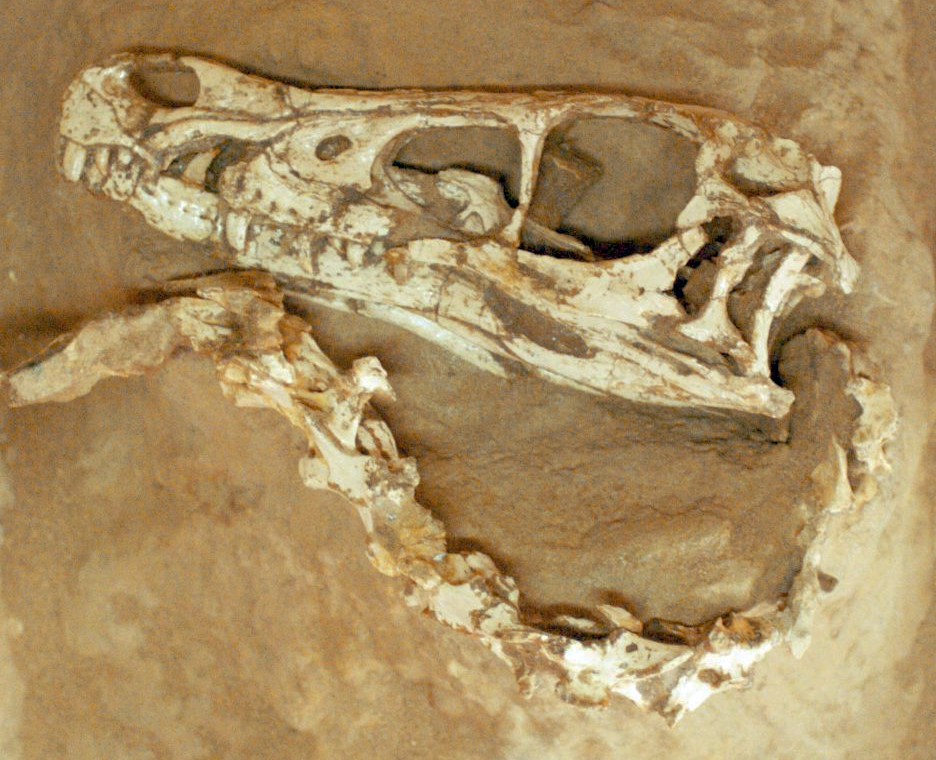
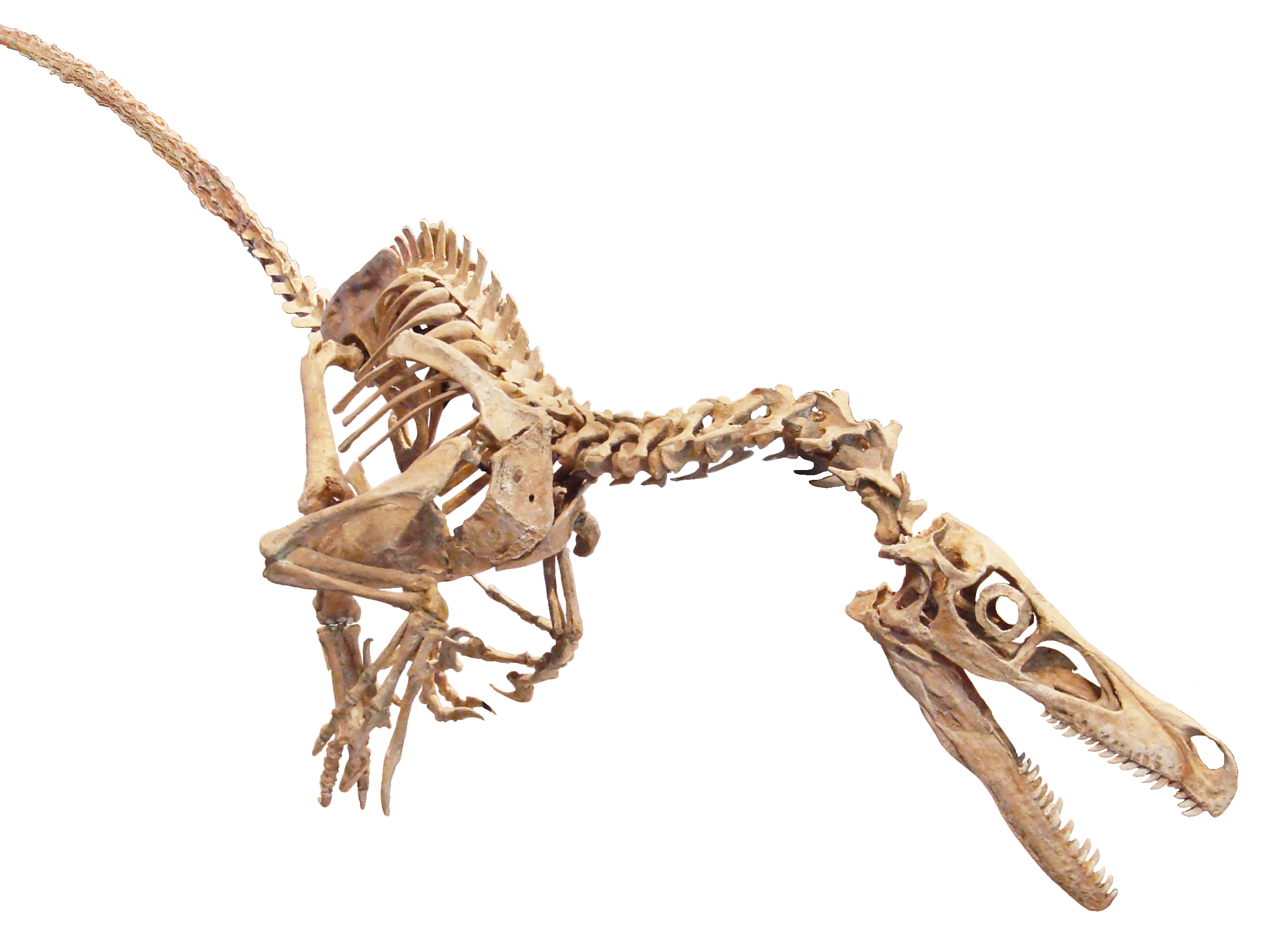
Based on multiple specimens. The holotype AMNH 6515 consists only of a skull and manual phalanges. Specimen MPC-D 100/985, described by Norell & Makovicky (1999), is the most complete and includes detailed post-cranial elements including furcula, coracoids, and pelvis. The famous 'Fighting Dinosaurs' specimen (MPC-D 100/25) preserves skull and claws in situ.
Found elements
Inferred elements
Scientific Literature
15 papers in chronological order — from the original description to recent research.
Three new Theropoda, Protoceratops zone, central Mongolia
Osborn, H.F. · American Museum Novitates
Founding paper establishing the genus and species Velociraptor mongoliensis. Henry Fairfield Osborn describes holotype AMNH 6515 — a laterally compressed skull and a manual ungual phalanx — collected by Peter Kaisen during the American Museum of Natural History expedition to the Flaming Cliffs (Bayn Dzak), Mongolia, in August 1923. Osborn diagnoses the new taxon by its recurved densely set teeth, low elongate skull, and relatively small body size compared to other Cretáceous theropods. The name mongoliensis refers to the country of origin. Published as American Museum Novitates 144, it is one of the first papers on Mongolian dinosaurs and lays the foundation for a century of dromaeosaurid research.
Important features of the dromaeosaur skeleton: information from a new specimen
Norell, M.A. & Makovicky, P.J. · American Museum Novitates
Norell and Makovicky describe a new, partially three-dimensionally preserved dromaeosaurid skeleton (IGM 100/985) collected at Tugrugeen Shireh, Mongolia, during the 1993 joint AMNH-Mongolian Academy of Sciences expeditions. The specimen, referred to Velociraptor mongoliensis, documents for the first time several post-cranial elements of the genus with exceptional quality: a furcula, paired sternal plates with articular grooves for the coracoids, and scapula in a subhorizontal position relative to the dorsal column. These characters are remarkably similar to those found in Archaeopteryx and basal birds. Published as American Museum Novitates 3215.

The skull of Velociraptor (Theropoda) from the Late Cretáceous of Mongolia
Barsbold, R. & Osmólska, H. · Acta Palaeontologica Polonica
Barsbold and Osmólska provide the most detailed cranial analysis of Velociraptor mongoliensis to date, examining material from multiple specimens including holotype AMNH 6515 and the Fighting Dinosaurs specimen (MPC-D 100/25). The work systematically documents the cranial differences distinguishing Velociraptor from Deinonychus: the laterally convex supratemporal arcade, depressed nasal, longer maxillary process, and convex ventral border of the dentary. Published in Acta Palaeontologica Polonica vol. 44(2): 189-219, it is the primary anatômical reference for the taxon's cranial morphology.
Important features of the dromaeosaurid skeleton II: information from newly collected specimens of Velociraptor mongoliensis
Norell, M.A. & Makovicky, P.J. · American Museum Novitates
Second part of Norell and Makovicky's monographic series on the post-cranial anatomy of Velociraptor mongoliensis, published as American Museum Novitates 3282 with 45 pages. The work describes multiple newly collected specimens, concentrating on lesser-known skeletal elements: pectoral girdle, forelimb, and pelvic girdle. The central finding is that Velociraptor exhibits several near-avian postcranial characters: reduced anti-iliac shelf, furcula, scapula in subhorizontal position relative to the dorsal column, and sternal plates articulating with coracoids. These characters morphologically approximate Velociraptor to Archaeopteryx, reinforcing the dromaeosaurid position as close bird relatives.
New evidence on deinonychosaurian dinosaurs from the Late Cretáceous of Patagonia
Novas, F.E. & Pol, D. · Nature
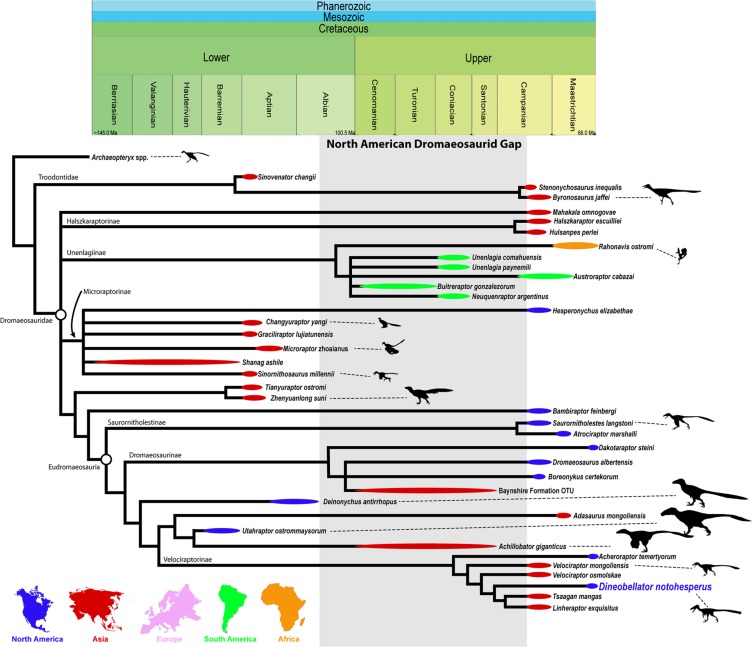
Novas and Pol describe new deinonychosaurian material from the Late Cretáceous of Patagonia and conduct a comprehensive phylogenetic analysis of Deinonychosauria. The result confirms a distinct Velociraptorinae clade including Velociraptor mongoliensis, Deinonychus antirrhopus, and referred Gondwanan material. Published in Nature 433: 858-861, the work is fundamental for understanding the biogeographic distribution of Velociraptorinae and demonstrates that the lineage reached both the Northern and Southern Hemispheres in the Late Cretáceous. The Novas & Pol (2005) phylogenetic analysis served as reference for subsequent systematic studies on dromaeosaurids.
Feather quill knobs in the dinosaur Velociraptor
Turner, A.H., Makovicky, P.J. & Norell, M.A. · Science
High-impact article published in Science providing the first direct osteological evidence of feathers in Velociraptor mongoliensis. Turner, Makovicky, and Norell document six quill knobs on the posterior forearm (ulna) of specimen IGM 100/981 from the Djadochta Formation. The spacing of the preserved knobs suggests approximately 14 secondary feathers ('flight feathers' of the forearm) were present — a number comparable to Archaeopteryx. This finding places Velociraptor among the confirmed feathered dromaeosaurids, reinforcing the evolutionary dinosaur-to-bird transition. The discovery also raises a functional question: if Velociraptor had flight feathers but could not fly, what was their function? Hypotheses include thermoregulation, display, maneuvering control when pursuing prey, and nest brooding.
A basal dromaeosaurid and size evolution preceding avian flight
Turner, A.H., Pol, D., Clarke, J.A., Erickson, G.M. & Norell, M.A. · Science
Turner et al. describe Mahakala omnogovae, a new basal dromaeosaurid from the Late Cretáceous of Mongolia, and conduct a comprehensive phylogenetic analysis of Paraves. Mahakala is the most basal known dromaeosaurid, and its phylogenetic position, combined with size data across the group, indicates that extreme miniaturization was ancestral in Paraves — meaning the common ancestor of birds, troodontids, and dromaeosaurids was small. Velociraptor mongoliensis is recovered within Velociraptorinae. Published in Science 317: 1378-1381, this work is fundamental for understanding the evolution of avian flight and the exact position of Velociraptor in the feathered dinosaur tree.


Biomechanics of dromaeosaurid dinosaur claws: application of X-ray microtomography, nanoindentation, and finite element analysis
Manning, P.L. et al. · The Anatômical Record
Manning et al. apply an innovative combination of techniques to the study of dromaeosaurid sickle claws: X-ray microtomography (micro-CT), nanoindentation, and finite element analysis (FEA). The result contradicts the hypothesis that the sickle claw was used for eviscerating large prey. The FEA model confirms claws were well-adapted for climbing: resistant to forces in the longitudinal plane but limited in tangential forces. The claw tip functioned as a puncturing and gripping element, while the expanded proximal portion transferred load stress through trabeculae and cortical bone. Published in The Anatômical Record 292(9): 1397-1405, this is one of the first studies to apply FEA to dromaeosaurid paleontológical material.


Evidence of predatory behavior by carnivorous dinosaurs
Carpenter, K. · Gaia
Carpenter analyzes the Fighting Dinosaurs specimen (MPC-D 100/25) as conclusive evidence of active predatory behavior in theropods. The specimen, discovered by a Polish-Mongolian expedition in 1971 from the Djadochta Formation, preserves a Velociraptor mongoliensis with its sickle claw near the jugular region of Protoceratops andrewsi, while the ceratopsian bit and crushed the predator's forearm. Carpenter interprets the scene as a predation attack interrupted by a sand slide that buried both animals alive. The work was published in Gaia 15: 135-144 and is the primary reference for behavioral interpretations based on the Fighting Dinosaurs specimen.
Late Mesozoic stratigraphy and vertebrates of the Gobi Basin
Jerzykiewicz, T. & Russell, D.A. · Cretáceous Research
Jerzykiewicz and Russell present the most comprehensive compilation of Mongolian Cretáceous stratigraphy, published in Cretáceous Research 12: 345-377. The work documents how the Gobi region was gradually transformed into a semi-arid desert environment during the Campanian, represented by the Djadochta and Baruungoyot Formations. Sedimentological evidence reveals a complex facies mosaic: alluvial fan deposition, short-lived fluvial streams, and minor lacustrine áreas. The authors correlate vertebrate faunas from different formations and provide the essential paleoenvironmental context for understanding Velociraptor's ecology: an arid aeolian dune environment with scarce water resources and an associated fauna including Protoceratops, Oviraptor, and small mammals.

New evidence for a trophic relationship between the dinosaurs Velociraptor and Protoceratops
Hone, D., Choiniere, J., Sullivan, C., Xu, X., Pittman, M. & Tan, Q. · Palaeogeography, Palaeoclimatology, Palaeoecology
Hone et al. report new evidence of a trophic relationship between Velociraptor and Protoceratops, complementing the Fighting Dinosaurs specimen. In the Bayan Mandahu Formation (Inner Mongolia, China), a Velociraptor tooth and Protoceratops bones with compatible tooth marks were found in association. The work is published in Palaeogeography, Palaeoclimatology, Palaeoecology 291: 488-492 and is important for demonstrating that the predator-prey relationship between Velociraptor and Protoceratops was not a unique event but an ecológically documentable pattern across multiple localities and formations. Analysis of tooth marks on Protoceratops bones indicates carcass processing, suggesting Velociraptor both hunted and consumed already-dead prey.
A review of dromaeosaurid systematics and paravian phylogeny
Turner, A.H., Makovicky, P.J. & Norell, M.A. · Bulletin of the American Museum of Natural History
The most comprehensive monograph on dromaeosaurid systematics, published in Bulletin of the American Museum of Natural History 371: 1-206. Turner, Makovicky, and Norell review all 31 named Dromaeosauridae taxa, validating 26 based on apomorphy-based diagnoses. The Paraves phylogenetic analysis is the largest ever conducted for the group. Velociraptor mongoliensis is confirmed as the type species of Velociraptorinae. The work includes detailed osteological descriptions, data matrices with hundreds of characters, and discussion of biogeographic relationships. This monograph is the fundamental taxonomic reference for Dromaeosauridae and the mandatory starting point for any subsequent phylogenetic study of the group.


A new species of Velociraptor (Dinosauria: Dromaeosauridae) from the Upper Cretáceous of northern China
Godefroit, P., Currie, P.J., Li, H., Shang, C.Y. & Dong, Z. · Journal of Vertebrate Paleontology
Godefroit et al. describe Velociraptor osmolskae n. sp. based on paired maxillae and a left lacrimal (holotype IMM 99NM-BYM-3/3) from the Bayan Mandahu Formation, Inner Mongolia, China — a second formation correlating to the Djadochta. Published in Journal of Vertebrate Paleontology 28(2): 432-438, this work is important for extending the Velociraptor genus to China and documenting intraspecific or interspecific morphological variation within the genus. The holotype was collected during a Sino-Belgian expedition in 1999. The species is named in honor of Polish paleontologist Halszka Osmólska, who died in March 2008.


The endocranium and trophic ecology of Velociraptor mongoliensis
King, J.L., Sipla, J.S., Georgi, J.A., Balanoff, A.M. & Neenan, J.M. · Journal of Anatomy
King et al. apply X-ray computed microtomography (micro-CT) to digitally reconstruct the endocranial anatomy of Velociraptor mongoliensis, published in Journal of Anatomy 237(5): 861-869. The reconstruction includes the brain endocast, cranial nerves, vascular structures, and the endósseous labyrinth of the inner ear. Results reveal that Velociraptor possessed relatively large olfactory bulbs (indicating acute olfaction), a developed cerebellum (indicating good balance and coordination), and semicircular canal geometry of the labyrinth compatible with rapid head movements. These neuroanatômical data are consistent with a highly sensory active predator capable of detecting prey at a distance and executing precise attacks.


Velociraptor: the state of the art 100 years after the discovery of this iconic dinosaur
Bindellini, G., Moscarella, A., Makovicky, P., Manucci, F. & Romano, M. · Italian Journal of Geosciences
A review article commemorating the centennial of Velociraptor mongoliensis description, published in Italian Journal of Geosciences 144(3): 460-486. Bindellini et al. present a new skeletal reconstruction of specimen MUST SN1140/BM digitized by photogrammetry, and synthesize the state of the art of 100 years of research. The work covers anatomy, phylogeny, behavior, paleoecology, and the evolution of scientific interpretations about the animal. It is the most up-to-date synthesis on Velociraptor available, incorporating micro-CT data, modern phylogenetic analysis, and evidence-based paleoart. Published with Peter Makovicky as co-author, one of the foremost experts on dromaeosaurids, this article is a mandatory current reference.

Espécimes famosos em museus
AMNH 6515 (Holótipo)
American Museum of Natural History, New York, EUA
Holotype of Velociraptor mongoliensis, consisting of a laterally compressed skull and a manual ungual phalanx, collected at the Flaming Cliffs (Bayn Dzak) in August 1923. Basis for Osborn's (1924) original description.
MPC-D 100/25 — 'Dinossauros Lutadores'
Museu de Paleontologia da Mongólia, Ulaanbaatar
The most famous specimen in the world: Velociraptor mongoliensis and Protoceratops andrewsi preserved in combat. Discovered at Tugrik Shire in 1971, it is the most direct record of predatory behavior in dinosaurs ever found and is natural heritage of Mongolia.
MPC-D 100/985
Museu de Paleontologia da Mongólia, Ulaanbaatar
Most complete specimen of Velociraptor mongoliensis with preserved post-cranial material, collected at Tugrugeen Shireh in 1993. Basis for Norell & Makovicky's (1997, 1999) work documenting furcula, sternal plates, and other near-avian elements.
In cinema and popular culture
Few dinosaurs have left as deep a mark on pop culture as Velociraptor, thanks above all to Jurassic Park (1993). Steven Spielberg's film transformed a turkey-sized animal into a two-meter monster capable of opening doors and coordinating ambushes, using Deinonychus morphology instead of the real animal. The result was a permanent cultural icon. The sequels Lost World (1997), Jurassic Park III (2001), and the Jurassic World franchise (2015-2022) maintained and amplified this depiction, reaching the named, military-trained Velociraptors of Jurassic World. On the opposite side, the Prehistoric Planet series (Apple TV+, 2022) narrated by David Attenborough presented for the first time to a large audience a feathered, correct-sized, evidence-based Velociraptor, marking a turning point in media representation. The discrepancy between the cinematic and scientific Velociraptor has itself become a cultural theme: paleontologists like Jack Horner and Mark Norell regularly comment on Jurassic Park's errors, and the phrase 'the real Velociraptor was turkey-sized' has entered the popular vocabulary of science commúnication.

Classificação
Descoberta
Curiosidade
The real Velociraptor was approximately turkey-sized — not human-sized as shown in Jurassic Park. The film used the morphology of Deinonychus, a dromaeosaurid twice the size of Velociraptor. When Jurassic Park was released in 1993, Utahraptor — a dromaeosaurid actually the size depicted in the film — was being described, prompting designer Stan Winston to quip: 'After we created ours, they discovered it'.