
Yutyrannus huali
Yutyrannus huali
"Beautiful feathered tyrant"
Sobre esta espécie
Yutyrannus huali is the largest feathered animal known in the history of life, measuring around 9 metres in length and weighing approximately 1.4 tonnes. It lived during the Early Cretaceous, some 125 million years ago, in what is now northeastern China. A basal tyrannosauroid of the family Proceratosauridae, it was a distant relative of the famous T. rex but far more primitive. Its filamentous feathers, exceptionally preserved in all three known specimens, reached up to 20 cm in length and covered much of the body, likely aiding thermoregulation in a cold, high-altitude environment. It bore a prominent nasal crest and proportionally longer arms than derived tyrannosaurids.
Geological formation & environment
The Yixian Formation is one of the world's most extraordinary fossil sites, part of the Jehol Biota in northeastern China. It dates to the Early Cretaceous (Barremian–Aptian, ~129.7–122.1 Ma). The original environment was temperate forests surrounding seasonal lakes at high altitude, with a mean temperature of only 5.9°C. The exceptional preservation of soft tissues, feathers, and even stomach contents results from fine-grained sedimentation in calm lacustrine environments, potentially accelerated by volcanic events. The formation preserves the world's most complete diversity of feathered theropods, including multiple species of primitive birds, dromaeosaurids, oviraptorosaurs, and Yutyrannus itself, the ecosystem's largest predator.
Image gallery



Scientific reconstruction of Yutyrannus huali by Tomopteryx (Tom Parker, 2016), showing the animal in lateral view with dense filamentous feather covering, prominent nasal crest, and relatively long forelimbs.
Tomopteryx (Tom Parker) / Wikimedia Commons — CC BY-SA 4.0
Ecology and behavior
Habitat
Yutyrannus inhabited the temperate forests surrounding seasonal lakes of the Yixian Formation in what is now Liaoning Province, northeastern China, approximately 125 million years ago. The environment, reconstructed by Zhang et al. (2021), was high-altitude (2.8–4.1 km) and cold-climate, with a mean annual temperature of only 5.9°C and likely snowy winters. The landscape consisted of forests dominated by conifers, ferns, and ginkgos, with nutrient-rich lakes. Volcanic activity was frequent, contributing to exceptional fossil preservation. The ecosystem was shared with sauropods like Dongbeititan, iguanodonts, pterosaurs, primitive birds, and numerous small mammals and reptiles.
Feeding
As the largest terrestrial predator of the Jehol Biota, Yutyrannus likely preyed on medium-sized sauropods like Dongbeititan and possibly iguanodonts and other ornithopods of the formation. Its cranial morphology, with a pneumatized nasal crest but relatively less robust skull than derived tyrannosaurids, suggests a comparatively less powerful bite in relative terms, compensated by absolute size. The teeth, though not completely described, were typical of carnivorous theropods. Given the cold climate and possible gregarious nature (suggested by the three specimens found together), it may have hunted in groups to take down larger prey.
Behavior and senses
The discovery of three specimens (adult, subadult, and juvenile) from the same location, claimed to be from a single quarry, suggests Yutyrannus may have been a gregarious animal that lived and hunted in family groups, though interpretation is limited by the fossil dealer provenance. The prominent nasal crest, structurally similar to Guanlong's, was highly pneumatized and likely served intraspecific display, species recognition, or sexual communication functions. There is no direct evidence of nesting behavior, but as a basal tyrannosauroid with inferred endothermic metabolism, it likely cared for its young.
Physiology and growth
Yutyrannus is the most direct evidence that endothermic metabolism and feather coverage were not exclusive to small dinosaurs. Filamentous feathers up to 20 cm long, covering much of the body, provided essential thermal insulation in the high-altitude, 5.9°C mean temperature environment of the Yixian Formation. Bell et al. (2017) confirmed that feather coverage was the ancestral condition of tyrannosauroids, lost only in large-bodied derived tyrannosaurids of the Late Cretaceous. The relatively light skull with extensive pneumatization balanced structural resistance with lower mass, and the proportionally longer arms compared to derived tyrannosaurids retained some functionality in prey capture.
Paleogeography
Continental configuration

Ron Blakey · CC BY 3.0 · Cretáceous, ~90 Ma
During the Barremiano (~125–122 Ma), Yutyrannus huali inhabited Laramidia, the western half of present-day North America, separated from the east by the Western Interior Seaway, a shallow sea dividing the continent. The continents were in very different positions: India was drifting toward Asia, Antarctica was still connected to Australia, and South America was an isolated island.
Inventário de Ossos
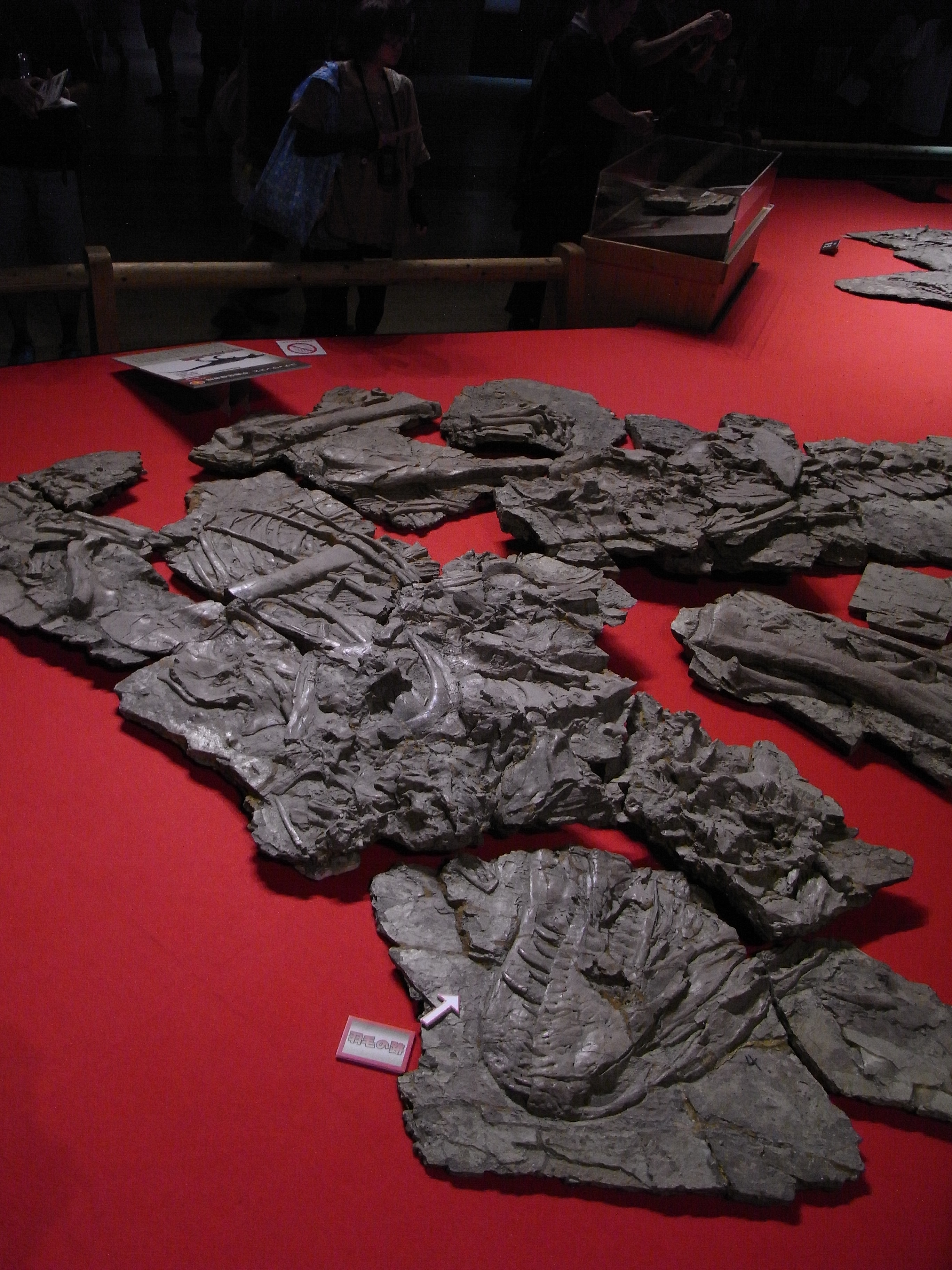
Based on three nearly complete specimens: holotype ZCDM V5000 (adult), paratype ZCDM V5001 (subadult, on the same slab as the holotype), and paratype ELDM V1001 (juvenile). Together the three specimens cover virtually the entire skeleton and preserve direct evidence of filamentous feathers, making Yutyrannus one of the best-documented tyrannosauroids from the Early Cretaceous.
Found elements
Inferred elements
Scientific Literature
15 papers in chronological order — from the original description to recent research.
A gigantic feathered dinosaur from the Lower Cretaceous of China
Xu, X., Wang, K., Zhang, K., Ma, Q., Xing, L., Sullivan, C., Hu, D., Cheng, S. & Wang, S. · Nature
The founding paper formally describing Yutyrannus huali from three nearly complete skeletons from the Yixian Formation of Liaoning, China: holotype ZCDM V5000 (adult, ~9 m, ~1,414 kg) and two paratypes representing a subadult and a juvenile. The work establishes the diagnostic characters of the species, including the prominent nasal crest formed by nasals and premaxillae, tridactyl hands, and filamentous feathers up to 20 cm preserved directly in the fossils. Xu et al. conduct phylogenetic analysis placing Yutyrannus as a basal tyrannosauroid, more derived than Dilong and Guanlong but more primitive than Eotyrannus. The most impactful finding is that Y. huali is 40 times heavier than Beipiaosaurus, the previous record holder for largest dinosaur with direct feather evidence. The paper proposes feathers likely served thermoregulation in a relatively cold climate, challenging the hypothesis that large dinosaurs necessarily lost feathers for heat dissipation.
The phylogeny and evolutionary history of tyrannosauroid dinosaurs
Brusatte, S.L. & Carr, T.D. · Scientific Reports
The most comprehensive phylogenetic analysis of Tyrannosauroidea yet conducted, combining data from multiple previous studies and incorporating newly discovered taxa including Yutyrannus. The work uses parsimony methods and, for the first time in a tyrannosauroid dataset, Bayesian analysis, with highly congruent results. The authors identify three major clusters in the tree: a basal Proceratosauridae clade of small-to-medium forms with elaborate cranial crests (Middle Jurassic–Early Cretaceous), an intermediate grade, and a derived clade of large-bodied Late Cretaceous apex predators. Crucially, Yutyrannus is placed within Proceratosauridae, more basal than Dilong, with Sinotyrannus as its sister taxon. The paper discusses tyrannosauroid biogeography, including East Asia's role as the group's diversification center, and provides the phylogenetic foundation for any future evolutionary analysis of the species.

Tyrannosauroid integument reveals conflicting patterns of gigantism and feather evolution
Bell, P.R., Campione, N.E., Persons, W.S., Currie, P.J., Larson, P.L., Tanke, D.H. & Bakker, R.T. · Biology Letters
Seminal study comparing integument patterns across tyrannosauroids, combining Yutyrannus material with new skin impressions from Tyrannosaurus, Albertosaurus, Daspletosaurus, Gorgosaurus, and Tarbosaurus. It confirms that large Late Cretaceous tyrannosaurids had scaly skin, not feathers. Bayesian ancestral state analysis indicates the ancestral tyrannosauroid integument likely comprised filamentous feathers (88.9–89.8% probability), with loss occurring in the tyrannosaurid ancestor. Crucially, the authors show that the large body size of Yutyrannus and tyrannosaurids evolved independently in two separate gigantism events. Yutyrannus's retention of feathers despite its large size suggests the cold climate of the Yixian Formation, rather than body size per se, determined whether feathers were retained or lost.
Basal tyrannosauroids from China and evidence for protofeathers in tyrannosauroids
Xu, X., Norell, M.A., Kuang, X., Wang, X., Zhao, Q. & Jia, C. · Nature
Description of Dilong paradoxus, the first confirmed feathered tyrannosauroid, found in the same Yixian Formation where Yutyrannus would later be discovered. The study establishes the presence of filamentous feathers (protofeathers) in basal tyrannosauroids, creating the essential evolutionary context for understanding Yutyrannus. Dilong was much smaller (~1.6 m), but filaments preserved near the jaw and tail demonstrate that the lineage leading to large derived tyrannosaurids descended from feathered ancestors. Xu et al. speculate that feathers correlate negatively with body size, a hypothesis that Yutyrannus would refute eight years later by showing a 9-metre animal fully covered in feathers. This work is a prerequisite for understanding why the Yutyrannus discovery was so surprising.
The osteology and affinities of Eotyrannus lengi, a tyrannosauroid theropod from the Wealden Supergroup of southern England
Naish, D. & Cau, A. · PeerJ
Complete osteological monograph of Eotyrannus lengi, an Early Cretaceous tyrannosauroid from England, with a new phylogenetic analysis of the entire superfamily Tyrannosauroidea. The work includes Yutyrannus in the data matrix and confirms its position within Proceratosauridae, phylogenetically separated from Eotyrannus by the Xiongguanlong clade. Naish & Cau (2022) place Eotyrannus as intermediate between Proceratosauridae (which includes Yutyrannus) and more derived tyrannosauroids, clarifying biogeographic relationships between Asian and European lineages. The study also revisits comparative forelimb morphology, confirming that Yutyrannus retained proportionally longer arms than derived tyrannosaurids, possibly a basal feature of the lineage.
Comparative cranial biomechanics reveal that Late Cretaceous tyrannosaurids exerted relatively greater bite force than in early-diverging tyrannosauroids
Johnson-Ransom, E., Li, F., Xu, X., Ramos, R., Midzuk, A.J., Thon, U., Atkins-Weltman, K. & Snively, E. · The Anatomical Record
Comparative cranial biomechanics study including Yutyrannus among analyzed tyrannosauroids via jaw muscle force calculations and finite element analysis (FEA). Results show that Yutyrannus, as a large proceratosaurid, exhibited lower cranial stress than most adult tyrannosaurids, reflecting its more basal phylogenetic position and less specialized cranial adaptations. While derived tyrannosaurids (Tyrannosaurus, Tarbosaurus) evolved robust skulls maximizing bite force, Yutyrannus maintained a proportionally lighter skull, consistent with its different predatory strategy and smaller body size. The work quantifies for the first time the biomechanical performance differences between Proceratosauridae and Tyrannosauridae, showing that bite force escalation was a gradual evolutionary trend along the lineage.

Convergent evolution of a mobile bony tongue in flighted dinosaurs and pterosaurs
Li, Z., Zhou, Z. & Clarke, J.A. · PLOS ONE
Study on the evolution of the mobile bony tongue in dinosaurs, which includes Yutyrannus huali specimen ELDM V1001 as an anatomical comparison point. Analysis of hyoid bones (which support the tongue) in modern archosaurs (birds and crocodilians) and extinct forms reveals that most non-avian dinosaurs, including Yutyrannus, had short, simple hyoids similar to crocodilians, indicating a relatively immobile tongue anchored to the floor of the mouth. This finding directly affects interpretation of Yutyrannus feeding behavior: unlike what is sometimes depicted in dinosaur films, the animal did not project its tongue when biting prey. Mobile tongues evolved convergently only in pterosaurs and birds, being absent in tyrannosauroids like Yutyrannus.

A basal tyrannosauroid dinosaur from the Late Jurassic of China
Xu, X., Clark, J.M., Forster, C.A., Norell, M.A., Erickson, G.M., Eberth, D.A., Jia, C. & Zhao, Q. · Nature
Description of Guanlong wucaii, a proceratosaurid from the Late Jurassic of China (Shishugou Formation, ~160 Ma) demonstrating that the prominent cranial crest and relatively long arms are basal features of Proceratosauridae, the family to which Yutyrannus belongs. Guanlong is about 1 m in length, contrasting with Yutyrannus's 9 m, illustrating the enormous size variation within Proceratosauridae. The study establishes diagnostic family characters — the nasal crest formed by nasals and premaxillae, large external naris, and forelimb proportions — all retained by Yutyrannus 35 Ma later. The phylogenetic analysis of Guanlong is the starting point for understanding the evolutionary history of the group that would culminate in Yutyrannus.

High-altitude and cold habitat for the Early Cretaceous feathered dinosaurs at Sihetun, western Liaoning, China
Zhang, L., Hay, W.W., Sun, Y., Fang, Q. & Ye, C. · Geophysical Research Letters
Geochemical study using paleosol carbonate oxygen isotopes and clumped isotope thermometry from the Yixian Formation at Sihetun to reconstruct paleotemperature and paleoelevation. The result is remarkable: mean annual temperature of only 5.9 ± 1.7°C and elevation of 2.8–4.1 km during the Early Cretaceous, with likely freezing winters. These data provide the environmental context explaining why Yutyrannus maintained dense feather coverage despite its large size: the environment was genuinely cold enough for feather-based thermoregulation to be advantageous in animals of any size. The work corroborates Bell et al.'s (2017) hypothesis that climate, not body size, was the main determinant of feather retention in large tyrannosauroids.
The Jehol Biota, an early Cretaceous terrestrial Lagerstätte: new discoveries and implications
Zhou, Z. · National Science Review
Comprehensive review of the Jehol Biota, the Early Cretaceous terrestrial Lagerstätte of northeastern China, which includes the Yixian Formation where Yutyrannus was found. The paper synthesizes decades of discoveries in dinosaurs, birds, mammals, pterosaurs, insects, and plants, and discusses the taphonomic mechanisms responsible for extraordinary preservation, including volcanic activity, lacustrine sedimentation, and rapid burial. Zhou documents that the Jehol Biota records one of the most complete and diverse terrestrial ecosystems of the Mesozoic, with high diversity of feathered theropods. The ecological context presented is essential for understanding Yutyrannus's paleoenvironment: temperate forests around seasonal lakes, with conifer, fern, and early angiosperm vegetation, and a diverse fauna of small mammals, primitive birds, and reptiles.


Extremely rapid, yet noncatastrophic, preservation of the flattened-feathered and 3D dinosaurs of the Early Cretaceous of China
Olsen, P.E., Sha, J., Fang, Y., Chang, C., Cunningham, J.A., Liao, H., Meng, F., Nie, C., Olsen, N.J., Pan, Y., Sha, J., Whiteside, J.H., Xu, X. & Tong, H. · Proceedings of the National Academy of Sciences
Innovative taphonomic study challenging the established hypothesis that spectacular fossils from the Yixian Formation were preserved by Pompeii-like volcanic events. Using high-precision U-Pb zircon geochronology, Olsen et al. show that Yixian Formation accumulation rates are an order of magnitude higher than previous estimates, and that 3D dinosaurs were buried in collapsed burrows, not pyroclastic flows. Flat-feathered animals (like Yutyrannus) were buried on the bottom of deep lakes over tens of thousands of years of normal life and death processes. The work reinterprets the Yixian Formation taphonomy, suggesting the environment was habitable and that animals lived and died under relatively normal conditions, then were preserved by the formation's typical fine-grained lacustrine sedimentation.


Gigantism and comparative life-history parameters of tyrannosaurid dinosaurs
Erickson, G.M., Makovicky, P.J., Currie, P.J., Norell, M.A., Yerby, S.A. & Brochu, C.A. · Nature
Foundational bone histology study on tyrannosaurids establishing the methodology of reading growth rings (LAGs) as a tool for determining age and reconstructing growth curves in tyrannosauroids. Although focused on derived tyrannosaurids (T. rex, Albertosaurus, Daspletosaurus, Gorgosaurus), the work is directly relevant to Yutyrannus: it demonstrates that tyrannosauroids grew explosively during adolescence with endothermic metabolism, and that bone histology analyses are the standard method for studying tyrannosauroid ontogeny. The difference in growth strategy between Yutyrannus (which does not belong to Tyrannosauridae) and derived tyrannosaurids documented in later studies is compared against the baseline established by Erickson et al. (2004) for the derived forms.


Tyrannosaurus was not a fast runner
Hutchinson, J.R. & Garcia, M. · Nature
Classic biomechanical study establishing the locomotor limits of large tyrannosauroids through computational musculoskeletal modeling. Although focused on T. rex, the work is directly relevant to Yutyrannus: at ~1,414 kg, Yutyrannus was lighter than large tyrannosaurids, but still far too large to be an agile runner. The methodology developed by Hutchinson & Garcia was subsequently applied to tyrannosauroids of different sizes, and results suggest animals in Yutyrannus's size range could likely reach moderately higher speeds than adult T. rex, but were equally dependent on ambush and stealth for hunting. Locomotor biomechanical analysis of tyrannosauroids like Yutyrannus rests directly on the methodological foundations established by this fundamental paper.


Tyrant Dinosaur Evolution Tracks the Rise and Fall of Late Cretaceous Oceans
Loewen, M.A., Irmis, R.B., Sertich, J.J.W., Currie, P.J. & Sampson, S.D. · PLOS ONE
Phylogenetic analysis of new North American tyrannosaurids including Yutyrannus and other Asian proceratosaurids as a basal outgroup. The work demonstrates that derived tyrannosaurid diversification in the Late Cretaceous of North America tracked the transgressive-regressive cycles of the Western Interior Seaway, while the lineage including Yutyrannus remained in Asia with more primitive morphology. The phylogenetic analysis confirms Yutyrannus's position as a member of a basal clade diverging well before the major derived tyrannosaurid radiation, providing biogeographic context for why large feathered tyrannosauroids persisted in Asia while similar forms were replaced by scaly-skinned tyrannosaurids in North America.


First large tyrannosauroid theropod from the Early Cretaceous Jehol Biota in northeastern China
Ji, Q., Ji, S.-A. & Zhang, L.-J. · Geological Bulletin of China
Description of Sinotyrannus kazuoensis, a large-bodied tyrannosauroid (9–10 m) from the Jiufotang Formation, coeval with and phylogenetically close to Yutyrannus. The work demonstrates that large basal tyrannosauroids were not exclusive to the Yixian Formation, also occurring in the adjacent Jiufotang Formation of the same period. Brusatte & Carr (2016) would subsequently identify Sinotyrannus as the sister taxon of Yutyrannus within Proceratosauridae. The discovery of Sinotyrannus expanded the geographic record of large proceratosaurids in northeastern China and demonstrated that the evolutionary pattern of basal gigantism in tyrannosauroids was broader than previously supposed, not limited to the Yixian Formation specimens where Yutyrannus was found.


Espécimes famosos em museus
Holótipo ZCDM V5000 + Parátipo ZCDM V5001
Zhucheng Dinosaur Museum (Zhucheng, China) / Instituto de Vertebrados e Paleoantropologia (IVPP, Beijing, China)
Holotype ZCDM V5000 is the largest specimen, representing an adult approximately 9 metres long and 1,414 kg, with a 90.5 cm skull. On the same rock slab, paratype ZCDM V5001 (subadult) was preserved. The discovery of both specimens together suggests possible gregarious behavior. Prepared at the IVPP in Beijing before being deposited at the Zhucheng Dinosaur Museum.
Parátipo ELDM V1001
Erlianhaote Dinosaur Museum (Erlianhaote, Mongólia Interior, China) / Instituto de Vertebrados e Paleoantropologia (IVPP, Beijing, China)
Paratype ELDM V1001 is the smallest and youngest of the three specimens, estimated to be approximately 8 years younger than the holotype. It preserves direct evidence of filamentous feathers extending from the dorsal side of the neck (measuring more than 20 cm) and near a limb bone tentatively identified as a humerus. This specimen is particularly valuable for preserving the morphology of a young individual, enabling ontogenetic studies, and for serving as the basis of hyoid comparisons in Li et al. (2018).
In cinema and popular culture
Yutyrannus huali occupies a peculiar niche in popular culture: discovered in 2012, it is too young to have appeared in the great dinosaur films of the 20th century, but new enough to emerge at the moment when feathered dinosaur depictions began gaining mainstream acceptance. Its most notable animated debut was in the fourteenth film of The Land Before Time franchise (2016), where it appeared with full feather coverage, a rare example of scientific accuracy in children's animation. In park simulation games, Jurassic World Evolution 2 included it in the Feathered Species Pack (2023), marking its indirect entry into the Jurassic Park franchise. The peak of its media representation came with Netflix's 'The Dinosaurs' documentary series (2026), produced by Steven Spielberg, where it is portrayed as the 'Snow King', hunting in a snowy environment with its family, in a depiction that integrates the most recent scientific data on the cold climate of the Yixian Formation. The evolution of its portrayals reflects the general shift in popular paleontology: from terrifying scaly monsters to feathered, social, and ecologically contextualized predators.

Classificação

Descoberta
Curiosidade
Yutyrannus huali is 40 times heavier than Beipiaosaurus, which was the previous record holder for the largest animal with direct feather evidence. To put it in perspective: the 20-cm filamentous feathers found on Yutyrannus's neck are longer than the feathers of many modern birds, on an animal that weighed as much as an adult northern white rhinoceros.